
 100% FREE ACCESS
11th Standard CBSE Syllabus & Materials
11th Standard CBSE
CBSE 11th Economics PART-A - Presentation of Data - New Sample Question Papers Study Material - QB365 Set A
NEW11th Standard CBSE
CBSE 11th Economics PART-A - Organisation of Data - New Sample Question Papers Study Material - QB365 Set A
NEW11th Standard CBSE
CBSE 11th Economics PART-A - Collection of Data - New Sample Question Papers Study Material - QB365 Set A
NEW11th Standard CBSE
CBSE 11th Economics PART-A - Introduction to Economics and Statistics - New Sample Question Papers Study Material - QB365 Set A
NEW11th Standard CBSE
CBSE 11th Business Studies International Trade Sample Question Papers Study Material - QB365 Set A
NEW11th Standard CBSE
CBSE 11th Business Studies Evolution and Fundamentals of Business Sample Question Papers Study Material - QB365 Set A

Published on: 13/08/2019
Mechanical Properties of Solids
Download CBSE Class 11th Standard CBSE Physics question papers, sample papers, important questions, and previous year solved papers in PDF format. Get free study materials, NCERT solutions, and exam preparation resources for Class 11th Standard CBSE Physics
Questions + Answers key
Take MCQ Physics Test
1.
Two cylinders A and B of radii rand 2r are soldered co-axially. The free end of A is clamped and the free end of B is twisted by an angle ф. Find twist at the junction taking the material of two cylinders to be same and of equal length.
2.
What is the shape of stress-strain graph within elastic limit?
3.
The stress-strain graphs for materials A and B are shown in Fig. (a) and Fig. (b).
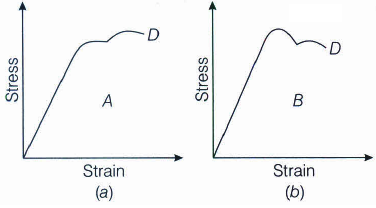
The graphs are drawn to the same scale.
(a) Which of the materials has the greater Young’s modulus?
(b) Which of the two is the stronger material?
4.
A uniform pressure p is exerted on all sides of a solid cube at temperature t0C.By what amount should the temperature of the cube raised in order to bring its volume back to the volume it had before the pressure was applied, if the Bulk modulus and coefficient of volume expansion of the material B are \(\gamma \) and respectively.
5.
What is Bulk modulud for a perfectly rigid body?
6.
A square lead slab of side 50 cm and thickness 10 cm is subjected to a shearing force (on its narrow edge) of 9.0 x 10⁴ N. The lower edge is reveted to the floor. How much will the upper edge be displaced? Modulus of rigidity of lead = 5.6 x 10⁹ N/m2
7.
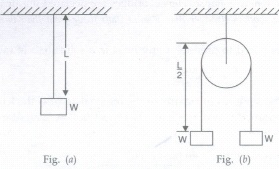
When a weight W is hung from one end of a wire of length L (other end being fixed), the length of the wire increases by I (Fig. a). If the wire is passed over a pulley and two weights W each are hung at the two ends (Fig. b), What will be the total elongation in the wire?
8.
The length of a metal wire is l1 when the tension in it is T1 and is l2when the tension is T2· Find the original length of the wire.
9.
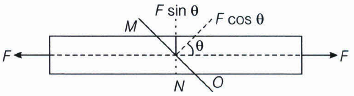
A bar of cross-section A is subjected to equal and opposite tensile forces at its ends. Consider a plane section of the bar whose normal makes an angle 8 with the axis of the bar.
(i) What is the tensile stress on this plane?
(ii) What is the shearing stress on this plane?
(iii) For what value of 8 is the tensile stress maximum?
(iv) For what value of e is the shearing stress maximum?
10.
Identical springs of steel and copper are equally stretched.On which, more work will have to be done?
11.
A boy's catapult is made of a rubber cord 42 cm long and 6 mm in diameter. The boy stretches the cord by 20 cm. Find the Young's modulus of the rubber if a stone weighing 0.02 kg when catapulated flies with a velocity of 20 ms-1. Disregard the change in the cross-section of the cord in stretching.
12.
State Hooke's law. Define Young's modulus of elasticity. A wire loaded by a weight of density 7.6 g cm-3 is found to measure 90 cm. On immersing the weight in water, the length decreased by 0.18 cm. Find the original length of wire.
13.
Consider an Indian rubber cube having modulus of rigidity of 2 x 10⁷ dyne/cm2 and of side 8 cm. If one side of the rubber is fixed, while a tangential force equal to the weight of 300 kg is applied to the opposite face, then find out the shearing strain produced and distance through which the strain side moves.
14.
What is the length of a wire that breaks under its own weight when suspended vertically? Breaking stress = 5 x 10⁷ Nm-2 and density of the material of the wire = 3 x 10³ kg/m3
15.
Young's modulus of a wire depends on
its material
its length
its area of cross-section
both (b) and (c)
16.
A spring of force constant k is cut into two equal parts. The force constant of each part is
k/2
k
2k
4k
17.
Which of the following is not a unit of Young's modulus?
Nm-2
Mega Pascal (MPa)
dyne cm-2
Nm-1
18.
Young's modulus of a material has the same unit as
stress
energy
compressibility
pressure
19.
Dimensional formula of stress is same as that of
impulse
strain
force
pressure
1.
Let ፒ be the torque applied at the free end and ф be the angle of twist at the junction. Then
\(\tau =\frac { \pi \eta { r }^{ 4 }(\Phi '-0) }{ 2l } =\frac { \pi \eta (2r)^{ 4 }(\Phi -\Phi ') }{ 2l } \)
⇒ ф'= 16(ф-ф')
or 17 ф' = 16 ф
or ф' = \(\\ \frac { 16 }{ 17 } \) ф.
2.
A straight line.
3.
(i) In the two graphs, the slope of graph in Fig. (a) is greater than the slope of graph in Fig. (b), so material A has greater Young's modulus.
(ii) Material A is stronger than material B because it can withstand more load without breaking. For material A, the break even point (D) is higher.
4.
[(\(\frac{p}{γB}\))]
5.
Bulk modulus \((B)=\frac { p }{ \Delta V/V } =\frac { pV }{ \Delta V } \)
For perfectly rigid body, change in volume Δ V=0
\(B=\frac { pV }{ 0 } =\infty \)
Therefore, Bulk modulus for a perfectly rigd body is \(\infty \)
6.
Given,
L=50 cm=50×10−2 m
t=10 cm=10×10−2 m
G=5.6×10⁹ Pa
F=9.0×10⁴ N
Area of the face on which force is applied,
A=50×10=500 cm2=0.05 m2
Let ΔL be the displacement of the upper edge of the slab, due to tangential force F applied.
\( \text { Then, } G=\frac{\left(\frac{F}{A}\right)}{\left(\frac{\Delta L}{L}\right)} \)
\( \Rightarrow \Delta L=\frac{F L}{G A}=\frac{9 \times 10^4 \times 50 \times 10^{-2}}{5.6 \times 10^9 \times 0.05} \)
\( \therefore \Delta L=1.6 \times 10^{-4} \mathrm{~m}
\)
7.
(a) Let Y = Young's modulus of the material of wire.
If a be its area of cross-section, then
\(\Upsilon =\frac { F/A }{ l/L } =\frac { WL }{ Al } \) (∵ F = W)
or l=\(\frac { WL }{ A\Upsilon } \) ...........(i)
(b) When the wire is passed over a pully, let I' be the increase in length of the each segment. Since \(\frac{L}{2}\) = length of each segment
∴ \(\quad \Upsilon =\frac { W(L/2) }{ Al^{ ' } } \)
or l' = \(\frac { 1 }{ 2 } \frac { WL }{ A\Upsilon } =\frac { 1 }{ 2 } \) [From eqn. (i)] ......(ii)
∴ Total increase in the length of the wire
= l' + l' = 2l'= 2 x \(\frac{l}{2}\)= l
8.
Let l and A be the original length and area of cross-section of the metal wire.
Change in length in the first case = (l1 - l)
Change in length in the second case = (l2 - l)
\(\Upsilon =\frac { { T }_{ 1 } }{ A } \times \frac { l }{ ({ l }_{ 1 }-l) } =\frac { { T }_{ 2 } }{ A } \times \frac { l }{ ({ l }_{ 2 }-l) } \)
or T2l2 - T1l = T2l1-T2l
or l(T2-T1) = T2l1-T1l2 ⇒ l = \(\frac { { T }_{ 2 }{ l }_{ 1 }-{ T }_{ 1 }{ l }_{ 2 } }{ ({ T }_{ 2 }-{ T }_{ 1 }) } \).
9.
(i) The resolved part of F along the normal is the tensile force on this plane and the resolved part parallel to the plane is the shearing force on the plane.
Area of MO plane section = A \(\sec { \theta } \)
Tensile stress =\(\frac { Force }{ Area } \)= \(\frac { F\cos { \theta } }{ F\sec { \theta } } \)
=\(\frac { F }{ A } \cos ^{ 2 }{ \theta } \) \(\left[ \because \quad \sec { \theta } =\frac { 1 }{ \cos { \theta } } \right] \quad \)
(ii) Shearing stress applied on the top face
So, F = \(F\sin { \theta } \)
Shearing stress =\(\frac { Force }{ Area } \)=\(\frac { F\sin { \theta } }{ A\sec { \theta } } \)
= \(\frac { F }{ A } \sin { \theta } \cos { \theta } \)
= \(\frac { F }{ 2A } \sin { 2\theta } \) \(\left[ \because \quad \sin { 2\theta } =2\sin { \theta } \cos { \theta } \right] \)
(iii) Tensile stress will be maximum when \(\cos ^{ 2 }{ \theta } \)i is maximum i.e. \(\cos { \theta } \) = 1 or \( \theta\) = 0°.
(iv) Shearing stress will be maximum when \(sin 2 \theta\) is maximum i.e. \(sin 2 \theta\) = 1 or \(2\theta\) = 90° or \( \theta\) = 45°.
10.
\(Work\ done\ in\ strtching\ a\ wire\ is\ given\ by\)
\(\\ W=\frac { 1 }{ 2 } F\times \triangle l\)
\(\\ As\ springs\ of\ steel\ and\ copper\ are\ equally\ streched.Therefore,for\ same\ force(F).\)
\(\\ W\propto \triangle l\)
\(\\ Young's\ modulus\ (Y)=\frac { F }{ A } \times \frac { l }{ \triangle l } \)
\(\\ or\ \triangle l=\frac { F }{ A } \times \frac { l }{ Y } \)
\(\\ As\ both\ springs\ are\ identical\)
\( \triangle l\propto \frac { 1 }{ Y } \)
\(\\ From \ Eqs.(i) \ and \ (ii),\ we \ get \ W\propto \frac { 1 }{ Y }\)
\( \\ \therefore \frac { { W }_{ steel } }{ { W }_{ copper } } =\frac { { Y }_{ copper } }{ { Y }_{ steel } } <1\ [as\ { Y }_{ steel }>{ Y }_{ copper }]\)
\(\\ or\ { W }_{ steel }\ <\ { W }_{ copper }\)
\(\\ Therefore,\ more\ work\ will\ be\ done\ for\ stretching\ copper\ spring.\)
11.
Due to extension produced in the cord, energy is stored in it which is converted into kinetic energy when the stone flies away. Assuming that there is no loss of energy in this process, the kinetic energy of the stone is given by
W = \(\frac{1}{2}\)mv2 = 4J
This must be equal to the work done in stretching the cord.
Using the equation.
W = \(\frac{1}{2}\)FΔl = 4J
Where F is the stretching force. Since
Δl = 20 cm = 0.2 m
F= \(\frac { 4\times 2 }{ 0.2 } \)= 40 N
Stress = \(\frac { F }{ A } =\frac { 40 }{ { \pi r }^{ 2 } } \)
Now, r = 3 mm = 3 x 10⁻³ m
Hence, Stress = \(\frac { 40 }{ \pi (3\times 10^{ - })^{ 2 } } \)=1.415 x 10⁶ Nm-2
But Strain = \(\frac { 20 }{ 42 } \)=0.476
Young's modulus = \(\Upsilon =\frac { 1.415\times { 10 }^{ 6 } }{ 0.476 } \)
= 2.97 x 10⁶ Nm-2.
12.
For Hooke's law and Young's modulus of elasticity, see fact that matter on pages 386-387 of this text book.
Let L be the original length of the wire, A be its .area of cross-section and W be the load attached to the wire. Then, Young's modulus of the wire is given by
Y = \(\frac { W\times L }{ A\times \triangle L } \)
Since ΔL = 90-L
∴ \(\Upsilon =\frac { W\times L }{ A(90-L) } \) ......(1)
Volume of weight attached = \(\frac { W }{ density\quad of\quad weight } \)
= \(\frac { W }{ 7.6 } \)cm3
Weight of water displaced = \(\frac { W }{ 7.6 } \) x density of water
\(\frac { W }{ 7.6 } \times 1=\frac { W }{ 7.6 } \)
∴ Net weight after immersing in water is
W'=W-\(\frac { W }{ 7.6 } =\frac { 6.6W }{ 7.6 } \)
Length of wire after immersing in water
= (90 - 0.18) = 89.82 cm
∴ Change in length on immersing in water,
ΔL'=(89.82-L)cm
∴ \(\Upsilon \)=\(\frac { W'L }{ A\triangle L' } \)
= \(\frac { 6.6W\times L }{ 7.6\times A(89.82-L) } \) ....(2)
Comparing eqns. (1) and (2), we get
\(\frac { W\times L }{ A(90-L) } =\frac { 6.6W\times L }{ 7.6\times A\times (89.82-L) } \)
7.6 x (89.82-L) = 6.6 (90-L)
682.632-7.6L = 594-6.6L
∴ L = 88.632 cm
13.
Given, modulus of rigidity, \(\eta =2\times { 10 }^{ 7 }\) dyne/cm3
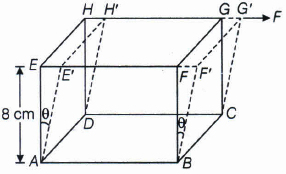
Side of the cube, l = 8 cm
Area, A = l2 = 64 cm2
Force or load, F= 300 kgf = 300\(\times \) 1000\(\times \)981 dyne
As, \(\eta =\frac { F }{ A\theta } \)
\(\Rightarrow \quad \theta =\frac { F }{ A\eta } \)
\(\theta =\frac { 300\times 1000\times 981 }{ 64\times 2\times { 10 }^{ 7 } } \simeq \) 0.23 rad
As, \(\eta =\frac { F }{ A } \frac { l }{ \Delta l } \)
\(\Rightarrow \quad \quad \quad \frac { \Delta l }{ l } =\theta\)
\( \Rightarrow \quad \Delta l=l\theta =8\times 0.23\)
\(\Delta l\) = 1.84 cm
14.
1.67 km
15.
(a)
its material
16.
(c)
2k
17.
(d)
Nm-1
18.
(a)
stress
19.
(d)
pressure

11th Standard CBSE Syllabus & Materials
11th Standard CBSE
CBSE 11th Business Studies Forms of Business Organisation Sample Question Papers Study Material - QB365 Set A
NEW11th Standard CBSE
CBSE 11th Business Studies Business, Trade and Commerce Sample Question Papers Study Material - QB365 Set A
NEW11th Standard CBSE
CBSE 11th Physics Waves Sample Question Papers Study Material - QB365 Set A
NEW11th Standard CBSE
CBSE 11th Physics Kinetic Theory Sample Question Papers Study Material - QB365 Set A



CBSE 11th Standard CBSE Subjects
CBSE Standards









