
 100% FREE ACCESS
11th Standard CBSE Syllabus & Materials
11th Standard CBSE
CBSE 11th Economics PART-A - Presentation of Data - New Sample Question Papers Study Material - QB365 Set A
NEW11th Standard CBSE
CBSE 11th Economics PART-A - Organisation of Data - New Sample Question Papers Study Material - QB365 Set A
NEW11th Standard CBSE
CBSE 11th Economics PART-A - Collection of Data - New Sample Question Papers Study Material - QB365 Set A
NEW11th Standard CBSE
CBSE 11th Economics PART-A - Introduction to Economics and Statistics - New Sample Question Papers Study Material - QB365 Set A
NEW11th Standard CBSE
CBSE 11th Business Studies International Trade Sample Question Papers Study Material - QB365 Set A
NEW11th Standard CBSE
CBSE 11th Business Studies Evolution and Fundamentals of Business Sample Question Papers Study Material - QB365 Set A

Published on: 27/09/2019
Mechanical Properties of Solids
Download CBSE Class 11th Standard CBSE Physics question papers, sample papers, important questions, and previous year solved papers in PDF format. Get free study materials, NCERT solutions, and exam preparation resources for Class 11th Standard CBSE Physics
Questions + Answers key
Take MCQ Physics Test
1.
What is elastic hysteresis?
2.
What do you mean by compressibility? Why are solids least compressible and gases most compressible?
3.
What is an elastomer? What are their special features?
4.
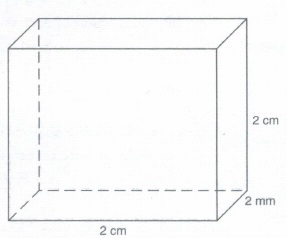
Calculate the force required to punch a hole 2 cm square in a steel sheet 2 mm thick whose shearing strength is 3.5 x 10⁸ Nm-2.
5.
A 4 m long aluminium wire whose diameter is 3 mm is used to support a mass of 50 kg. What will be the elongation of the wire? \(\Upsilon \) for aluminium is 7 x 10¹⁰ Nm-2. Given: g = 9.8 ms-2.
6.
Two wires A and B of length, l radius r and length 2l, radius 2r having same Young's modulus \(\Upsilon \) are hung with a weight mg, see fig. What is the net elongation in the two wires?
7.
Elasticity is said to be internal property of matter. Explain.
8.
The length of a metal wire is l1 when the tension in it is T1 and is l2when the tension is T2· Find the original length of the wire.
9.
A solid sphere of radius 10 cm is subjected to a uniform pressure equal to 5 x 10⁸ Nm-2. Calculate the change in volume. Bulk modulus of the material of the sphere is 3.14 x 10¹¹ Nm-2.
10.
Why are the springs made of steel and not of copper?
11.
Explain why steel is more elastic than rubber.
12.
A steel wire of length 4 m is stretched through 2 mm. The cross-section area of the wire is 2.0 mm2. If Young's modulus of steel is 2.0 x 10¹¹ N/m2, find
(i) the energy density of the wire and
(ii) the elastic potential energy stored in the wire.
13.
Read the following two statements below carefully and state, with reasons, if it is true or false.
(a) The Young’s modulus of rubber is greater than that of steel;
(b) The stretching of a coil is determined by its shear modulus.
14.
Determine the volume contraction of a solid copper cube, 10cm on an edge, when subjected to a hydraulic pressure of 7 x 10⁶ Pa. Bulk modulus for copper = 140 x 109 Pa.
15.
Two parallel steel wires A and B are fixed to rigid support at the upper ends and subjected to the same load at the lower ands. The lengths of wires are in the ratio 4:5 and their radii are in the ratio 4:3. The increase in the length of the wire A is 1mm. Calculate the increase in the length of the wire B.
1.
We know that some materials take appreciable time to recover their original condition completely. In other words, the strain persists even when the stress is removed. This lagging behind of strain is called elastic hysteresis.
2.
Compressibility of the material of a body is defined as the reciprocal of its bulk modulus. It is, thus, defined as the fractional change in volume per unit increase in pressure.
Compressibility, K=\(\frac { 1 }{ B } =-\left( \frac { \triangle V }{ V } \right) \times \frac { 1 }{ P } \)
The solids are least compressible whereas gases are most compressible. It is on account of the fact that in solids neighbouring atoms are tightly coupled but molecules in gases are very poorly coupled to their neighbours.
3.
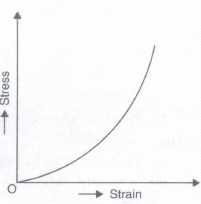
Elastomers are those substances which can be stretched to cause large strains. Substances like tissue of aorta, rubber etc., are elastomers.
The stress-strain curve for an elastomer is as shown in figure below. Although elastic region is very large but the material does not obey Hooke's law over most of the region Moreover, there is no well defined plastic region.
4.
The shearing stress is exerted on the rectangular surface (2.0 cm x 2.0 cm x 0.2 cm) that is the boundary of the hole. The area of this surface is (see Fig)
A = 2.0 x 10-2 x 4 x 0.2 x 10-2 m2
= 1.6 x 10⁻⁴ m2
Since the minimum shearing stress to rupture the steel is
\(\left( \frac { F }{ A } \right) _{ min }\)=.5 x 108 Nm-2
The force required is given by
F=3.5 x 108 x 1.6 x 10-4N=5.6 x 10⁴ N
5.
l = 4m, r = 1.5 mm = 1.5 x 10⁻³ m,
M = 50 kg,
\(\Upsilon \)=7 x 10¹⁰ Nm-2, F = 50 x 9.8 N = 490 N, Δl = ?
∴ \(\Upsilon =\frac { F\times l }{ A\times \triangle l } \)
or \(\triangle l=\frac { F\times l }{ { \pi r }^{ 2 }\times \Upsilon } =\frac { 490\times 4\times 7 }{ 22\times (1.5\times { 10 }^{ -3 })^{ 2 }\times 7\times 10^{ 10 } } \)m
= 39.6 x 10-4 = 39.6 x 10-4 x 103 mm = 3.96 mm
6.
Here, the pulling force F (= mg) is same on both the wires. Let Δl1 , Δl2 be the elongations in the two wires.
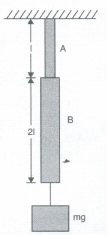
As, \(\Upsilon =\frac { Fl }{ { \pi r }^{ 2 }\triangle l } \) or \(\triangle l=\frac { Fl }{ \Upsilon { \pi r }^{ 2 } } \)
For wire 'A', \({ \triangle l }_{ 1 }=\frac { mgl }{ \Upsilon \pi { r }^{ 2 } } \)
For wire 'B', \({ \triangle l }_{ 2 }=\frac { mg(2l) }{ \Upsilon \pi (2{ r }^{ 2 }) } =\frac { mgl }{ 2\Upsilon \pi { r }^{ 2 } } \)
Total elongation = Δl1 + Δl2
=\(\frac { mgl }{ \Upsilon \pi { r }^{ 2 } } +\frac { 1 }{ 2 } \frac { mgl }{ \Upsilon \pi { r }^{ 2 } } =\frac { 3 }{ 2 } \frac { mgl }{ \Upsilon \pi { r }^{ 2 } } \).
7.
When a deforming force acts on a body, the atoms of the substance get displaced from their original positions. Due to this, the configuration of the body (substance) changes. The moment, the deforming force is removed, the atoms return to their original positions and hence the substance or body regains its original configuration. That is why, elasticity is said to be internal property of matter.
8.
Let l and A be the original length and area of cross-section of the metal wire.
Change in length in the first case = (l1 - l)
Change in length in the second case = (l2 - l)
\(\Upsilon =\frac { { T }_{ 1 } }{ A } \times \frac { l }{ ({ l }_{ 1 }-l) } =\frac { { T }_{ 2 } }{ A } \times \frac { l }{ ({ l }_{ 2 }-l) } \)
or T2l2 - T1l = T2l1-T2l
or l(T2-T1) = T2l1-T1l2 ⇒ l = \(\frac { { T }_{ 2 }{ l }_{ 1 }-{ T }_{ 1 }{ l }_{ 2 } }{ ({ T }_{ 2 }-{ T }_{ 1 }) } \).
9.
We know, K = \(\frac { PV }{ \triangle V } \)
∴ ΔV = \(\frac { PV }{ K } \)
Now P = 5 x 10⁸ Nm-2;
V = \(\frac { 4 }{ 3 } \pi \)r3 = \(\frac { 4 }{ 3 } \pi \)(0.1)3 m3
= 4.19 x 10⁻³ m3
[∵ r = 10 cm = 0.1 m]
K = 3.14 x 10¹¹ Nm-2
ΔV = \(\frac { 5\times 10^{ 8 }\times 4.19\times 10^{ -3 } }{ 3.14\times 10^{ 11 } } \)
= 6.67 x 10⁻⁶ m3.
10.
A spring will be better one if a large restoring force is set up in it on being deformed, which in turn depends upon the elasticity of the material of the spring. Since the Young's modulus of elasticity of steel is more than that of copper, hence steel is preferred in making the springs.
11.
Consider two pieces of wires, one of steel and the other of rubber. Suppose both are of equal length (L) and of equal area of cross-section (a). Let each be stretched by equal forces, each being equal to F. We find that the change in length of the rubber wire (lr) is more than that of the steel (ls) i.e. lr < Is If \(\Upsilon \)s and \(\Upsilon \)r, the Young's moduli of steel and rubber respectively, then from the definition of Young's modulus,
\({ \Upsilon }_{ s }=\frac { F.L }{ a.{ l }_{ s } } \) and \({ \Upsilon }_{ r }=\frac { F.L }{ a.{ l }_{ r } } \)
∴ \(\frac { { \Upsilon }_{ s } }{ { \Upsilon }_{ r } } =\frac { { l }_{ r } }{ { l }_{ s } } \)
As lr > ls ∴ \(\frac { { \Upsilon }_{ s } }{ { \Upsilon }_{ r } } \)>1 or \({ \Upsilon }_{ s }>{ \Upsilon }_{ r }\).
i.e., the Young's modulus of steel is more than that of rubber. Hence steel is more elastic than rubber.
(or ) Any material which offers more opposition to the deforming force to change its configuration is more elastic.
12.
(i) Energy density = \(\frac { 1 }{ 2 } \left( \frac { \Upsilon l }{ L } \right) .\frac { 1 }{ L } \)
=\(\frac { 1 }{ 2 } \left[ \frac { 2\times 10^{ 11 }\times 2\times { 10 }^{ -3 } }{ 4 } \right] \times \left[ \frac { 2\times 10^{ -3 } }{ 4 } \right] \)
=\(\frac { 1 }{ 2 } \) x 108 x \(\frac { 1 }{ 2 } \) x 10-3
= 0.25 x 105
= 2.5 x 10⁴ J/m3.
(ii) Potential energy stored in the wire
U = \(\frac { 1 }{ 2 } \left( \frac { \Upsilon Al }{ L } \right) .l\)
= \(\frac { 1 }{ 2 } \left[ \frac { 2\times { 10 }^{ 11 }\times 2\times 10^{ -6 }\times 2\times 10^{ -3 } }{ 4 } \right] \) x 2 x 10-3
= 102 x 2 x 10-3
= 0.2 J.
13.
(a) False. The Young's modulus is defined as the ratio of stress to the strain within elastic limit. For a given stretching force elongation is more in rubber and quite less in steel. Hence, rubber is less elastic than steel.
(b) True. Stretching of a coil is determined by its shear modulus. When equal and opposite forces are applied at opposite ends of a coil, the distance as well as shape of helicals of the coil change and it involves shear modulus.
14.
Given, each side of cube()=10cm=0.1m
Hydralic pressure (p)=7×10⁶ Pa
Bulk modulus for copper(B)=140×109 Pa
Volume contraction(△V)=?|
Volume of the cube(V)=I3=(0.1)3=1×10⁻³m3
Bulk modulus for copper(B) \(=\frac { p }{ \triangle V/V } \)
\(\\ \triangle V=\frac { pV }{ B }\)
\( \\ \triangle V=\frac { 7\times 10^{ 6 }\times 1\times 10^{ -3 } }{ 140\times 10^{ 9 } } =\frac { 1 }{ 20 } \times 10^{ -6 }m^{ 3 }\)
\(\\ =0.05\times 10^{ -6 }m^{ 3 }=5\times 10^{ -8 }m^{ 3 }\)
15.
For wire A, \(F_1=F, A_1=\pi(A r)^2, l_1=4 l, \mathrm{Y} _1=\mathrm{Y}, \Delta I_1 =1 \mathrm{~mm}\).
For wire B, \(F_2=F, A_2=\pi(3 r)^2, l_2=5 l\),
\( Y_2=Y, \Delta l_2=? \)
\( Y=\frac{F_1}{A_1} \times \frac{1_1}{\Delta_1}=\frac{F_2}{A_2} \times \frac{l_2}{\Delta l_2} \)
\( \Delta l_2=\frac{F_2}{F_1} \times \frac{A_1}{A_2} \times \frac{l_2}{l_1} \times \Delta l_1 \)
\( =1 \times\left(\frac{4}{3}\right) \times\left(\frac{5}{4}\right) \times 1=\frac{20}{9} \mathrm{~mm}=2.22 \mathrm{~mm}\)

11th Standard CBSE Syllabus & Materials
11th Standard CBSE
CBSE 11th Business Studies Forms of Business Organisation Sample Question Papers Study Material - QB365 Set A
NEW11th Standard CBSE
CBSE 11th Business Studies Business, Trade and Commerce Sample Question Papers Study Material - QB365 Set A
NEW11th Standard CBSE
CBSE 11th Physics Waves Sample Question Papers Study Material - QB365 Set A
NEW11th Standard CBSE
CBSE 11th Physics Kinetic Theory Sample Question Papers Study Material - QB365 Set A



CBSE 11th Standard CBSE Subjects
CBSE Standards









