
 100% FREE ACCESS
11th Standard CBSE Syllabus & Materials
11th Standard CBSE
CBSE 11th Economics PART-A - Presentation of Data - New Sample Question Papers Study Material - QB365 Set A
NEW11th Standard CBSE
CBSE 11th Economics PART-A - Organisation of Data - New Sample Question Papers Study Material - QB365 Set A
NEW11th Standard CBSE
CBSE 11th Economics PART-A - Collection of Data - New Sample Question Papers Study Material - QB365 Set A
NEW11th Standard CBSE
CBSE 11th Economics PART-A - Introduction to Economics and Statistics - New Sample Question Papers Study Material - QB365 Set A
NEW11th Standard CBSE
CBSE 11th Business Studies International Trade Sample Question Papers Study Material - QB365 Set A
NEW11th Standard CBSE
CBSE 11th Business Studies Evolution and Fundamentals of Business Sample Question Papers Study Material - QB365 Set A

Published on: 16/09/2019
Mechanical Properties of Solids
Download CBSE Class 11th Standard CBSE Physics question papers, sample papers, important questions, and previous year solved papers in PDF format. Get free study materials, NCERT solutions, and exam preparation resources for Class 11th Standard CBSE Physics
Questions + Answers key
Take MCQ Physics Test
1.
Two cylinders A and B of radii rand 2r are soldered co-axially. The free end of A is clamped and the free end of B is twisted by an angle ф. Find twist at the junction taking the material of two cylinders to be same and of equal length.
2.
Why are the bridges declared unsafe after long use?
3.
Which of the three Young's modulus of elasticity, Bulk modulus and shear modulus is possible in all the three states of matter (solid, liquid and gas)?
4.
Write copper, steel, glass and rubber in the order of increasing coefficient of elasticity.
5.
Give an example of pure shear.
6.
A wire of length L and cross-sectional area A is made of material of Young's modulus \(\Upsilon \). What is the work done in stretching the wire by an amount x?
7.
What is the shape of stress-strain graph within elastic limit?
8.
What is Poisson's ratio?
9.
How much should be pressure the a litre of water be changed to compress it by 0.10 %? Bulk modulus of elasticity of water = 2.2 x 10⁹ Nm-2.
10.
Compute the fractional change in volume of a glass slab, when subjected to a hydraulic pressure of 10 atm.
11.
A piece of copper having a rectangular cross-section of 15.2 mm × 19.1 mm is pulled in tension with 44,500 N force, producing only elastic deformation. Calculate the resulting strain?
12.
A wire of length L and radius r is clamped rigidly at one end. When the other end of the wire is pulled by a force j, its length increases by l. Another wire of the same material of length 2L and radius 2r, is pulled by a force 2f Find the increase in length of this wire.
13.
The stress-strain graphs for materials A and B are shown in Fig. (a) and Fig. (b).
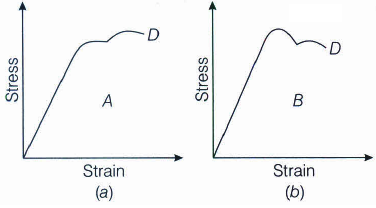
The graphs are drawn to the same scale.
(a) Which of the materials has the greater Young’s modulus?
(b) Which of the two is the stronger material?
14.
To what depth must a rubber ball be taken in deep sea so that its volume is decreased by 0.1%? (The Bulk modulus of rubber is 9.8 x 10⁸ N/m2; and the density of seawater is 103 kg/m 3 .)
15.
A solid sphere of radius R made of a material of bulk modulus B is surrounded by a liqiud in a cylindrical container. A massless piston of area A floats on the surface of the liqiud. When a mass M is placed on the piston on the piston to compress the liqiud, find fractiional change in the radius of the sphere?
1.
Let ፒ be the torque applied at the free end and ф be the angle of twist at the junction. Then
\(\tau =\frac { \pi \eta { r }^{ 4 }(\Phi '-0) }{ 2l } =\frac { \pi \eta (2r)^{ 4 }(\Phi -\Phi ') }{ 2l } \)
⇒ ф'= 16(ф-ф')
or 17 ф' = 16 ф
or ф' = \(\\ \frac { 16 }{ 17 } \) ф.
2.
Due to the repeated stress and strain, the material used in the bridges loses elastic strength and ultimately may collapse. Hence, bridges are declared unsafe after long use.
3.
Bulk modulus of elasticity only.
4.
Rubber, glass, copper and steel.
5.
Twisting of cylinder produces pure shear.
6.
Work done = elastic potential energy of stretched wire
= \(\frac { 1 }{ 2 } \) x \(\Upsilon \) x (strain)2 x volume = \(\frac { 1 }{ 2 } \) x \(\Upsilon \) x \(\left( \frac { x }{ L } \right) ^{ 2 }\) x (A x L)
= \(\frac { \Upsilon A{ x }^{ 2 } }{ 2L } \).
7.
A straight line.
8.
The ratio of lateral strain to the longitudinal strain is called Poisson's ratio.
9.
V =1 litre = 10-3 m3; ΔV/V = 0.10/100 = 10-3
K = \(\frac { pV }{ \triangle V } \)
p = K\(\frac { pV }{ \triangle V } \) = (2.2 x 109) x 10-3 = 2.2 x 10⁶ Pa.
10.
Here, P =10 atm = 10 x 1.013 x 105 Pa; k = 37 x 109 Nm-2
Volumetric strain = \(\frac { \triangle V }{ V } =\frac { P }{ K } =\frac { 10\times 1.013\times 10^{ 5 } }{ 37\times 10^{ 9 } } \) = 2.74 x 10⁻⁵
∴ Fractional change in volume = \(\frac { \triangle V }{ V } \) = 2.74 x 10⁻⁵.
11.
Here, A =15.2 x 19.2 x 10-6 m2; F = 44500 N; η = 42 x 109 Nm-2
Strain = \(\frac { Stress }{ modulus\ of\ elasticity } =\frac { F/A }{ \eta } \)
=\(\frac { F }{ A\eta } =\frac { 44500 }{ (15.2\times 19.2\times 10^{ -6 })\times 42\times 10^{ 9 } } \)
= 3.65 x 10⁻³.
12.
The situation is shown in the diagram.
Now, Young's modulus (Y) = \(\frac { f }{ A } \times \frac { L }{ l } \)
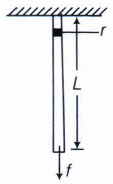
For first wire, Y = \(\frac { f }{ \pi { r }^{ 2 } } \times \frac { L }{ l } \) ....(i)
For second wire, Y = \(\frac { 2f }{ \pi { (2r) }^{ 2 } } \)\(\times \frac { 2L }{ l\prime } =\frac { f }{ \pi { r }^{ 2 } } \times \frac { L }{ l\prime } \) ...(ii)
For Eqs. (i) and (ii), \(\frac { f }{ \pi { r }^{ 2 } } \times \frac { L }{ l } \)= \(\frac { f }{ \pi { r }^{ 2 } } \times \frac { L }{ l\prime } \)
\(\therefore\) l = l' [ \(\because\) both wires are of same material, hence, Young's modulus will be same].
13.
(i) In the two graphs, the slope of graph in Fig. (a) is greater than the slope of graph in Fig. (b), so material A has greater Young's modulus.
(ii) Material A is stronger than material B because it can withstand more load without breaking. For material A, the break even point (D) is higher.
14.
Bulk modulus of rubber (b) = 9.8 x 10⁸ N/m2
Density of seawater (p) = 103 kg/m3
Percentage decrease in volume
\(\left( \frac { \Delta V }{ V } \times 100 \right) =0.1\ or\ \frac { \Delta V }{ V } =\frac { 0.1 }{ 100 } \)
\(\\ or \frac { \Delta V }{ V } =\frac { 1 }{ 1000 } \)
Let the rubber ball be taken up to depth h.
Change in pressure (p) = hpg
Bulk modulus \((B)=\frac { p }{ (\Delta V/V) } =\frac { hpg }{ (\Delta V/V) } \)
\(or\ h=\frac { B\times (\Delta V/V) }{ pg } =\frac { 9.8\times 10^{ 8 }\times \frac { 1 }{ 1000 } }{ 10^{ 3 }\times 9.8 } =100m\)
15.
When mass M is placed on the piston, the excess pressure, p=Mg/A. As the pressure is equally applicable from all the direction on the sphere, hence there will be decrease in volume due to decrease in raius sphere. Volume of the sphere, \(V=\frac { 3 }{ 4 } \pi { R }^{ 3 }\)
Differentiating it , we get,
\(\Delta V=\frac { 4 }{ 3 } \pi (3{ R }^{ 2 })\Delta R=4\pi { R }^{ 2 }\Delta R\)
\(\\ \frac { \Delta V }{ V } =\frac { 4\pi { R }^{ 2 }\Delta R }{ \frac { 4 }{ 3 } \pi { R }^{ 3 } } =\frac { 3\Delta R }{ R } \)
We know that, \(B=\frac { P }{ dV/V } =\frac { Mg }{ A } \diagup \frac { 3\Delta R }{ R } \)
\(or\ \frac { \Delta R }{ R } =\frac { Mg }{ 3BA } \)

11th Standard CBSE Syllabus & Materials
11th Standard CBSE
CBSE 11th Business Studies Forms of Business Organisation Sample Question Papers Study Material - QB365 Set A
NEW11th Standard CBSE
CBSE 11th Business Studies Business, Trade and Commerce Sample Question Papers Study Material - QB365 Set A
NEW11th Standard CBSE
CBSE 11th Physics Waves Sample Question Papers Study Material - QB365 Set A
NEW11th Standard CBSE
CBSE 11th Physics Kinetic Theory Sample Question Papers Study Material - QB365 Set A



CBSE 11th Standard CBSE Subjects
CBSE Standards









