
 100% FREE ACCESS
11th Standard CBSE Syllabus & Materials
11th Standard CBSE
CBSE 11th Economics PART-A - Presentation of Data - New Sample Question Papers Study Material - QB365 Set A
NEW11th Standard CBSE
CBSE 11th Economics PART-A - Organisation of Data - New Sample Question Papers Study Material - QB365 Set A
NEW11th Standard CBSE
CBSE 11th Economics PART-A - Collection of Data - New Sample Question Papers Study Material - QB365 Set A
NEW11th Standard CBSE
CBSE 11th Economics PART-A - Introduction to Economics and Statistics - New Sample Question Papers Study Material - QB365 Set A
NEW11th Standard CBSE
CBSE 11th Business Studies International Trade Sample Question Papers Study Material - QB365 Set A
NEW11th Standard CBSE
CBSE 11th Business Studies Evolution and Fundamentals of Business Sample Question Papers Study Material - QB365 Set A

Published on: 20/09/2019
Motion in a Straight Line
Download CBSE Class 11th Standard CBSE Physics question papers, sample papers, important questions, and previous year solved papers in PDF format. Get free study materials, NCERT solutions, and exam preparation resources for Class 11th Standard CBSE Physics
Questions + Answers key
Take MCQ Physics Test
1.
Establish the kinematic equation v2 - u2 = 2as from velocity-time graph for a uniformly accelerated motion.
2.
A ship is moving at a speed of 56 km h-1. One second later, it is moving at a speed of 58 km h-1 What is its acceleration?
3.
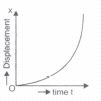
Draw displacement-time graph for a uniformly accelerated motion. What is its shape?
4.
Two trains of lengths 109 m and 91m are moving in opposite directions with velocities 34 km h-1 and 38 kmh-1 respectively. In what time the two trains will completely cross each other? Choose the most logical reference point for time measurement.
5.
The velocity of a particle is given by equation v = 4 + 2 (c1 + c2 t), where c1and c2 are constant. Find the initial velocity and acceleration of the particle.
6.
A certain automobile manufacturer claims that its super-delux sports car will accelerate from rest to a speed of 42.0 ms:' in 8.0 s. Under the important assumption that the acceleration is constant,
(a) Determine the acceleration of car in ms-2.
(b) Find the distance the car travels in 8.0 s.
(c) Find the distance the car travels in 8th second.
7.
The displacement (in metre) of a particle moving alone x-axis is given by x = 18t + 15t2 Find the instantaneous velocity at t = 0 and t = 2s
8.
A man walks on a straight road from his home to a market 2.5 km away with a speed of 5 km h–1. Finding the market closed, he instantly turns and walks back home with a speed of 7.5 km h–1. What is the
(a) magnitude of average velocity, and
(b) average speed of the man over the interval of time (i) 0 to 30 min, (ii) 0 to 50 min, (iii) 0 to 40 min ? [Note: You will appreciate from this exercise why it is better to define average speed as total path length divided by time, and not as magnitude of average velocity. You would not like to tell the tired man on his return home that his average speed was zero !]
9.
The displacement x of a particle moving in one dimension is related to time t by the relation x\(=\sqrt { { 2t }^{ 2 }-3t } \) ,where x is in metre and t in second. Find the displacement of the particle when its velocity is zero.
10.
A body is projected vertically upwards from A, the top of a tower it reaches the ground in it t1 second.If it is projected vertically downwards from A with the same velocity it reaches the ground in t2 second.If it falls freely, from A, prove that it would reach the ground in \(\sqrt { { t }_{ 1 }{ t }_{ 2 } } \) second.
11.
A person travels along a straight road for the first half with avelocity v1 and the second half with velocity v1 and the second half with velocity v2. What is the mean velocity of the person?
12.
A police van moving on a highway with a speed of 30 km h–1 fires a bullet at a thief’s car speeding away in the same direction with a speed of 192 km h–1. If the muzzle speed of the bullet is 150 m s–1, with what speed does the bullet hit the thief’s car ? (Note: Obtain that speed which is relevant for damaging the thief’s car).
13.
A particle starts moving from position of rest under a constant acceleration. It is travels a distance x in t second, what distance will it travel in next t second?
14.
Read each statement below carefully and state with reasons and examples, if it is true or false ; A particle in one-dimensional motion
(a) with zero speed at an instant may have non-zero acceleration at that instant
(b) with zero speed may have non-zero velocity,
(c) with constant speed must have zero acceleration,
(d) with positive value of acceleration must be speeding up.
15.
To what height does the ball rise and after how long does the ball return to the player's hands?(Take g = 9.8ms-2 and neglect air resistance)
1.
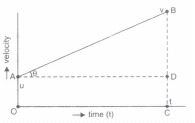
The velocity-time graph for uniformly accelerated motion has been shown in Fig. with initial velocity at t = 0 as u and final velocity at = 5 time t as v. Then area under the v-t graph gives the value of total displacement in the given time. Hence, displacement of moving particle in time t
=area of trapezium ∆ ABC
s = \(\frac { 1 }{ 2 } \)(OA + CB) x OC,
= \(\frac { 1 }{ 2 } \)(U + V) x t
However, from definition of acceleration, we know that \(a=\frac { v-u }{ t } \)or \(t=\frac { v-u }{ a } \)
Substituting this value of time t in equation (i), we get
Displacement s =\(\frac { 1 }{ 2 } (u+v)\times \frac { v-u }{ a } \) or \(\frac { v^{ 2 }-u^{ 2 } }{ 2a } \)
\(\Rightarrow \)2as = v2-u2 of v2 = u2+ 2as
2.
Here,
Initial speed, u =56 km h-I = 56 \(\times \) \(\frac { 5 }{ 18 } \) ms-1
= \(\frac { 140 }{ 9 } \)ms-1= 15.55ms-1
Final speed, v=58 km h-1 = 58 X \(\frac { 5 }{ 18 } \)ms-1
=\(\frac { 145 }{ 9 } \)ms-1= 16.11ms-1
Time taken=1s
Using equation of motion
v = u + at
\(\Rightarrow \) a=\(\frac { v-u }{ t } \)
\(\Rightarrow \) a=\(\left( \frac { 16.11-15.55 }{ 1 } \right) \)
= 0.56ms-2, a = 0.56 ms-2
3.
Displacement-time graph for a uniformly accelerated motion has been shown in adjoining Fig. The graph is parabolic in shape.
4.
Relative speed = (34 + 38) kmh-1 = 72 krnh-1
= 72 x - ms-1 = 20 ms-1
Total distance = (109 + 91) m = 200 m
Time = \(\frac { 200m }{ 20ms^{ -1 } } \) =10 s.
5.
Given equation of velocity,
v = 4 + 2 (c1 + c2t)
=> v = (4 + 2c1) + 2c2t
Compare the above equation with equation of motion
v = u + at
Initial velocity, u = 4 + 2c1
Acceleration of the particle = 2c2.
6.
(a) We are given that u = 0 and velocity after 8 s is 42 m/s, so we can use v = u + at to find acceleration
a = \(\frac { v-u }{ t } =\frac { 42.0-u }{ 8.0 } \)= 5.25ms-2
(b) distance travelled in 8.0 s, we can use , s = ut +\(\frac { 1 }{ 2 } \)at2
= 0 + \(\frac { 1 }{ 2 } \)\(\times \)5.25\(\times \)82 = 168m
(c) distance travelled in 8th second, we have, Sn =u+(2n-1)\(\frac { a }{ 2 } \)
= (2 x 8 - 1) \(\times \frac { 5.25 }{ 2 } \) = 39.375 m.
7.
Given, displacement
x = 18t + 15t2
Instantaneous velocity,
\({ v }_{ i }=\frac { dx }{ dt } =18+30t\)
Instantanous velocity at
t = 0, v = 18 + 30 x 0
= 18 m/s
t = 2s, v = 18 + 30 x 2
= 78 m/s
8.
(i) Time taken by man to go from his home to market
\({ t }_{ 1 }=\frac { Distance }{ Speed } =\frac { 2.5 }{ 5 } h\)
Time taken by man to go from market to his home
\({ t }_{ 2 }=\frac { 2.5 }{ 5 } =\frac { 1 }{ 3 } h\)
Total time taken,t1 + t2 \(=\frac { 1 }{ 2 } +\frac { 1 }{ 3 } =\frac { 5 }{ 6 } h=50min\)
0 to 30 min
(a) Average velocity \(=\frac { Displacement }{ Time } =\frac { 2.5 }{ 1/2 } =5km/h\)
(b) Average speed \(=\frac { Distance }{ Time } =\frac { 2.5 }{ 1/2 } =5km/h\)
(ii) Time taken by man to go from his home to market
\({ t }_{ 1 }=\frac { Distance }{ Speed } =\frac { 2.5 }{ 5 } h\)
Time taken by man to go from mae=rket to his home
\({ t }_{ 2 }=\frac { 2.5 }{ 5 } =\frac { 1 }{ 3 } h\)
Total time taken,t1+t2 \(=\frac { 1 }{ 2 } +\frac { 1 }{ 3 } =\frac { 5 }{ 6 } h=50min\)
0 to 50 min
Total distance travelled = 2.5 + 2.5 = 5 km.
Total displacement = 2.5 -2.5 = 0
(a) Average velocity \(=\frac { Displacement }{ Time } =0\)
(b) Average speed \(=\frac { Distance }{ Time } =\frac { 5 }{ 5/6 } =6km/h\)
(iii) Time taken by man to go from his home to market
\({ t }_{ 1 }=\frac { Distance }{ Speed } =\frac { 2.5 }{ 5 } h\)
Time taken by man to go from mae=rket to his home
\({ t }_{ 2 }=\frac { 2.5 }{ 5 } =\frac { 1 }{ 3 } h\)
Total time taken,t1 + t2 \(=\frac { 1 }{ 2 } +\frac { 1 }{ 3 } =\frac { 5 }{ 6 } h=50min\)
Distance moved in 30 in (from home to market)
= 25 km
Distance moved in 10 min (from market to home) with speed
7.5 km/h \(=7.5\times \frac { 10 }{ 60 } =1.25km\)
So, displacement = 2.5-1.25 = 1.25km
Distance travelled = 2.5+1.25 = 3.75 km
(a) Average velocity \(=\frac { 1.25 }{ (40/60) } =1.875km/h\)
(b) Average speed \(=\frac { 3.75 }{ (40/60) } =5.625km/h\)
9.
\(-\frac { 9 }{ 8 } m\)
10.
Using relations
Consider upwards as negative and downwards as positive.
\(h=-u{ t }_{ 1 }+\frac { 1 }{ 2 } g{ t }_{ 1 }^{ 2 }.............(i)\)
\(\\ h=u{ t }_{ 2 }+\frac { 1 }{ 2 } g{ t }_{ 2 }^{ 2 }...............(ii)\)
\(\\ On \ substracting \ Eqs. \ (i) \ from \ (ii), \ we \ get\)
\(\\ or \ 0=({ t }_{ 2 }+{ t }_{ 1 })+\frac { 1 }{ 2 } g{ t }_{ 2 }^{ 2 }-\frac { 1 }{ 2 } g{ t }_{ 1 }^{ 2 }\)
\(\\ or\ u({ t }_{ 2 }+{ t }_{ 1 })+\frac { 1 }{ 2 } g({ t }_{ 2 }+{ t }_{ 1 })({ t }_{ 2 }-{ t }_{ 1 })=0\)
\(\\ or\ u+\frac { 1 }{ 2 } g({ t }_{ 2 }+{ t }_{ 1 })=0\)
\(\\ or \ u=-\frac { g }{ 2 } ({ t }_{ 2 }-{ t }_{ 1 }).........(iii)\)
\(\\ From \ Eqs \ (i) \ and \ (iii), \ we \ get\)
\(\\ Now,\quad h=\frac { g{ t }_{ 1 } }{ 2 } ({ t }_{ 2 }-{ t }_{ 1 })+\frac { 1 }{ 2 } g{ t }_{ 1 }^{ 2 }=\frac { 1 }{ 2 } g{ t }_{ 1 }{ t }_{ 2 }.....(iv)\)
\(\\ Again, \ when \ the \ body \ falls \ freely.\)
\(\\ h=\frac { 1 }{ 2 } g{ t }^{ 2 };\frac { 1 }{ 2 } g{ t }_{ 1 }{ t }_{ 2 }=\frac { 1 }{ 2 } g{ t }^{ 2 }\quad [fron\quad eq.iv]\)
\(\\ or\quad t=\sqrt { { t }_{ 1 }{ t }_{ 2 } } \quad Hence\quad proved\)
11.
TIme taken by person to travel first half
\(t_{ 1 }=\frac { (d/2) }{ v_{ 1 } } =\frac { d }{ 2v_{ 1 } } \)
Time taken by person to travel second half
\(t_{ 2 }=\frac { (d/2) }{ v_{ 2 } } =\frac { d }{ 2v_{ 2 } } \)
Total time \(={ t }_{ 1 }+{ t }_{ 2 }=\frac { d }{ 2 } \left[ \frac { 1 }{ { v }_{ 1 } } +\frac { 1 }{ { v }_{ 2 } } \right] =\frac { d({ { v } }_{ 1 }+{ v }_{ 2 }) }{ 2{ v }_{ 1 }{ v }_{ 2 } } \)
Mean velocity or average velocity
\(=\frac { d }{ { t }_{ 1 }+{ t }_{ 2 } } =\frac { { 2v }_{ 1 }{ v }_{ 2 } }{ ({ v }_{ 1 }+{ v }_{ 2 }) } \)
12.
Muzzle speed of the bullet,
v = 150 ms-1
= 150\( \times \) \(\frac{18}{5}\)
= 540 kmh-1
Speed of police van, vp = 30 km/h
speed of the thief's car, vr = 192 km/h
Since the bullet is sharing the velocity of the police van, its effectively velocity is
vB = v + vP
= 540 +30
= 570 km /h
Since the speed of the bullet w.r.t the thief's car ,oving in the same direction .
vBT = vB - vT
= 570 - 192
= 378 km / h
= \( \frac{378 \times 1000}{60 \times 60 } \)
= 105 ms-1
13.
Here, \(\mathrm{u}=0, \mathrm{~s}=\mathrm{x}, \mathrm{t}=\mathrm{t}\)
Using the relation, \(\mathrm{s}=u t+\frac{1}{2} a t^2\), we have x
\(=0+\frac{1}{2} a t^2\)
Let the body travel a distance y in next t seconds. The total distance travelled in t+t=2t
seconds will be (x+y), So,
\(x+y=0+\frac{1}{2} a(2 t)^2=\frac{1}{2} a \times 4 t^2=2 a t^2\)
Dividing (ii) by (i), we get
\(\frac{x+y}{x}=4 \Rightarrow x+y=4 x \Rightarrow y=3 x\)
14.
(i) True, when a body is thrown vertically upwards in the space, then at the highest point, the body has zero speed but has downward acceleration equal to the acceleration due to gravity.
(ii) False, because velocity is the speed of body in a given direction. When speed is zero, the magnitude of velocity of body is zero, hence velocity is zero.
(iii) True, when a particle is moving along a straight line with a constant speed, its velocity remains constant with time. Therefore, acceleration (i,e. change in velocity/time) is zero.
(iv) False, if the initial velocity of a body is negative, then even in the case of positive acceleration, the body speeds down. A body speeds up when the acceleration acts in the direction of motion.
15.
Let t be the time taken by the ball to reach the highest point where height from ground be s.
Taking vertical upward motion of the ball, we have u =- 29.4ms-, a = 9.8ms-, v = 0, s = S,t = ?
As, v2-u2 = 2 as
0 -(-29.4)2 = 2 x 9.8 x S
or \(S=\frac { -{ (29.4) }^{ 2 } }{ 2\times 9.8 } =-44.1m\)
Here, negative sign shows that the distance is covered in upward direction.
As, v = u + at
\(\therefore \quad 0=-29.4+9.8\times t\quad or\quad t=\frac { 29.4 }{ 9.8 } =3s\)
It means time of ascent = 3s
When an object moves under the effect of gravity alone, the time of ascent is always equal to the time of descent.
Therefore, total time after which the ball returns to the player's hand = 3 + 3 = 6s.

11th Standard CBSE Syllabus & Materials
11th Standard CBSE
CBSE 11th Business Studies Forms of Business Organisation Sample Question Papers Study Material - QB365 Set A
NEW11th Standard CBSE
CBSE 11th Business Studies Business, Trade and Commerce Sample Question Papers Study Material - QB365 Set A
NEW11th Standard CBSE
CBSE 11th Physics Waves Sample Question Papers Study Material - QB365 Set A
NEW11th Standard CBSE
CBSE 11th Physics Kinetic Theory Sample Question Papers Study Material - QB365 Set A



CBSE 11th Standard CBSE Subjects
CBSE Standards









