
 100% FREE ACCESS
11th Standard CBSE Syllabus & Materials
11th Standard CBSE
CBSE 11th Economics PART-A - Presentation of Data - New Sample Question Papers Study Material - QB365 Set A
NEW11th Standard CBSE
CBSE 11th Economics PART-A - Organisation of Data - New Sample Question Papers Study Material - QB365 Set A
NEW11th Standard CBSE
CBSE 11th Economics PART-A - Collection of Data - New Sample Question Papers Study Material - QB365 Set A
NEW11th Standard CBSE
CBSE 11th Economics PART-A - Introduction to Economics and Statistics - New Sample Question Papers Study Material - QB365 Set A
NEW11th Standard CBSE
CBSE 11th Business Studies International Trade Sample Question Papers Study Material - QB365 Set A
NEW11th Standard CBSE
CBSE 11th Business Studies Evolution and Fundamentals of Business Sample Question Papers Study Material - QB365 Set A

Published on: 18/10/2019
Oscillation
Download CBSE Class 11th Standard CBSE Physics question papers, sample papers, important questions, and previous year solved papers in PDF format. Get free study materials, NCERT solutions, and exam preparation resources for Class 11th Standard CBSE Physics
Questions + Answers key
Take MCQ Physics Test
1.
Find the expression for time period of motion of a body suspended by two springs connected in parallel and series.
2.
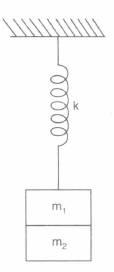
Define simple harmonic motion (5HM). Two masses mI and m2 are suspended together by a massless spring of spring constant k. When the masses are in equilibrium, mI is removed without disturbing the system. Find the angular frequency and amplitude oscillation of m2
3.
Show that for a particle in linear SHM the average kinetic energy over a period of oscillation equals the average potential energy over the same period.
4.
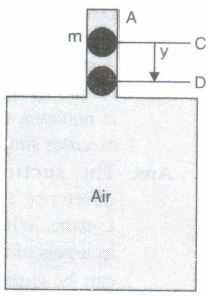
An air chamber of volume V has a neck area of cross section a into which a ball of mass m just fits and can move up and down without any friction (Fig.). Show that when the ball is pressed down a little and released, it executes SHM. Obtain an expression for the time period of oscillations assuming pressure-volume variations of air to be isothermal.
5.
A cylindrical piece of cork of density of base area A and height h floats in a liquid of density ρl . The cork is depressed slightly and then released. Show that the cork oscillates up and down simple harmonically with a period \(T=2\pi \sqrt { \frac { h\rho }{ { \rho }_{ 1 }g } } \) where ρ is the density of cork. (Ignore damping due to viscosity of the liquid).
6.
The motion of a particle executing simple harmonic motion is described by the displacement function, x(t) = A cos (ωt + φ ).
If the initial (t = 0) position of the particle is 1 cm and its initial velocity is ω cm/s, what are its amplitude and initial phase angle ? The angular frequency of the particle is π s–1. If instead of the cosine function, we choose the sine function to describe the SHM : x = B sin (ωt + α), what are the amplitude and initial phase of the particle with the above initial conditions.
7.
A spring of force constant \({ 1200\ Nm }^{ -1 }\)is mounted on a horiontal table as a mass of 3 kg is attached to the free end of the spring, pulled sideways to adistance of 2.0 cm and released. Determine
(i) The frequency of oscillations.
(ii) The maximum acceleration of the mass, and
(iii) the maximum speed of the mass?
8.
A particle moving with SHM ina stright line has a speed of 6 m/s when 4 m/s from the centre of oscillation and a speed of 8 m/s when 3 m from the oscillation and the shortest time taken by the partile in moving from the extreme position to a point mid way between the extreme position and the centre.
9.
A particle is subjected to two simple harmonic otions in the same direction having equal magnitude and equal frequency. If the resultant amplitude is equal to the amplitude of the individual motion. Fnd the phase difference between two individual motions.
1.
Consider a body of mass M suspended by two springs connected in parallel as shown in Fig. (n) Let k1 and k2 be the spring constants of two springs respectively. Let the body be pulled down so that each spring is stretched through a distance y. Restoring forces F1 and F2 will be developed in the springs S1 and S2 respectively.
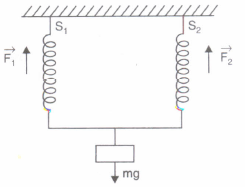
According to Hooke's law, F1 = - k1y
and F2 = -k2y
Since both the forces acting in the same direction, therefore, total restoring force acting on the body is given by
F = F1 + F2 = - k1 y - k2 Y = - (k1 + k2) y
∴ Acceleration produced in the body is given by
\(a={F\over M}=-{(k_1+k_2)y\over M}\) ..(i)
since \({(k_1+k_2)\over M}\) is constant ∴ a ∝ - y
Hence motion of the body is SHM.
Time period of body is given by
\(T=2\pi\sqrt{y\over |a|}=2\pi\sqrt{M\over k_1+k_2}\ \ ...(ii)\)
If k1=k2=k
Then \(T=2\pi\sqrt{M\over 2K}\)
For series: Consider a body of mass M suspended by two springs S1 and S2 which are connected in series as shown in Fig. (b). Let k1 and k2 be the spring constants of springs S1 and S2 respectively. Suppose at any instant, the displacement of the body from equilibrium position is y in the downward direction. If y1 and y2 be the extension produced in the springs S1 and S2 respectively, then
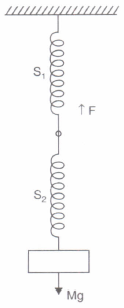
y = y1 + y2 ...(i)
Restoring forces developed in S1 and S2 are given by
F1 = - k1 + y1 ....(ii)
F2 = - k2 + Y2 ....(iii)
Multiplying eqns. (ii) by k2 and eqn. (iii) by k1 and adding, we get
∴ k2 F1 + k1 F2 = - k1 k2 (yl + y2) = - k1 k2 y
[From eqn. (i)]
Since both the springs are connected in series, so
F1 = F2 = F
∴ F(k1 + k2) = -k1k2y or \(F=-{k_1k_2\over (k_1+k_2)y}\)
If a be the acceleration produced in the body of mass M, then
\(a={F\over M}=-{k_1k_2y\over (k_1+k_2)M}\) ...(ii)
Time period of the body is given by
\(T=2\pi\sqrt{y\over |a|}=2\pi\sqrt{(k_1+k_2)M\over k_1k_2}\)
\(T=2\pi\sqrt{\left({1\over k_1}+{1\over k_2}\right)M}\)
2.
For definition, see text. Let x1 be the extension produced in the spring when it is loaded with mass m2 alone and x2 be the further extension when mass ml is added to mass m2 so that x = x1 + x2 is the total extension produced by m1 + m2: (see Fig). Thus we have, For equilibrium state of m2•
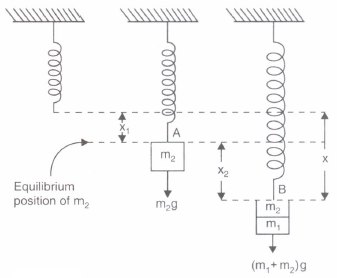
m2 g = k x1 ...(1)
For equilibrium state of (m1 + m2)
(m2 + m2) g = k(x) = k(x1 + x2) ...(2)
When the mass m1 is removed, the mass m2 will move upwards under the unbalanced force = m1g. Hence
Restoring force (F) on
m2 = -m1 g
Substracting (1) and (2) we have
m1g = k x2 ...(3)
Hence, Restoring force on
m2 = - k x2
∴ acceleration of \(m_2={F\over m_2}=-{k\over m^2}x_2\)
∴ accelaration ∝: - displacement
Angular frequency is \(ω=\sqrt{k\over m_2}\)
∴ Frequency of oscillation is \(n={ω\over 2\pi}={1\over 2\pi}\sqrt{k\over m_2}\)
It is clear that A is the equilibrium postion of m2 and Bits maximum displacement position. Hence AB = x2 is the amplitude of oscillation of m2 which from Eq. (3) is given by
Amplitude = \(x_2={m_1g\over k}\)
3.
Let the particle executingSHMstarts oscillating from its mean position. Then displacement equation is
x = A sin ωt
∴ Particle velocity, v = Aພcosωt
∴ Instantaneous K.E., K = \(\frac { 1 }{ 2 } { mv }^{ 2 }=\frac { 1 }{ 2 } { mA }^{ 2 }{ \omega }^{ 2 }{ cos }^{ 2 }\omega t\)
∴ Average value of K.E. over one complete cycle
\({ K }_{ av }=\frac { 1 }{ T } \int _{ o }^{ T }{ \frac { 1 }{ 2 } { mA }^{ 2 }{ \omega }^{ 2 }{ cos }^{ 2 }\omega tdt=\frac { { mA }^{ 2 }{ \omega }^{ 2 } }{ 2T } = } \int _{ 0 }^{ T }{ { { cos }^{ 2 }\omega tdt } } \)
\(=\frac { { mA }^{ 2 }{ \omega }^{ 2 } }{ 2T } \int _{ 0 }^{ T }{ \frac { (1+cos2\omega t) }{ 2 } dt } \)
\(=\frac { { mA }^{ 2 }{ \omega }^{ 2 } }{ 4T } { \left[ t+\frac { sin2\omega t }{ 2\omega } \right] }_{ 0 }^{ T }\)
\(=\frac { { mA }^{ 2 }{ \omega }^{ 2 } }{ 4T } \left[ (T-0)+\left( \frac { sin2\omega t-sin0 }{ 2\omega } \right) \right] \)
\(=\frac { 1 }{ 4 } { mA }^{ 2 }{ \omega }^{ 2 }...(i)\)
Again instantaneous P.E., U = \(\frac { 1 }{ 2 } { kx }^{ 2 }=\frac { 1 }{ 2 } { m\omega }^{ 2 }{ x }^{ 2 }=\frac { 1 }{ 2 } { m\omega }^{ 2 }{ A }^{ 2 }{ sin }^{ 2 }\omega t\)
∴ Average value of P.E. over one complete cycle
\(U_{ av }=\frac { 1 }{ T } \int _{ o }^{ T }{ \frac { 1 }{ 2 } { m\omega }^{ 2 }{ A }^{ 2 }{ sin }^{ 2 }\omega t=\frac { { mA }^{ 2 }{ \omega }^{ 2 } }{ 2T } = } \int _{ 0 }^{ T }{ { { sin }^{ 2 }\omega tdt } } \)
\(=\frac { { m\omega }^{ 2 }{ A }^{ 2 } }{ 2T } \int _{ 0 }^{ T }{ \frac { (1-cos2\omega t) }{ 2 } dt } \)
\(=\frac { { m\omega }^{ 2 }{ A }^{ 2 } }{ 4T } { \left[ t-\frac { sin2\omega t }{ 2\omega } \right] }_{ 0 }^{ T }\)
\(=\frac { { m\omega }^{ 2 }{ A }^{ 2 } }{ 4T } \left[ (T-0)-\left( \frac { sin2\omega t-sin0 }{ 2\omega } \right) \right] \)
\(=\frac { 1 }{ 4 } { m\omega }^{ 2 }A^{ 2 }...(ii)\)
Simple comparison of (i) and (ii), shows that
\(K_{ av }=U_{ av }=\frac { 1 }{ 4 } { m\omega }^{ 2 }A^{ 2 }\)
4.
Consider an air chamber of volume V with a long neck of uniform area of cross-section A, and a frictionless ball of mass m fitted smoothly in the neck at position C, Fig. The pressure of air below the ball inside the chamber is equal to the atmospheric pressure. Increase the pressure on the ball by a little amount p. so that the ball is depressed to position D, where CD = y.
There will be decrease in volume and hence increase in pressure of air inside the chamber. The decrease in volume of the air inside the chamber, ΔV = Ay
Volumetric strain =\(\frac { change\ in\ volume }{ original\ volume } \)
\(=\frac { \Delta V }{ V } =\frac { Ay }{ V } \)
∴Bulk Modulus of elasticity E. will be
\(E=\frac { stress(or\ increase\ in\ pressure) }{ volumetric\ strain } \)
\(=\frac { -p }{ Ay/V } =\frac { -pV }{ Ay } \)
Here, negative sign shows that the increase in pressure will decrease the volume of air in the chamber.
Now, \(p=\frac { -EAy }{ V } \)
Due to this excess pressure, the restoring force acting on the ball is
\(F=p\times A=\frac { \_ EAy }{ V } .A=\frac { -E{ A }^{ 2 } }{ V } y\quad ...(i)\)
Since F ∝ y and negative sign shows that the force is directed towards equilibrium position. If the applied increased pressure is removed from the ball, the ball will start executing linear SHM in the neck of chamber with C as mean position.
In S.H.M., the restoring force,
F = -ky ...(ii)
Comparing (i) and (ii), we have
Spring factor, k = EA2/V
Here inertia factor mass of ball = m.
Period, T = \(2\pi \sqrt { \frac { inertia\ factor }{ spring\ factor } } \)
\(=2\pi \sqrt { \frac { m }{ { EA }^{ 2 }/V } } =\frac { 2\pi }{ A } \sqrt { \frac { mV }{ E } } \)
∴ Frequency, v = \(\frac { 1 }{ T } =\frac { A }{ 2\pi } \sqrt { \frac { E }{ mV } } \)
5.
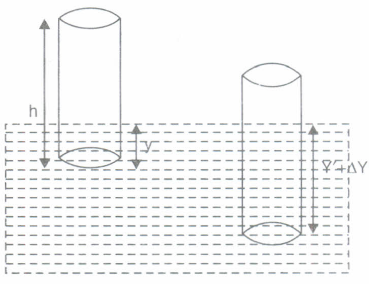
Say, initially in equilibrium, y height of cylinder is inside the liquid. Then, Weight of the cylinder = upthrust due to liquid displaced
∴ Ahρg = Ayρlg
When the cork cylinder is depressed slightly by Δy and released, a restoring force, equal to additional upthrust, acts on it. The restoring force is
F = A(y +Δy) ρlg - Ayρlg = AρlgΔy
∴ Acceleration \(a=\frac { F }{ m } =\frac { A{ \rho }_{ 1 }g\Delta y }{ Ah\rho } =\frac { { \rho }_{ 1 }g }{ h\rho } .\Delta y\)and the acceleration is directed in a direction opposite to Δy. Obviously, as a∞-Δy, the motion of cork cylinder is SHM, whose time period is given by
\(T=2\pi \sqrt { \frac { displacement }{ acceleration } } \)
\(=2\pi \sqrt { \frac { \Delta y }{ a } } \)
\(=2\pi \sqrt { \frac { h\rho }{ { \rho }_{ 1 }g } } \)
6.
The given displacement function is
x(t) = A cos (ωt + \(\phi \)) ...(i)
At t 0, x(0) = 1 cm. Also, ω = \(\pi\)s-1
∴ 1 = A cos(\(\pi\)\(\times\)0+\(\phi \))
⇒ A cos\(\phi \) = 1 ....(ii)
Also, differentiating eqn. (i) w.r.t. 't'.
v = \(\frac{d}{dt}x(t)\)=-Aωsin(ωt + \(\phi \)) ....(iii)
Now at t = 0, v = ω
∴ from eqn. (iii), ω = -Aωsin(\(\pi\)\(\times\)0 + \(\phi \))
or A sin \(\phi \)=-1 ....(iv)
Squaring and adding eqns. (ii) and (iv).
A2 cos2\(\phi \)+ A2 sin2\(\phi \) = 12 + 12 or A =\(\sqrt2\)cm
Dividing eqns. (ii) and (iv),
\(\frac { Asin\phi }{ Acos\phi } =\frac { -1 }{ 1 } \therefore tan\phi =-1\Rightarrow \phi =\frac { 3\pi }{ 4 } \)
If instead we use the sine function, i.e.,
x = B sin (ωt+ α),then v =\(\frac{d}{dt}\)Bωcos(ωt + α)
∴ At t = 0, using x = 1and v = ω, we get 1 = B sin(ω\(\times\)0+α)
or B sin α = 1 ...(v)
and ω = Bωcos(ω\(\times\)0+α) or Bcosα = 1 ...(vi)
Dividing (v) by (vi),
tanα = 1 or α = \(\frac{\pi}{4}\) or \(\frac{5\pi}{4}\)
Squaring (v) and (vi), we get
B2 sin2α + B2 cos2 α= 12 + 12
⇒ B = \(\sqrt2\) cm
7.
Given that,
Spring constant k =1200 Nm-1
mass m=3 kg
The distance at which mass is pulled from its equilibrium x=0.2 cm
(i) Frequency,
\( f=\frac{1}{T}=\frac{1}{2 \pi} \sqrt{\frac{k}{m}} \)
\( =\frac{1}{2 \times 3.142} \times \sqrt{\frac{1200}{3}} \)
\( f=3.18 \mathrm{~Hz}\)
(ii) The acceleration is given by
\(a=-\omega^2 x=-\frac{k}{m} x\)
or \(\left|a_{\max }\right|=\frac{k}{m}\left|x_{\max }\right|\)
i.e., acceleration will be maximum, when x is maximum.
i.e., \(\mathrm{x}_{\max }=\mathrm{A}=0.02 \mathrm{~m}\)
\(\therefore \mathrm{a}=\frac{1200}{3} \times 0.02=8.0 \mathrm{~ms}^{-2}\)
(ii) The maximum speed of the mass is given by \( v=A \omega=A \sqrt{\frac{k}{m}}=0.02 \times \sqrt{\frac{1200}{3}} =0.40 \mathrm{~ms}^{-1}
\)
8.
\(V^2=\omega^2\left(r^2-y^2\right)\)
(i) \(6^2=\omega^2\left(r^2-4^2\right)\)
(ii) \(\omega^2\left(r^2-3^2\right)\)
or \(\frac{64}{36}=\frac{r^2-9}{r^2-16}\)
On solving, \(r= \pm 5 m\) and \(\omega=2 s^{-1}\)
For the given displacement, \(x=\frac{r}{2}, t=\) ?
Asx \(x=r \cos \omega t\)
\(\therefore \frac{r}{2}=r \cos 2 t \text { or } \cos 2 t=\frac{1}{2}=\cos \left(\frac{\pi}{3}\right)\)
or \(2 t=\frac{\pi}{3}\) or \(t=\frac{\pi}{6} s\)
9.
Formula used: \(A_R=A \sqrt{2(1+\cos \delta}\)
Given: \(A_1=A_2=A_R=A\)
The resultant amplitude is also A.
If the phase difference between two motions is \(\delta\)
\( A=\sqrt{A^2+A^2+2 A \cdot A \cos \delta}\)
\( =A \sqrt{2(1+\cos \delta} \)
\( \Rightarrow A=2 A \cos \frac{\delta}{2} \)
\( \cos \frac{\delta}{2}=\frac{1}{2} \)
\( \Rightarrow \delta=\frac{2 \pi}{3}
\)

11th Standard CBSE Syllabus & Materials
11th Standard CBSE
CBSE 11th Business Studies Forms of Business Organisation Sample Question Papers Study Material - QB365 Set A
NEW11th Standard CBSE
CBSE 11th Business Studies Business, Trade and Commerce Sample Question Papers Study Material - QB365 Set A
NEW11th Standard CBSE
CBSE 11th Physics Waves Sample Question Papers Study Material - QB365 Set A
NEW11th Standard CBSE
CBSE 11th Physics Kinetic Theory Sample Question Papers Study Material - QB365 Set A



CBSE 11th Standard CBSE Subjects
CBSE Standards









