
 100% FREE ACCESS
11th Standard CBSE Syllabus & Materials
11th Standard CBSE
CBSE 11th Economics PART-A - Presentation of Data - New Sample Question Papers Study Material - QB365 Set A
NEW11th Standard CBSE
CBSE 11th Economics PART-A - Organisation of Data - New Sample Question Papers Study Material - QB365 Set A
NEW11th Standard CBSE
CBSE 11th Economics PART-A - Collection of Data - New Sample Question Papers Study Material - QB365 Set A
NEW11th Standard CBSE
CBSE 11th Economics PART-A - Introduction to Economics and Statistics - New Sample Question Papers Study Material - QB365 Set A
NEW11th Standard CBSE
CBSE 11th Business Studies International Trade Sample Question Papers Study Material - QB365 Set A
NEW11th Standard CBSE
CBSE 11th Business Studies Evolution and Fundamentals of Business Sample Question Papers Study Material - QB365 Set A

Published on: 27/09/2019
Oscillation
Download CBSE Class 11th Standard CBSE Physics question papers, sample papers, important questions, and previous year solved papers in PDF format. Get free study materials, NCERT solutions, and exam preparation resources for Class 11th Standard CBSE Physics
Questions + Answers key
Take MCQ Physics Test
1.
The mass 'M' attached to a spring oscillates with a period 2 s. If the mass is increased by 2 kg, the period increases by 1 s. Find the initial mass 'M', assuming that Hooke's law is obeyed.
2.
What is the frequency of a second pendulum in an elevator moving up with an acceleration of \(\frac{g}{2}?\)
3.
A cylindrical wooden block of cross-section 15.0 cm2 and mass 230 gm is floated over water with an extra weight 50 gm attached to its bottom. The cylinder floats vertically. From the state of equilibrium, it is slightly depressed and released. If the specific gravity of wood is 0.30 and g = 9.8 m per sec2, find the frequency of oscillation of the block.
4.
A simple pendulum in a stationary lift has time period T. What would be the effect on the time period when the left
(i) moves up with uniform velocity v
(ii) moves down with uniform velocity v
(iii) moves up with uniform acceleration a
(iv) moves down with uniform acceleration a
(v) beings to fall freely under gravity?
5.
A particle of mass 0.1 kg is held between two rigid supports by two springs of force constants 8 N/m and 2 N/m. If the particle is displaced along the direction of the length of the springs, calculate its frequency of vibration.
6.
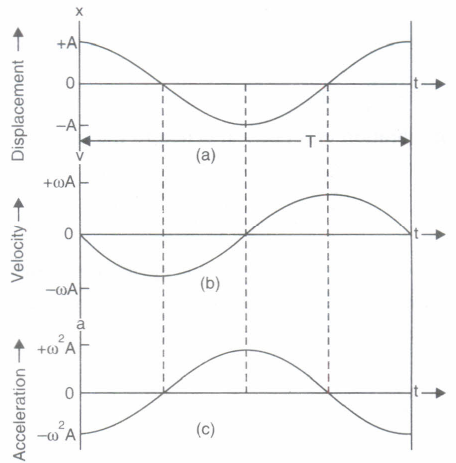
A SHM is expressed by the equation x = A cos (ωt + \(\phi\)) and the phase angle \(\phi\) = 0. Draw graphs to show variation of displacement, velocity and acceleration for one complete cycle in SHM.
7.
A block with a mass of 3.0 kg is suspended from an ideal spring having negligible mass and stretches the spring by 0.2 m.
(a) What is the force constant of the spring?
(b) What is the period of oscillation of the block if it is pulled down and released?
8.
Two pendulums of lengths 100 cm and 110.25 cm start oscillating in phase simultaneously. After how many oscillations will they again be in phase together?
9.
A particle of mass 0.8 kg is executing simple harmonic motion with an amplitude of 1.0 metre and periodic time \(\frac{11}{7}\)sec. Calculate the velocity and the kinetic energy of the particle at the moment when its displacement is 0.6 metre.
10.
A girl is swinging in the sitting position. How will the period of the swing be changed if she stands up?
11.
A body weighing 10 g has a velocity of 6 cms-1 after one second of its starting from mean position. If the time period is 6 s, then find the kinetic energy, potential energy and the total energy.
12.
Let us take the position of mass when the spring is unstretched as x = 0 and the direction from left to right as the positive direction of the x-axis. Given x as a function of time t for the oscillating mass, if at the moment we start the stopwatch (t = 0), the mass is at the maximum stretched position.
In what way do these functions for SHM differ from each other, in frequency, in amplitude or the initial phase?
13.
The motion of a simple pendulum is approximately simple harmonic for small angle oscillations. For larger angles of oscillation, a more involved analysis sjows that T is greater than \(2\pi \sqrt { \frac { l }{ g } } \) .Think of a qualitative argument to appreciate this result.
14.
When the mass is displaced a little to one side, one spring gets compressed and another is elongated.Due to which the combination of sp[rings. Here, effective spring factor k will be given by \(k={ k }_{ 1 }+{ k }_{ 2 }=600+600=1200{ Nm }^{ -1 }\)
1.
Let the initial mass and time periods be M and T respectively. If Hooke's law is obeyed, then the oscillations of the spring will be simple harmonic having time period T given by
\(T=2\pi \sqrt { \frac { M }{ k } } \)
Given T = 2 s
\(2=2\pi \sqrt { \frac { M }{ k } } \)k = spring constant...(i)
On increasing the mass by 2 kg
\(3=2\pi \sqrt { \frac { M+2 }{ k } } \)....(ii)
Squaring and dividing equation (ii) by (i) we have
\(\frac { 9 }{ 4 } =\frac { M+2 }{ M } =1+\frac { 2 }{ M } \)
\(or\quad \frac { 2 }{ M } \quad =\frac { 9 }{ 4 } -1=\frac { 5 }{ 4 } \)
\(\therefore M=\frac { 2\times 4 }{ 5 } =\frac { 8 }{ 5 } =1.6kg\)
2.
For second pendulum, frequency v = \(\frac{1}{2}\)s-1
When elevator is moving upwards with acceleration a, the effective acceleration due to gravity is g1= g + a = g + \(\frac{g}{2}\)=\(\frac{3g}{2}\)
Since,\(v=\frac { 1 }{ 2\pi } \sqrt { \frac { g }{ l } } \)
Hence, v2 ∝g
\(\therefore \frac { { v }_{ 1 }^{ 2 } }{ { v }^{ 2 } } =\frac { { g }_{ 1 } }{ g } =\frac { \frac { 3g }{ 2 } }{ g } =\frac { 3 }{ 2 } \)
\(or\quad \frac { { v }_{ 1 } }{ v } =\sqrt { \frac { 3 }{ 2 } } =1.225\)
\(\Rightarrow { v }_{ 1 }=1.225v=1.225\times \frac { 1 }{ 2 } =0.612{ s }^{ -1 }\)
3.
Area of cross-section of the block = \(\pi\)r2 = 15 cm2
= 15 x 10-4 m2
Total weight of the block = (230 + 50) = 280 gm = 0.28 kg
Density of wood = 0.30 gm/ c.c. = 300 kg/ m3
Density of water = 103 kg/ m3
When the cylinder is depressed in water through a distance y, the Restoring force weight of water displaced
F = Aydg = (15 x 10-4) x 103 x 9.8 Newton
Restoring force per unit distance= \(\frac{F}{y}\) = k
= (15 x 10-4) x 103 x 9.8 newton/ metre
= 1.5 x 9.8 N/m
Hence the frequency of oscillation is given by
\(=\frac { 1 }{ 2\pi } \sqrt { \left( \frac { k }{ m } \right) } =\frac { 1 }{ 2\pi } \sqrt { \frac { 1.5\times 9.8 }{ 0.28 } } \)
= 1.15 Hz
4.
(i) and (ii) since acceleration of the lift is zero therefore there will be no effect on time period.
(iii) When the lift moves up with uniform acceleration at the effective value of acceleration due to gravity is g + a.
\(\therefore T'=2\pi \sqrt { \frac { l }{ g+a } } \)Clearly,T'
(iv) When the lift moves down with uniform acceleration a, then the effective value of g is g - a.
\(\therefore T'=2\pi \sqrt { \frac { l }{ g-a } } \)Clearly,T'
(v) When the lift begins to fall freely under gravity, the effective vlaue of g becomes zero. So, T is infinite i.e., the simple pendulum shall not oscillate.
5.
The situation is shown in the fig. When the mass is displaced along the direction of the length of the spring, one spring is compressed while the other is extended but the force due to both the springs is in the same direction. Hence the effective force constant

k = k1 + k2 = 8 N/m + 2 N/m = 10 N/m
The frequency of vibration is given by
\(v=\frac { 1 }{ 2\pi } \sqrt { \frac { k }{ m } } =\frac { 1 }{ 2\pi } \sqrt { \frac { 10 }{ 0.1 } } \)
\(or\quad v=\frac { 10 }{ 2\pi } =\frac { 5 }{ \pi } { s }^{ -1 }\)
6.
Let x = A cos (ωt + \(\phi\)) and if phase angle \(\phi\) is zero, then
x = A cos ωt
\(\therefore \quad v=\frac { dx }{ dt } =-A\omega \quad sin\omega t\)
\(and\quad a=\frac { dv }{ dt } =-a{ \omega }^{ 2 }cos\omega t=-{ \omega }^{ 2 }x\)
Thus, values of z, v and a at different times, over one complete oscillation cycle,
| Time t | 0 | \(\frac{T}{4}\) | \(\frac{T}{2}\) | \(\frac{3T}{4}\) | T |
| ωt | 0 | \(\frac{\pi}{2}\) | \(\pi\) | \(\frac{3\pi}{2}\) | 2\(\pi\) |
| x | A | 0 | -A | 0 | A |
| v | 0 | -Aω | 0 | +Aω | 0 |
| a | -Aω2 | 0 | Aω2 | 0 | -Aω2 |
With the given data we plot x-t, v-t and a-t graphs. The graphs have been shown in Fig. (a), (b) and (c).
7.
(a) Force constant \(k=\frac { F }{ l } =\frac { mg }{ l } \)
Here m = 3.0 kg and elongation in length of spring l = 0.2 m
∴ Force constant k = \(\frac{3.0\times 9.8}{0.2}=174Nm^{-1}\)
(b) Period of oscillation \(T=2\pi \sqrt { \frac { m }{ k } } =2\times 3.14\times \sqrt { \frac { 3 }{ 147 } } =0.9s\)
8.
\(T=2\pi \sqrt{\frac{l}{g}}, l_1=100 cm\ ; l_2=110.25 cm\)
For smaller pendulum, \(T_1=2\pi \sqrt{\frac{100}{g}}\) -- (i)
For larger pendulum, \(T_1=2\pi \sqrt{\frac{110.25}{g}}\) -- (ii)
Let these pendulums oscillate in phase again if larger pendulum completes' n' oscillations. It means smaller pendulum must complete (n + 1) oscillations.
\(nT_2=(n+1)T_1\)
or \(\frac{n+1}{n}=\frac{T_2}{T_1}=\sqrt{\frac{110.25}{100}}=1.05\)
or \(1+\frac{1}{n}= 1.05 \ or \ \frac{1}{n}=0.05 = \frac{5}{100}=\frac{1}{20}\)
∴ n = 20.
Hence both pendulums will again oscillate in phase after 20 oscillations of the larger or 21 oscillations of the smaller pendulum.
9.
We know that,\(v=\omega \sqrt { \left( { a }^{ 2 }-{ y }^{ 2 } \right) } \)
Further \(\omega =\frac { 2\pi }{ T } \)
\(v=\frac { 2\pi }{ T } \sqrt { ({ a }^{ 2 }-{ y }^{ 2 }) } =\frac { 2\times 3.14 }{ \left( \frac { 11 }{ 7 } \right) } \sqrt { [({ 1.0) }^{ 2 }-({ 0.6) }^{ 2 })] } \)
= 3.2 m/sec.
Kinetic energy at this displacement is given by
\(K=\frac { 1 }{ 2 } { mv }^{ 2 }\)
\(=\frac { 1 }{ 2 } \times 0.8\times { (3.2) }^{ 2 }=4.1joule\)
10.
This can be explained using the concept of a simple pendulum. We know that the time period of a simple pendulum is given by
\(T=2\pi \sqrt { \frac { l }{ g } } i.e,\quad T\infty \sqrt { l } \)
When the girl stands up, the distance between the point of suspension and the centre of mass of the swinging body decreases i.e.,l decreases, so T will also decrease.
11.
\(Here,m=10g,T=6s\)
\(\omega =\frac { 2\pi }{ T } =\frac { 2\pi }{ 6 } =\frac { \pi }{ 3 } rads^{ -1 }\)
\( When\ t=1s,v=6cms^{ -1 }\)
\(\\ As\ v=A\omega cos\omega t\)
\( 6=A\times \frac { \pi }{ 3 } cos\frac { \pi }{ 3 } \times 1=A\times \frac { \pi }{ 3 } cos{ 60 }^{ \circ }\)
\(=A\times \frac { \pi }{ 3 } \times \frac { 1 }{ 2 } =\frac { \pi A }{ 6 } orA=\frac { 36 }{ \pi } cm\)
\(Total\ energy,E=\frac { 1 }{ 2 } m{ A }^{ 2 }\omega ^{ 2 }\)
\(=\frac { 1 }{ 2 } \times 10\times \left( \frac { 36 }{ \pi } \right) ^{ 2 }\times \left( \frac { \pi }{ 3 } \right) ^{ 2 }=720erg\)
\(\\ Kinetic\ energy=\frac { 1 }{ 2 } m{ v }^{ 2 }=\frac { 1 }{ 2 } \times 10\times 6^{ 2 }=180erg\)
\(\\ \therefore Potential\ energy=Total\ energy-Kinetic\ energy\)
\( =720-180=540erg\)
12.
\(When\ t=0,x=+A\)
\(\\ x(t)=Asin(\omega t+\phi )\ at\ t=0\ and\ x=+A\)
\(+A=Asin(\omega \times 0+\phi )\)
\( or\ 1=sin\phi \Rightarrow \phi =\frac { \pi }{ 2 } \)
\(\\ \therefore \ x(t)=Asin\left( \omega t+\frac { \pi }{ 2 } \right)\)
\(=Acos\omega t=Acos20t=2cos20t\)
13.
If we replace \(sin\theta \approx \theta \) for large angles, then actually \(sin\theta <\theta \)
Now since this factor is multiplied to the restoring force mg\(sin\theta \) is replaced by \(mg\theta \) which means ana effective reduction in g for large angles. hence, there is an increase in time period T over that given by the formula \(T=2\pi \sqrt { \frac { l }{ g } } \) as compared to the acse which it is assumed \(sin\theta \simeq \theta \)
14.
\(T=0.314\ s,\ { v }_{ max }=1{ ms }^{ -1 },\ E=1.5\ J\)

11th Standard CBSE Syllabus & Materials
11th Standard CBSE
CBSE 11th Business Studies Forms of Business Organisation Sample Question Papers Study Material - QB365 Set A
NEW11th Standard CBSE
CBSE 11th Business Studies Business, Trade and Commerce Sample Question Papers Study Material - QB365 Set A
NEW11th Standard CBSE
CBSE 11th Physics Waves Sample Question Papers Study Material - QB365 Set A
NEW11th Standard CBSE
CBSE 11th Physics Kinetic Theory Sample Question Papers Study Material - QB365 Set A



CBSE 11th Standard CBSE Subjects
CBSE Standards









