
 100% FREE ACCESS
11th Standard CBSE Syllabus & Materials
11th Standard CBSE
CBSE 11th Economics PART-A - Presentation of Data - New Sample Question Papers Study Material - QB365 Set A
NEW11th Standard CBSE
CBSE 11th Economics PART-A - Organisation of Data - New Sample Question Papers Study Material - QB365 Set A
NEW11th Standard CBSE
CBSE 11th Economics PART-A - Collection of Data - New Sample Question Papers Study Material - QB365 Set A
NEW11th Standard CBSE
CBSE 11th Economics PART-A - Introduction to Economics and Statistics - New Sample Question Papers Study Material - QB365 Set A
NEW11th Standard CBSE
CBSE 11th Business Studies International Trade Sample Question Papers Study Material - QB365 Set A
NEW11th Standard CBSE
CBSE 11th Business Studies Evolution and Fundamentals of Business Sample Question Papers Study Material - QB365 Set A

Published on: 05/03/2020
11th Standard CBSE Physics Public Exam Important Question 2019-2020
Download CBSE Class 11th Standard CBSE Physics question papers, sample papers, important questions, and previous year solved papers in PDF format. Get free study materials, NCERT solutions, and exam preparation resources for Class 11th Standard CBSE Physics
Questions + Answers key
Take MCQ Physics Test
1.
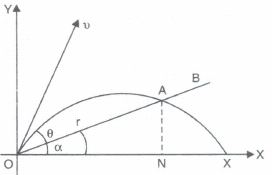
A projectile, launched with a speed v at an angle \(\theta\) to the horizontal, hits a plane inclined at an angle a to the horizontal (\(\alpha < \theta\)) and passing through the point of launching. Obtain an expression for the range r of the projectile on this inclined plane. When does the projectile hit this plane?
2.
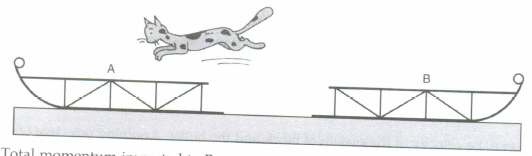
Two 22.7 kg ice sleds A and B are placed a short distance apart, one directly behind the other, as shown in Fig. A 3.63 kg cat, standing on one sled, jumps across to the other and immediately back to the first. Both jumps are made at a speed of 3.05 ms-1 relative to the ice. Find the final speeds of the two sleds.
3.
Show that for a particle in linear SHM the average kinetic energy over a period of oscillation equals the average potential energy over the same period.
4.
Write the expressions for Cv and Cp of a gas in terms of gas constant R and constant y, where \(γ={C_P\over C_v}\)
5.
Estimate the total number of air molecules (inclusive of oxygen, nitrogen, water vapour and other constituents) in a room of capacity 25.0 m3 at a temperature of 27 °C and 1 atm pressure.
6.
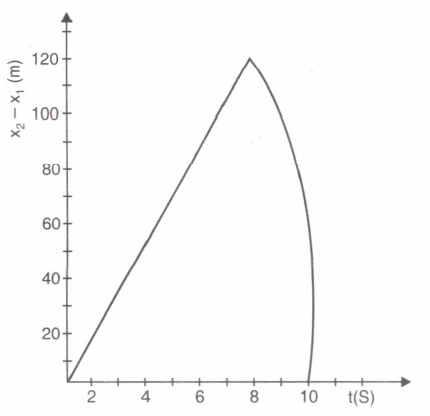
Two stones are thrown up simultaneously from the edge of a cliff 200 m high with initial speeds of 15 ms-1 and 30 ms-1, Verify that the graph shown in Fig. correctly represents the time variation of the relative position of the second stone with respect to the first. Neglect air resistance and assume that the stones do not rebound after hitting the ground. Take g = 10 ms>. Give the equations for the linear and curved parts of the plot.
7.
The vertical motion of a huge piston in machine is simple harmonic with a frequency of 0.50 s-1. A block of 10 kg is placed on the piston. What is the maximum amplitude of the piston's SHM for the block and the piston to remain together?
8.
A balloon has 5.0 g mole of helium at 70C Calculate the number of atoms of helium in the balloon.
9.
2 A blacksmith fixes iron ring on the rim of the wooden wheel of a horse cart. The diameter of the rim and the iron ring are 5.243 m and 5.231 m, respectively at 27 °C. To what temperature should the ring be heated so as to fit the rim of the wheel?
10.
The absolute temperature (kelvin scale) T is related to the temperature tc on the celsius scale by tc =T-273.15. Why do we have 273.15 in this relation and 273.16?
11.
A Cube Placed in Water and Mercury
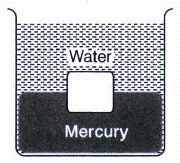
A tank contains water and mercury as shown in figure. An iron cube of edge 6 cm is in equilibrium as shown in figure. What is the fraction of cube inside the mercury? Given, density of iron =- 7.7 x 10³ kqm-3 and density of mercury =- 13.6 x 10³ kgm-3
12.
If the terminal speed of a sphere of gold (density = 19.5\({ kg }/{ { m }^{ 3 } }\)) is 0.2m/s in viscous liquid (density = 19.5\({ kg }/{ { m }^{ 3 } }\)) is 0.2m/s in viscous liquid density (density = 1.5\({ kg }/{ { m }^{ 3 } }\)). Find out the terminal speed of a sphere of silver(density = 10.5\({ kg }/{ { m }^{ 3 } }\)) of the same size in the same liquid.
13.
A 14.5 kg mass, fastened to the end of a steel wire of unstretched length 1.0 m, is whirled in a vertical circle with an angular velocity of 2 rev/s at the bottom of the circle. The cross-sectional area of the wire is 0.065 cm2 . Calculate the elongation of the wire when the mass is at the lowest point of its path.
14.
Flying tackla
A man carrying mass M = 125 kg makes a flying tackle at v1 = 4 m/s on a stationary quarterback of mass m =85 kg and his helmet makes solid contact with quarterback's femur.
(i) What is the final speed of two athletes immediately after contact and also determine the average force exerted on the quarterback's femur, when last collision occur at 0.100 s ?
(ii) If area of cross-section of quarterback's femur is 5 x 10- 4 m2 , then estimate the shear stress exerted on femur in the collision.
15.
The acceleration due to gravity at the moon's surface is 1.67 ms-2 . If the radius of the moon is 1.74x10⁶ m, then calculate the mass of the moon.
16.
The planet Neptune travels around the sun with a period of 165 yr. Show that the radius of its orbit is approximately thirty times that of the earth's orbit, both being considered as circular.
17.
To maintain a rotor at a uniform angular speed of 200 rad s-1, an engine needs to transmit a torque of 180 N m. What is the power required by the engine ? (Note: uniform angular velocity in the absence of friction implies zero torque. In practice, applied torque is needed to counter frictional torque). Assume that the engine is 100% efficient.
18.
Find the centre of mass for a solid cone of base radius r and height h.
19.
Force on the Block
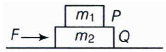
A block P of mass 4 kg is placed on another block Q of mass 5 kg, and the block Q rests on a smooth horizontal table. For sliding block P on Q, horizontal force of 12 Nis required to be applied on P. How much maximum force can applied on Q so that both P and Q move together? Also, find out acceleration produced by this force.
20.
Figure shows (x, t), (y, t) diagram of a particle moving in 2-dimensions.
-Q.png)
-Q.png)
If the particle has a mass of 500 g, find the force (direction and magnitude) acting on the particle.
21.
A cyclist is riding with a speed of 27kmh-1. As he approaches, a circular turn on the road of f radius 80 m, he applies brakes and reduces his speed at the constant rate of 0.5 ms-2.What is the magnitude and direction of the net acceleration of the cyclist on the circular turn?
22.
Just as precise measurements are necessary in science, it is equally important to be able to make rough estimates of quantities using rudimentary ideas and common observations. Think of ways by which you can estimate the following (where an estimate is difficult to obtain, try to get upper bound on the quantity).
The number of strands of hair on our head
23.
Science, like any knowledge, can be put to good or bad use, depending on the user. Given below are some of the application of science. Formulate your views on whether the particular application is good, bad or something that cannot be so clearly categorized.
(i) Mass vaccination against small pox to curb and finally eradicate this disease from the population.
(ii) Television for eradication of illiteracy and for mass communication for news and ideas.
(iii) Prenatal sex determination.
(iv) Computers for increase in work efficiency.
(v) Putting artificial satellites around the earth.
(vi) Development of nuclear weapons.
(vii) Development of new and powerful techniques of chemical and biological warfare.
(viii) Purification of water for drinking.
(ix) Plastic surgery.
(x) Cloning.
24.
A man weighing 60 kg is sitting in a lift which is moving vertically with an acceleration of 2 ms-2. Prove that the reaction on the base of the lift is greater when it is ascending than when it is descending. (Given g = 9.8 ms-2).
25.
Can a motion be periodic but not oscillatory? If your answer is yes, give an example and if not explain why?
26.
Is it possible to open a pen cap with one finger? Why?
27.
An observer places his ear at the end of a long steel pipe. He can hear two sounds, when a workman hammers the other end of the pipe. Why?
28.
What is the nature of force involved in the winding of a watch?
29.
Name three physical properties which can have different values in different directions.
30.
Which is a bigger unit-light year or parsec?
31.
Find the temperature at which rms speed of a gas is half of its value of 00C, pressure remaining constant.
32.
The difference between length of a certain brass rod and that of a steel rod is claimed to be constant at all temperatures. In this possible?
33.
A vertical off-shore structure is built to withstand a maximum stress of 109 Pa. Is the structure suitable for putting up on top of an oil well in the ocean ? Take the depth of the ocean to be roughly 3 km, and ignore ocean currents.
34.
The acceleration due to gravity on a planet is 1.96\({ ms }^{ -2 }\). If it is safe to jump from a height of 2m on the earth, then what will be the corresponding safe height on the planet?
35.
Mahak was very lazy and overweight.She didn't do any exercise or physical work. As her weight was increasing whenever she walked she felt pain in her knees. She consulted a doctor who advised her to reduce her weight otherwise her condition would not improve. She tried to follow doctors advice and changed her life style, she stopped eating junk food, started using stairs instead of using cars. After sometime, she became fit and fine again.
(i) What values do you infer from this?
36.
A passenger arriving in a new town wishes to go from the station to a hotel located 10 km away on a straight road from the station. A dishonest cabman takes him along a circuitous path 23 km long and reaches the hotel in 28 min. What is
(a) the average speed of the taxi,
(b) the magnitude of average velocity ? Are the two equal ?
37.
Round off the following number as indicated
143.45 upto 4 digits
38.
The acceleration associated with a mass 'm' moving in a circular path is Eobefound. It is given that the velocity at any instant is v = krt, where k is a constant. Classify the motion and find acceleration.
39.
State the assumptions of the kinetic theory of gases. The density of carbon dioxide gas at 0 °C and at a pressure of 1.0 x 10⁵ newton/metre2: is 1.98 kg/m3. Find the root mean square velocity of its molecules at 0 °C and 30°C. Pressure is constant.
40.
A particle moves in a circle of radius 20 cm. Its linear speed at any time is given by v = 2t where v is in m/s and t is in seconds. Find the radial and tangential accelerations at t = 3 seconds and hence calculate the total acceleration at this time.
41.
Determine the force required to double the length of a steel wire of area of cross-section 5 x 10⁻⁵m2. Young's modulus of steel =2 x 10¹¹ Nm-2.
42.
The distance of the Sun from the Earth is 1.496 x 10¹¹ m (i.e., 1 A.u.). If the angular diameter of the Sun is 2000. find the diameter of the Sun.
43.
A body of mass 2kg is at rest at a height of 10 m above the ground. Calculate its potential energy and kinetic energy after it has fallen through half the height. Also find the velocity at this instant.
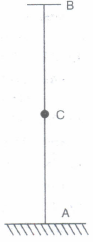
44.
A small drop of water of surface tension T is squeezed between two clean glass plates so that a thin layer of thickness d and area A is formed between them. If the angle of contact is zero, what is the force required to pull the plates apart.
45.
Briefly, do we need quantum theory?
46.
A stone dropped from the top of a tower of height 300 m splashes into the water of a pond near the base of the tower. When is the splash heard at the top given that the speed of sound in air is 340 m s–1 ? (g = 9.8 m s–2)
47.
Explain, why?
(i) 500 J of work is done on a gas to reduce its volume by compression adiabatically. What is the change in internal energy of the gas?
(ii) The coolant in a chemical or a nuclear plant , i.e. the liquid used to prevent the different parts of a plant from getting too hot should have high specific heat.
(iii) The climate of a harbour town is more temperate than that of a town in a desert at the same latitude
48.
The brass scale of a barometer gives correct reading at 0 0C. Coefficient of linear expansion of brass is 2.0 x 10⁻⁵/0 C. The barometer reads 75.00 cm at 270 C. What is the true atmospheric pressure at 270 C.
49.
A comet orbits the sun in a highly elliptical orbit. Does the comet have a constant
(a) linear speed,
(b) angular speed,
(c) angular momentum,
(d) kinetic energy,
(e) potential energy,
(f) total energy throughout its orbit? Neglect any mass loss of the comet when it comes very close to the Sun.
50.
To what height does the ball rise and after how long does the ball return to the player's hands?(Take g = 9.8ms-2 and neglect air resistance)
51.
A plane is indined at an angle of 30° with horizontal. The magnitude of component of a vector \(\overset\rightarrow{A}\)=-10\(\hat{k} \) perpendicular to this plane is (here z-direction is vertically upwards
5\(\sqrt{2}\)
5\(\sqrt{3}\)
5
2.5
52.
Oxygen and hydrogen gases are at the same temperature T. The kinetic energy of an oxygen molecule will be equal to
16 times the kinetic energy of a hydrogen molecule
5 times the kinetic energy of a hydrogen molecule
the kinetic energy of a hydrogen molecule
one-fourth the kinetic energy of a hydrogen molecule
53.
A cylindrical solid of mass M has raidus R and length L. Its moment of inertia about a generator is:
\(N\left( \frac { L }{ R } +\frac { { R }^{ 2 } }{ 4 } \right) \)
\(\frac { 1 }{ 2 } { MR }^{ 2 }\)
\(\frac { 3 }{ 2 } { MR }^{ 2 }\)
\(M\left( \frac { { L }^{ 2 } }{ 3 } +\frac { { R }^{ 2 } }{ 4 } \right) \)
54.
Distance-time graph of a body at rest is
parallel to time-axis
parallel to distance-axis
inclined to time-axis
perpendicular to both axes.
55.
What is the dimensions of power:
[MLT-2]
[ML2T]
[ML2T2]
[MLT-3]
56.
Two particles P and Q describe SHM of same amplitude a and frequency v along the same straight line. The maximum distance between two particles is √2 a. The phase difference between the particles is
zero
π/2
π/6
π/3
57.
A wire has a mass 0.3 ± 0.003 g, radius 0.5 ± 0.005 mill and length 6 ± 0.06 cm. The maximum percentage error in the measurement of its density is _____.
1
2
3
4
58.
Two pulses in a stretched string whose centres are initially 8 cm apart are moving towards each other as shown in figure. The speed of each pulse is 2 cms-1. After 2 second, the total energy of the pulses will be
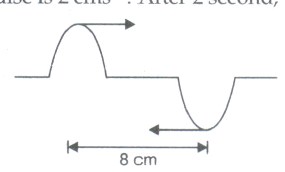
zero
purely kinetic
purely potential
Partly kinetic and partly potential
59.
Dimensional formula of stress is same as that of
impulse
strain
force
pressure
60.
Mars has about 1/10th as much mass as the earth and half as great a diameter. TI1e acceleration of a falling body on Mars is about
9.8 m s-2
1.96 ms-2
3.92 m s-2
4.9 m s-2
61.
For a ball falling in a liquid with constant velocity, ratio of resistance force due to the liquid to that due to gravity is
1
\(\frac{2a^2\rho g}{9\eta^2}\)
\(\frac{2a^2(\rho-\sigma)g}{9\eta}\)
none
62.
If the tension in the cable supporting an elevator is equal to the weight of the elevator, the elevator may _______.
going up with uniform speed
going down with non-uniform speed
going up with increasing speed
going down with increasing speed
63.
An ideal heat engine exhosting heat at 27°C is to have 25%efficiency. It must take heat at: _______.
127°C
227°C
327°C
673°C
64.
The range of strong nuclear force is about
10-15 m
10-14 m
10-16 m
10-10 m
1.
Let OAB be the inclined plane making an angle \(\alpha\) to the horizontal and let the projectile hit it at a point A where OA = r (Fig.).
At the instant the projectile hits the inclined plane, its horizontal and vertical displacements are ON (= r cos \(\alpha\)) and NA (= r sin \(\alpha\)) respectively.
Now the time taken to cover a horizontal distance r cos \(\alpha\) is clearly r cos \(\alpha\)/ v cos \(\theta\). The vertical distance moved in this time being r sin \(\alpha\), we have
\(r \ sin \alpha=(v \ sin \theta)({r \ cos \alpha \over v \ cos \theta})-{1\over2}g({r \ cos \alpha\over v cos \theta})^2\)
or \(r(sin \alpha - tan \theta cos \alpha)=-{1\over2}g{\cos^2\alpha\over v^2 \cos^2 \theta }r^2\)
\(\therefore r={2v^2cos^2\theta\over g \ cos^2 \alpha}[tan \theta cos \alpha-sin \alpha]\)
\(={2v^2cos^2\theta\over g \ cos^2 \alpha}[{sin \theta cos \alpha-cos \theta sin \alpha\over cos \theta}]\)
\(={2v^2cos^2\theta\over g \ cos^2 \alpha} sin (\theta - \alpha)\)
Thus the range of the projectile on the inclined plane is
\(={2v^2cos^2\theta\over g \ cos^2 \alpha} sin (\theta - \alpha)\)
The time at which the projectile hits the inclined plane being (r cos \(\alpha\) / v cos \(\theta\)), we have
\(t={r \ cos \alpha \over v \ cos \theta}={2v^2cos\theta\over g \ cos^2\alpha} sin (\theta - \alpha){cos \alpha\over v cos \theta}\)
or \(t={2 \ v \ sin (\theta - \alpha)\over g \ cos \alpha}\)
A confirmation of these results is obtained by putting \(\alpha\) = 0 for which case we get
\(r={2 \ v^2 cos \theta \ sin \theta \over g}={v^2sin 2\theta\over g}and \ t={2 \ v \ sin \theta \over g}\)
the usual expressions for the range and time of flight of a projectile.
2.
Total momentum imparted to B
2 x 3.63 x 3.05 kg ms-1
Velocity of B \(=\frac{2\times3.63\times3.05}{22.7}ms^{-1}=0.975\ ms^{-1}\)
Velocity of A when the cat jumps away from A
\(=\frac{3.63\times3.05}{22.7}ms^{-1}=0.4877\ ms^{-1}\)
When the cat comes back to A
Velocity of A \(=\frac{22.7\times0.4877+3.63\times3.05}{22.7+3.63}\ ms^{-1}\)
= 0.841 ms-1
3.
Let the particle executingSHMstarts oscillating from its mean position. Then displacement equation is
x = A sin ωt
∴ Particle velocity, v = Aພcosωt
∴ Instantaneous K.E., K = \(\frac { 1 }{ 2 } { mv }^{ 2 }=\frac { 1 }{ 2 } { mA }^{ 2 }{ \omega }^{ 2 }{ cos }^{ 2 }\omega t\)
∴ Average value of K.E. over one complete cycle
\({ K }_{ av }=\frac { 1 }{ T } \int _{ o }^{ T }{ \frac { 1 }{ 2 } { mA }^{ 2 }{ \omega }^{ 2 }{ cos }^{ 2 }\omega tdt=\frac { { mA }^{ 2 }{ \omega }^{ 2 } }{ 2T } = } \int _{ 0 }^{ T }{ { { cos }^{ 2 }\omega tdt } } \)
\(=\frac { { mA }^{ 2 }{ \omega }^{ 2 } }{ 2T } \int _{ 0 }^{ T }{ \frac { (1+cos2\omega t) }{ 2 } dt } \)
\(=\frac { { mA }^{ 2 }{ \omega }^{ 2 } }{ 4T } { \left[ t+\frac { sin2\omega t }{ 2\omega } \right] }_{ 0 }^{ T }\)
\(=\frac { { mA }^{ 2 }{ \omega }^{ 2 } }{ 4T } \left[ (T-0)+\left( \frac { sin2\omega t-sin0 }{ 2\omega } \right) \right] \)
\(=\frac { 1 }{ 4 } { mA }^{ 2 }{ \omega }^{ 2 }...(i)\)
Again instantaneous P.E., U = \(\frac { 1 }{ 2 } { kx }^{ 2 }=\frac { 1 }{ 2 } { m\omega }^{ 2 }{ x }^{ 2 }=\frac { 1 }{ 2 } { m\omega }^{ 2 }{ A }^{ 2 }{ sin }^{ 2 }\omega t\)
∴ Average value of P.E. over one complete cycle
\(U_{ av }=\frac { 1 }{ T } \int _{ o }^{ T }{ \frac { 1 }{ 2 } { m\omega }^{ 2 }{ A }^{ 2 }{ sin }^{ 2 }\omega t=\frac { { mA }^{ 2 }{ \omega }^{ 2 } }{ 2T } = } \int _{ 0 }^{ T }{ { { sin }^{ 2 }\omega tdt } } \)
\(=\frac { { m\omega }^{ 2 }{ A }^{ 2 } }{ 2T } \int _{ 0 }^{ T }{ \frac { (1-cos2\omega t) }{ 2 } dt } \)
\(=\frac { { m\omega }^{ 2 }{ A }^{ 2 } }{ 4T } { \left[ t-\frac { sin2\omega t }{ 2\omega } \right] }_{ 0 }^{ T }\)
\(=\frac { { m\omega }^{ 2 }{ A }^{ 2 } }{ 4T } \left[ (T-0)-\left( \frac { sin2\omega t-sin0 }{ 2\omega } \right) \right] \)
\(=\frac { 1 }{ 4 } { m\omega }^{ 2 }A^{ 2 }...(ii)\)
Simple comparison of (i) and (ii), shows that
\(K_{ av }=U_{ av }=\frac { 1 }{ 4 } { m\omega }^{ 2 }A^{ 2 }\)
4.
We know that Cp - Cv = R
and \({C_P\over C_v}=γ\)
From eqn. (ii) Cp = γCv and sustituting this value in (i),
We have \(⋎C_v-C_v=R⇒C_v={R\over (⋎-1)}\)
\(C_v=γ.C_v={γR\over(γ-1)}\)
5.
Here volume of room V = 25.0 m3 , temperature, T = 270C = 300 K and
Pressure, P = 1 atm = 1.01 x 10⁵ pa
According to gas equation,
PV = \(\mu \)RT = \(\mu \)NA.KB T
Hence, total number of air molecules in the volume of given gas,
N=\(\mu \). NA = \(\frac { PV }{ { k }_{ B }T } \)
\(\therefore N=\frac { 1.01\times { 10 }^{ 5 }\times 25.0 }{ (1.38\times { 10 }^{ -23 })\times 300 } =6.1\times { 10 }^{ 26 }\)
6.
For first stone
x (0) 200 m, v (0) = 15 ms-1, a = -10 ms-2
x1 (t) X(0) + v (0) t + \(\frac{1}{2}\) a t2
x1 (t) 200 + 15t - 5t2
When the first stone hits the ground, x1 (t) = a
∴ 5t2 + 15t + 200 a
On simplification, t = 8 s
For second stone, X(0) = 200 m, v (0) = 30 ms-1, a = -10 ms-2
x2 (t) 200 + 30t - 5t2
When this stone hits the ground, x2(t) = a
∴ -5t2 + 30t + 200 = 0
Relative position of second stone w.r.t. first is given by x2 (t) - x1(t) = 15t
Since there is a linear relationship between x2(t) - X1 (t) and i, therefore the graph is a straight line.
For maximum separation, t = 8 s
So maximum separation is 120 m
After 8 second, only the second stone would be in motion. So, the graph is in accordance with the quadratic equation.
7.
As, \(v=\frac { 1 }{ 2\pi } \sqrt { \frac { k }{ m } } \)
\(k=4\pi ^{ 2 }m{ v }^{ 2 }\)
For maximum displacement \({ y }_{ max }=A\)
Maximum restoring force,
F = - kA =- mg
or \(A=\frac { mg }{ k } =\frac { mg }{ 4{ \pi }^{ 2 }{ mv }^{ 2 } } =\frac { g }{ 4\pi ^{ 2 }{ v }^{ 2 } }\)
\( \\ =\frac { 9.8 }{ 4\times { (3.14) }^{ 2 }\times { (0.50) }^{ 2 } } =0.99m\)
8.
Here, \(\mu =5.0,\quad T={ 7 }^{ \circ }C=273+7\quad =280K\)
Number of atoms =\(\mu { N }_{ A }=5.0\times 6.02\times { 10 }^{ 23 }\approx 30\times { 10 }^{ 23 }\)
9.
Given, T1 = 27 °C
LT1 = 5.231 m
LT2 = 5.243 m
So, LT2 =LT1 [1+αl (T2 –T1 )]
5.243 m = 5.231 m [1 + 1.20×10⁻⁵ K–1 (T2 –27 °C)] or T2 = 218 °C
10.
As the triple point of water on Celsius is 0.010C (and not 00 C) and on kelvin scale 273.16 and the size of degree on the two scale is same, so
tc - 0.01 = T - 273.16
tc = T - 273.15
11.
Let y be the depth of cube in mercury. The depth of cube in water will be (0.06 - y) m. The buoyant force on cube due to mercury can be find out by using
Archimedes' principle.
B1 = (0.06)2 x y x (13.6 x 103)x 9.8 N
Similarly, due to water the buoyant force on cube is
B2 = (0.06)2 x (0.06 - y) x 103 x 9.8 N
When cube is in equilibrium, the sum of both the buoyant forces will be equal to the total weight of iron
cube. B1 + B2 = weight of iron cube
or = (0.06)2 x 103 x 9.8 [13.6 Y + (0.06 - y)]
= (0.06)3 x 7.7 x 103 x 9.8
\(y=\frac { 0.396 }{ 12.6 } =0.032m\)
Fraction of cube inside mercury = \(\frac { 0.032 }{ 0.06 } =0.533=\) 53%
12.
\(1.76\times 10^{ -2 }{ N }/{ m }\)
13.
Given, mass(m) = 14 .5kg
Length of wire (l ) = 1 m
Angular frequency (v) = 2 revls
Angular velocity (\(\omega \)) = 2\(\pi \)v
= 2\(\pi \)\(\times \)2 rad/s = 4\(\pi \) rad/s
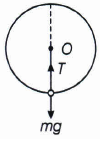
Area of cross-section of wire (A) = 0.065 cm2
= 6.5 \(\times \)10-6 m2
Young's modulus for steel (Y) = 2 \(\times \) 1011 N/m2.
At lowest point of the vertical circle, T - mg = ml\({ \omega }^{ 2 }\)
or T= mg + m\({ \omega }^{ 2 }\)
= (14.5\(\times \)9.8)+14.5\(\times \)1\(\times \)\({ (4\pi ) }^{ 2 }\)
= 14.5(9.8+16\({ \pi }^{ 2 }\))
= 14.5(9.8\(\times \)16\(\times \)9.87) [\(\because \) \({ \pi }^{ 2 }\)=9.87]
= 14.5\(\times \) 167.72N=2431.94 N
Young's modulus (Y) =\(\frac { Stress }{ Strain } =\frac { (T/A) }{ \Delta l/l } =\frac { Tl }{ A.\Delta l } \)
\(\therefore \Delta l=\frac { T.l }{ A.Y } =\frac { 2431.94\times 1 }{ 6.5\times { 10 }^{ -6 }\times 2\times { 10 }^{ 11 } } \)
= 1.87\(\times \)10-3 m =1.87 mm
14.
(i) Here, M = 125 kg,
v1 = 4 m/s,
m = 85 kg
Applying, conservation of linear momentum, we get
pinitial = pfinal i.e., Mv1 = ( M + m ) vf
The value of final speed
vf = \(\frac { M{ v }_{ i } }{ M+m } \) = \(\frac { 125\times 4 }{ (125+85) } \) = 2.38 m / s
(ii) Average force exerted to the quarterback's femur
So, Fav x \(\Delta \) t = M ( vf - vi )
i.e. Fav = \(\frac { M({ v }_{ f }-{ v }_{ i }) }{ \Delta t } \) = \(\frac { 125(4-2.38) }{ 0.1 } \)
= \(\frac { 125\times 1.62 }{ 0.1 } \) = 2.03 x 10³ N
Shearing stress = \(\frac { F }{ A } \) = \(\frac { 2.03\times { 10 }^{ 3 } }{ 5\times { 10 }^{ -4 } } \)
= 4.06 x 10⁶ Pa
15.
\(g=\frac { GM }{ { R }^{ 2 } } \ or\ \ M=\frac { gR^{ 2 } }{ G } \)
This relation is true not only to the earth but for any heavenly body which is assumed to be spherical
\(g=1.67ms^{ -2 },\ R=1.74\times 10^{ 6 }m\)
\(\\ G=6.67\times 10^{ 11 }Nm^{ -2 }kg^{ -2 }\)
\(\\ \therefore Mass\ of\ the\ moon,\ M=\frac { 1.67\times (1.74\times 10^{ 6 })^{ 2 } }{ 6.67\times 10^{ -11 } } kg\)
\(\\ =7.58\times 10^{ 22 }kg\)
16.
To solve this question, we use the Kepler’s third law. This states that the square of the period of the revolution of all the planets about the sun is directly proportional to the cube of the mean distance between the planets and the sun. This can be mathematically given as
T2 ∝ R3
⇒T2=kR3 where T is the period of the revolution of a planet around the sun, R is the mean radius of the planet to the sun.
Hence, we can write by comparison between two planets, that
\(\frac{T_1^2}{T_2^2}=\frac{R_1^3}{R_2^3}\)
We can use any planet with a known distance and period as the second planet. We choose earth.
\(\frac{T_N^2}{T_E^2}=\frac{R_N^3}{R_E^3}\) where the subscript N and E stands for Neptune and Earth respectively.
For earth, the period is 1 year. Hence, write that
\( \frac{165^2}{1^2}=\frac{R_N^3}{R_E^3} \)
\( \Rightarrow R_N^3=165^2 R_E^3\)
Hence, by finding the cube root of both sides, we have
\(R_N=\sqrt[3]{165^2} R_E\)
⇒RN=30RE
Radius of the earth is about 1.50×10¹¹m
Hence, RN=30(1.50×10¹¹)=4.5×10¹²m
17.
Work done by torque in turing rotor by angle d \(\theta \) is
= \(\tau \) d \(\theta \)
So, power delivered by engine
P = \(\frac { Work\ done }{ Time\ taken } =\tau \frac { d\theta }{ dt } \)
[dt= time for turing by angle dθ]
or P = \(\tau \omega \)
So, power required = 180 x 200 = 36000 W
= 36 k W [ 1 k W = 1000 W]
18.
In this question we are given a solid uniform cone of radius R and height h, we need to find the center of mass from the vertex. We need to use the below diagram to understand the problem.
Let us consider the radius of the base of the cone to be R and height is h.
We will consider a small circular cross section of radius ‘z’ and thickness ‘dr’ from a distance ‘r’ from the vertex of the solid cone.
Consider two triangles ABC and AOD. These triangles are similar triangles, so we can write,
AB/AO=BC/OD
This can be expressed as,
r/h=z/R…… (1)
The volume of the small volume element considered is, dV=πz2dr,
which can be written in terms of r from equation (1). So we get,
\(d V=\frac{\pi R^2 r^2}{h^2} d r\) ...(2)
Center of mass for continuous mass distribution is given by the formula,
\(C . M=\frac{1}{M} \int r \rho \frac{\pi R^2 r^2}{h^2} d r \)
\( \Longrightarrow C . M=\frac{\pi R^2 \rho}{M h^2} \int r^3 d r\)
The limits of integration are from 0 to h, so
\(C . M=\frac{\pi R^2 \rho}{M h^2} \int_0^h r^3 d r\)
On integrating and applying the limits we get,
\(C . M=\frac{\pi R^2 \rho h^2}{4 M}\)
Substituting M as \(M=\rho V=\frac{\rho}{3 \pi R^2 h}\), we can write
\(\mathrm{C} \cdot \mathrm{M}=\frac{3 h}{4}\)
At height \(\frac { h }{ 4 } \) from the point, O. O is at the centre of the base of the cone
19.
Here, m1 = 4 kg, m2 = 5 kg
Force applied on block P = 12 N
This force must be equal to the kinetic .friction applied on P by Q.
\(12={ F }_{ k }={ \mu }_{ k }R={ \mu }_{ k }{ m }_{ 1 }g \)
\(\\ 12={ \mu }_{ k }\times 4g\ or\ { \mu }_{ k }={ \frac { 12 }{ 4g } }=\frac { 3 }{ g }\)
acceleration of P=\(\frac { 12 }{ 4 } =3m/s\)
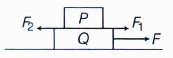
When force F is applied on Q to create common motion in P & Q, the forces created (friction) is shown in the diagram above. F, force will be created on P and F2 force will be created on Q.
Considering forces on Q, we have
\(F-{ F }_{ 2 }(net\quad force)={ m }_{ 2 }\times a={ m }_{ 2 }\times 3\)
Since,
\({ F }_{ 1 }={ F }_{ 2 }={ \mu }_{ 1 }{ m }_{ 1 }g\)
\(\\ F-{ \mu }_{ k }{ m }_{ 2 }g={ m }_{ 2 }\times 3\)
\(\\ F={ \mu }_{ k }{ m }_{ 2 }g+{ m }_{ 2 }\times 3=\frac { 3 }{ g } \times 4\times g+5\times 3=12+15=27N\)
As this force moves both the blocks together on a smooth table, so the acceleration produced is
\(a=\frac { F }{ { m }_{ 1 }+{ m }_{ 2 } } =\frac { 27 }{ 4+5 } =3m/s\)
20.
Given, mass of the particle (m) = 500 g = 0.5 kg
x-t graph of the particle is a straight line.
Hence, particle is moving with a uniform velocity along x-axis, i. e. its acceleration along x-axis is zero and hence, force acting along x-axis is zero.
y- t graph of particle is a parabola. Therefore, particle is in accelerated motion along y-axis.
At t = 0, uy= 0
Along y-axis, at t = 2s, y =4m
Using equation of motion,
\(y={ u }_{ y }t+\frac { 1 }{ 2 } { a }_{ y }{ t }^{ 2 }\)
\(\\ 4=0\times 2+\frac { 1 }{ 2 } \times { a }_{ y }\times { (2) }^{ 2 }\)
\(\\ { a }_{ y }=2m/{ s }^{ 2 }\)
Force acting y-axis (fy) = may
\(0.5\times 2=1.0N\) (along y-axis)
21.
Here, v = 27 kmh-1 = 27\(\times \)(1000 m) \(\times \)(60\(\times \)60 s)-1 = 7.5 ms-1, r = 80 m
Centripetal acceleration, ac=\(\frac { { v }^{ 2 } }{ r } =\frac { { (7.5) }^{ 2 } }{ 80 } \) = 0.7 ms-2
Let the cyclist applies the brakes at the point P of the circular turn, then tangential acceleration aT will act opposite to velocity.
Acceleration along the tangent, aT = 0.5 ms-2
Angle between both the accelerations is \(90°\)
Therefore, the magnitude of resultant acceleration \(a=\sqrt { { a }_{ C }^{ 2 }+{ a }_{ T }^{ 2 } } =\sqrt { { (0.7) }^{ 2 }+{ (0.5) }^{ 2 } } \)
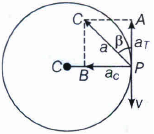
Let the resultant acceleration make an angle \(\beta \) with the tangent i. e. the direction of net acceleration of the cyclist then, \(\tan { \beta } =\frac { { a }_{ C } }{ { a }_{ T } } =\frac { 0.7 }{ 0.5 } \) = 1.4 or \(\beta =54°28\prime \)
22.
The number of strands of hair on our head
If we assume a uniform distribution of strands of hair on head then, the number of strands of hair
= Area of the head/Area of cross-section of hair
The thickness of a strand of hair is measured by an appropriate instrument, if it is obtained
d = 5 x 10-5 = 5 x 10⁻³ cm
Then, area of cross-section of human hair
\(=\pi \left( \frac { d }{ 2 } \right) ^{ 2 }=\frac { \pi d^{ 2 } }{ 4 } \)
\(\\ =\frac { 3.14\times (5\times 10^{ -3 })^{ 2 } }{ 4 } =\frac { 3.14\times 25 }{ 4 } \times 10^{ -6 }cm^{ 2 }\)
Average radius of human head (r)=8 cm
\(\because \) Area of human head \(=\pi r^{ 2 }=3.14\times (8)^{ 2 }\)
3.14 x 64 cm2
\(\therefore \)The number of strands of hair \(=\frac { 3.14\times 64 }{ 3.14\times \frac { 25 }{ 4 } \times 10^{ -6 } } \)
\(\approx 10\times 10^{ 6 }=10^{ 7 }\)
23.
(i) Mass vaccination is good as, it is used to make the socity free from the diseases like small pox.
(ii) Television for eradication of illiteracy and for mass communication of news and ideas is good as, it is a medium which is easily within the reach of common man and also they are very habitual to it.
(iii) Prenatal sex determination is bad because people are misusing it. Some of the people after determination of sex of child, think to abort. They do it especially with girl child.
(iv) Computer for increase in work efficiency is good as using the computer, a man can do much more work with greater efficiency and accuracy.
(v) Putting artificial satellite into orbits around the Earth is good for development as these satellites serve many purpose like remote sensing, weather foresting.
(vi) Development of nuclear weapons is bad as they can be used in mass destruction.
(vii) Development of new and powerful tool of chemical and biological warfare are bad, as they can also be used for mass destruction.
(viii) Purification of water for drinking purpose is good as we can save ourself from the diseases which we can have due to drinking of the water.
(ix) Plastic surgery is good as with the help of it a man or women can remove the skin defects occurring due to accident or some other reasons. It has some bad effects too but they are not very considerable.
(x) Cloning is good as far as animals are concerned. With the help of it, we can develop some species of animals which can be used to serve some specific purpose. But it is not good for human beings.
24.
We know, when the lift accelerates upward, the reaction R] on the base is given by
R1 = Mg + Ma = M (g + a)
⇒ R1 = 60 (9.8 + 2) = 60 x 11.8 = 708 N.
When the lift accelerates downward with acceleration a, the reaction R2 on the base given by
R2 = Mg - Ma = M (g - a)
⇒ R2 = 60 (9.8 - 2) = 60 x 7.8 = 468 N
Therefore, R1 > R2.
25.
Yes, e.g., circular motion is periodic but not oscillatory.
26.
No, since torque cannot be applied.
27.
This is because sound is transmitted both through air and medium.
28.
As the energy is recoverable therefore the force is conservative force.
29.
Thermal conductivity, electrical conductivity and compressibility.
30.
Parsec is bigger unit than light year (1 parsec = 3.26 light year).
31.
68.25 K
32.
Yes, it is possible to describe the difference of length to remain constant. So, the change in length of each rod must br equal at all temperature. Let Lb and Ls be the length of the brass and the steel rod \(\alpha _{ b }\)and \(\alpha _{ s }\)be the coefficients of linear expansion of the two metals. Let there is change in temperature be \(\triangle T\)
Then \(\alpha _{ b }L_{ b }\triangle T=\alpha _{ s }L_{ s }\triangle T\)
or \(\quad \alpha _{ b }L_{ b }=\alpha _{ s }L_{ s }\quad \quad \Rightarrow \quad L_{ b }/L_{ s }=\alpha _{ s }/\alpha _{ b }\)
Hence, the length of the rods must be in the inverse ratio of the coefficient of linear expansion of their materials.
33.
Given, depth of ocean (h) = 3km = 3000m
Density of water\((\rho )\) = \({ 10 }^{ 3 }kg/m^{ 3 }\)
Pressure exerted by water column
\(p=h\rho g=3000\times 10^{ 3 }9.8\)
\(\\=29.4\times 10^{ 6 }Pa=2.94\times 10^{ 7 }Pa\)
Maxim stress which can be withstand by the vertical off-shore structure = \({ 10 }^{ 9 }Pa\)
As, \({ 10 }^{ 9 }Pa>2.9\times { 10 }^{ 7 }Pa\)
Therefore, the vertical structure is suitable for putting up in top of an oil well in the ocean.
34.
The safety of a person depends upon the momentum with which the person hits the planet. Since, the mass of the person is constant, therefore the maximum velocity v is the limiting factor.
35.
We infer that we should avoid junk food and do physical work instead of depending on machines.
36.
Here, actual path length travelled, s = 23 km; Displacement = 10 km;
Time taken, t = 28 min = \(\frac{28}{60} h\)
(a) Average speed of taxi = \(\frac{\text { actual path length }}{\text { time taken }}=\frac{23}{\frac{28}{60}} k \frac{m}{h}=49.3 \mathrm{~km} / \mathrm{h}\)
(b) Magnitude of average velocity = \(=\frac{\text { displacement }}{\text { time taken }}=\frac{10}{\frac{28}{60}} \mathrm{~km} / \mathrm{h}=21.4 \mathrm{~km} / \mathrm{h}\)
The average speed is not equal to the magnitude of average velocity. The two are equal for the motion of taxi along a straight path in one direction.
37.
143.4
38.
Given v = krt
Since velocity changes with time, the motion in circular path involves tangential acceleration.
So it is a non-uniform circular motion.
\(a_r={v^2\over r}=k^2 \ rt^2\)
or \(a_k={dv\over dt}=kr\)
Net acceleration = an =\(a_n=\sqrt{a^2_r+a^2_t}\)
\(=\sqrt{(k^2rt^2)^2+(kr)^2}=kr\sqrt{1+k^2t^4}\)
39.
The entire structure of the kinetic theory of gases is based on the following assumptions which were first stated by Classius.
1. A gas consists of a very large number of molecules (of the order of Avogadro's number, 1023), which are perfect elastic spheres. They are identical in all respects for a given gas and are different for different gases.
2. The molecules of a gas are in a state of incessant random motion. They move in all directions with different speeds, (of the order of 500 m/s) and obey Newton's laws of motion.
3. The size of the gas molecules is very small as compared to the distance between them. If typical size of a molecule is 2 \(\dot { A } \) .average distance between the molecules is \(\ge \)20 A. Hence volume occupied by the molecules is negligible in comparison to the volume of the gas.
4. The molecules do not exert any force of attraction or repulsion on each other, except during collision.
5. The collisions of the molecules with themselves and with the walls of the vessel are perfectly elastic. As such the momentum and the kinetic energy of the molecules are conserved during collisions, though their velocities change.
6. There is no concentration of the molecules at any point inside the container i.e., molecular density is uniform throughout the gas.
7. A molecule moves along a straight line between two successive collisions and the average straight distance covered between two successive collisions is called the mean free path of the molecules
8. The collisions are almost instantaneous, i.e., the time of collision of two molecules is negligible as compared to time interval between two successive collisions.
Numerical:
We know that
\(P=\frac { 1 }{ 3 } \rho { v }^{ 2 }\)
\(\\ \therefore { v }_{ rms }=\sqrt { ({ v }^{ 2 }) } =\left( \frac { 3p }{ \rho } \right) \)
Given that P = 1,0 x 10⁵ newton / meter2 and
\(\rho =1.98\ kg/meter^{ 3 }\)
\(\\ \therefore \ { v }_{ rms }=\sqrt { \left[ \left\{ \frac { 3\times (1.0\times { 10 }^{ 5 } }{ 1.98 } \right\} \right] } =389\ meter/sec\)
From kinetic theory of gases, the root mean square speed is directly proportional to the square root of absolute temperature
\({ v }_{ rms }\propto \sqrt { T } \)
\(\\ \therefore \ \frac { { (v }_{ rms })_{ 30 } }{ { (v }_{ rms })_{ 0 } } =\sqrt { \left[ \left( \frac { 273+30 }{ 273+0 } \right) \right] } =\sqrt { \left[ \left( \frac { 303 }{ 273 } \right) \right] } =1.053\)
\(\\ or\ { (v }_{ rms })_{ 30 }={ (v }_{ rms })_{ 0 }\times 1.053\)
\(\\ =389\times 1.053=410\ meter/sec\)
40.
The linear speed at 3 seconds is
v = 2 x 3 = 6 m/s
The radial acceleration at 3 seconds
\(={v^2\over r}={6\times6\over 0.2}=180 m/s^2\)
The tangential acceleration is given by
\({dv\over dt}=2, Since \ v=2t\)
\(\therefore\) tangential acceleration is 2 m/s2.
Total acceleration \(=\sqrt{a^2_r+a_t^2}=\sqrt{180^2+2^2}=\sqrt{32400+4}\)
\(=\sqrt{32404} ms^{-2}\)
41.
Here, Young's modulus, \(\Upsilon \) = 2 x 10¹¹Nm-2
Area of cross-section, A = 5 x 10⁻⁵ m2
Let the initial length of wire be L. Then, increase in length of wire,
ΔL= L
Now, \(\Upsilon \)=\(\frac { F\times L }{ A\times \triangle L } \)
∴ F = \(\frac { \Upsilon \times A\times \triangle L }{ L } \)
⇒ F = \(\frac { 2\times 10^{ 11 }\times 5\times 10^{ -5 }\times L }{ L } \)
or F = 107 N.
42.
\(\theta =2000"\)
\(\\ =\frac { 2000 }{ 3600 } \times \frac { \pi }{ 180 } rad\)
\(d=1.496\times { 10 }^{ 11 }\)
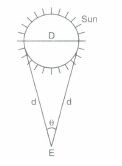
From the figure,
\(\theta =\frac { D }{ d } \)
\(\\ D=\theta d\)
= 9.7 x 10-3 x 1.496 x 1011
= 1.45 x 10⁹ m
43.
Total energy at B = kinetic energy + potential energy
= 0 + mgh
= 2 \(\times\) 9.8 \(\times\)10
= 196 J
As it descends half the height, it loses potential energy which is given by
\(=mg\frac { h }{ 2 } \)
\(=\frac { 1 }{ 2 } mgh=98\ J\)
\(\therefore\) its potential energy at C = (196 - 98) = 98 J
The loss of potential energy = gain in kinetic energy
= 196 - 98
= 98 J
But \(K.E.=\frac { 1 }{ 2 } { mv }^{ 2 }\)
\(\therefore \quad \frac { 1 }{ 2 } \times 2\times { v }^{ 2 }=98\)
\(\Rightarrow \ { v }^{ 2 }=98\ or\ v=7\sqrt { 2 } m/s\)
44.
An extremely thin layer of liquid can be considered as the collection of large number of hemispherical drops. In case of a spherical drop, the excess of pressure = \(\frac{2T}{r}\) But in case of thin layer of liquid, which is a combination of hemispherical drops, the excess pressure is \(P=\frac{T}{r},\) where \(r=\frac{d}{2}\)
Therefore,
\(P=\frac{T}{\frac{d}{2}}=\frac{2T}{d}\)
Force due to surface tension pushing the two plates together is
\(F=P\times A=\frac{2TA}{d}\)
45.
Many phenomena at microscopic level are not explained by classical theory. So quantum theory is needed, e.g., photoelectric effect, interaction among elementary particles.
46.
Given, h = 300m, g = 9.8m/s2 , v = 340ms-1
t1 = time taken by stone to strike the water surface
\(t_{ 1 }=\sqrt { \frac { 2h }{ g } } =\sqrt { \frac { 300 }{ 49 } } =7.82s\left( as\quad h=0+\frac { 1 }{ 2 } gt^{ 2 }_{ 1 } \right) \)
t2 = time taken by the splash's sound to reach top of the tower
\(t_{ 2 }=\frac { h }{ v } =\frac { 300 }{ 340 } =0.882\quad \left[ v=\frac { h }{ t_{ 2 } } \right] \)
Total time, t = time to hear splash of sound
= t1 + t2 =7.82 + 0.882
= 8.702
47.
(i)\(\therefore \) process is adiabatic
\(\therefore \) \(\Delta \)Q = 0
Work done on the gas,\(\Delta \)W = -500J
According to the first law of thermodynamics.
\(\Delta \)Q = \(\Delta \)U +\(\Delta \)W \(\Rightarrow \) \(\Delta \)U = -\(\Delta \)W = 500J
(ii) This is because heat absorbed by a substance (coolant) is directly proportional to the specific heat of the substance.
(iii) This is because in a harbour town, the relative humidity is more than in a desert town. Hence, the climate of a harbour town is without extremes of hot and cold.
48.
As the brass scale of a barometer gives correct reading at T1 = 00 C , hence at temperature T2 = 270 C., the scale will expand and will not give correct reading
In such, true value
= Observed scale reading x\((1+\alpha \triangle T)\)
True pressure = 75.00 cm x [1 + 2.0 x 10-5 x (27 - 0)]
= 75 x (1 + 2.0 x 10-5 x 27]
= 75.00(1 + 54 x 10-5) cm = 75.04 cm
49.
(i) According to law of conservation of angular momentum.L = mvr = constant, therefore the comet moves faster when it is close to the sun and moves slower when it is father away from the sun. Therefore, the speed of the comet does not remain constant
(ii) As the linear speed varies, the angular speed also varies.Therefore, angular speed of the comet does not remain constant
(iii) As no external torque is acting on the comet, therefore, according to law of conservation of angular momentum, the angular momentum of the comet remain constant
(iv) Kinetic energy of the comet = \(\frac { 1 }{ 2 } { mv }^{ 2 }\)
As the linear of the comet changes, its kinetic energy also changes.Therefore, its KE does not remain constant
(v) Potential energy of the comet changes as its kinetic energy changes.
(vi) Only angular momentum and total energy of a comet remain constant throughout its orbit.
50.
Let t be the time taken by the ball to reach the highest point where height from ground be s.
Taking vertical upward motion of the ball, we have u =- 29.4ms-, a = 9.8ms-, v = 0, s = S,t = ?
As, v2-u2 = 2 as
0 -(-29.4)2 = 2 x 9.8 x S
or \(S=\frac { -{ (29.4) }^{ 2 } }{ 2\times 9.8 } =-44.1m\)
Here, negative sign shows that the distance is covered in upward direction.
As, v = u + at
\(\therefore \quad 0=-29.4+9.8\times t\quad or\quad t=\frac { 29.4 }{ 9.8 } =3s\)
It means time of ascent = 3s
When an object moves under the effect of gravity alone, the time of ascent is always equal to the time of descent.
Therefore, total time after which the ball returns to the player's hand = 3 + 3 = 6s.
51.
(b)
5\(\sqrt{3}\)
52.
(c)
the kinetic energy of a hydrogen molecule
53.
(c)
\(\frac { 3 }{ 2 } { MR }^{ 2 }\)
54.
(a)
parallel to time-axis
55.
(d)
[MLT-3]
56.
(a)
zero
57.
(d)
4
58.
(b)
purely kinetic
59.
(d)
pressure
60.
(c)
3.92 m s-2
61.
(a)
1
62.
(a)
going up with uniform speed
63.
(a)
127°C
64.
(a)
10-15 m

11th Standard CBSE Syllabus & Materials
11th Standard CBSE
CBSE 11th Business Studies Forms of Business Organisation Sample Question Papers Study Material - QB365 Set A
NEW11th Standard CBSE
CBSE 11th Business Studies Business, Trade and Commerce Sample Question Papers Study Material - QB365 Set A
NEW11th Standard CBSE
CBSE 11th Physics Waves Sample Question Papers Study Material - QB365 Set A
NEW11th Standard CBSE
CBSE 11th Physics Kinetic Theory Sample Question Papers Study Material - QB365 Set A



CBSE 11th Standard CBSE Subjects
CBSE Standards









