
 100% FREE ACCESS
11th Standard CBSE Syllabus & Materials
11th Standard CBSE
CBSE 11th Economics PART-A - Presentation of Data - New Sample Question Papers Study Material - QB365 Set A
NEW11th Standard CBSE
CBSE 11th Economics PART-A - Organisation of Data - New Sample Question Papers Study Material - QB365 Set A
NEW11th Standard CBSE
CBSE 11th Economics PART-A - Collection of Data - New Sample Question Papers Study Material - QB365 Set A
NEW11th Standard CBSE
CBSE 11th Economics PART-A - Introduction to Economics and Statistics - New Sample Question Papers Study Material - QB365 Set A
NEW11th Standard CBSE
CBSE 11th Business Studies International Trade Sample Question Papers Study Material - QB365 Set A
NEW11th Standard CBSE
CBSE 11th Business Studies Evolution and Fundamentals of Business Sample Question Papers Study Material - QB365 Set A

Published on: 05/03/2020
11th Standard CBSE Physics Public Exam Sample Question 2020
Download CBSE Class 11th Standard CBSE Physics question papers, sample papers, important questions, and previous year solved papers in PDF format. Get free study materials, NCERT solutions, and exam preparation resources for Class 11th Standard CBSE Physics
Questions + Answers key
Take MCQ Physics Test
1.
Show that for an isolated system the centre of mass moves with a uniform velocity along a straight line path.
2.
Why a hollow shaft is stronger than a solid shaft made from the same and equal amounts of material?
3.
The following equation represents standing wave set up in medium, \(y=4 cos \frac{\pi}{3} sin 40 \ \pi t\) where x and y are in cm and t in sec. Find out the amplitude and the velocity of the two component waves and calculate the distance between adjacent nodes. What is the velocity of a medium particle at x = 3 cm at time \(\frac{1}{8}\) sec?
4.
Calculate
(i) r.m.s. velocity
(ii) mean kinetic energy of one gram molecule of hydrogen at S.T.P. Given density of hydrogen at S. T.P. is 0.09 kg m-3.
5.
The blades of a windmill sweep out a circle of area A. (a) If the wind flows at a velocity v perpendicular to the circle, uhat is the mass of the air passing through it in time t? (b) What is the kinetic energy of the air? (c) Assume that the windmill converts 25% of the wind's energy into electrical energy, and that A = 30 m2, v = 36 km/h and the density of air is 1.2 kg m-3. What is the electrical power produced?
6.
A Carnot engine absorbs 6 x 10⁵ cal at 227 o C. Calculate work done per cycle by the engine if its sink is maintained at 127o C.
7.
The triple points of neon and carbon dioxide are 24.57 K and 216.55 K respectively. Express these temperatures on the Celsius and Fahrenheit scales.
8.
(a) What is the largest average velocity of blood flow in an artery of radius 2 \(\times\) 10- 3m, if the flow must remain laminar?
(b) What is the corresponding flow rate ? (Take viscosity of blood to be 2.084 x 10⁻³ Pa -s)
9.
A saturn year is 29.5 times the earth year. How far is the saturn from the sun if the earth is 1.50 × 10⁸ km away from the sun ?
10.
A helicopter of mass 1000 kg reises with a vertical acceleration of 15m /s2. The crew and the passengers weigh 300 kg. Give the magnitude and direction of the
(i) force on floor by the crew and passengers.
(ii) action of the rotor of the helicopter on the surrounding air
(iii) force on the helicopter due to the surrounding air, take g = 10 m/s2.
11.
In a harbour, wind is blowing at the speed of 72 km/h and the flag on the mast of a boat anchored in the harbour flutters along the N-E direction. If the boat starts moving at a speed of 51 km/h to the North, what is the direction of flag on the mast of the boat?
12.
To what height does the ball rise and after how long does the ball return to the player's hands?(Take g = 9.8ms-2 and neglect air resistance)
13.
Write in about 1000 words, a fiction piece based on your speculation on the science and technology of the twenty second century.
14.
What is the minimum number of coplanar vectors of different magnitudes, which may give zero resultant?
15.
The amplitude of a harmonic oscillator is doubled. How does its energy change?
16.
Which component of a force does not contribute towards torque
17.
A retarding force is applied to stop a motor car. If the speed of the motor car is doubled, how much more distance will it cover before stopping under the same retarding force?
18.
When a source moves at a speed greater than that of sound, will Doppler formula hold? What will happen?
19.
A mass 'm' collides with another mass '2m' and sticks to it. What is the nature of the collision?
20.
How does density of a solid change as it is heated ?
21.
How is compressibility related to bulk modulus?
22.
A sample of an ideal gas in a cylinder is compressed adiabatically to 1/3 rd of its volume. Will the final pressure be more or less titan 3 times the initial pressure
23.
What is unified field theory?
24.
What will be the internal energy of 8g of oxygen at STP?
25.
Two soap bubble of radii 6 cm and 8 cm coalesce to from a single bubble. Find the radius of the new bubble
26.
Determine the speed with which the earth would have to rotate on its axis so that a person on the equator would weigh 3/5th as much as at present. Take the equatorial radius as 6400km.
27.
Centre of gravity of a body on the earth coincides with its centre of mass for a small object and for a large object, it may not. What is the qualiative meaning of small and large in this regards? For which following two of them coincides, a building, a pond, a lake, a mountain.
28.
Rohit and Suresh were going to the market when they spotted aman whi left a black bag in the correct of a stall and ran away.They went near it and heard some ticking sound coming form it. They immediately called police and altered the people nearby. By their alertness, a major tragedy was averted.
(i) What qualities of Rohit and Suresh do you appreciate?
29.
From a school, a group of boys went for a picnic in a village. They went through fields and enjoyed the beauty of nature. While walking, they saw a well which they had never seen in the city. They were very excited and started drawing water from well. They planned to have a competition in which they decide that the who would draw more water would become winner . A villager who was listening to them, went to them and told them about the importance of water. He also explained that they use the water of this for irrigating their fields and also for drinking.
If the two boys raising the bucket, pull it an angle \(\theta \) to each other and each exerts a force of 20N, their effective pull is 30N. What is the angle between their arms?
30.
A scooter is moving along a straight line AB covers a distance of 360 m in 24 s and returns back from B to C and coveres 240 m in 18 s Find the total path length t.avelled by the scooter
31.
How many metric tons are there in teragram?
32.
Write down the number of significant figure in the following.
0.04
33.
A particle located at x = 0 at time t = 0 starts moving along the positive x direction with a velocity v that varies as v = \(\alpha\sqrt{x}\) . How do the displacement, velocity and acceleration of the particle vary with time? What is the average velocity of the particle over the first s metres of its path?
34.
Define radius of gyration and give the physical significance of moment of inertia
35.
What is law of equipartition of energy? Given Avogadro number = 6.02 x 10²³ and Boltzmann's constant = 1.38 x 10⁻²³ joule/(molecule-K). Calculate
(a) the average kinetic energy of translation of an oxygen molecule at 27°C,
(b) the total kinetic energy of an oxygen molecule at 27°C (c) the total kinetic energy in joules of a gram-molecule of oxygen at 27°C.
36.
Wlzat is Calorimetry? State its principle
A copper calorimeter of mass 100 g contains 200 g of a mixture of ice and water. Steam at 1000C under normal pressure is passed into the calorimeter and the temperature of the mixture is allowed to rise to 50°C. If the mass of the calorimeter and its contents is now 330 g, what was the ratio of ice and water in the beginning? Neglect heat losses. Given
Specific heat capacity of copper = 0.42 x 10³ J Kg-1k-1
Specific heat capacity of water = 4.2 x 10³ J Kg-1K-1
Latent heat affusion of ice = 3.36 x 10⁵ J kg-1
Latent heat of condensation of steam = 22.5 x 10⁵ J kg-1
37.
What do you understand by Poisson's ratio? Find the value of Poisson's ratio at which the volume of a wire does not change when the wire is subjected to a tension.
38.
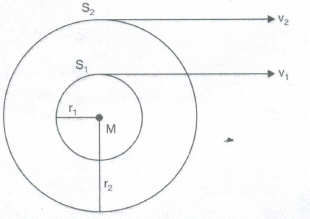
Two satellites S1 and S2 revolve round a planet in coplanar circular orbit in the same sense. Their periods of revolution are one hour and 8 hours respectively. The radius of the orbit of S1 is 104 km. When S2 is close to S1 find
(i) the speed of S2 relative to S1
(ii) the angular speed of S2 as actually observed by an astronaut in S1.
39.
The motion of a particle executing simple harmonic motion is described by the displacement function, x(t) = A cos (ωt + φ ).
If the initial (t = 0) position of the particle is 1 cm and its initial velocity is ω cm/s, what are its amplitude and initial phase angle ? The angular frequency of the particle is π s–1. If instead of the cosine function, we choose the sine function to describe the SHM : x = B sin (ωt + α), what are the amplitude and initial phase of the particle with the above initial conditions.
40.
Explain why
(a) The angle of contact of mercury with glass is obtuse, while that of water with glass is acute.
(b) Water on a clean glass surface tends to spread out while mercury on the same surface tends to form drops. (Put differently, water wets glass while mercury does not.)
(c) Surface tension of a liquid is independent of the area of the surface.
(d) Water with detergent dissolved in it should have small angles of contact.
(e) A drop of liquid under no external forces is always spherical in shape.
41.
A whistle of frequency 540 Hz rotates in a circle of radius 2 m at a linear speed of 30 m/s. What is the lowest and highest frequency heard by an observer along distance away at rest with respect to the centre of circle. Take speed of sound in air as 330 m/s. Can the appartment frequency be ever equal to actual?
42.
A body of mass 0.2 kg and velocity with 1 s after it passes through it, mean position be 6 m/s executes SHM. Find out the total energy and potential energy of the body if time period of the body is 8s during the SHM?
43.
Consider an ideal gas with following distribution of speeds.
| Speed (m/s) | % of molecules |
| 200 | 10 |
| 400 | 20 |
| 600 | 40 |
| 800 | 20 |
| 1000 | 10 |
(i) Calculate Vrms and hence \(T(m=3.0\times { 10 }^{ -26 }kg)\)
(ii) If all the molecules with speed 1000 m/s escape from the system, calculate new Vrms and hence T.
44.
The quantities in the following table represent four different paths for same initial and final states.Find the values a,b,c,d,e,f and g.
| S.NO | Q(J) | W(J) | \(\triangle \)U(J) |
| Path I | -80 | -120 | d |
| Path II | 90 | c | e |
| Path III | a | 40 | f |
| Path IV | b | -40 | g |
45.
Aman went for a weekend trip with his parents and grandparents to a remote village. His grandfather showed him the fields and the crops they grow. As they moved forward, they saw that a bullock cart got struck in wet mud and the driver was not able to push it out by himself. Seeing him in distress, Aman ran to his help and together they pushed it out, but iron rim of the wheel came out.
They tried to put it on the wheel but it was smaller than diameter of wheel. Suddenly, he got an idea. He collected some wood and set them on fire and heated the rim and then rim easily slipped on the wheel. Cartman thanked Aman and moved away.
(i) What values of Aman does the incident show?
(ii) If the diameter of the rim and ring were 5.243 m and 5.231 m respectively at 27 \(^{0}\)C. To what temperature had Aman heated the ring so as to fit the rim of the wheel? Coefficient of linear expansion of iron = 1.20 x 10⁻⁵ K-1
(iii) Which property of solids is used in this phenomenon?
46.
Sahil was going to his friends' house to give him Diwali gift on his motorcycle. He was going at a speed of 60 Km/h. When he saw the red light, he applied the brakes but a car which was behind him, coming at a very high speed, could not stop in time and hit a scooter coming from a side and ran away.
Sahil saw that accident and immediately ran to help the person on scooter. He was bleeding profusely. Sahil stopped an autorikshaw and took the accident victim said that since lot of blood is lost, he had to be given a blood transfusion.
Sahil immediately offered to donate blood and save a life.
(i) What values of Sahil do you appreciate?
(ii) What is the attitude of people towards road accident victim?
(iii) In the blood transfusion, the bottle is set up so that the level of blood is 1.3 m above the needle, which has an internal diameter of 0.36 mm and is 3 cm in length. If the 4.5 cm3 of blood passes through the needle in one minute, calculate the viscosity of blood, the density of blood is 1020 kgm-3
47.
Flying tackle
A man carrying mass M = 125 kg makes a flying tackle at v1 = 4 m/s on a stationary quarterback of mass m =85 kg and his helmet makes solid contact with quarterback's femur.
If area of cross-section of quarterback's femur is 5 x 10⁻⁴ m2, then estimate the shear stress exerted on femur in the collision.
48.
Rajeev was going through Kepler's law of planetary motion. He read that while studying the theory of planetary motion, Kepler established three laws. According to Kepler's second law, the line joining a planet to the sun sweeps out equal areas in equal intervals of time, i.e. the areal velocity of the planet around the sun is constant. This led him to conclude that the linear speed of the planet when closer to the sun is more that its linear speed when away from the sun.
Read the above passage and answer the question.
What values of life do Rajeev learn from Kepler's second law?
49.
Explain why? It is easier to pull a lawn mower than to push it.
50.
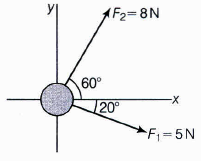
'A hockey puck with a mass of 0.3 kg slides on the 1 N = 105 dyne C1 horizontal frictionless surface of an ice rink. Two forces act on the puck as shown in figure. The force F1 has a magnitude of 5 Nand F2 has a magnitude of 8 N. Determine the acceleration of the puck.
51.
A particle is projected in air at an angle \(\beta \) to a surface which itself is inclined at an angle \(\alpha \) to the horizontal as shown in figure
Find
(i) time of flight
(ii) expression for the range on the plane surface i.e. L and
(iii) the value of \(\beta \) at which range will be maximum.
52.
Which of the following is the most precise device for measuring length :
(a) a vernier callipers with 20 divisions on the sliding scale
(b) a screw gauge of pitch 1 mm and 100 divisions on the circular scale
(c) an optical instrument that can measure length to within a wavelength of light ?
53.
A particle moves on a given line with a constant speed \(\upsilon \). At a certain time it is at a point P on its straight line path. O is fixed point. The value of \(\overrightarrow { OP } \times \overrightarrow { \upsilon } \) is (where y is perpendicular distance from O to given line)
- y\(\upsilon \)\(\hat{k}\)
-2y\(\upsilon \)\(\hat{k}\)
-3y \(\upsilon \)\(\hat{k}\)
none
54.
A man of mass M is standing at the centre of a rotating turn table rotating with an angular velocity w. The man holds two 'dumb bells' of mass M/4 each in each of his two hands. If he stretches his arms to a horizontal position, the turn table acquires a new angular velocity w' where
\(\omega\)' = 2 \(\omega\)
\(\omega\)' =\(\omega\)/2
\(\omega\)' > \(\omega\)
\(\omega\)' < \(\omega\)
55.
Oxygen and hydrogen gases are at the same temperature T. The kinetic energy of an oxygen molecule will be equal to
16 times the kinetic energy of a hydrogen molecule
5 times the kinetic energy of a hydrogen molecule
the kinetic energy of a hydrogen molecule
one-fourth the kinetic energy of a hydrogen molecule
56.
The displacement x of a particle varies with time according to the relation x=\(\frac { a }{ b } \)(1-e-bt). Then
At t =\(\frac { 1 }{ b } \) , the displacement of the particle is nearly (2/3) (a/b).
The particle cannot reach a point at a distance x from its starting position if x> a/ b.
The velocity and acceleration of the particle at t = 0 are a and - ab respectively.
The particle will come back to its starting point as t ⇾∞.
57.
A particle executes simple harmonic motion between x = - A and x = + A. The time taken for it to go from 0 to \(A\over 2\) is T1 and to go from \(A\over 2\) to A is T2. Then
T1 < T2
T1 > T2
T1 = T2
T1 = 2T2
58.
The dimensions of entropy are _____.
M0L-1T0K
M0L-2T0K2
MLT-2K
ML2T-2K-1
59.
A source X of unknown frequency produces 8 beats per second with a source of 250 Hz and 12 beats per second with a source of 270 Hz. The frequency of the source X is
242 Hz
258 Hz
282 Hz
262 Hz
60.
Dimensional formula of stress is same as that of
impulse
strain
force
pressure
61.
If three uniform spheres, each having mass M and radius r, are kept in such a way that each touches the other two, the magnitude of the gravitational force on any sphere due to the other two is
\(\frac{GM^2}{4r^2}\)
\(\frac{2GM^2}{r^2}\)
\(\frac{2GM^2}{4r^2}\)
\(\frac{\sqrt 3GM^2}{4r^2}\)
62.
A cylindrical vessel is filled with water upto height H. A hole is bored in the wall at a depth h from the free surface of water. For maximum range, h is equal to
H/4
H/2
3H/4
H
63.
A particle of mass 5 kg is pulled along a smooth horizontal surface by a horizontal string. The acceleration of the particle is 10 ms-2. The tension in the string is_______.
2 N
50 N
15 N
10 N
64.
A black body is at 727°C. It emits energy at a rate which is proportional to _______.
(1000)4
(1000)2
(727)4
(727)2
65.
Who proposed the wave theory?
Maxwell
Huygens
M. Plank
G.P. Thomson
66.
A body is moving unidirectionally under the influence of a source of constant power. Its displacement in time t is proportional to
t1/2
t
t3/2
t2
1.
Let M be the total mass of a system supposed to be concentrated at the centre of mass whose position vector is" then in the presence of an external force \(\vec { F } \) we have
\(\vec { F } =M\frac { { d }^{ 2 }\vec { r } }{ { dt }^{ 2 } } =M\frac { d }{ dt } \left( \frac { \vec { dr } }{ dt } \right) =M\frac { d }{ dt } ({ \vec { v } }_{ cm })\)
However for an isolated system, force F = 0 and hence, we have
\(M\frac { d }{ dt } ({ \vec { \upsilon } }_{ cm })=0\quad or\frac { d }{ dt } ({ \vec { \upsilon } }_{ cm })or{ \vec { \upsilon } }_{ cm }=a\quad constant\)
It means that for an isolated system the centre of mass moves with a uniform velocity along a straight line path.
2.
The torque required to produce a unit twist in a solid shaft of radius r is given by
\(\tau =\frac { \pi \eta { r }^{ 4 } }{ 2l } \) ....(1)
where η is the ~odulus of rigidity of the material and I is the length of the shaft. The torque required to produce a unit twist in a hollow shaft of inner and outer radii ri and r0 is given by
\({ \tau }^{ ' }=\frac { \pi \eta ({ r }_{ 0 }^{ 4 }-{ r }_{ i }^{ 4 }) }{ 2l } =\frac { \pi \eta ({ r }_{ 0 }^{ 2 }-{ r }_{ i }^{ 4 })({ r }_{ 0 }^{ 2 }+{ r }_{ i }^{ 2 }) }{ 2l } \) .....(2)
Dividing (2) by (I), we get
\(\frac { { \tau }^{ ' } }{ \tau } =\frac { ({ r }_{ 0 }^{ 2 }-{ r }_{ i }^{ 2 })({ r }_{ 0 }^{ 2 }+{ r }_{ i }^{ 2 }) }{ { r }^{ 4 } } \) ......(3)
Since the two shafts are made of the same material and the amounts of material are equal,
∴ \({ \pi r }^{ 2 }l=\pi ({ r }_{ 0 }^{ 2 }-{ r }_{ i }^{ 2 })l\quad \) or r2 = \({ r }_{ 0 }^{ 2 }-{ r }_{ i }^{ 2 }\)
From (3), \(\frac { { \tau }^{ ' } }{ \tau } =\frac { { r }_{ 0 }^{ 2 }+{ r }_{ i }^{ 2 } }{ r^{ 2 } } \) or \(\frac { { \tau }^{ ' } }{ \tau } >1\) or \(\tau '>\tau \).
3.
The given equation of stationary wave is \(y=4 cos \frac{\pi}{3} sin 40 \ \pi t\)
or \(y=2 \times 2 cos \frac{2\pi x}{6} sin \frac{2x(120)t}{6}\) --- (i)
We know that \(y=2a cos \frac{2\pi x}{\lambda} sin \frac{2x vt}{\lambda}\) --- (ii)
By comparing tow equations, we get
a = 2 cm,λ = 6 cm and v = 220 cm /sec.
The component waves are
\(y_{1}= a sin \frac{2\pi}{\lambda}(vt-x)\)
and \(y_{2}= a sin \frac{2\pi}{\lambda}(vt+x)\)
Distance between two adjacent nodes = \(\frac{\lambda}{2}=\frac{6}{2}=3 cm\).
Particle velocity \(\frac{dy}{dt} = 4 cos\frac{\pi}{x}cos(40\pi t).40 \pi\)
\(= 160 \ cos \frac{\pi x}{3} \ cos 40\pi t\)
=\(160 \ \pi \ cos \frac{\pi x}{3} cos (40\pi \times \frac{1}{8}) = 160 \pi \ \ [∵ cos \pi=cos 5\pi = -1]\)
Hence, particle velocity = 160 cm/sec.
4.
Here, \(\rho\) = 0.09 kg m-3
At S.T.P., Pressure P = 1.01 x 10⁵ pa.
According to kinetic theory of gases.
\(p=\frac { 1 }{ 3 } \rho { C }^{ 2 }\quad or\quad C=\sqrt { \frac { 3p }{ \rho } } \)
\(=\sqrt { \frac { 3\times 1.01\times { 10 }^{ 5 } }{ 0.09 } } =1837.5\quad { ms }^{ -1 }\)
Volume occupied by one mole of hydrogen at S.T.P. = 22.4 liters = 22.4 x 10⁻³ m3
\(\therefore \) Mass of hydrogen, M = volume x density
= 22.4 x 10-3 x 0.09
= 2.016 x 10⁻³kg
Average K.E/mole =\(\frac { 1 }{ 2 } \)MC2
=\(\frac { 1 }{ 2 } \) x (2.016 x 10-3) x (1837.5)2
= 3403.4 J
5.
(a) Volume of wind flowing per second = Av
Mass of wind flowing per second = Avp
Mass of air passing in second = Avpt
(b) Kinetic energy of air = \(\frac { 1 }{ 2 } { mv }^{ 2 }=\frac { 1 }{ 2 } (Avpt){ v }^{ 2 }=\frac { 1 }{ 2 } { av }^{ 3 }pt\)
(c) Electrical energy produced = \(\frac { 25 }{ 100 } \times \frac { 1 }{ 2 } { Av }^{ 3 }pt=\frac { { Av }^{ 3 }pt }{ 8 } \)
Electrical power = \(\frac { A{ v }^{ 3 }pt }{ 8t } =\frac { { Av }^{ 3 }p }{ 8 } \)
Now, A = 30 m2, v = 36 kmh-1 = \(36\times \frac { 5 }{ 18 } { ms }^{ -1 }10{ ms }^{ -1 }\)
and p = 1.2 kg ms-1
\(\therefore\) Electrical power = \(\frac { 30\times 10\times 10\times 10\times 1.2 }{ 8 } W=4500\)
W = 4.5 KW.
6.
Here, heat abs or bed \(=\mathrm{Q}_1=6 \times 10^5 \mathrm{cal}\).
Initial temperature \(=\mathrm{T}_1=227^{\circ} \mathrm{C}=227+273=500 \mathrm{~K}\).
Final temperature \(=\mathrm{T}_2=127^{\circ} \mathrm{C}=127+273=400 \mathrm{~K}\).
As, for Carnot engine;
\( \frac{Q_2}{Q_1}=\frac{T_2}{T_1} \)
\(Q_2=Q_1 \frac{T_2}{T_1} \)
\( \mathrm{Q}_2=\frac{400}{500} \times 6 \times 10^5 \)
\( \mathrm{Q}_2=4.8 \times 10^5 \mathrm{cal} \)
\( \mathrm{Q}_2=\text { Final heat emitted } \)
\( \text { As } \mathrm{w}=\mathrm{Q}_1-\mathrm{Q}_2=6 \times 10^5-4.8 \times 10^5 \)
\(=1.2 \times 10^5 \mathrm{cal} \)
\( \text { Work }=\mathrm{w}=1.2 \times 10^5 \times 4.2 \mathrm{~J} \)
\(\text { Dore }=5.04 \times 10^5 \mathrm{~J}
\)
7.
For neon Triple point T = 24.57 K
TC = T(K) - 273.15
= 24.57 - 273.15 = - 248.580C
TF = 9/5TC + 32= 9/5 x (- 248.58) + 32 = -415.440F
For carbon dioxide Triple point, T = 216.55 K
TC = T(K) - 273.15 = 216.55 - 273.15 = -56.60C
TF = 9/5TC + 32 = 9/5x (-56.6) + 32 = 69.880C
8.
(a) Given, radius of artery ( r ) = 2 \(\times\) 10- 3 m
\(\therefore \) Diameter of artery D = 2r = 4 \(\times\) 10-3m
Density of whole blood ( \(\rho\) ) = 1.06 \(\times\) 103 kg / m3
Coefficient of viscosity of blood ( \(\eta\) ) = 2.084 \(\times\)103 Pa - s
For laminar flow, maximum value of Reynold's number
Re = 2000
Critical velocity ( vc ) = \(\frac{R_e\eta}{\rho D} \)
= \(\frac{2000\times2.084\times10^3}{1.06\times10^3\times4\times10^{-3}} \)
= 9.83 \(\times\)105m / s
(b) Flow rate of blood = Volume of blood flowing per second
= Avc
= \(\pi\)r2\(\times\)vc
= 3.14\(\times\)(2\(\times\)10-3)2\(\times\)9.83\(\times\)105
= 12.35 m3/s
9.
According to Kepler's third law of planetary motion,
\({ T }^{ 2 }\ \alpha \ { r }^{ 3 }\)
\(\\ Thus,\ \frac { { T }_{ S }^{ 2 } }{ { T }_{ E }^{ 2 } } =\frac { { r }_{ S }^{ 3 } }{ { r }_{ E }^{ 3 } } \ or \left( \frac { { T }_{ S } }{ { T }_{ E } } \right) ^{ 2 }=\left( \frac { { r }_{ S } }{ { r }_{ E } } \right) ^{ 3 }\)
\(\\ \left( \frac { { r }_{ S } }{ { r }_{ E } } \right) =\left( \frac { { T }_{ S } }{ { T }_{ E } } \right) ^{ 2/3 }\\\)
\( \\ { r }_{ S }=\left( \frac { { T }_{ S } }{ { T }_{ E } } \right) ^{ 2/3 }\times { r }_{ E }\)
\(\\ As,\quad \left( \frac { { T }_{ S } }{ { T }_{ E } } \right) =29.5\)
\(\\ { r }_{ E }=1.5\times 10^{ 8 }km\)
\(\\ { r }_{ S }=(29.5)^{ 2/3 }(1.5\times 10^{ 8 }km)\)
\(=14.3\times 10^{ 8 }km\)
10.
\(\because \) Mass of the helicopter, m1 = 1000 kg
Mass of the crew and the passengers, m2 = 300 kg
Acceleration of the helicopter, a = 15 m/ s2
Acceleration due to gravity, g = 10 m/s2
(i) Let R, be the reaction applied by the floor on the crew and the passengers.
-S.png)
R1- m2g = m2a
or
R1= m2g + m2a = m2(g+a)
= 300(10 + 15) = 7500N(upward direction)
(ii) Action of the rotor of the helicopter on the surrounding air
= ( m1 + m2 ) g + ( m1 + m2 ) a
= ( m1 + m2 ) ( g + a )
= ( 1000 + 300 ) x (10 + 15 )
= 1300 x 25 = 32500 N
Force (action ) of the rotor of the helicopter on the surrounding air = 32500 N (downward)
11.
When the boat is anchored in the harbour, the flag flutters along the N-E direction. It shows that the velocity of wind is along the North-East direction. When the boat starts moving, the flag will flutter along the direction of relative velocity of wind W.r.t. boat. Let vwb be the relative velocity of wind W.r.t.boat and \(\beta \) be the angle between vwb and vw.
Then, vwb= vw + (-vb)
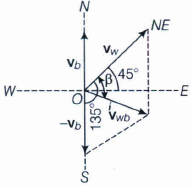
Here, |vw| = 72 km/h and |-vb| = 15 km/h
Angle between vw and - vb is \(135°\) i.e. \(\theta =135°\) Then,
\(\tan { \beta } =\frac { 51\sin { 135° } }{ 72+51\cos { 135° } } =\frac { 51\sin { 45° } }{ 72+51(-\cos { 45°) } } \)
=\(\frac { 51\times (1/\sqrt { 2 } ) }{ 72-51(1/\sqrt { 2 } ) } \) = 1.0039
\(\therefore \) \(\beta =\tan ^{ -1 }{ (1.0039)=45.1° } \)
Angle w.r.t. East direction = \(45.1°\)-\(45°\)=\(0.1°\)
It means the flag will flutter almost due East.
12.
Let t be the time taken by the ball to reach the highest point where height from ground be s.
Taking vertical upward motion of the ball, we have u =- 29.4ms-, a = 9.8ms-, v = 0, s = S,t = ?
As, v2-u2 = 2 as
0 -(-29.4)2 = 2 x 9.8 x S
or \(S=\frac { -{ (29.4) }^{ 2 } }{ 2\times 9.8 } =-44.1m\)
Here, negative sign shows that the distance is covered in upward direction.
As, v = u + at
\(\therefore \quad 0=-29.4+9.8\times t\quad or\quad t=\frac { 29.4 }{ 9.8 } =3s\)
It means time of ascent = 3s
When an object moves under the effect of gravity alone, the time of ascent is always equal to the time of descent.
Therefore, total time after which the ball returns to the player's hand = 3 + 3 = 6s.
13.
Imagine you along with your friends are in a spaceship which is moving towards Mars. The body of the speceship is made of a specially designed matter which become more harder as its temperature increases. nuclear power plants in spaceship.
Two of them work alternatively and third is for emergency. The speed of the spaceship is very high and all of you are very happy. The energy produced in power plants are converted into electric energy which runs the motors of the spaceship.
You along with your friends reach safely on Mars, collects data, takes photographs and then returns to the Earth. In return journey is working and due to overheating. its efficiency is decreasing continuously.
You and your friends try to reduce the temperature of the plant and try to repair the fuse of the other power plants.
Finally, fuse of one other plant is repaired and start to work before the first plant crosses the danger limit of an excess of temperature. Finally, you and your friends return safely on Earth.
14.
Three. Their resultant will be zero provided they can be represented by three sides of a triangle taken in order.
15.
As E ∝ A2, the energy of harmonic oscillator will became 4 times, its original value when its amplitude is doubled.
16.
The radial component of a force does not contribute towards torque.
17.
Since, S \(\alpha\) v2, therefore motor car will cover a distance four times longer than before.
18.
No, as it is valid only when vs < v . When vs >v ,shock waves are produced.
19.
Whenever a mass collides and gets stuck to the other mass, the collision is said to be inelastic.
20.
Density of a solid decreases as it is heated (i.e., as its temperature rises) as per following relation: p / = p(1 - \(\gamma \).\(\triangle\).T), where p = density of given solid at temperature T and p' = density of given solid at temperature (T + \(\triangle\).T).
21.
Compressibility is defined as the reciprocal of bulk modulus (B) i.e.,
K = \(\frac{1}{B}\).
22.
Change in pressure will be more than 3 times the initial pressure.
23.
The theory with which scientists try to unify all forces is called unified field theory.
24.
Oxygen is a diatomic gas.
Number of moles of O2 gas
\(=\frac { Atomic\ wt. }{ Molecular\ wt. } =\frac { 8 }{ 32 } \)
\(\\ =\frac { 1 }{ 4 } =0.25\)
\(\\ \therefore \ Energy\ associated\ with\ 1\ mole\ of\ oxygen\)
\(\\ U=\frac { 5 }{ 2 } RT\)
\(\\ \therefore \ Internal\ enreyg\ of\ 8g\ of\ oxygen=0.25\times \frac { 5 }{ 2 } \times 8.31\times 273=1417.9J\)
25.
Surface energy of first soap bubble
= Surface tension \(\times\) Surface area
\(=2\times 4\pi { R }_{ 1 }^{ 2 }S=8\pi { R }_{ 1 }^{ 2 }S\)
Surface energy of second soap bubble\(=8\pi { R }_{ 1 }^{ 2 }S\)
Let the radius of the new soap bubble is R SO, the surface energy of new bubble \(=8\pi { R }_{ 1 }^{ 2 }S\)
By the law of conservation of energy
\(8\pi { R }^{ 2 }S=8\pi { R }_{ 1 }^{ 2 }S+8\pi { R }_{ 1 }^{ 2 }S\)
\(\\ { R }^{ 2 }={ R }_{ 1 }^{ 2 }+{ R }_{ 2 }^{ 2 }=36+64\)
\(\\ { R }^{ 2 }=100{ cm }^{ 2 }\Rightarrow R=10\ cm\)
26.
Acceleration due to gravity at the equator is
\(g_{ e }=g-R\omega ^{ 2 }\)
\(\\ mg_{ e }=mg-mR\omega ^{ 2 }\ or\)
\(\\ \frac { 3 }{ 5 } mg=mg-mR\omega ^{ 2 }\ \left[ \because mg_{ e }=\frac { 3 }{ 5 } mg \right] \)
\(\\ \therefore \omega =\sqrt { \frac { 2g }{ 5R } } ={ \sqrt { \frac { 2\times 9.8 }{ 5\times 6400\times 10^{ 3 } } } =7.8\times 10^{ -4 } }rad/s\)
27.
Centre of mass and centre of gravity are two different concepts. But if g goes not vary from one part of body to other than CG and CM coincides.
So, when vertical height of the object is very small compared to a radius of earth, we call object small, otherwise, we call it extended. In above context, building and pond are small objects and a deep lake and a mountain are large extend objects.
28.
Rohit and suresh were very alert and courageous. They also have presence of mind.
29.
Given, A = 20 N, B = 20 N, R = 30 N, \(\theta \) = ?
\(R=\sqrt { { A }^{ 2 }+{ B }^{ 2 }+2AB\cos { \theta } }\)
\( \\ 30=\sqrt { { 2 }0^{ 2 }+{ 2 }0^{ 2 }+2\times 20\times 20\cos { \theta } } \)
\(\\ \cos { \theta } =\frac { { 30 }^{ 2 }-{ 2 }0^{ 2 }-{ 2 }0^{ 2 } }{ 2\times { 2 }0^{ 2 } } =0.125\)
\( \Rightarrow \quad \theta ={ 82 }^{ 0 }{ 49 }^{ ' }\)
30.
From the above question, we draw the following figure.
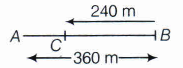
Total path length = AB + BC = 360 + 240 = 600 m
31.
In 1 teragram = 1012g
In 1 metric ton = 103kg = 103 x 103 = 106g
Number of metric tons are in teragram
\(\frac { { 10 }^{ 12 }g }{ { 10 }^{ 6 }g } ={ 10 }^{ 6 }\)
32.
One
33.
v = \(\frac{dx}{dt}\)
Since v = \(\alpha\sqrt{x}\)
we have \( \frac{dx}{dt}=\alpha\sqrt{x} \) or \(\frac{dx}{\sqrt{x}}=\alpha dt\)
Intefrating from \( t=0(x=0) to \ t=t(x=x)\)
we have \( \overset { x }{ \underset { 0 }{ \int } } { x }^{ -1/2 }dx=\alpha \overset { t }{ \underset { 0 }{ \int } } dt\)
∴ \({ \left| \frac { { x }^{ 1/2 } }{ 1/2 } \right| }_{ 0 }^{ x }=\alpha t\)
or \( x = \frac{\alpha^2t^2}{4}\)
The time dependence of the velocity is obtained by differentiating both sides of this relation w.r.t. time t. Thus
\(v=\frac{dv}{dt}=\frac{\alpha.2t}{4}=\frac{\alpha^2}{2}t\)
The velocity x of the particle is thus increasing in direct proportion to time.
Similarly, the time dependence of acceleration is obtained by differentiating both sides of this relation w.r.t. 't', Thus
\( a=\frac{dv}{dt}=\frac{\alpha^2}{2}\)
The particle is thus moving with a constant acceleration.
To find the average velocity over the first s metre, we assume that the time taken to cover this distance is T. Using
\( x=\frac{\alpha^2t^2}{4}\)
we get s= \(\frac{\alpha^2T^2}{4} or \ T=\frac{2\sqrt{s}}{\alpha}\)
The average velocity vav \((=s/T)\) is, therefore
\( v_{av}=(\frac{\alpha}{2}\sqrt{s}) \).
34.
The radius of gyration of a body about the axis of rotation of a body is the point at which the weighed mass of the body acts. It is also equal to the square root of moment of inertia of all particles of the body about the axis of rotation divided by the total mass of the body i.e.,
\(k=\sqrt {\frac{m_1r_1^2+m_2r_2^2+m_3r_3^2....+m_nr_n^2}{m_1+m_2+m_3...+m_n}}\)
\(\sqrt {\frac{\sum mR}{M}}=\sqrt {\frac{I}{M}}\)
Its dimensions are those of length and its is measured in metre in SI units. The moment of a body is a quantity which comes in rotational motion and plays same role in rotational motion as does mas in translational motion. Thus a body continues of rotate or be at rest in the absence of any external torque. This is similar to the law of inertia in translational motion. This aspect is used in over creasing the dead points in the engines and crankshafts. Similarly, the kinetic energy of rotation is dependent on the moment of inertia of the body in the same manner the kinetic energy of translation of motion depends, on the mass of the body. For a given angular velocity (\(\omega\)) kinetic energy of rotation \(\propto\) I. If equal torques are applied I1 and I2 the their angular acceleration are inversely proportional to the moments of inertia of the bodies.
\(\frac{I_1\alpha_1}{I_2\alpha_2}=1\)
\(\frac{\alpha_1}{\alpha_2}=\frac{I_2}{I_1}\)
\(\alpha\propto\frac{1}{I}\)
Similarly if two bodies have same angular acceleration, then the moments of inertia are directly proportional to the torque applied on then.
\(\frac{\tau_1}{\tau_2}=\frac{I_1}{I_2}\ or \alpha_1=\alpha_2\)
The linear momentum of a body depends on its mass and velocity. If two bodies have same velocity, then their moments are proportional to their masses i.e.,
\(\frac{\rho_1}{\rho_2}=\frac{m_1}{m_2}\)
Similarly for angular momentum
\(\frac{L_1}{L_2}=\frac{I_1}{I_2}\)
Thus, moment of inertia of a body plays same role in the rotational motion as does mass in translational motion.
The moment of inertia determines the amount of torque to be applied to produce desired angular acceleration.
35.
Given, Avogadro number N = 6.02 x 10²³
Boltzmann's constant k = 1.38 x 10⁻²³ joule/molecule K
Kelvin temperature T = 27 + 273 = 300 K.
(a) An oxygen molecule has three degrees of freedom with respect of translation. Hence the average kinetic energy of translation of molecule
\(3\times \frac { 1 }{ 2 } kT=\frac { 3 }{ 2 } kT\)
(\(\because \) Average kinetic energy of a gas molecule per degree of freedom is \(\frac { 1 }{ 2 } \) kT.)
\(=3\times \frac { 1 }{ 2 } (1.38\times { 10 }^{ -23 })\times 300\)
= 10.35 x 10⁻²¹ joule/molecule
One gm molecule of oxygen contains N molecules. Hence the total kinetic energy of 1 gm molecule of the gas
\(=N\times \frac { 5 }{ 2 } kT\)
= (6.02 x 1023) x 10.35 x 10-21
= 6231 joule/mole
36.
For calorimetry and its principle, see text
Heat is lost by stearn in getting condensed and gained by water, ice and the calorimeter.
Let the calorimeter originally contain x grams of ice and (200- x) grams of water , we then have
Heat gained by calorimeter = \(\frac { 100 }{ 1000 } \) x 0.42 x 103 x (50 - 0)
= 2100 J
Heat gained by ice = \(\frac { x }{ 1000 } \) {3.36 x 10⁵ + 4.2x10³ (50 - 0) }
= x {336 + 210} = 546 x J
Heat gained by water =\(\frac { \left( 200-x \right) }{ 1000 } \) x 4.2 103 x (50 - 0)
= (42000 - 210 x) J
Heat lost by stearn = \(\frac { (330-200-100) }{ 1000 } \) x [22.5 x 10⁵ + 4.2 x 103 x (100 - 50)]
= 30 (2250 + 210) = 73800 J
Heat gained = Heat lost
546 x + 2100 + 42000 - 210x = 73800
Mass of ice in the original mixture = 88.4 g
Mass of water in the original mixture = 200 - 88.4 = 111.6 g
Ratio of ice present to water present = 88.4 : 111.6
= 1 : 1.26
37.
For Poisson's ratio, see text.
Poisson's ratio
where r is the radius of the wire and l its length.
Volume of the wire before expansion V1
Volume of the wire after expansion
V2 = \(\pi\)(r-Δr)2(l+Δl)
If the volume is to remain unchanged during expansion, we require that
V1 = V2, i.e.,
\(\pi\)r2l = \(\pi\)[r2-2r Δr + (Δr)2](l+Δl)
= \(\pi\)r2(l+Δl)-2\(\pi\)r Δrl-2r Δr Δl \(\pi\) + (Δr)2(l+Δl)\(\pi\)
or 2\(\pi\)r Δrl =\(\pi\)r2 Δl + terms containing the product of Δr and Δl, which can be neglected.
Hence \(\frac { \triangle r/r }{ \triangle l/l } =\frac { 1 }{ 2 } \)
or σ = 0.5
Thus the volume of the wire does not change if the Poisson's ratio of the material of the wire is 0.5.
38.
The centripetal force required by a satellite of mass m revolving in a circular orbit of radius r with a speed v is supplied by the gravitational force extended by the planet of mass M on the satellite. Thus
\(\frac{Mv^2}{r}=G\frac{Mm}{r^2}\)
\(v=\sqrt {\frac{Gm}{r}}\)
The period of revolution of the satellite is
\(T=\frac{2\pi r}{v}=2\pi\sqrt {\frac{r^3}{GM}}\)
For satellite S1 let T=T1,r=r1,v=v1
Then \(T_1^2=\frac{4\pi^2r_1^3}{GM}\)
For satellite S2 , \(T_2^2=\frac{4\pi^2r_2^2}{GM}\therefore \frac{T_1^2}{T_2^2}=\frac{r_1^3}{r_2^3}\)
\(r_2=r_1(\frac{T_2}{T_1})^{\frac{2}{3}}\)
\(=10^4(\frac{8}{1})^{\frac{2}{3}}\)
\(=4\times10^4\ km\)
\(v_1=\frac{2\pi r_1}{T_1}\)
\(=\frac{2\pi\times10^4}{1}=2\pi\times10^4\ km/hr\)
\(v_2=\frac{2\pi r_2}{T_2}\)
\(=\frac{2\pi\times4\times10^4}{8}\)
\(=\pi\times10^4\ km/hour\)
Velocity of S2 relative to \(S_1=v_2-c_1=\theta_r(say)\)
\(v_r=(\pi\times10^4-2\pi\times10^4)\ km/hr\)
\(=-\pi\times10^4\ km/hour\)
Let r2-r1 = r
The angular velocity of S2 relative to S1 is given by
\(\omega=\frac{v_r}{r}=\frac{\pi\times10^4}{(4-1)10^4}\ rad/hour\)
\(\omega=\frac{\pi}{3}\ rad/hour\)
39.
The given displacement function is
x(t) = A cos (ωt + \(\phi \)) ...(i)
At t 0, x(0) = 1 cm. Also, ω = \(\pi\)s-1
∴ 1 = A cos(\(\pi\)\(\times\)0+\(\phi \))
⇒ A cos\(\phi \) = 1 ....(ii)
Also, differentiating eqn. (i) w.r.t. 't'.
v = \(\frac{d}{dt}x(t)\)=-Aωsin(ωt + \(\phi \)) ....(iii)
Now at t = 0, v = ω
∴ from eqn. (iii), ω = -Aωsin(\(\pi\)\(\times\)0 + \(\phi \))
or A sin \(\phi \)=-1 ....(iv)
Squaring and adding eqns. (ii) and (iv).
A2 cos2\(\phi \)+ A2 sin2\(\phi \) = 12 + 12 or A =\(\sqrt2\)cm
Dividing eqns. (ii) and (iv),
\(\frac { Asin\phi }{ Acos\phi } =\frac { -1 }{ 1 } \therefore tan\phi =-1\Rightarrow \phi =\frac { 3\pi }{ 4 } \)
If instead we use the sine function, i.e.,
x = B sin (ωt+ α),then v =\(\frac{d}{dt}\)Bωcos(ωt + α)
∴ At t = 0, using x = 1and v = ω, we get 1 = B sin(ω\(\times\)0+α)
or B sin α = 1 ...(v)
and ω = Bωcos(ω\(\times\)0+α) or Bcosα = 1 ...(vi)
Dividing (v) by (vi),
tanα = 1 or α = \(\frac{\pi}{4}\) or \(\frac{5\pi}{4}\)
Squaring (v) and (vi), we get
B2 sin2α + B2 cos2 α= 12 + 12
⇒ B = \(\sqrt2\) cm
40.
(a) Let a drop of a liquid L be poured on a solid surface S placed in air A. If TSL, TLA and TSA be the surface tensions corresponding to solid-liquid layer, liquid-air layer and solid-air layer respectively and \(\theta\) be the angle of contact between the liquid and solid, then
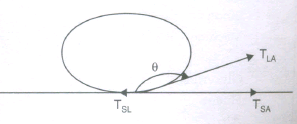
\(T_{LA}\cos\theta+T_{SL}=T_{SA}\)
\(\Rightarrow \cos\theta=\frac{T_{SA}-T_{SL}}{T_{LA}}\)
For the mercury-glass interface, TSA < TSL, Therefore, cos \(\theta\) is negative. Thus \(\theta\) is an obtuse angle. For the water-glass interface, TSA > TSL, Therefore cos \(\theta\) is positive. Thus, \(\theta\) is an acute angle.
(b) Water on a clean glass surface tends to spread out i.e., water wets glass because force of cohesion of water is much less than the force of adhesion due to glass. In case of mercury force of cohesion due to mercury molecules is quite strong as compared to adhesion force due to glass. Consequently, mercury does not wet glass and tends to form drops.
(c) Surface tension of liquid is the force acting per unit length on a line drawn tangentially to the liquid surface at rest. Since t; .is force is independent of the area of liquid surface therefore, surface tension is also independent of the area of the liquid surface.
(d) We know that the clothes have narrow pores or spaces which act as capillaries. Also, we know that the rise of liquid in a capillary tube is directly proportional to cos \(\theta\) (Here \(\theta\) is the angle of contact). As \(\theta\) is small for detergent, therefore cos \(\theta\) will be large. Due to this, the detergent will penetrate more in the narrow pores of the clothes.
(e) We know that any system tends to remain in a state of minimum energy. In the absence of any external force for a given volume of liquid its surface area and consequently. Surface energy is least for a spherical shape. It is due to this reason that a liquid drop, in the absence of an external force is spherical in shape.
41.
495 Hz, 594 Hz, Yes
42.
Given, m = 0.2kg, T = 8s
\(\omega =\frac { 2\pi }{ T } =\frac { 2\pi }{ 8 } =\frac { \pi }{ 4 } rad/s\)
When t = 1s, v = 6m/s
\(v(t)=\omega A\cos { \omega t } \)
\(\\ 6=\frac { \pi }{ 4 } \times Acos\left( \frac { \pi }{ 4 } \times 1 \right) \)
\(\\ 6=\frac { \pi }{ 4 } \times A\times \frac { 1 }{ \sqrt { 2 } } \)
\( A=\frac { \sqrt [ 4 ]{ 2\times 6 } }{ \pi } =\frac { \sqrt [ 24 ]{ 2 } }{ \pi } m\)
The total energy of the body
E = \(\frac { 1 }{ 2 } m{ \omega }^{ 2 }{ A }^{ 2 }=\frac { 1 }{ 2 } \times 0.2\times \left( \frac { \pi }{ 4 } \right) ^{ 2 }\times \left( \frac { \sqrt [ 24 ]{ 2 } }{ \pi } \right) ^{ 2 }\)
\( =\frac { 230.4 }{ 23 } =7.2\ J\)
Potential energy, PE =E - KE =7.2-\(\frac { 1 }{ 2 } \)mv2
= \(7.2-\frac { 1 }{ 2 } \times 0.2\times (6{ ) }^{ 2 }=7.2-3.6\)
Potential energy = 3.6 J
43.
(i) This problem is designed to give an idean about cooling by evaporation
\({ V }^{ 2 }_{ rms }=\frac { \underset { i }{ \Sigma { n }_{ i } } { v }_{ i }^{ 2 } }{ \Sigma { n }_{ i } }\)
\(=\ \frac { 10\times \left( 200 \right) ^{ 2 }\times \left( 400 \right) ^{ 2 }+40\times \left( 600 \right) ^{ 2 }+20\times \left( 800 \right) ^{ 2 }+10\times \left( 1000 \right) ^{ 2 } }{ 100 }\)
\(=\frac { 10\times { 100 }^{ 2 }\times \left( 1\times 4+2\times 16+4\times 36+2\times 64+1\times 100 \right) }{ 100 } \)
\(1000\times \left( 4+32+144+128+100 \right)\)
\( \\ =408\times 1000\ { m }^{ 2 }/{ s }^{ 2 }\)
\(\\ \therefore \ { v }_{ rms }=639\ m/s\)
\(\\ \frac { 1 }{ 2 } { mv }^{ 2 }=\frac { 3 }{ 2 } kT\)
\(\\ \therefore \ T=\frac { 1 }{ 3 } \frac { mv^{ 2 }_{ rms } }{ k } =\frac { 1 }{ 3 } \times \frac { 30\times { 10 }^{ -26 }\times 4.08\times { 10 }^{ 5 } }{ 1.38\times { 10 }^{ -23 } } \)
\(\\ =2.96\times { 10 }^{ 2 }=296\ K\)
(ii) This problem is designed to give an
\({ v }_{ rms }^{ 2 }=\frac { 10\times \left( 200 \right) ^{ 2 }+20\times \left( 400 \right) ^{ 2 }+40\times \left( 600 \right) ^{ 2 }+20\times \left( 800 \right) ^{ 2 } }{ 90 } \)
\(\\ =\frac { 10\times { 100 }^{ 2 }(1\times 4+2\times 16+4\times 36+2\times 64) }{ 90 } \)
\(\\ { v }_{ rms }^{ 2 }=10000\times \frac { 308 }{ 9 }\)
\( \\ { v }_{ rms }^{ 2 }=342\times 1000\ { m }^{ 2 }/{ s }^{ 2 }\)
\(\\ { v }_{ rms }=584\ m/s\)
\(T=\frac { 1 }{ 3 } \frac { m{ v }^{ 2 }_{ rms } }{ k } \)
T = 248 K
44.
\(For \ path \ I, \ \triangle Q=\triangle W+\triangle U\ \Rightarrow \ \triangle U=\triangle Q-\triangle W\)
\( =-80-(-120)=40\ J\)
\(\\ As,\ \triangle U=\ a\ state\ function,\ so\ d=e=f=g=40\ J\)
\(\\ Now\ for\ Path\ III,\ \triangle Q=\triangle W+\triangle U\)
\(\\ 90=c+40\ \Rightarrow \ c=50\ J\)
\(\\ Similarly,\ a=80J,\ b=0\)
45.
(i) Aman loves nature and his helpful boy. He also has presence of mind as he thought of an excellent idea to help cartman.
(ii) \({ L }_{ 1 }=5.231m,{ L }_{ 2 }=5.243m,{ T }_{ 1 }=27 ^{0}C,{ T }_{ 2 }=?\)
As we know
\(\therefore { T }_{ 2 }-{ T }_{ 1 }=\frac { { L }_{ 2 }-{ L }_{ 1 } }{ { L }_{ 1 }\times \alpha } \)
\(\\ { T }_{ 2 }=\frac { { L }_{ 2 }-{ L }_{ 1 } }{ { L }_{ 1 }\alpha } \)
\({ T }_{ 2 }=\frac { 5.243-5.231 }{ 5.231\times 1.2\times { 10 }^{ -5 } } +27\)
\(\\ =218 \ ^{0} C\)
(iii) Linear expansion of solids i.e increase in length of solid on heating.
46.
(i) Sahil is very helpful and generous person.
(ii) People don't bother about the road accident victims because they probably think that they don't know the victim or they don't want to get involved in a police case.
(iii) Given,
\(h=1.3m,\rho =1020kg/{ m }^{ 3 },p=h\rho g\)
\(p=1.3\times 1020\times 9.8\)
\(\\ r=\frac { D }{ 2 } =\frac { 0.36 }{ 2 } =0.18mm=0.8\times { 10 }^{ -3 }m\)
\(\\ l=3cm\ =\ 3\times { 10 }^{ -2 }m\)
\(\\ V=\frac { Total\ volume }{ Time } =\frac { 4.5\times { 10 }^{ -6 } }{ 60 } { m }^{ 3 }/s\)
\(Viscosity,\eta =\frac { \pi p{ r }^{ 4 } }{ 8Vl }\)
\(=\frac { 22 }{ 7 } \times \frac { (1.3\times 1020\times 9.8)\times (0.18\times { 10 }^{ -3 })^{ -4 } }{ 8\times \left( \frac { 4.5\times { 10 }^{ -6 } }{ 60 } \right) \times 3\times { 10 }^{ 2 } } \)
\(\\ \eta =0.00238\ Pa-s\)
47.
Average force exerted to the quarterback's femur
So Fav x \(\Delta \) t = M ( vf - vi )
i.e. Fav = \(\frac { M({ v }_{ f }-{ v }_{ i }) }{ \Delta t } \) = \(\frac { 125(4-2.38) }{ 0.1 } \)
= \(\frac { 125\times 1.62 }{ 0.1 } \) = 2.03 x 10³ N
Shearing stress = \(\frac { F }{ A } \) = \(\frac { 2.03\times { 10 }^{ 3 } }{ 5\times { 10 }^{ -4 } } \)
= 4.06 x 10⁶ Pa
48.
Kepler's second law establishes that the linear speed of a planet, when closer to the sun, is more than its linear speed when away from the sun. The planets revolve around the sun on account of the gravitational pull of the sun. Thus, sun is the source of energy. The law implies that when you are closer to the source of energy, your speed/progress is faster. And when you are far away from the source of energy, your speed/progress become slow. This is so true in everyday life.
49.
In pulling a lawn mower, a force F is applied in upward direction, making an angle \(\theta \) with the horizontal [Fig]. Its vertical component in upward direction decreasing the effective weight of the mower.
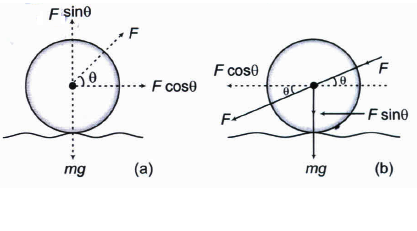
In pushing a lawn mower, a force F is applied in downward direction, making an angle \(\theta \) with the horizontal [Fig]. Its vertical component is in downward direction increasing the effective weight of the mower. Therefore, it is easier to pull a lawn mower than to push it.
50.
Given,F1 = 5N,F2 = 8N, m = 0.3 kg and acceleration a = ?.The resultant force in the x-direction exerted on the puck.
\(\Sigma { F }_{ x }={ F }_{ 1x }+{ F }_{ 2x }={ F }_{ 1 }\cos { 20° } +{ F }_{ 2 }\cos { 60° } \)
\(\\=(5N)(0.940)+(8N)(0.500)=8.70N\)
The resultant force in the y-direction exerted on the puck,
\(\Sigma { F }_{ y }={ F }_{ 1y }+{ F }_{ 2y }={ -F }_{ 1 }\sin { 20° } +{ F }_{ 2 }\sin { 60° } \)
\(\\ =(5N)(0.342)+(8N)(0.8666)=5.22N\)
Now, we can use Newton's second law in component form to find the x and y-component of acceleration
\({ a }_{ x }=\frac { \Sigma { F }_{ x } }{ m } =\frac { 8.70N }{ 0.3kg } =29.0m/{ s }^{ 2 }\)
\(\\ { a }_{ y }=\frac { \Sigma { F }_{ y } }{ m } =\frac { 5.22N }{ 0.3kg } =17.4m/{ s }^{ 2 }\)
Magnitude, \(a=\sqrt { { (29.0) }^{ 2 }+{ (17.4) }^{ 2 } } m/{ s }^{ 2 }=33.8m/{ s }^{ 2 }\)
and its direction is
\(\theta =\tan ^{ -1 }{ ({ a }_{ y }/{ a }_{ x }) } =\tan ^{ -1 }{ (17.4/29.0)=31.0° } \)
relative to the positive x-axis.
51.
(i) \(T=\frac { { 2u }_{ 0 }\sin { \beta } }{ g\cos { \alpha } } \)
(ii) \(R=\frac { { 2u }_{ 0 }\sin { \beta } \cos { \left( \alpha +\beta \right) } }{ g\cos { ^{ 2 }\alpha } } \)
(iii) \(\beta =\frac { \pi }{ 4 } -\frac { \alpha }{ 2 } \)
52.
The instrument whose least count is minimum, is called the most precise device.
i) Number of divisions on vernier scale = 20
Main scale Division (MSD) = 1 mm
As 20 divisions on vernier scale will be equal to the 19 divisions on the vernier scale will be equal to the 19 division on main scale.
∴ vernier scale Division (VSD) \(=\frac { 19 }{ 20 } MSD\)
Least count of vernier callipers
= 1MSD − 1VSD
\(\\=1MSD-\frac { 19 }{ 20 } MSD=\frac { 1 }{ 20 } MSD\)
\(\\ =\frac { 1 }{ 20 } mm=\frac { 1 }{ 200 } cm=0.005cm\)
ii) Pitch of screw guage = 1mm
Number of divisions on circular scale = 100
Least count of screw guage
\(=\frac { Pitch }{ Number\ of\ division\ on\ circular\ scale } \)
\(\\ =\frac { 1 }{ 100 } mm=\frac { 1 }{ 1000 } cm=0.001cm\)
iii) Wavelength of light \((\lambda )\approx { 10 }^{ -7 }m\)
= 10-5cm = 0.00001 cm
\(\therefore \) As the given optical instrument can measure length to within a wavelength of light, therefore, least count of the given optical instrument
= Wavelength of light
= 0.00001 cm
The least count is minimum for the given optical instrument. Therefore, the given optical instrument is the most precise.
53.
(a)
- y\(\upsilon \)\(\hat{k}\)
54.
(d)
\(\omega\)' < \(\omega\)
55.
(c)
the kinetic energy of a hydrogen molecule
56.
(a)
At t =\(\frac { 1 }{ b } \) , the displacement of the particle is nearly (2/3) (a/b).
57.
(a)
T1 < T2
58.
(d)
ML2T-2K-1
59.
(b)
258 Hz
60.
(d)
pressure
61.
(d)
\(\frac{\sqrt 3GM^2}{4r^2}\)
62.
(b)
H/2
63.
(b)
50 N
64.
(a)
(1000)4
65.
(b)
Huygens
66.
(b)
t

11th Standard CBSE Syllabus & Materials
11th Standard CBSE
CBSE 11th Business Studies Forms of Business Organisation Sample Question Papers Study Material - QB365 Set A
NEW11th Standard CBSE
CBSE 11th Business Studies Business, Trade and Commerce Sample Question Papers Study Material - QB365 Set A
NEW11th Standard CBSE
CBSE 11th Physics Waves Sample Question Papers Study Material - QB365 Set A
NEW11th Standard CBSE
CBSE 11th Physics Kinetic Theory Sample Question Papers Study Material - QB365 Set A



CBSE 11th Standard CBSE Subjects
CBSE Standards









