
 100% FREE ACCESS
11th Standard CBSE Syllabus & Materials
11th Standard CBSE
CBSE 11th Economics PART-A - Presentation of Data - New Sample Question Papers Study Material - QB365 Set A
NEW11th Standard CBSE
CBSE 11th Economics PART-A - Organisation of Data - New Sample Question Papers Study Material - QB365 Set A
NEW11th Standard CBSE
CBSE 11th Economics PART-A - Collection of Data - New Sample Question Papers Study Material - QB365 Set A
NEW11th Standard CBSE
CBSE 11th Economics PART-A - Introduction to Economics and Statistics - New Sample Question Papers Study Material - QB365 Set A
NEW11th Standard CBSE
CBSE 11th Business Studies International Trade Sample Question Papers Study Material - QB365 Set A
NEW11th Standard CBSE
CBSE 11th Business Studies Evolution and Fundamentals of Business Sample Question Papers Study Material - QB365 Set A

Published on: 15/09/2018
Model Paper 2
Download CBSE Class 11th Standard CBSE Physics question papers, sample papers, important questions, and previous year solved papers in PDF format. Get free study materials, NCERT solutions, and exam preparation resources for Class 11th Standard CBSE Physics
Questions + Answers key
Take MCQ Physics Test
1.
A car travelling with a speed of 90 km / h on a straight road is ahead of a scooter travelling with a speed of 60 km / h. How would the relative velocity be altered, if scooter is ahead of the car?
2.
If the displacement of a body is zero, is distance necessarily zero? Answer with one example.
3.
Thye position x of a body is given by x = A sin(wt). Find the time at which the displacements is maximum.
4.
Explain how an object could have zero avaerage velocity but non-zero average speed?
5.
A drunkard walking in a narrow lane takes 5 steps forward and 3 steps backward, followed again by 5 steps forward and 3 steps backward, and so on. Each step is 1 m long and requires 1 s. Plot the x-t graph of his motion. Determine graphically and otherwise how long the drunkard takes to fall in a pit 13 m away from the start.
6.
Find the acceleration and velocity of a ball at the instant it reaches its highest point it was thrown up with velocity v.
7.
Write an expression for distance covered in nth second for a uniformly accelerated motion.
8.
Consider that the acceleration of a moving body varies with timewe.What does the area under acceleration - time graph for any time interval represnt?
9.
The displacement-time graph for two particles X and Y are straight lines making angles of 30o and 60o with the time axis. What is the ratio of the velocities of Y and X ?
10.
Is it possible that x-t graph could have negative slope?
11.
The displacement-time graph of a particle is parallel to time-axis, what is the velocity of the particle?
12.
Position-time graph could have negative slope Is it true or false?
13.
For which condition, the distance and the magnitude of displacement of an object have the same values?
14.
Does the displacement of an object depend on the choice of the postion of origin of the coordinate system?
15.
What is the condition for an object to be considered as a point object?
16.
An object starts from rest and covers a total distance X in the following manner: It first has a uniform acceleration al for some time tl, moves with the speed acquired at the end of tl for some distance and is then given a uniform retardation a2 so that it is again at rest at the end of the journey. Show that the journey is covered in least time if the body is accelerated for
a time of\(\left[ \frac { 2Xa_{ 2 } }{ a_{ 1 }(a_{ 1 }+{ a }_{ 2 } } \right] ^{ \frac { 1 }{ 2 } }\) and this minimum time is \(\left[ 2X\left( \frac { 1 }{ { a }_{ 1 } } +\frac { 1 }{ { a }_{ 2 } } \right) \right] ^{ \frac { 1 }{ 2 } }\)
17.
A particle located at x = 0 at time t = 0 starts moving along the positive x direction with a velocity v that varies as v = \(\alpha\sqrt{x}\) . How do the displacement, velocity and acceleration of the particle vary with time? What is the average velocity of the particle over the first s metres of its path?
18.
Derive the three basic kinematic equations by calculus method.
19.
A ball of mass 100 g is projected vertically upwards from the ground with a velocity of 49 m/ s. At the same time another identical ball is dropped from a height of 98 m fo fall freely along the same path as followed by the first ball. After sometime, the two balls collide and stick together and finally fall together. Find the time of fliglIt of the masses.
20.
State the kinematic equations for uniformly accelerated motion.
1.
Let vc and vs be the velocities of the car and the scooter , respectively.
vc = 90 km /h and 60 km / h [ given ]
when the car is ahead of the scooter b, then the relative velocity is
vcs = vc - vs
= 90 - 60
= 30 km / h ( away from the scooter )
When the scooter is ahead of the car, then the relative velocity is vcs = vc - vs
= 90 - 60
= 30 km / h ( toward the scooter )
2.
No, because the distance covered by an object is the path length of the path covered by the object. The displacement of an object is given by the change in position between the initial position and final position.
e.g A boy starts from his home and moves towards maket along a straight path. Then, he returns to home from the same path. Here, displacement is zero but distance is non-zero.
3.
The value of position x will be maximum, when the value of sin (wt) is maximum for this
\(sin(\omega t)=1=sin\quad \pi /2\)
or \(\omega t=\frac { \pi }{ 2 } \Rightarrow t=\left( \frac { \pi }{ 2\omega } \right) \)
4.
Average velocity,
\(v=\frac { Net \ displacement }{ Total \ time \ taken } \)
and aveae speed,
\({ S }_{ av }=\frac { Total \ distance \ travelled }{ Total \ time \ taken } \)
If an object moves along a straight line starting from origin and then returns back to origin.
Average velocity = 0
and
Average speed =\(\frac { 2s }{ t } \)
5.
The effective distance travelled by drunked in 8 steps = 5-3 = 2 m
Therefore, he takes 32 steps to move 8 m
Now he will have to cover 5 m more to reach the pit, for which he has to take only 5 forward steps.
Therefore, he will have to take = 32 + 5 = 37 steps to move 13 m. Thus, he will fall into the pit after taking 37 steps. i.e., after 37 s from the start.
6.
Acceleration is 9.8 m/s2 (downwards) and velocity is zero at the highest point.
7.
If a the uniform acceleration, then
s ( nth ) = u + 1/2 a ( 2n - 1 )
where , s ( cered in n th second, u is thent )is the distance nd, u covered in n th second , u is the intial velocity.
8.
The area under acceleration - y time graph for many time interval represents the change of velocity of the body during that time interval.
9.
\(\frac { { v }_{ y } }{ v_{ x } } =\frac { tan60^{ o }\ }{ tan30^{ o } } =\frac { \sqrt { 3 } }{ 1/\sqrt { 3 } } =3:1\)
10.
Yes,when the velocity is negative, the x-t graph has a negative slope.
11.
The velocity of the paritcle is zero because the slope of (x-t )graph is zero.
12.
It is true because if the velocity of the object is negative, then slope of v-t graph is negative.
13.
The distance and the magnitude of displacement of an object have the same values, when the body is moving along a straight line path in a fixed direction.
14.
No, the displacement of the objects does not depend on the choice of the position of the origin.
15.
An object can be considered as a point object if the distance travelled by it is very large than its size.
16.
Let Xl be the distance travelled by the object in t1 second (starting from rest with uniform acceleration al)· Then v, the speed acquired after travelling distance Xl' is
Also 2a1x1= v2-02 = v2
∴ x1= \(\frac { { v }^{ 2 } }{ 2a_{ 1 } } \)
Let x2 and x3 denote the distance travelled in the second and third leg of the journey of the particle extending over time t2 and t3 respectively,
Then, x2=v t2
and -2a 2x3 = 02-v2 = -v2
Also 0 = v-a2t3 or v = a2t3
The total time t of the journey is
t = t1 + t2 + t3 = \(\frac { v }{ { a }_{ 1 } } +\frac { { x }_{ 2 } }{ v } +\frac { v }{ a_{ 2 } } \)
Also x1 + x2 + x2=\(\frac { { v }^{ 2 } }{ { 2a }_{ 1 } } +x_{ 2 }+\frac { { v }^{ 2 } }{ 2a_{ 2 } } \)
∴ \({ x }_{ 2 }=X-\frac { { v }^{ 2 } }{ 2 } \left( \frac { 1 }{ { a }_{ 1 } } +\frac { 1 }{ a_{ 2 } } \right) \)
From Eqns. (6) and (7) we have
\(t=\frac { v }{ { a }_{ 1 } } +\frac { X }{ v } -\frac { v }{ 2 } \left( \frac { 1 }{ { a }_{ 1 } } +\frac { 1 }{ a_{ 2 } } \right) +\frac { v }{ { a }_{ 2 } } \)
\(=\frac { X }{ v } +\frac { v }{ 2 } \left( \frac { 1 }{ { a }_{ 1 } } +\frac { 1 }{ a_{ 2 } } \right) \)
Using Eqns. (8) and (I), we have
\(t=\frac { X }{ { a }_{ 1 }{ t }_{ 1 } } +\frac { { a }_{ 1 }t_{ 1 } }{ 2 } \left( \frac { 1 }{ { a }_{ 1 } } +\frac { 1 }{ a_{ 2 } } \right) \)
For a particular value of X, t is least if,
\(\frac { dt }{ d{ t }_{ 1 } } =0\)
Differentiating Eqn. (9), we get, for least t
\(\frac { dt }{ d{ t }_{ 1 } } =\frac { X }{ { a }_{ 1 }{ t }_{ 1 }^{ 2 } } +\frac { { a }_{ 1 } }{ 2 } \left( \frac { 1 }{ { a }_{ 1 } } +\frac { 1 }{ a_{ 2 } } \right) =0\)
\(\frac { X }{ { a }_{ 1 }{ t }_{ 1 }^{ 2 } } =\frac { a_{ 1\quad }(a_{ 1 }+{ a }_{ 2 }) }{ 2{ a }_{ 1 }{ a }_{ 2 } } \)
or \(t_{ 1 }=\left[ \frac { X.2{ a }_{ 2 } }{ { a }_{ 1 }({ a }_{ 1 }+{ a }_{ 2 } } \right] ^{ \frac { 1 }{ 2 } }\)
Corresponding to this values of t1, we get from Eqn. (9),
\(t=\left[ 2X\left( \frac { 1 }{ { a }_{ 1 } } +\frac { 1 }{ { a }_{ 2 } } \right) \right] ^{ \frac { 1 }{ 2 } }\)
17.
v = \(\frac{dx}{dt}\)
Since v = \(\alpha\sqrt{x}\)
we have \( \frac{dx}{dt}=\alpha\sqrt{x} \) or \(\frac{dx}{\sqrt{x}}=\alpha dt\)
Intefrating from \( t=0(x=0) to \ t=t(x=x)\)
we have \( \overset { x }{ \underset { 0 }{ \int } } { x }^{ -1/2 }dx=\alpha \overset { t }{ \underset { 0 }{ \int } } dt\)
∴ \({ \left| \frac { { x }^{ 1/2 } }{ 1/2 } \right| }_{ 0 }^{ x }=\alpha t\)
or \( x = \frac{\alpha^2t^2}{4}\)
The time dependence of the velocity is obtained by differentiating both sides of this relation w.r.t. time t. Thus
\(v=\frac{dv}{dt}=\frac{\alpha.2t}{4}=\frac{\alpha^2}{2}t\)
The velocity x of the particle is thus increasing in direct proportion to time.
Similarly, the time dependence of acceleration is obtained by differentiating both sides of this relation w.r.t. 't', Thus
\( a=\frac{dv}{dt}=\frac{\alpha^2}{2}\)
The particle is thus moving with a constant acceleration.
To find the average velocity over the first s metre, we assume that the time taken to cover this distance is T. Using
\( x=\frac{\alpha^2t^2}{4}\)
we get s= \(\frac{\alpha^2T^2}{4} or \ T=\frac{2\sqrt{s}}{\alpha}\)
The average velocity vav \((=s/T)\) is, therefore
\( v_{av}=(\frac{\alpha}{2}\sqrt{s}) \).
18.
(i) Velocity attained by a particle after time t:
Let dt: be the change in velocity of the particle in time dt. Therefore, the acceleration of the particle is given by
\(a=\frac{dv}{dt} \ or \ dv=a \ dt\)
By integrating both sides, we get
\(\int{dv}= \int{a dt}\)
or \(\int{dv}= a \int{ dt}\)
or v = at + k --- (i)
where k is constant of integration.
when t = 0, v = u
Putting these values in equation (i), we get
k = u
Now putting the value of k in equation (i), we get
v = u + at
(ii) Displacement of the particle after time t:
Let dx be the displacement of the particle in time dt. Therefore, the velocity of the particle is given by
\(v=\frac{dx}{dt}\ or \ dx=vdt\)
Since v =u + at
∴ dx=(u+at)dt
Integrating both sides, we get
\(\int{dx}=\int{(u+at)}dt\)
or \(\int{dx}=\int{u}dt+\int{at \ dt}\)
\(x= u\int{dt}+a \int{t\ dt}\) [∵ u and a are constants]
or \(x=ut+a \frac{t^{2}}{2}+k\)
where k is constant of proportionality
where t = 0, x = x0
∴ from equation (ii), we get
\(x=x_{0}+ut+\frac{1}{2}at^{2}\)
or \(x-x_{0}=ut+\frac{1}{2}at^{2}\)
since x-x0= S, displacement of the particle in the time interval t.
S = \(ut+\frac{1}{2}at^{2}\)
(iii) Velocity attained by a particle after travelling a distance S:
We know, \(v=\frac{dx}{dt}\)
Multiplying and dividing R.H.S. by dv, we get
\(v=\frac{dx}{dt}.\frac{dv}{dv}=\frac{dx}{dv}.\frac{dv}{dt}\)
As \(\frac{dv}{dt}=a (acceleration)\)
∴ v = a\(\frac { dx }{ dv } \) or v dv=a dx
Integrating both sides, we get \(\int { v\ dv=\int { a\ dx=a\int { dx } } } \)
or = \(\frac { v^{ 2 } }{ 2 } \)ax+k
when x = 0,v = u
Then,from eqn.(i),k = \(\frac { u^{ 2 } }{ 2 } \)
Putting the value of k in eqn. (i), we get
\(\frac { v^{ 2 } }{ 2 } \)-ax+\(\frac { u^{ 2 } }{ 2 } \)
or \(\frac { v^{ 2 } }{ 2 } -\frac { u^{ 2 } }{ 2 } =ax\)
or v2-u2= 2ax
x = s, then
v2-u2 = 2 aS.
19.
We first find when and where the two balls collide. Let them collide at an instant f seconds after they start their respective motion. Clearly the two balls are at the same height above the ground at this instant.
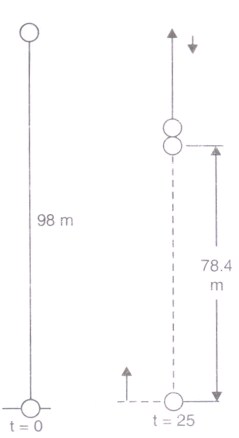
The height of the first ball after t seconds = 49 t - 1/2 x 9.8t2 = 4.9 t (10 - t)
Also the height of the second ball after t seconds = 98 - downward distance moved by it in t seconds.
= \(98-\frac{1}{2}\times 9.8 t^{2}=4.9(20-t^{2})\)
∴ \(4.9 t (100-t)=4.9(20-t^{2}) \)
or \(10t-t^{2}=20-t^{2}\ or \ t=2s\)
The balls thus collide two seconds after the start of their motion. Their velocities at this instant are
First ball: \(v_{1}=(49-9.8 \times 2) m/s\)
= 29.4 m/ s directed upwards
Second ball: v2 = \((0+9.8 \times 2)\) m/s
= 19.6 m/s directed downwards
if v is the velocity of the combined mass of the two balls after they stick together folluwing
their collision, we have, by principle of conservation of momentum.
\(200\times v=100 \times 29.4 -100 \times 19.6\)
∴ v = 4.9 m/s
The 'combined mass' thus moves upward, after collision with a velocity of 4.9 m/s. Its height above the ground at this instant is (considering the position of either of the two balls before collision)
\((98-\frac{1}{2}\times 9.8 \times 2^{2})m= (98-19.6)m = 78.4 m\)
We can now find the time t' taken by the 'combined mass' of the two balls to fall to ground.
We have for this 'combined mass',
u = 4.9 m/s ,s = -78.4 m, a = - g = -9.8 ms-2
ஃ -78.4= 4.9t'+1/2 (-9.8)t'2
or t'2-t'-16=0
ஃ \(t^{'}=\frac{1\pm \sqrt{1+64}}{2} = \frac{1\pm 8.06}{2}\)
= 4.532 s (leaving out the negative solution)
The 'combined mass' thus takes 4.53 s to fall to the ground. Since the balls collided
2 s after they started their motion, their total time of flight is (2 + 4.53) s = 6.53 s.
20.
For uniformly accelerated motion, we can derive some simple equations that relate displacement(x), time taken(t), Initial velocity(u), final velocity(v) and acceleration(a).
(i) Velocity attained after time t: The velocity-time graph for positive constant acceleration of a particle is shown in the figure.
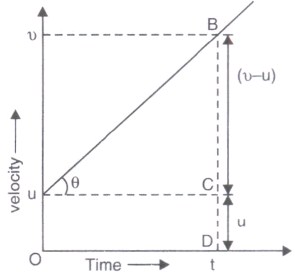
Let u be the initial velocity of the particle at t = 0 and v is the final velocity of the particle after time t. Consider two points A and B on the curve corresponding to t = 0 and t = t respectively.
Draw BD perpendicular to time axis. Also draw AC perpendicular to BD.
ஃ OA = CD = u;
BC = (v - u) and OD = t
Now slope of v-t graph = acceleration (a)
∴ a = slope of v - t graph = tan θ = \(\frac{BC}{AC}=\frac{BC}{OD} \ \ \ [∵ AC=OD]\)
∴ \(a=\frac{v-u}{t}\)
or v - u = at
v = u + at
(ii) Distance travelled in time t:
Let x0 position of the particle at t = 0 from the origin.
x = position of the particle at t = t from the origin.
∴ (x - x0) = S = distance travelled by the particle in the time interval (t - 0) = t
We know, distance travelled by a particle in the given time interval = area under velocity-time graph
∴ (x - x0) = Area OABD (see fig. above)
= Area of trapezium OABD
= \(\frac{1}{2}\) [Sum of parallel sides x perpendicular distance between parallel side]
=\(\frac{1}{2}(OA+BD)\times AC=\frac{1}{2}(u+v)t\)
Since v = u + at
∴ (x- x0) = \(\frac{1}{2}(OA+BD)\times AC = \frac{1}{2} (u+v) \times t\)
Since x - x0= S
∴ S = ut + \(\frac{1}{2}\)at2
(iii) Velocity attained after travelling a distance S:
We know, distance travelled by a particle in time t is equal to the area under velocitytime graph. Therefore, the distance (S) travelled by a particle during time interval tis given by
S = Area under v - t graph (see fig.) or
S = area of trapenium OABD
= \(\frac{1}{2}\)(sum of parallel sides) x perpendicular distance between these parallel
or S = \(\frac{1}{2}\)(OA + BD) x AC --- (i)
Now, acceleration, a = slope of v - t graph
or a = \(\frac{BC}{AC}=\frac{BD-CD}{AC}=\frac{v-u}{AC}\)
or \(AC=(\frac{v-u}{a})\) --- (ii)
Also OA = u and BD = v --- (iii)
Using equations (ii) and (iii) in equation (i), we get
\(S=\frac{1}{2}(v+u)\frac{(v-u)}{a}=\frac{v^{2}-u^{2}}{2a}\)
or, v2-u2 = 2aS

11th Standard CBSE Syllabus & Materials
11th Standard CBSE
CBSE 11th Business Studies Forms of Business Organisation Sample Question Papers Study Material - QB365 Set A
NEW11th Standard CBSE
CBSE 11th Business Studies Business, Trade and Commerce Sample Question Papers Study Material - QB365 Set A
NEW11th Standard CBSE
CBSE 11th Physics Waves Sample Question Papers Study Material - QB365 Set A
NEW11th Standard CBSE
CBSE 11th Physics Kinetic Theory Sample Question Papers Study Material - QB365 Set A



CBSE 11th Standard CBSE Subjects
CBSE Standards









