
 100% FREE ACCESS
11th Standard CBSE Syllabus & Materials
11th Standard CBSE
CBSE 11th Economics PART-A - Presentation of Data - New Sample Question Papers Study Material - QB365 Set A
NEW11th Standard CBSE
CBSE 11th Economics PART-A - Organisation of Data - New Sample Question Papers Study Material - QB365 Set A
NEW11th Standard CBSE
CBSE 11th Economics PART-A - Collection of Data - New Sample Question Papers Study Material - QB365 Set A
NEW11th Standard CBSE
CBSE 11th Economics PART-A - Introduction to Economics and Statistics - New Sample Question Papers Study Material - QB365 Set A
NEW11th Standard CBSE
CBSE 11th Business Studies International Trade Sample Question Papers Study Material - QB365 Set A
NEW11th Standard CBSE
CBSE 11th Business Studies Evolution and Fundamentals of Business Sample Question Papers Study Material - QB365 Set A

Published on: 05/09/2019
System of Particles and Rotational Motion
Download CBSE Class 11th Standard CBSE Physics question papers, sample papers, important questions, and previous year solved papers in PDF format. Get free study materials, NCERT solutions, and exam preparation resources for Class 11th Standard CBSE Physics
Questions + Answers key
Take MCQ Physics Test
1.
Give the location of the centre of mass of a (i) sphere, (ii) cylinder, (iii) ring, and (iv) cube, each of uniform mass density. Does the centre of mass of a body necessarily lie inside the body ?
2.
A fan of moment of inertia is 0.6 kg-m2 is to be run upto a working speed of 0.5 rps. What is the angular momentum of the fan?
3.
What is the moment of inertia of a solid cylinder of mass M and radius R about axis tangential to cylinder surface and parallel to the axis of cylinder?
4.
The moment of inertia of a disc about its diameter is \(\frac { { MR }^{ 2 } }{ 4 } \) , what will be its moment of inertia, an axis tangential to it and parallel to one of its diameter? [where M is mass of the disc and R is its radius.]
5.
The bottom of a ship is made heavy. Why?
6.
Why in hand driven grinding machine, a handle is put near the circumference of the stone or wheel?
7.
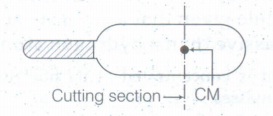
A cricket bat is cut through its centre of mass into two parts as shown. Then, state whether both parts are of same mass or not. Also, give a reason.
8.
If earth contract to half its radius. What would be the length of the day?
9.
Can the mass of body be taken to be concentrated at its centre of mass for the purpose of calculating its rotational inertia?
10.
Separation of Motion of a system of particles into motion of the centre of mass and motion about the centre of mass Show \(K=K^{\prime}+1 / 2 M V^{2}\) where K is the total kinteic energy of the system of particles, K' is the total kinetic energy of the system when the particle velocities are taken with respect to the centre of mass and MV2 /2 is the kinetic energy of the translation of the system as a whole (i.e., of the centre of mass motion of the system).The result has been used in Sec. 7.14
11.
Three masses 3 kg, 4 kg and 5 kg are located at the corners of an equilateral triangle of side lm, then what are the coordinates of centre of mass of this system.
12.
Moment of inertia of a thin rod of length l about an axis passing through its one end and perpendicular to its length is MR2/3. Find the value of radius of gyration for the given scenario.
13.
Give the location of the centre of mass of a Sphere.
14.
A comet revolves around the Sun in a highly elliptical orbit having a minimum distance of 7 x 10¹⁰ m and a maximum distance of 1.4 x 10¹³ m. If its speed while nearest to the sun is 60 kms-1, Find its linear speed when situated from the sun.
15.
A solid cylinder of mass 20 kg rotates about its axis with angular speed 100 rad s-1. The radius of the cylinder is 0.25 m. What is the kinetic energy associated with the rotation of the cylinder? What is the magnitude of angular momentum of the cylinder about its axis?
16.
A rope of negligible mass is wound round a hollow cylinder of mass 3 kg and radius 40 cm. What is the angular acceleration of the cylinder if the rope is pulled with a force of 30 N ? What is the linear acceleration of the rope ? Assume that there is no slipping.
17.
Two bodies of masses 1 kg and 2 kg are located at (1, 2) and (-1, 3), respectively. Calculate the coordinates of the centre of mass.
18.
From a uniform disk of radius R, a circular hole of radius R/2 is cut out. The centre of the hole is at R/2 from the centre of the original disc. Locate the centre of gravity of the resulting flat body.
19.
A uniform disc of radius R and mass M is resting on table on its rim. The coefficient of friction between rim and table is \(\mu \). Now, disc is pulled with force F. What is the maximum value of F for which the disc rolls without slipping?
1.
In all the four cases, as the mass density is uniform, centre of mass is located at their respective geometrical centres.
No, it is not necessary that the centre of mass of a body should lie on the body. For example, in case of a circular ring, centre of mass is at the centre of the ring, where there is no mass.
2.
1.9 km-m/s
3.
\(2{ MR }^{ 2 }\).
4.
\(\frac { 5 }{ 4 } { MR }^{2}\)
5.
The bottom of a ship is made heavy so that its centre of gravity remains low. This ensures the stability of its equilibrium.
6.
For a given force, torque can be increased if the perpendicular distance of the point of application of the force from the axis of rotation is increased.
Hence, the handle put near the circumference produces maximum torque.
7.
Centre of mass of a body lies towards region of heavier mass. So, if bat is cut through its centre of mass, both parts are not equal masses.
8.
The moment of inertia \(\left( I=\frac { 1 }{ 2 } MR^{ 2 } \right) \) of the earth about its own axis will become one-fourth and so its angular velocity will become four times\(\left( L=I\omega =constant \right) \). Hence, the time period will reduce to one-fourth \(\left( T=2\pi /\omega \right) \), i.e. 6 hours.
9.
No, the moment of inertia greatly depends on the distribution of mass about the axis of rotation.
10.
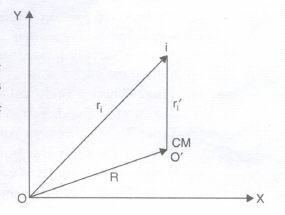
Here\(\vec { r_{ i } } =\vec { r'_{ i } } +\vec { R } +R\) and \(\vec { V_{ i } } =\vec { V'_{ i } } +\vec { V } \)
where\(\vec { r'_{ i } } \) and \(\vec { \upsilon '_{ i } } \) denote the radius vector and velocity of the ith, particle referred to centre of mass O' as the new origin and\(\vec { V } \) is the velocity of centre of mass relative to O.
Kinetic energy of the system of particles
K = \(\frac { 1 }{ 2 } \sum { { m }_{ i } } { v }_{ i }^{ 2 }\)
= \(\frac { 1 }{ 2 } \sum { { m }_{ i } } \vec { { v }_{ i } } .\vec { { v }_{ i } } \)
= \(\frac { 1 }{ 2 } \sum { { m }_{ i } } \left( { V }_{ i }^{ '2 }+{ V }^{ 2 }+2\vec { { V }_{ i }' } .\vec { V } \right) \)
= \(\frac { 1 }{ 2 } \sum { { m }_{ i }{ V }_{ i }^{ '2 } } +\frac { 1 }{ 2 } \sum { { m }_{ i }{ V }_{ i }^{ '2 } } +\sum { { m }_{ i }\vec { { V }_{ i } } } .\vec { V } \)
= \(\frac { 1 }{ 2 } { MV }^{ 2 }+K'\)
Where M=\(\sum { { m }_{ i } } \)
=total mass of the system
K' = \(\frac { 1 }{ 2 } \sum _{ i }^{ }{ { m }_{ i } } { v }_{ i }^{ '2 }\)
= kinetic energy of motion about the centre of mass
or \(\frac { 1 }{ 2 } \)Mv2 kinetic energy of motion of centre of mass
since \(\sum _{ i }^{ }{ { m }_{ i } } \vec { { V }'_{ i } } .\vec { V } =\sum { { m }_{ i } } \frac { d\vec { { r }_{ i } } }{ dt } .\vec { V } \)
=\(\frac { d }{ dt } \left( \sum { { m }_{ i } } \vec { r'_{ i } } \right) .\vec { V } =\frac { d }{ dt } \left( M\vec { R } .\vec { V } \right) \)
= 0
11.
Suppose the equilateral triangle lies in the xy-plane with mass 3 kg at the origin.
Let (x, y) be. the coordinates of centre of mass.
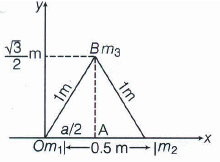
Clearly, AB=\(\sqrt { { (OB) }^{ 2 }-{ (OA) }^{ 2 } } =\sqrt { { (1) }^{ 2 }-{ \left( \frac { 1 }{ 2 } \right) }^{ 2 } } =\frac { \sqrt { 3 } }{ 2 } \)m
Now, x1= 0, x2 = 1m, x3 = OA = 0.5 m
m1 = 3kg, m2 = 4 kg, m3 = 5 kg
\(\therefore x=\frac { { m }_{ 1 }{ x }_{ 1 }+{ m }_{ 2 }{ x }_{ 2 }+m_{ 3 }{ x }_{ 3 } }{ { m }_{ 1 }+{ m }_{ 2 }+{ m }_{ 3 } }\)
\( \\ =\frac { 3\times 0+4\times 1+5\times 0.5 }{ 3+4+5 } \)
= \(\frac { 6.5 }{ 12 } \) = 0.54m
Again, y1 = 0, y2 = 0, y3 = AB = \(\frac { \sqrt { 3 } }{ 2 } \),
\(\therefore y=\frac { { m }_{ 1 }{ y }_{ 1 }+{ m }_{ 2 }{ y }_{ 2 }+m_{ 3 }{ y }_{ 3 } }{ { m }_{ 1 }+{ m }_{ 2 }+{ m }_{ 3 } }\)
\( \\ =\frac { 3\times 0+4\times 0+5\times \left( \frac { \sqrt { 3 } }{ 2 } \right) }{ 3+4+5 } \)
=\(\frac { 5\times \sqrt { 3 } }{ 2\times 12 } \) = 0.36 m
Thus, the coordinate of centre of mass are (0.54 m, 0.36 m).
12.
\(K=F/\sqrt { 3 } \).
13.
Centre of mass of a sphere lies at its geometrical centre.
14.
Let mass of cimet be M and its angular speed be \(\omega \) when situated at a distance r from the sun, then its angular momentum
L = I \(\omega \) = Mr2 \(\omega \)
If v be the linear speed, then L = Mr2 \(\omega \) = Mrv
In accordance with conservation law of angular momentum, we can write that
mr1v1 = mr2v2
\(\therefore \quad { v }_{ 2 }=\frac { { r }_{ 1 }{ v }_{ 1 } }{ { r }_{ 2 } } =\frac { 7\times{ 10 }^{ 10 }\times60 }{ 1.4\times{ 10 }^{ 13 } } =0.3\ Km/s\ or\ 300m/s\)
15.
Moment of inertia of cylinder about its own axis = \(=\frac { 1 }{ 2 } MR^{ 2 }\)
\(=\frac { 1 }{ 2 } \times 20\times { \left( 0.25 \right) }^{ 2 }kg-m^{2}\)
= 0.625 kg-m2
Kinetic energy of rotating cylinder
\(=\frac { 1 }{ 2 } { I\omega }^{ 2 }=\frac { 1 }{ 2 } (0.625) { \left( 100 \right) }^{ 2 }J=3125J\).
Angular momentum of cylinder about its own axis
\(=I\omega =0.625\times 100\)
\(\\ =62.5\ kg-{ m }^{ 2 }/s\)
16.
Torque on cylinder, \(\tau =force\times radius\)
\(=30\times 40=12N-m\)
Moment of inertia of hollow cylinder about its axis
\(I={ MR }^{ 2 }=3\times { \left( 0.4 \right) }^{ 2 }=0.48kg-{ m }^{ 2 }\)
Also, \(\tau =I\alpha \Rightarrow \alpha \frac { \tau }{ I } \)
\(\therefore \alpha =\frac { 12 }{ 0.48 } =25{ s }^{ -2 }\)
Linear acceleration of rope
\(\alpha =\frac { F }{ m } =\frac { 30 }{ 3 } =10m/{ s }^{ 2 }\).
17.
\(Given,\ { m }_{ 1 }=1kg,{ m }_{ 2 }=2kg\)
\( { x }_{ 1 }=1m,{ x }_{ 2 }=-1m\)
\( { y }_{ 1 }=2m,{ y }_{ 2 }=3m\)
\(\\ \therefore \quad { x }_{ CM }=\frac { { m }_{ 1 }{ x }_{ 1 }+{ m }_{ 2 }{ x }_{ 2 } }{ { m }_{ 1 }+{ m }_{ 2 } } =\frac { 1\times 1+2\times -1 }{ 1+2 } \)
\(=\frac { 1-2 }{ 3 } =\frac { -1 }{ 3 } =-0.33\)
\(\\ and\ { y }_{ CM }=\frac { { m }_{ 1 }{ y }_{ 1 }+{ m }_{ 2 }{ y }_{ 2 } }{ { m }_{ 1 }+{ m }_{ 2 } } =\frac { 1\times 2+2\times 3 }{ 1+2 } \)
\(\\=\frac { 2+6 }{ 3 } =\frac { 8 }{ 3 } =2.66\)
Thus, the coordinates of the centre of mass are (-0.33, 2.66).
18.
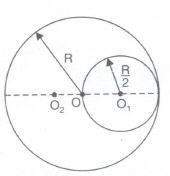
Let from a bigger uniform disc of radius R with centre O a smaller circular hole of radius\(\frac { R }{ 2 } \) with its centre at O1 (where OO1= \(\frac { R }{ 2 } \)) is cut out. Let centre of gravity or the centre of mass of remaining flat body be at O2 where OO2 = x. If σ be mass per unit area, then mass of whole disc M1 = \(\pi\)R2σ and mass of cut out part
M2 = \(\pi\)\(\left( \frac { R }{ 2 } \right) ^{ 2 }\) σ =\(\frac { 1 }{ 4 } \) \(\pi\)R2σ = \(\frac { { M }_{ 1 } }{ 4 } \)
∴ x = \(\frac { { M }_{ 1 }\times (0)-{ M }_{ 2 }({ OO }_{ 1 }) }{ { M }_{ 1 }-{ M }_{ 2 } } =\frac { 0-\frac { { M }_{ 1 } }{ 4 } \times \frac { R }{ 2 } }{ { M }_{ 1 }-\frac { { M }_{ 1 } }{ 4 } } =-\frac { R }{ 6 } \)
i.e O2 is at distance \(\frac { R }{ 6 } \)from centre of disc on diametrically opposite side to centre of hole.
19.
\( f \times R=\left(\frac{M R^2}{2}\right) \alpha \)
\( f=\frac{M R \alpha}{2} \)
\( F-f=M a_{c m} \)
\( a_{c m}=\frac{F-f}{M}\)
For pure rolling \(\mathrm{a}_{\mathrm{cm}}=\mathrm{R} \alpha\)
\(f=\frac{M}{2}\left(a_{c m}\right)=\frac{M}{2}\left(\frac{F-f}{M}\right)\)
so, on rearranging above equation, we get
F = 3f
\({ F }_{ max }=\mu mg ={ F }_{ max }=3\mu mg\).

11th Standard CBSE Syllabus & Materials
11th Standard CBSE
CBSE 11th Business Studies Forms of Business Organisation Sample Question Papers Study Material - QB365 Set A
NEW11th Standard CBSE
CBSE 11th Business Studies Business, Trade and Commerce Sample Question Papers Study Material - QB365 Set A
NEW11th Standard CBSE
CBSE 11th Physics Waves Sample Question Papers Study Material - QB365 Set A
NEW11th Standard CBSE
CBSE 11th Physics Kinetic Theory Sample Question Papers Study Material - QB365 Set A



CBSE 11th Standard CBSE Subjects
CBSE Standards









