
 100% FREE ACCESS
11th Standard CBSE Syllabus & Materials
11th Standard CBSE
CBSE 11th Economics PART-A - Presentation of Data - New Sample Question Papers Study Material - QB365 Set A
NEW11th Standard CBSE
CBSE 11th Economics PART-A - Organisation of Data - New Sample Question Papers Study Material - QB365 Set A
NEW11th Standard CBSE
CBSE 11th Economics PART-A - Collection of Data - New Sample Question Papers Study Material - QB365 Set A
NEW11th Standard CBSE
CBSE 11th Economics PART-A - Introduction to Economics and Statistics - New Sample Question Papers Study Material - QB365 Set A
NEW11th Standard CBSE
CBSE 11th Business Studies International Trade Sample Question Papers Study Material - QB365 Set A
NEW11th Standard CBSE
CBSE 11th Business Studies Evolution and Fundamentals of Business Sample Question Papers Study Material - QB365 Set A

Published on: 27/09/2019
System of Particles and Rotational Motion
Download CBSE Class 11th Standard CBSE Physics question papers, sample papers, important questions, and previous year solved papers in PDF format. Get free study materials, NCERT solutions, and exam preparation resources for Class 11th Standard CBSE Physics
Questions + Answers key
Take MCQ Physics Test
1.
A rod of weight W is supported by two parallel knife edges A and B and is in equilibrium in a horizontal position. The distance between the knife edges is d and the centre of mass of the rod is at a distance x from A. Find the value of normal reactions at the knife edges A and B
2.
Equal torques are applied on a cylinder and a sphere. Both have same mass and radius. The cylinder rotates about its axis and the sphere rotates about one of its diameters. Which will acquire greater speed? Explain why.
3.
Mathematically establish the third equation of rotational motion ω2 -\({ \omega }_{ 0 }^{ 2 }\) = 2α\(\theta\)
4.
A ring, a disc and a shpere, all of the same radius and mass roll down an inclined plane from the same height h. Which of the three reaches the bottom (i) earliest (ii) latest?
5.
How much fraction of the kinetic energy of rolling is purely translational
6.
A circular hole of radius 1 m is cut off from a disc of radius 6 m. The centre of the hole is 3 m from the centre of the disc. Find the centre of mass of the remaining disc.
7.
Angular momentum of a system is conserved if its M.I. is changed. ls its rotational K.E. also conserved?
8.
(a) Find the moment of inertia of a sphere about a tangent to the sphere, given the moment of inertia of the sphere about any of its diameters to be 2 MR2/5, where M is the mass of the sphere and R is the radius of the sphere.
(b) Given the moment of inertia of a disc of mass M and radius R about any of its diameters to be MR2/4, find its moment of inertia about an axis normal to the disc and passing through a point on its edge.
9.
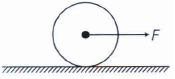
uniform disc of radius R is resting on a table on its rim. The coefficient of friction between disc and table is \(\mu \)(figure). Now, the disc is lled with a force F as shown in the figure. What is the maximum value of F for which the disc rolls without slipping?
10.
A particle on a rotating disc have initial and final angular position are 6rad, -2rad. In which case, particle undergoes a negative displacement.
11.
A particle on a rotating disc have initial and final angular position are -4rad, -8rad. In which case, particle undergoes a negative displacement.
12.
A particle on a rotating disc have initial and final angular position are -2rad, +6rad. In which case, particle undergoes a negative displacement.
13.
A cylinder of mass 10 kg and radius 15 cm is rolling perfectly on a plane of inclination \({ 30 }^{ \circ }\). The coefficient of static friction, \({ \mu }_{ s }=0.25\).
(a) How much is the force of friction acting on the cylinder?
(b) What is the work done against friction during rolling?
(c) If the inclination θ of the plane is increased, at what value of θ does the cylinder begin to skid, and not roll perfectly?
14.
A bullet of mass 10 g and speed 500 m/s is fired into a door and gets embedded exactly at the centre of the door. The door is 1.0 m wide and weight 12 kg. It is hinged at one end and rotates about a vertical axis practically without friction. Find the angular speed of the door just after the bullet embeds into it.
(Hint: The moment of inertia of the door about the vertical axis at one end is ML2/3.)
15.
A solid cylinder of mass 20 kg rotates about its axis with angular speed 100 rad s-1. The radius of the cylinder is 0.25 m. What is the kinetic energy associated with the rotation of the cylinder? What is the magnitude of angular momentum of the cylinder about its axis?
1.
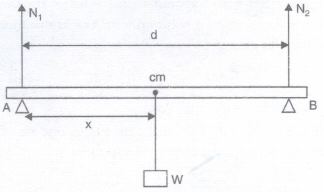
Let reactions on two knife edges be N1 and N2 respectively.
Then N1+ N2 = W ...(i)
and from principle of moments, taking moments at point A, we have
N2 \(\times\)d = W\(\times\)x ..(ii)
Equation (ii) leads
N2 =\(\frac { Wx }{ d } \)
and substituting this value in (i), we get N1 = W -N2 = W-\(\frac { Wx }{ d } \) = W\(\left( 1-\frac { x }{ d } \right) \)
2.
We know ፒ = Iα or \(\alpha =\frac { \tau }{ I } \)
∴ Angular acceleration produced in the cylinder is \(\alpha _{ c }=\frac { \tau }{ I_{ c } } \)
Similarly, acceleration produced in the sphere is
\(\alpha _{ S }=\frac { \tau }{ I_{ S } } \)
∴ \(\frac { \alpha _{ C } }{ \alpha _{ S } } =\frac { I_{ S } }{ I_{ C } } \)
Now \(I_{ S }=\frac { 2 }{ 3 } { MR }^{ 2 }\quad and\quad { I }_{ C }=\frac { 1 }{ 2 } { MR }^{ 2 }\)
∴ \(\frac { { \alpha }_{ C } }{ { \alpha }_{ S } } =\frac { 4 }{ 3 } \) or \({ \alpha }_{ C }=\frac { 4 }{ 3 } { \alpha }_{ S }\)
or \({ \alpha }_{ C }>{ \alpha }_{ S }\)
Thus cylinder will acquire greater speed than that of the sphere
3.
We know that angular acceleration is defined as
∴ \(\alpha =\frac { d\omega }{ d\theta } .\frac { d\theta }{ dt } =\omega \frac { d\omega }{ d\theta } \) \(\left[ \because \omega =\frac { d\theta }{ dt } \right] \)
or α d \(\theta\) = ωdω
On integrating, we have
\(\int _{ 0 }^{ \theta }{ \alpha d\theta } =\int _{ { \omega }_{ 0 } }^{ \omega }{ \omega d\omega } \)
∴ \(\left[ \alpha \theta \right] _{ 0 }^{ \theta }=\left[ \frac { { \omega }^{ 2 } }{ 2 } \right] _{ { \omega }_{ 0 } }^{ \omega }\)
or ω(\(\theta\)-0) = \(\frac { { \omega }^{ 2 } }{ 2 } -\frac { { \omega }_{ 0 }^{ 2 } }{ 2 } \)
⇒ω2-ω02 = 2α\(\theta\) ,which is the requisite relation
4.
Linear acceleration of a body rolling down an inclined plane
a =\(\frac { g\quad sin\theta }{ 1+\frac { 1 }{ M{ r }^{ 2 } } } \)
Linear acceleartion of ring =\(\frac { g\quad sin\theta }{ 1+\frac { M{ r }^{ 2 } }{ M{ r }^{ 2 } } } =\frac { g sin\theta }{ 2 } \) [∵ I= Mr2]
Linear acceleration of disc =\(\frac { g\quad sin\theta }{ 1+\frac { M{ r }^{ 2 } }{ 2M{ r }^{ 2 } } } \) =\(\frac { g sin \theta }{ 1.5 } \) [∵ I=\(\frac { 1 }{ 2 } \)Mr2]
Linear acceleration of sphere =\(\frac { g\quad sin\theta }{ 1+\frac { 2 }{ 5 } \frac { M{ r }^{ 2 } }{ M{ r }^{ 2 } } } \) =\(\frac { g sin\theta }{ 1.5 } \) [∵I=\(\frac { 1 }{ 2 } \)Mr2]
Therefore, the sphere reaches first and ring the last.
5.
Fraction of translational kinetic energy = \(\frac { \frac { 1 }{ 2 } { mv }^{ 2 } }{ \frac { 1 }{ 2 } { mv }^{ 2 }+\frac { 1 }{ 2 } I{ \omega }^{ 2 } } \)
\(=\frac { 1 }{ 1+\frac { { k }^{ 2 } }{ { r }^{ 2 } } } =\frac { { r }^{ 2 } }{ ({ k }^{ 2 }+r^{ 2 }) } \)
6.
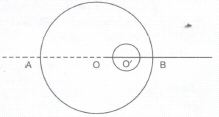
Let 0 be the centre of the disc and O' that of the hole.
To find the centre of mass, we use the fact that a body balances at this point, i.e the algebraic sum of the moments of the weights about the centre of gravity is zero. The weight W1 of the disc acts at point O. The hole can be regarded as a negative weight W2 acting at O'
If X is the distance of the centre of gravity of the combination from point 0, then
X = \(\frac { { W }_{ 1 }\times O+(-{ W }_{ 2 })\times 3 }{ { W }_{ 1 }+(-{ W }_{ 2 }) } \)
Also W1= ρ\(\pi \)\(\times\)(6)2 =36 ρ\(\pi \)
W2=ρ\(\pi \)\(\times\)(1)2 =ρ\(\pi \)
where ρ is the mass per unit area of the disc.
Substituting the values of W1 and W2, we get
\(X=\frac { -\rho \pi \times 3 }{ 36\rho \pi -\rho \pi } m=\frac { -3 }{ 35 } m\)
The negative sign indicates that the centre of gravity is to the left of the point O.
7.
Kinetic energy of rotation = \(\frac { 1 }{ 2 } I{ \omega }^{ 2 }=\frac { 1 }{ 2 } (I\omega )=\frac { 1 }{ 2 } L\omega \)
L= Iω is constant if moment of inertia (I) of the system changes. It means as I changes, then ω also changes to keep Iω= constant. Hence K.E. of rotation also changes with the change in I. In other words, rotation K.E. is not conserved.
8.
(a) Moment of inertia of sphere about any diameter = MR2
Applying theorem of parallel axes
Moment of inertia of sphere about a tangent to the sphere =\(\frac { 2 }{ 5 } \)MR2+ M(R)2 =\(\frac { 7 }{ 5 } \)MR2
(b) We are given, moment of inertia of the disc about any of its diameters =\(\frac { 1 }{ 4 } \)MR2
(i) Using theorem of perpendicular axes, moment of inertia of the disc about an axis passing through its centre and normal to the disc =2\(\times\)\(\frac { 1 }{ 4 } \)MR2 +\(\frac { 1 }{ 2 } \)MR2
(ii) Using theorem axes, moment of inertia of the disc passing through a point on its edge and normal to the dies = \(\frac { 1 }{ 2 } \) MR2 + MR2 =\(\frac { 3 }{ 2 } \)MR2
9.
Let the acceleration of the centre of mass of disc be a, then , Ma = F - f
The angular acceleration of the disc is a =a/ R (if there is no sliding).
Then, \(\left( \frac { 1 }{ 2 } M{ R }^{ 2 } \right) \alpha \) = Rf \(\Rightarrow \) Ma =2f
Thus, f = F /3.Since, there is no sliding.
\(\Rightarrow \) f <\(\mu \) F\(\le \) 3\(\mu \) Mg
10.
Angular displacement is
\(\Delta \theta =-2rad-(+6rad)=-8rad\)
11.
Angular displacement is
\(\Delta \theta ={ \theta }_{ f }-{ \theta }_{ i }=-8rad-(-4rad)=-4rad\)
12.
Angular displacement is
\(\Delta \theta ={ \theta }_{ f }-{ \theta }_{ i }=6-(-2)=8rad\)
13.
(a) Given, mass of the cylinder m =10 kg
Radius, r = 15 cm = 0.15 m
Inclination of plane, \(\theta ={ 30 }^{ \circ }\)
Coefficient of static friction, \({ \mu }_{ s }=0.25\).
Force of friction acting on the cylinder on the inclined plane,
\(F=\frac { 1 }{ 3 } mg\sin { \theta } =\frac { 1 }{ 3 } \times 10\times 9.8\times \sin { { 30 }^{ \circ } } \)
\(=\frac { 1 }{ 3 } \times 10\times 9.8\times \frac { 1 }{ 2 }\)
\( =16.3\quad N\)
(b) Force of friction acts perpendicular to the direction of displacement.
\(\therefore \) Work done aganist friction during rolling
\(W=Fscos{ 90 }^{ \circ }=0\).
(c) For rolling without slipping,
\(\mu =\frac { 1 }{ 3 } \tan { \theta } \)
or \(\tan { \theta } =3\mu =3\times 0.25=0.75\)
\(=tan{ 36 }^{ \circ }{ 54 }^{ ' }\)
or \(\theta ={ 36 }^{ \circ }{ 54 }^{ ' }={ 37 }^{ \circ }\).
14.
Given, mass of bullet (m) = 10 gm = 0.01 kg
Speed of bullet (v) = 500 m/s
Width of the door (l) = 1.0 m
Mass of the door (M) = 12kg
As bullet gets embedded exactly at the centre of the door, therefore its distance from the hinged end of the door,
r = \(\frac { l }{ 2 } =\frac { 1 }{ 2 } m\)
Angular momentum transferred by the bullet to the door,
\(L=mv\times r=0.01\times 500\times \frac { 1 }{ 2 } =2.5Js\)
Moment of inertia of the door about the vertical axis at one of its end, \(I=\frac { { Ml }^{ 2 } }{ 3 } =\frac { 12\times { \left( 1 \right) }^{ 2 } }{ 3 } =4kg-m^{ 2 }\)
But angular momentum, \(L=I\omega \)
\(2.5=4\times \omega \)
\(\omega =\frac { 2.5 }{ 4 } =0.625rad/s\).
15.
Moment of inertia of cylinder about its own axis = \(=\frac { 1 }{ 2 } MR^{ 2 }\)
\(=\frac { 1 }{ 2 } \times 20\times { \left( 0.25 \right) }^{ 2 }kg-m^{2}\)
= 0.625 kg-m2
Kinetic energy of rotating cylinder
\(=\frac { 1 }{ 2 } { I\omega }^{ 2 }=\frac { 1 }{ 2 } (0.625) { \left( 100 \right) }^{ 2 }J=3125J\).
Angular momentum of cylinder about its own axis
\(=I\omega =0.625\times 100\)
\(\\ =62.5\ kg-{ m }^{ 2 }/s\)

11th Standard CBSE Syllabus & Materials
11th Standard CBSE
CBSE 11th Business Studies Forms of Business Organisation Sample Question Papers Study Material - QB365 Set A
NEW11th Standard CBSE
CBSE 11th Business Studies Business, Trade and Commerce Sample Question Papers Study Material - QB365 Set A
NEW11th Standard CBSE
CBSE 11th Physics Waves Sample Question Papers Study Material - QB365 Set A
NEW11th Standard CBSE
CBSE 11th Physics Kinetic Theory Sample Question Papers Study Material - QB365 Set A



CBSE 11th Standard CBSE Subjects
CBSE Standards









