
 100% FREE ACCESS
11th Standard CBSE Syllabus & Materials
11th Standard CBSE
CBSE 11th Economics PART-A - Presentation of Data - New Sample Question Papers Study Material - QB365 Set A
NEW11th Standard CBSE
CBSE 11th Economics PART-A - Organisation of Data - New Sample Question Papers Study Material - QB365 Set A
NEW11th Standard CBSE
CBSE 11th Economics PART-A - Collection of Data - New Sample Question Papers Study Material - QB365 Set A
NEW11th Standard CBSE
CBSE 11th Economics PART-A - Introduction to Economics and Statistics - New Sample Question Papers Study Material - QB365 Set A
NEW11th Standard CBSE
CBSE 11th Business Studies International Trade Sample Question Papers Study Material - QB365 Set A
NEW11th Standard CBSE
CBSE 11th Business Studies Evolution and Fundamentals of Business Sample Question Papers Study Material - QB365 Set A

Published on: 16/09/2019
System of Particles and Rotational Motion
Download CBSE Class 11th Standard CBSE Physics question papers, sample papers, important questions, and previous year solved papers in PDF format. Get free study materials, NCERT solutions, and exam preparation resources for Class 11th Standard CBSE Physics
Questions + Answers key
Take MCQ Physics Test
1.
Should the centre of mass of a body necessarily lie inside the body? Explain
2.
Name the quantity which can bring rolling without slipping
3.
Why does a girl have to lean towards right when carrying a bag in her left hand?
4.
A labourer standing near the top of an old wooden step-ladder feels unstable. Why?
5.
Can a body in translatory motion have angular momentum?
6.
What type of motion is produced by couple?
7.
Which component of a force does not contribute towards torque
8.
Does tile radius of gyration depend on the angular velocity of the body?
9.
Does angular momentum of a body in translatory motion is zero?
10.
A fan of moment of inertia is 0.6 kg-m2 is to be run upto a working speed of 0.5 rps. What is the angular momentum of the fan?
11.
If earth contract to half its radius. What would be the length of the day?
12.
A solid cylinder of mass 20 kg rotates about its axis with angular speed of 100 rad/s. The radius of cylinder is 0.25m. What is KE of rotation of cylinder?
13.
If ice on poles melts, then what is the change in duration of day?
14.
Two boys of the same weight it at the opposite ends of a diameter of a rotating circular table. What happens to the speed of rotation if they move nearer to the axis of rotation?
15.
A person is standing on a rotating table with metal spheres in his hands. If he withdraw his hands to his chest, what will be the effect on his angular velocity?
1.
No, it may lie outside the body. In case of semicircular ring, it is at the centre which is outside the ring.
2.
Friction with the surface.
3.
When the girl carries a bag in her left hand, the centre of gravity of the system is shifted to the left. In order to bring it in the middle, the girl has to lean towards right.
4.
The point of contact of the ladder with the ground is the point about which the ladder can rotate. When the labourer is at the top of the ladder, the lever arm of force i large. So, the turning effect can. be large.
5.
Yes, a particle in translatory motion always has an angular momentum, unless the point (about which angular momentum is calculated) lies on the line of motion.
6.
Only rotational motion
7.
The radial component of a force does not contribute towards torque.
8.
No, \(K=\sqrt { \frac { 1 }{ M } } \)
9.
Angular momentum of a body is measured with respect to certain origin.
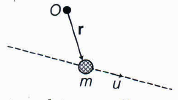
So, a body in translatory motion can have angular momentum.
It will be zero, if origin lies on the line of motion of particle.
10.
1.9 km-m/s
11.
The moment of inertia \(\left( I=\frac { 1 }{ 2 } MR^{ 2 } \right) \) of the earth about its own axis will become one-fourth and so its angular velocity will become four times\(\left( L=I\omega =constant \right) \). Hence, the time period will reduce to one-fourth \(\left( T=2\pi /\omega \right) \), i.e. 6 hours.
12.
M = 20 Kg, \(\omega =100rad/s,R=0.25m\).
Moment of inertia of cylinder about its own axis
\(=\frac { 1 }{ 2 } MR^{ 2 }=\frac { 1 }{ 2 } \times 20\times { \left( 0.25 \right) }^{ 2 }\)
Rotational KE \(=\frac { 1 }{ 2 } { I\omega }^{ 2 }\)
\(=\frac { 1 }{ 2 } { I\omega }^{ 2 }=\frac { 1 }{ 2 } \times 0.625\times { \left( 100 \right) }^{ 2 }=3125J\).
13.
Molten ice from poles into ocean and so mass is going away from axis of rotation. So, moment of inertia of earth increases and to conserve angular momentum, angular velocity (\(\omega \)) decreases. So, time period of rotation increases (\(T=2\pi /\omega \) ). So, net effect of global warming is increasing in the duration of day.
14.
The moment of inertia of the system (circular table + two boys) decreases. To conserve angular momentum (\(L=I\omega =constant\)), the speed of rotation of the circular table increases.
15.
When the person withdraws his chest, his moment of inertia decreases. No external torque is acting on the system. So, to conserve angular momentum, the angular velocity increases.

11th Standard CBSE Syllabus & Materials
11th Standard CBSE
CBSE 11th Business Studies Forms of Business Organisation Sample Question Papers Study Material - QB365 Set A
NEW11th Standard CBSE
CBSE 11th Business Studies Business, Trade and Commerce Sample Question Papers Study Material - QB365 Set A
NEW11th Standard CBSE
CBSE 11th Physics Waves Sample Question Papers Study Material - QB365 Set A
NEW11th Standard CBSE
CBSE 11th Physics Kinetic Theory Sample Question Papers Study Material - QB365 Set A



CBSE 11th Standard CBSE Subjects
CBSE Standards









