
 100% FREE ACCESS
11th Standard CBSE Syllabus & Materials
11th Standard CBSE
CBSE 11th Economics PART-A - Presentation of Data - New Sample Question Papers Study Material - QB365 Set A
NEW11th Standard CBSE
CBSE 11th Economics PART-A - Organisation of Data - New Sample Question Papers Study Material - QB365 Set A
NEW11th Standard CBSE
CBSE 11th Economics PART-A - Collection of Data - New Sample Question Papers Study Material - QB365 Set A
NEW11th Standard CBSE
CBSE 11th Economics PART-A - Introduction to Economics and Statistics - New Sample Question Papers Study Material - QB365 Set A
NEW11th Standard CBSE
CBSE 11th Business Studies International Trade Sample Question Papers Study Material - QB365 Set A
NEW11th Standard CBSE
CBSE 11th Business Studies Evolution and Fundamentals of Business Sample Question Papers Study Material - QB365 Set A

Published on: 11/10/2019
Thermal Properties of Matter
Download CBSE Class 11th Standard CBSE Physics question papers, sample papers, important questions, and previous year solved papers in PDF format. Get free study materials, NCERT solutions, and exam preparation resources for Class 11th Standard CBSE Physics
Questions + Answers key
Take MCQ Physics Test
1.
A block of wood is floating on water at ooe with a certain volume x above the level of water. The temperature of water is gradually increased from ooe to 8 0C, How does the volume x change with change in temperature ?
2.
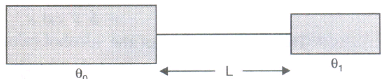
The figure shows a large tank of water at a constant temperature f}o and a small vessel containing
a mass 'm' ofwater at an initial temperature f}l « f}c). A metal rod of length L, area of cross section and thermal conductivity K connects the two vessels, Find the time taken for the temperature of the water in the smaller vessel to become \(\theta\)2 (\(\theta\)1< \(\theta\)2 <\(\theta\)0 ) Specific heat capacity of water is's' and all other heat capacities are negligible.
3.
A brass rod of length 50 cm and diameter 3.0 mm is joined to a steel rod of the same length and diameter. What is the change in length of the combined rod at 250 °C, if the original lengths are at 40.0 °C? Is there a ‘thermal stress’ developed at the junction ? The ends of the rod are free to expand (Co-efficient of linear expansion of brass = 2.0 x 10⁻⁵ K-1 , steel =1.2 x 10⁻⁵ K-1
4.
Distinguish between conduction, convection and radiation
5.
Explain why an optical pyrometer (for measuring high temperature) calibrated for an ideal black body radiation gives too low a value for the temperature of a red hot iron piece in the open, but gives a correct value for the temperature when the same piece is in the furnace.
6.
What is the temperature of the triple point of water on an absolute scale whose unit interval size is equal to that of the fahrenheit scale?
7.
Answer the following.
(a) The triple-point of water is a standard fixed point in modern thermometry. Why ? What is wrong in taking the melting point of ice and the boiling point of water as standard fixed points (as was originally done in the Celsius scale) ?
(b) There were two fixed points in the original Celsius scale as mentioned above which were assigned the number 0 °C and 100 °C respectively. On the absolute scale, one of the fixed points is the triple-point of water, which on the Kelvin absolute scale is assigned the number 273.16 K. What is the other fixed point on this (Kelvin) scale?
(c) The absolute temperature (Kelvin scale) T is related to the temperature tc on the Celsius scale by tc = T – 273.15 Why do we have 273.15 in this relation, and not 273.16?
(d) What is the temperature of the triple-point of water on an absolute scale whose unit interval size is equal to that of the Fahrenheit scale?
8.
A brass wire 1.8 m long at 27o C is held taut with little tension between two rigid support. If the wire is cooled to a temperature of -39o C, what is the tension developed in the wire if its diameter is 2mm?
9.
A copper cube of mass 200 g slides down on a rough inclined plane having inclination 37o at a constant speed. If any loss in mechanical energy goes into the copper block as thermal energy. Find the increase in the temperature of the block as it slides down through 60 cm. Given, specific heat of copper is 420 J Kg-1K-1 .
10.
A circular disc made by iron is rotating about its axis of rotation with a uniform angular speed \(\omega \)
Determine the change in the linear speed of particle at the rim in percentage. The disc of rim is slowly heated from 20o C to 50o C keeping the angular speed uniform. Give that coefficient of linear expansion for the material of iron is \(1.2\times 10^{ -5\quad }\)\(^{0}\)C-1
1.
As the density of water increases and volume of water decreases from a °C to 4°C, so the volume x of the wooden block will increase till the temperature of water becomes 4°C. Now, as the temperature increases from 4°C to 8°C, the density of water decreases and its volume increases above 4°C, therefore the volume x of the block will also decrease.
2.
Suppose the temperature of the water in the smaller vessel is 8 at time t. In the next time interval dt, a heat, \(\triangle\)\(\theta\) is transferred to it where
\(\triangle \theta =\frac { KA }{ L } \left( { \theta }_{ 0 }-{ \theta } \right) dt\)
This heat increases the temperature of the water of mass 'm' to \(\theta\) + d\(\theta\)
Where \(\triangle\)\(\theta\) = ms d\(\theta\)
From eqn. (i) and (ii),
\(\frac { KA }{ L } \left( { \theta }_{ 0 }-{ \theta } \right) dt=msd\theta \)
or dt = \(\frac { Lms }{ KA } \frac { d\theta }{ { \theta }_{ 0 }-\theta } \)
\(\Rightarrow\) \(\int _{ 0 }^{ T }{ dt } =\frac { Lms }{ KA } \int _{ { \theta }_{ 1 } }^{ { \theta }_{ 2 } }{ \frac { d\theta }{ { \theta }_{ o }-\theta } } \)
where T is the time required for the temperature of the water to become \(\theta\)2
Thus, \(\left[ \frac { Lms }{ KA } In\frac { { \theta }_{ 0 }-{ \theta }_{ 1 } }{ { \theta }_{ 0 }-{ \theta }_{ 2 } } \right] \)
3.
\(For\ brass\ rod,\ l=50\ cm,\ t_{ 1 }=40^{ 0 }C,\ t_{ 2 }=250^{ 0 }C\)
\(\ \alpha =2.0\times 10^{ -5 }\ ^{ 0 }C^{ -1 }\)
\(\\ Change\ in\ length\ of\ brass\ rod\ is\)
\(\\ \triangle l=\alpha l({ t }_{ 2 }-{ t }_{ 1 })\)
\(\\ =2.0\times 10^{ -5 }\times 50\times (250-40)=0.21cm\)
\(\\ For\ steel\ rod,\ l=50cm,t_{ 1 }=40^{ 0 }C,\ t_{ 2 }=250^{ 0 }C,\)
\(\\ \ \alpha =1.2\times 10^{ -5 }\ ^{ 0 }C^{ -1 }\)
\(\\ Change\in\ length\ o f\ steel\ rod\ is\)
\(\\ \triangle l'=\alpha l({ t }_{ 2 }-{ t }_{ 1 })\)
\(\\ =1.2\times 10^{ -5 }\times 50\times (250-40)=0.13cm\)
\(\\ Change\ in\ length\ of\ the\ combined\ rod\ at\ 250^{ 0 }C\)
\(\\ =\triangle l+\triangle l'=0.21+0.13=0.34cm\)
\(\\ =1.2\times 10^{ -5 }\times 50\times (250-40)=0.13cm\)
\(\\ Change\ in\ length\ of\ the\ combined\ rod\ at\ 250^{ 0 }C\)
\(\\ =\triangle l+\triangle l'=0.21+0.13=0.34cm\)
As the rods expand freely, so no thermal stress is developed at the junction.
4.
| S.No | Conduction | Convection | Radiation |
| 1 | It is the transfer of heat by direct physical contact | It is the transfer of heat by the motion of a fluid | It is the transfer of heat by electromagnetic waves. |
| 2 | It is due to temperature difference. Heat flows from high-temperature region to low temperature region. | It is due to difference in density. Heat flows from low destiny region to high density region | It occurs from all bodies at temperatures above 0 K |
| 3 | It occurs in solids through molecular collisions, without actual flow of matter. | It occurs in fluids by actual flow of matter | It can take place at large distances and does not heat the intervening medium |
| 4 | It is a slow process | It is also a slow process | It propagates at the speed of light. |
| 5 | It does not obey the laws of reflection and refraction | It does not obey the laws of reflection and refraction | It obeys the laws of reflection and refarction |
5.
Let T be the temperature of the hot iron in the furnace. Heat radiated per second per unit area, E = \(\sigma \)T4 . When the body is placed in the open at temperature T0 , the heat radiated/Second/unit area,
E' = \(\sigma \)(T4-T04)
Clearly, E' < E. So, the optical pyrometer gives too low a value for the temperature in the open.
6.
One degree on fahrenheit scale
= 180 / 100 = 9 / 5 divisions on Celsius scale
But one Celsius scale division is equal to one division on kelvin scale.
\(\therefore \) Triple point on kelvin scale (whose size of a degree is equal to that of the fahrenheit scale)
= 273.16 x 9 / 5 = 491.69
7.
(a) The melting point of ice as well as the boiling of water change in pressure. The presence of impurities also changes the melting and boiling points. However, the triple point of water has a unique temperature and is independent of external factors.
(b) The other fixed point on Kelvin scale is absolute zero, which is the temperature at which the volume and pressure of any gas become zero.
(c) As the triple point of water on Celsius is 0.010C (and not 00 C) and on kelvin scale 273.16 and the size of degree on the two scale is same, so
tc - 0.01 = T - 273.16
tc = T - 273.15
(d) One degree on fahrenheit scale
= 180 / 100 = 9 / 5 divisions on Celsius scale
But one Celsius scale division is equal to one division on kelvin scale.
\(\therefore \) Triple point on kelvin scale (whose size of a degree is equal to that of the fahrenheit scale)
= 273.16 x 9 / 5 = 491.69
8.
\(3.8\times { 10 }^{ 2 }N\)
9.
8.6 × 10∘C

As block slides along x only mgsinθ and friction F do work, let them be mglsin θ and wF.
Now, speed is constant
∴ All the loss in potential energy is dissipated as heat, no. kinetic energy being gained.
(s is the specific heat) ⇒ mglsinθ = wF = Heat lost = ms Δ T
\( \Rightarrow \Delta T=\frac{g l \sin \theta}{5}=\frac{10 \times \frac{60}{100} \times \frac{3}{5}}{420}\)
\( =8.6 \times 10^{-3}{ }^{\circ} \mathrm{C}
\)
10.
3.6 x 10⁻²

11th Standard CBSE Syllabus & Materials
11th Standard CBSE
CBSE 11th Business Studies Forms of Business Organisation Sample Question Papers Study Material - QB365 Set A
NEW11th Standard CBSE
CBSE 11th Business Studies Business, Trade and Commerce Sample Question Papers Study Material - QB365 Set A
NEW11th Standard CBSE
CBSE 11th Physics Waves Sample Question Papers Study Material - QB365 Set A
NEW11th Standard CBSE
CBSE 11th Physics Kinetic Theory Sample Question Papers Study Material - QB365 Set A



CBSE 11th Standard CBSE Subjects
CBSE Standards









