
 100% FREE ACCESS
11th Standard CBSE Syllabus & Materials
11th Standard CBSE
CBSE 11th Economics PART-A - Presentation of Data - New Sample Question Papers Study Material - QB365 Set A
NEW11th Standard CBSE
CBSE 11th Economics PART-A - Organisation of Data - New Sample Question Papers Study Material - QB365 Set A
NEW11th Standard CBSE
CBSE 11th Economics PART-A - Collection of Data - New Sample Question Papers Study Material - QB365 Set A
NEW11th Standard CBSE
CBSE 11th Economics PART-A - Introduction to Economics and Statistics - New Sample Question Papers Study Material - QB365 Set A
NEW11th Standard CBSE
CBSE 11th Business Studies International Trade Sample Question Papers Study Material - QB365 Set A
NEW11th Standard CBSE
CBSE 11th Business Studies Evolution and Fundamentals of Business Sample Question Papers Study Material - QB365 Set A

Published on: 26/07/2019
Motion in a Straight Line
Download CBSE Class 11th Standard CBSE Physics question papers, sample papers, important questions, and previous year solved papers in PDF format. Get free study materials, NCERT solutions, and exam preparation resources for Class 11th Standard CBSE Physics
Questions + Answers key
Take MCQ Physics Test
1.
Under what condition will the distance and displacement of a moving object will have the same magnitude?
2.
Write the expression for distance covered in nth second by a uniformly accelerated body.
3.
What is the shape of displacement-time graph for uniform linear motion?
4.
The displacement o a particle is given by at2. What is the dependency of accleration on time?
5.
For what condiion, an object could be considered as a point object? Describe in brief
6.
In which of the following examples of motion, can be the body be considered approximately a point object?
A monkey sitting on the top of a man cycling smoothly on a circular track.
7.
Position-time graph could have negative slope Is it true or false?
8.
For which condition, the distance and the magnitude of displacement of an object have the same values?
9.
Does the displacement of an object depend on the choice of the postion of origin of the coordinate system?
10.
Can a tumbling beaker that has slipped off the edge of a table considered as a point object?
11.
What is the condition for an object to be considered as a point object?
12.
Two trains of lengths 109 m and 91m are moving in opposite directions with velocities 34 km h-1 and 38 kmh-1 respectively. In what time the two trains will completely cross each other? Choose the most logical reference point for time measurement.
13.
The velocity of a particle is given by equation v = 4 + 2 (c1 + c2 t), where c1and c2 are constant. Find the initial velocity and acceleration of the particle.
14.
To what height does the ball rise and after how long does the ball return to the player's hands?(Take g = 9.8ms-2 and neglect air resistance)
15.
Choose x=0 and t=0 be the location and time at its highest point, vertically downward direction to be the positive direction of x-axis and give the signs of position, velocity and acceleration of the ball during its upward and downward motion.
16.
What are the velocity and accelration of the ball at the highest point of its motion?
17.
State the kinematic equations for uniformly accelerated motion.
18.
Two parallel rail tracks run North-South.Train A moves North with a speed of 54 kmh-1. and train B moves South with a speed of 90 kmh-1 . What is the velocity of monkey on the roof of the train A against its motion (with a velocity of 18 kmh-1 with respect to train A) as observed by a man standing on the ground?
19.
In case of a moving body
displacement > distance
displacement < distance
displacement ≥ distance
displacement ≤ distance
20.
When the distance travelled by a body is directly proportional to the time, the body is said to have a
zero speed
uniform acceleration
zero velocity
uniform speed
21.
Which of the following is not a vector quantity?
acceleration
velocity
speed
displacement
22.
The displacement of an object at any instant is given by x = 30 + 20 t2, where x is in metres and t in seconds. The acceleration of the object will be
40 ms-2
50 ms-2
30 ms-2
zero
23.
The displacement x of a particle varies with time according to the relation x=\(\frac { a }{ b } \)(1-e-bt). Then
At t =\(\frac { 1 }{ b } \) , the displacement of the particle is nearly (2/3) (a/b).
The particle cannot reach a point at a distance x from its starting position if x> a/ b.
The velocity and acceleration of the particle at t = 0 are a and - ab respectively.
The particle will come back to its starting point as t ⇾∞.
1.
Distance and displacement will have the same magnitude when the object moves along a straight line without change in its direction.
2.
If a is the uniform acceleration
then,s = u +\(\frac { 1 }{ 2 } a\)(2n-l) where u is the initial velocity.
3.
A straight line inclined to the time axis.
4.
Let x be the displacement . Then, x = at2
\(\therefore\) Velocity of the object , v = \(\frac{dx}{dt}\)
Accleration of the object , a = \(\frac{dv}{dt}\)
It means that a is constant.
5.
An object could be considered as a point object if it covers a distance much larger than its own size.
e.g., If a bus of 5 m in size move 100 km, then the bus can be considered as a point object.
6.
Any object can be considered as a point object if the distance travelled by it is very large in comparison to its dimensions.
Man along with monkey is cycling smoothly which indicates that the distance travelled by the man is very large, therefore monkey can be taken as a point object.
7.
It is true because if the velocity of the object is negative, then slope of v-t graph is negative.
8.
The distance and the magnitude of displacement of an object have the same values, when the body is moving along a straight line path in a fixed direction.
9.
No, the displacement of the objects does not depend on the choice of the position of the origin.
10.
No, because the size of the beaker is not negligible as compared to the height of the table.
11.
An object can be considered as a point object if the distance travelled by it is very large than its size.
12.
Relative speed = (34 + 38) kmh-1 = 72 krnh-1
= 72 x - ms-1 = 20 ms-1
Total distance = (109 + 91) m = 200 m
Time = \(\frac { 200m }{ 20ms^{ -1 } } \) =10 s.
13.
Given equation of velocity,
v = 4 + 2 (c1 + c2t)
=> v = (4 + 2c1) + 2c2t
Compare the above equation with equation of motion
v = u + at
Initial velocity, u = 4 + 2c1
Acceleration of the particle = 2c2.
14.
Let t be the time taken by the ball to reach the highest point where height from ground be s.
Taking vertical upward motion of the ball, we have u =- 29.4ms-, a = 9.8ms-, v = 0, s = S,t = ?
As, v2-u2 = 2 as
0 -(-29.4)2 = 2 x 9.8 x S
or \(S=\frac { -{ (29.4) }^{ 2 } }{ 2\times 9.8 } =-44.1m\)
Here, negative sign shows that the distance is covered in upward direction.
As, v = u + at
\(\therefore \quad 0=-29.4+9.8\times t\quad or\quad t=\frac { 29.4 }{ 9.8 } =3s\)
It means time of ascent = 3s
When an object moves under the effect of gravity alone, the time of ascent is always equal to the time of descent.
Therefore, total time after which the ball returns to the player's hand = 3 + 3 = 6s.
15.
When the highest point is chosen as the location for x=0 and t=0 and vertically downward direction to be the positive direction of x-axis and upward direction as negative direction of x-axis.
During upward motion, sign of position is negative, sign of velocity is negative and sign of acceleration is positive.During downward motion, sign of position is positive, sign of velocity is positive and sign of acceleration is also positive.
16.
At the highest point, the velocity of the ball becomes zero and acceleration is equal to the acceleration due to gravity=9.8ms-2 in vertically downward direction.
17.
For uniformly accelerated motion, we can derive some simple equations that relate displacement(x), time taken(t), Initial velocity(u), final velocity(v) and acceleration(a).
(i) Velocity attained after time t: The velocity-time graph for positive constant acceleration of a particle is shown in the figure.
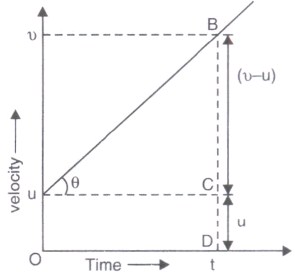
Let u be the initial velocity of the particle at t = 0 and v is the final velocity of the particle after time t. Consider two points A and B on the curve corresponding to t = 0 and t = t respectively.
Draw BD perpendicular to time axis. Also draw AC perpendicular to BD.
ஃ OA = CD = u;
BC = (v - u) and OD = t
Now slope of v-t graph = acceleration (a)
∴ a = slope of v - t graph = tan θ = \(\frac{BC}{AC}=\frac{BC}{OD} \ \ \ [∵ AC=OD]\)
∴ \(a=\frac{v-u}{t}\)
or v - u = at
v = u + at
(ii) Distance travelled in time t:
Let x0 position of the particle at t = 0 from the origin.
x = position of the particle at t = t from the origin.
∴ (x - x0) = S = distance travelled by the particle in the time interval (t - 0) = t
We know, distance travelled by a particle in the given time interval = area under velocity-time graph
∴ (x - x0) = Area OABD (see fig. above)
= Area of trapezium OABD
= \(\frac{1}{2}\) [Sum of parallel sides x perpendicular distance between parallel side]
=\(\frac{1}{2}(OA+BD)\times AC=\frac{1}{2}(u+v)t\)
Since v = u + at
∴ (x- x0) = \(\frac{1}{2}(OA+BD)\times AC = \frac{1}{2} (u+v) \times t\)
Since x - x0= S
∴ S = ut + \(\frac{1}{2}\)at2
(iii) Velocity attained after travelling a distance S:
We know, distance travelled by a particle in time t is equal to the area under velocitytime graph. Therefore, the distance (S) travelled by a particle during time interval tis given by
S = Area under v - t graph (see fig.) or
S = area of trapenium OABD
= \(\frac{1}{2}\)(sum of parallel sides) x perpendicular distance between these parallel
or S = \(\frac{1}{2}\)(OA + BD) x AC --- (i)
Now, acceleration, a = slope of v - t graph
or a = \(\frac{BC}{AC}=\frac{BD-CD}{AC}=\frac{v-u}{AC}\)
or \(AC=(\frac{v-u}{a})\) --- (ii)
Also OA = u and BD = v --- (iii)
Using equations (ii) and (iii) in equation (i), we get
\(S=\frac{1}{2}(v+u)\frac{(v-u)}{a}=\frac{v^{2}-u^{2}}{2a}\)
or, v2-u2 = 2aS
18.
Taking South to North direction as the positive direction
i.e., x-axis, we have
Let velocity of monkey with respect to ground = v m
\(\therefore \) Relative velocity of monkey with respect to train A= vm-vA=-18kmh- = -5ms-1
vm= v-5 = 15 - 5 = 10ms-1
19.
(d)
displacement ≤ distance
20.
(d)
uniform speed
21.
(c)
speed
22.
(c)
30 ms-2
23.
(a)
At t =\(\frac { 1 }{ b } \) , the displacement of the particle is nearly (2/3) (a/b).

11th Standard CBSE Syllabus & Materials
11th Standard CBSE
CBSE 11th Business Studies Forms of Business Organisation Sample Question Papers Study Material - QB365 Set A
NEW11th Standard CBSE
CBSE 11th Business Studies Business, Trade and Commerce Sample Question Papers Study Material - QB365 Set A
NEW11th Standard CBSE
CBSE 11th Physics Waves Sample Question Papers Study Material - QB365 Set A
NEW11th Standard CBSE
CBSE 11th Physics Kinetic Theory Sample Question Papers Study Material - QB365 Set A



CBSE 11th Standard CBSE Subjects
CBSE Standards









