
 100% FREE ACCESS
11th Standard CBSE Syllabus & Materials
11th Standard CBSE
CBSE 11th Economics PART-A - Presentation of Data - New Sample Question Papers Study Material - QB365 Set A
NEW11th Standard CBSE
CBSE 11th Economics PART-A - Organisation of Data - New Sample Question Papers Study Material - QB365 Set A
NEW11th Standard CBSE
CBSE 11th Economics PART-A - Collection of Data - New Sample Question Papers Study Material - QB365 Set A
NEW11th Standard CBSE
CBSE 11th Economics PART-A - Introduction to Economics and Statistics - New Sample Question Papers Study Material - QB365 Set A
NEW11th Standard CBSE
CBSE 11th Business Studies International Trade Sample Question Papers Study Material - QB365 Set A
NEW11th Standard CBSE
CBSE 11th Business Studies Evolution and Fundamentals of Business Sample Question Papers Study Material - QB365 Set A

Published on: 03/09/2019
Motion in a Plane
Download CBSE Class 11th Standard CBSE Physics question papers, sample papers, important questions, and previous year solved papers in PDF format. Get free study materials, NCERT solutions, and exam preparation resources for Class 11th Standard CBSE Physics
Questions + Answers key
Take MCQ Physics Test
1.
If,\(|A+B|=|A-B|\) What is the angle between A and B?
2.
When the sum of the two vectors maximum and minimum?
3.
What is the angle between A and B, if A and B denote the adjacent sides of a parallelogram drawn from a point and the area of the parallelogram is 1/2 AB?
4.
If \(|A+ B|=A.B\), What is the angle between A and B?
5.
The sum and difference of two vectors are perpendicular to each other.Prove that the vector are equal in magnitude
6.
Two forces 5 kg-wt.and 10 kg-wt.are acting with an inclination of 120o between them.Find the angle when the resultat makes with 10kg-wt
7.
Explain the property of two vectors A and B if \(|\mathbf{A}+\mathbf{B}|=|\mathbf{A}-\mathbf{B}|\)
8.
Find the angle made by vector, \(A=2\hat { i } +2\hat { j } \) with x-axis
9.
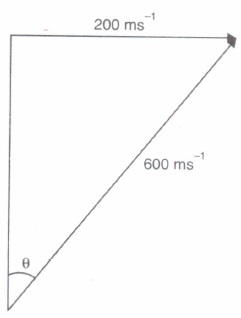
An aircraft flying horizontally at a height of 2km with a speed 200m/s passes directly over head an anti-aircraft gun.At what angle from the vertical should the gun be fired so that a shell with muzzle speed 600m/s may hit the plane? Calculate the safe height of the plane so that the shell may not hit it. Take g=10m/s2
10.
If unit vector \(\hat { a } \) and \(\hat { b } \) are inclined at angle then prove that \(\left| \hat { a } -\hat { b } \right| =2sin\quad \frac { \theta }{ 2 } \)
11.
A fighter plane flying horizontally at an altitude of 1.5 km with speed 720 km h-1 passes directly overhead an anti-aircraft gun. At what angle from the vertical should the gun be fired for the shell with muzzle speed 600 m S-1 to hit the plane? At what minimum altitude should the pilot fly the plane to avoid being hit? (Take g = 10 m S-2)?
12.
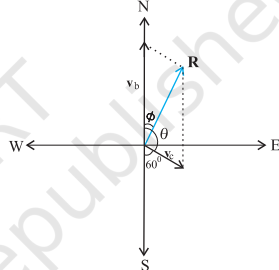
A motorboat is racing towards north at 25 km/h and the water current in that region is 10 km/h in the direction of 60° east of south. Find the resultant velocity of the boat.
1.
\(|A+B|=|A-B|
\)
\(\sqrt { A^{ 2 }+B^{ 2 }+2ABcos\theta } =\sqrt { A^{ 2 }+B^{ 2 }-2ABcos\theta }
\)
\(\Rightarrow 4ABcos\theta =0\Rightarrow cos\theta =0\)
Hence cos θ = 900 or θ = π/2
2.
The sum of two vectors is maximum, when both the Vectors are in the same direction and is minimum when they act in opposite direction.
As, \(R =\sqrt { A^{ 2 }+B^{ 2 }+2ABcos\theta }\)
(i) For R to be maximum, cos θ = +1
\(R_{ max }\sqrt { A^{ 2 }+B^{ 2 }+2AB } =A+B\)
(ii) For R to be minimum
cos θ = -1 or θ = 1800
\(R_{ min }\sqrt { A^{ 2 }+B^{ 2 }+2AB\left( -1 \right) } =A-B\)
3.
Area of parallelogram \(|A\times B|=AB\sin\theta =\frac { 1 }{ 2 } AB\)
\(\sin\theta =\frac { 1 }{ 2 } =\sin30^{ 0 }or\ \theta =30^{ 0 } \)
4.
As we know, A x B = ABsin θ
A.B = AB cosθ
According to the question
AB sinθ = AB cosθ
\(\Rightarrow \frac { \sin\theta }{ \cos\theta } =1\Rightarrow \tan\vartheta \Rightarrow \theta =45^{ 0 }\)
5.
As the vectors A + B and A - B are perpendicular to each other, therefore
\(x = {-b \pm \sqrt{b^2-4ac} \over 2a}(\vec { A } +\vec { B } ).(\vec { A } -\vec { B } )=0\)
\(\\ \vec { A } .\vec { A } -\vec { A } .\vec { B } .\vec { A } -\vec { B } .\vec { B } =0\)
or \(\vec { A } -\vec { B } =0\quad \ \quad [\therefore A.B=B.A]\ \)
\(\Rightarrow A=B\)
6.
Given,A = 5 kg-wt, B = 10 kg-wt , \(\theta =120\) then = \(\beta =?\)
\(tan\beta =\frac { B\ sin\theta }{ A+B\cos\theta } =\frac { 10 \ sin\ 120^{ 0 } }{ 5+10cos120^{ 0 } } =\frac { 5sin \ { 60 }^{ 0 } }{ 10-5cos{ 60 }^{ 0 } }\)
\( =\frac { 5\times \sqrt { 3 } /2 }{ 10-5/2 } =\frac { 1 }{ \sqrt { 3 } } =tan\quad { 30 }^{ o }\)
\(\\ \therefore \beta =30^{ o }\)
7.
As we know that
\(\left| A+B \right| =\sqrt { A^{ 2 }+{ B }^{ 2 }+2AB\quad cos\quad \theta } \)
And \(\left| A-B \right| =\sqrt { A^{ 2 }+{ B }^{ 2 }-2AB\quad cos\quad \theta } \)
But as per question, we have
\(\sqrt { A^{ 2 }+{ B }^{ 2 }+AB\quad cos\quad \theta } =\sqrt { A^{ 2 }+{ B }^{ 2 }-2AB\quad cos\theta } \)
Squaring both sides, we have (4 AB cos ) = 0
\(\sqrt { A^{ 2 }+{ B }^{ 2 }+AB\quad cos\quad \theta } =\sqrt { A^{ 2 }+{ B }^{ 2 }-2AB\quad cos\theta } \)
Hence, the two vectors A and B are perpendicular to each other.
8.
\(\theta ={ 45 }^{ o }\)
9.
We're asked to find the necessary launch angle (with respect to the vertical) of the anti-aircraft shell to hit an incoming plane flying overhead.
I'll assume the shell launcher will fire as soon as the plane is directly overhead.
The position component equations for the plane are given by
xplane=(200lm/s)t
yplane=2000lm
And for the anti-aircraft shell:
xshell=v0cosα0t
yshell=v0sinα0t−1/2gt
Ideally, the x-velocity for the plane and shell must be equal, because the x-component does not change; if they were different, it would never hit the target.
With that being said, the two quantities
(200lm/s)t
and v0cosα0t
should be the same; i.e.
v0cosα0=200lm/s:
The shell's initial velocity is 600 m/s:
(600lm/s)cosα0=200lm/s
\(\alpha_0=\arccos \left[\frac{200 \mathrm{~m} / \mathrm{s}}{600 \mathrm{~m} / \mathrm{s}}\right]={70.5^{\circ}}\)
However, this is the angle with respect to the horizontal. The angle measured from the vertical is
\(\text { angle }=90^{\circ}-70.5^{\circ}={19.5^{\circ}}\)
We can even use this value to find the time it takes the projectile to hit the target, knowing that the height of the plane (2000m) should be set equal to the y-position equation for the shell:
\(2000 \mathrm{~m}=(600 \mathrm{~m} / \mathrm{s}) \sin \left[70.5^{\circ}\right] t-\frac{1}{2} g t^2 \)
\(2000 \mathrm{~m}=593 t-5 t^2 \)
\(t=3.48 \mathrm{~s}\)
\(\theta \) = 19.50,H = 16km
10.
For any vector
\(a\Rightarrow \left| a \right| ^{ 2 }=a.a\)
\(\\ \therefore \left| \hat { a } -\hat { b } \right| ^{ 2 }=(\hat { a } -\hat { b } ).(\hat { a } -\hat { b } )\)
\(\\ =\hat { a } .\hat { a } -\hat { a } .\hat { b } -\hat { b } .\hat { a } +\hat { b } .\hat { b } \)
\(\\ =1-2\hat { a } .\hat { b } +1\quad \quad \quad [\therefore \hat { a } .\hat { a } =1\times 1\times cos0^{ o }=1]\)
\(\\ =2-2\times 1\times cos\quad \theta \)
\(\\ -2(1-cos\quad \theta )\)
\(\\ =2.2sin^{ 2 }\frac { \theta }{ 2 } =4sin^{ 2 }\frac { \theta }{ 2 } \quad \quad [\therefore 1-cos2\theta =2sin^{ 2 }\theta ]\)
Hence, \(\\ \left| \hat { a } -\hat { b } \right| =2sin\frac { \theta }{ 2 } \)
11.
Velocity of plane, vp=720\(\frac{5}{18}\)ms-1= 200 ms-1
Velocity of shell = 600 ms-1;
sin \(\theta \) = \(\frac{200}{600}=\frac{1}{3}\)
or \(\theta \) = sin-1\(\left( \frac { 1 }{ 3 } \right) \) = 19.470
This angle is with the vertical.
Let h be the required minimum height.
Using equation
v2- u2 = 2 as,we get
(0)2-(600 cos \(\theta \))2= -2x10xh
or, h=\(\frac { 600\times 600(1-sin^{ 2 }\theta ) }{ 20 } \)
= 30\(\times\)600\(\left( 1-\frac { 1 }{ 9 } \right) =\frac { 8 }{ 9 } \)\(\times\)30\(\times\)600m
= 16km.
12.
The vector vb representing the velocity of the motorboat and the vector vc representing the water current are shown in directions specified by the problem. Using the parallelogram method of addition, the resultant R is obtained in the direction shown in the figure.
We can obtain the magnitude of R using the Law of cosine
\(R=\sqrt{v_{\mathrm{b}}^{2}+v_{\mathrm{c}}^{2}+2 v_{\mathrm{b}} v_{\mathrm{c}} \cos 120^{\circ}}\)
\(=\sqrt{25^{2}+10^{2}+2 \times 25 \times 10(-1 / 2)} \cong 22 \mathrm{~km} / \mathrm{h}\)
To obtain the direction, we apply the Law of sines
\(\frac{R}{\sin \theta}=\frac{v_{c}}{\sin \phi} \text { or, } \sin \phi=\frac{v_{c}}{R} \sin \theta\)
\(=\frac{10 \times \sin 120^{\circ}}{21.8}=\frac{10 \sqrt{3}}{2 \times 21.8} \cong 0.397\)
\(\phi \cong 23.4^{\circ}\)

11th Standard CBSE Syllabus & Materials
11th Standard CBSE
CBSE 11th Business Studies Forms of Business Organisation Sample Question Papers Study Material - QB365 Set A
NEW11th Standard CBSE
CBSE 11th Business Studies Business, Trade and Commerce Sample Question Papers Study Material - QB365 Set A
NEW11th Standard CBSE
CBSE 11th Physics Waves Sample Question Papers Study Material - QB365 Set A
NEW11th Standard CBSE
CBSE 11th Physics Kinetic Theory Sample Question Papers Study Material - QB365 Set A



CBSE 11th Standard CBSE Subjects
CBSE Standards









