
 100% FREE ACCESS
11th Standard CBSE Syllabus & Materials
11th Standard CBSE
CBSE 11th Economics PART-A - Presentation of Data - New Sample Question Papers Study Material - QB365 Set A
NEW11th Standard CBSE
CBSE 11th Economics PART-A - Organisation of Data - New Sample Question Papers Study Material - QB365 Set A
NEW11th Standard CBSE
CBSE 11th Economics PART-A - Collection of Data - New Sample Question Papers Study Material - QB365 Set A
NEW11th Standard CBSE
CBSE 11th Economics PART-A - Introduction to Economics and Statistics - New Sample Question Papers Study Material - QB365 Set A
NEW11th Standard CBSE
CBSE 11th Business Studies International Trade Sample Question Papers Study Material - QB365 Set A
NEW11th Standard CBSE
CBSE 11th Business Studies Evolution and Fundamentals of Business Sample Question Papers Study Material - QB365 Set A

Published on: 28/07/2019
Motion in a Plane
Download CBSE Class 11th Standard CBSE Physics question papers, sample papers, important questions, and previous year solved papers in PDF format. Get free study materials, NCERT solutions, and exam preparation resources for Class 11th Standard CBSE Physics
Questions + Answers key
Take MCQ Physics Test
1.
What is the angle of projection at which the hmax and range are equal?
2.
Two bodies are projected at an angle \(\theta \) and to the(900-\(\theta \)) to the horizontal with same speed. Find the ratio of their time of flight.
3.
A cricket ball us thrown at a speed of 28\({ ms }^{ -1 }\)in a direction \({ 30 }^{ \circ }\)above the horizontal.
(i) the maximum height
(ii) the time taken by the ball to return to the same level and
(iii) the distance from the thrower to the point where the baU returns to the same level.
4.
The angle between vector A and B is 600 .What is the ratio of A.B and \(\left| A\times B \right| \) ?
5.
The dot product of two vectors vanished when vectors are orthogonal and has maximum value when vectors are parallel to each other.Explain
6.
Explain the property of two vectors A and B if \(|\mathbf{A}+\mathbf{B}|=|\mathbf{A}-\mathbf{B}|\)
7.
Can the walking on a road be an example of resolution of vectors?
8.
Under what condition the three vectors cannot give zero resultant?
9.
What are the minimum number of forces which are numerically equal whose vector sum can be zero?
10.
The magnitude of vectors A, B and C are 12,5 and 13 units respectively and A + B = C, find the angle between A and B.
11.
What is the angle made by vector, A = \(2\hat { i } +2\hat { j } \) with x-axis?
12.
What would be the effect on a vector if all its components are reversed in direction?
13.
Calculate the angular speed of the seconds hand of a clock. If the length of the seconds hand is 4 cm, calculate the speed of the tip of the seconds hand.
14.
Briefly disCI/5S subtraction of vectors.
15.
A bullet P is fired from a gun when the angle of elevation of the gun is 300. Another bullet Q is fired from the gun when the angle of elevation is 600. The vertical height attained in the second case is x times the vertical height attained in the first case. What is the value of x?
16.
There are two displacement vectors,one of the magnitude 3m and the other of 4m.How would two vectors be added so that the magnitude of the resultant vector be (i) 7 m (ii) 1 m and (iii) 5 m.
17.
A ball is thrown from a point in level with and at a horizontal distance r from the top of a tower of height H. How must the speed and angle of projection of the ball be related to r in order that the ball may just go grazing past the top edge of the tower? At what horizontal distance x from the foot of the tower does the ball hit the ground? For a given speed of projection, obtain an equation for finding the angle of projection so that x is at a minimum.
18.
A motorboat is racing towards north at 25 km/h and the water current in that region is 10 km/h in the direction of 60° east of south. Find the resultant velocity of the boat.
19.
At the top of the trajectory of a projectile, the directions of its velocity and accelerations are
parallel to each other
anti-parallel to each other
perpendicular to each other
inclined to each other at an angle of 45°
20.
A boy aims a gun at a target from a point, at a horizontal distance of 100 m. if the gun can impart a horizontal velocity of 500 ms-1 to the bullet, the height above the target where he must aim his gun, in order to hit it is (Take g = 10 ms=-2)
20 cm
10 cm
50 cm
100 cm
21.
From the top of a tower of height 40 m, a ball is projected upwards with a speed of 20 m/ s at an angle of elevation of 30°. The ratio of the total time taken by the ball to hit the ground to its time of flight (time taken to come back to the same elevation) is (Take g = 10 m/s2)
2:1
3:1
3:2
1.5:1
22.
The sum of magnitudes of two forces acting at a point is 18 units and the magnitude of their resultant is 12 units. The resultant is at 90° with the force of the smaller magnitude. The magnitude of the individual forces is
5, 12
5, 13
6,14
none of these
23.
If \(\overrightarrow { { a }_{ 1 } } \) and \(\overrightarrow { { a }_{ 2 } } \) are two non collinear unit vectors and if \(\left| \overrightarrow { { a }_{ 1 } } +\overrightarrow { { a }_{ 2 } } \right| \) =\(\sqrt{3}\), then the value of \(\left( \overrightarrow { { a }_{ 1 } } -\overrightarrow { { a }_{ 2 } } \right) .\left( 2\overrightarrow { { a }_{ 1 } } +\overrightarrow { { a }_{ 2 } } \right) \) is
2
\(\frac{3}{2}\)
\(\frac{1}{2}\)
1
1.
\(\frac { 2u^{ 2 }\ sin^{ 2 }\ \theta }{ g } =\frac { \ u^{ 2 }\sin\ 2\theta }{ g } \)
sin2\(\theta\) = 2.2 sin \(\theta\) cos \(\theta\) [ \(\therefore\) sin 28 = 2 sin \(\theta\) cos \(\theta\)]
sin \(\theta\) = 4 cos \(\theta\)
or, tan \(\theta\) = 4
\(\theta\) = tan-1(4).
2.
T1= \(\frac { 2u \ sin \ \theta }{ g } \) and T2 = \(\frac { 2u\ sin(90^{ 0 }-\theta ) }{ g } \)
Now, \(\frac { { T }_{ 1 } }{ { T }_{ 2 } } =\frac { 2u \ sin \ \theta }{ g } \times \frac { g }{ 2u\ sin(90^{ 0 }-\theta ) } \)
= sin\(\theta\) cos \(\theta\) = tan \(\theta\)
3.
(i) The maximum height attained by the ball is
\({ H }_{ m }=\frac { ({ \nu }_{ 0 }sin{ \theta }_{ 0 })^{ 2 } }{ 2g } \)
\(\\ =\frac { (28sin30^{ \circ })^{ 2 } }{ 2(9.8) } =\frac { 14\times 14 }{ 2\times 9.8 } =10.0\quad m\)
(ii) The time taken by the ball to return the same level is
\(T=\left( { 2\nu }_{ 0 }sin\theta _{ 0 } \right) /g=(2\times 28\times sin30^{ \circ })/9.8\)
\(=28/9.8=2.9s\)
(iii) The distance from the thrower to the point where the ball returns to the same level is
\(R=\frac { \left( { \nu }_{ 0 }^{ 2 }sin2\theta _{ 0 } \right) }{ g } =\frac { 28\times 28\times sin60^{ \circ } }{ 9.8 } =69m\)
4.
\(\therefore \) Ratio is
\(\frac { A.B }{ \left| A.B \right| } =\frac { AB\quad cos\quad \theta }{ AB\quad sin\quad \theta } =cot\quad \theta \)
\(\\ =cot\quad { 60 }^{ o }=\frac { 1 }{ \sqrt { 3 } } \)
\(\\ As,\quad\theta ={ 60 }^{ o },cot{ 60 }^{ o }=\frac { 1 }{ \sqrt { 3 } } \)
5.
We know that \(A.B=ABcos\theta \) when vectors are orthogonal \(\theta ={ 90 }^{ o }\)
So, \(A.B=ABcos90^{ o }=0\) when vectors are parallel \(\theta ={ 0 }^{ o }\) so, \(A.B=ABcos{ 0 }^{ o }=AB\ (maximum)\)
6.
As we know that
\(\left| A+B \right| =\sqrt { A^{ 2 }+{ B }^{ 2 }+2AB\quad cos\quad \theta } \)
And \(\left| A-B \right| =\sqrt { A^{ 2 }+{ B }^{ 2 }-2AB\quad cos\quad \theta } \)
But as per question, we have
\(\sqrt { A^{ 2 }+{ B }^{ 2 }+AB\quad cos\quad \theta } =\sqrt { A^{ 2 }+{ B }^{ 2 }-2AB\quad cos\theta } \)
Squaring both sides, we have (4 AB cos ) = 0
\(\sqrt { A^{ 2 }+{ B }^{ 2 }+AB\quad cos\quad \theta } =\sqrt { A^{ 2 }+{ B }^{ 2 }-2AB\quad cos\theta } \)
Hence, the two vectors A and B are perpendicular to each other.
7.
Yes, when a man walks on the road along an oblique direction. The horizontal component of the reaction helps the man to walk on the road.
8.
If three vectors acting on a point object at the same time are represented in magnitude and direction by tlte three sides of a triangle taken in the same order, their" resultant is zero.
The object is said to be in equilibrium

9.
Two only, provided that they are acting in opposite directions.
10.
We know that C2 = A2 + B2 or 132 = 122 + 52
Thus, the angle between A and B is 900
11.
For the vector, Ax= 2, Ay = 2
We know that angle is given by
\(\theta =tan^{ -1 }\left( \frac { A_{ y } }{ A_{ x } } \right) =tan^{ -1 }\left( \frac { 2 }{ 2 } \right)
\)
\(\theta =tan^{ -1 }(1)=45^{ 0 }\)
12.
Consider a vector \(\overset\rightarrow{F}\)
When x, y and z components are reversed, we get
Fx\(\left( -\overrightarrow { i } \right) \)+Fy\(\left( -\overrightarrow { j } \right) \)+FZ\(\left( -\overrightarrow { K } \right) \)=-\(\left[ { F }_{ x }\hat { i } +{ F }_{ y }\hat { j } +{ F }_{ Z }\hat { k } \right] =-\overrightarrow { F } \)
Therefore, the vector itself is reversed.
13.
Seconds hand of a clock completes one rotation in 60 s i.e.
T= 60 s, 8 = 2\(\pi\) rad
\(\therefore \) Angular speed, \(\omega ={\theta\over T}={2\pi \ rad \over 60 s}\)
\(={\pi\over 30}rad \ s^{-1}\)
Length of the seconds hand, R = 4 cm.
\(\therefore \) Speed of the tip of second's hand is \(v=\omega R={\pi\over 30}\times 4={2\pi\over 15}cm \ s^{-1}\)
14.
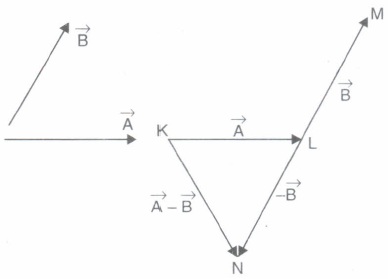
Subtraction of vectors is a special case of vector addition. Subtraction of \(\overset\rightarrow{B}\) from \(\overset\rightarrow{A}\) may be considered as addition of \(\left( -\overrightarrow { B } \right) \) i.e., negative of \(\overset\rightarrow{B}\) to vector \(\overset\rightarrow{A}\) .
\(\therefore\) \(\overset\rightarrow{A}\)-\(\overset\rightarrow{B}\)=\(\overset\rightarrow{A}\)+\(\left( -\overrightarrow { B } \right) \)
Therefore, we first draw \(\overset\rightarrow{A}\)and \(\overset\rightarrow{B}\) Now draw a vector having same magnitude as of \(\overset\rightarrow{B}\) but in oppo;ite direction. It is \(\left( -\overrightarrow { B } \right) \).sum of \(\overset\rightarrow{A}\) and \(\overset\rightarrow{B}\) gives the requisite result. In Fig.
\(\overset\rightarrow{A}\)-\(\overset\rightarrow{B}\)=\(\overset\rightarrow{A}\)+\(\left( -\overrightarrow { B } \right) \)
= \(\overset\rightarrow{KL}\)+\(\left( -\overrightarrow { LM } \right) \)
=\(\overset\rightarrow{KL}\)+\(\overset\rightarrow{LN}\)
=\(\overset\rightarrow{KL}\) .
15.
3
16.
(i) The magnitude of resultant R of two vectors A and B is
Given by,
\(R=\sqrt { { A }^{ 2 }+B^{ 2 }+2AB\quad cos\quad \theta } \)
\(=\sqrt { { 3 }^{ 2 }+{ 4 }^{ 2 }+2\times 3\times 4\quad cos\quad \theta } \)
R is 7m,if \(\theta ={ 0 }^{ o }\)
(ii) The magnitude of resultant R of two vectors A and B is
Given by,
\(R=\sqrt { { A }^{ 2 }+B^{ 2 }+2AB\quad cos\quad \theta } \)
\(=\sqrt { { 3 }^{ 2 }+{ 4 }^{ 2 }+2\times 3\times 4\quad cos\quad \theta } \)
R is m,if \(\theta ={ 180 }^{ o }\)
(iii) The magnitude of resultant R of two vectors A and B is
Given by,
\(R=\sqrt { { A }^{ 2 }+B^{ 2 }+2AB\quad cos\quad \theta }\)
\(=\sqrt { { 3 }^{ 2 }+{ 4 }^{ 2 }+2\times 3\times 4\quad cos\quad \theta } \)
R is m ,if \(\theta ={ 90 }^{ o }\)
17.
Let AB be the tower of height H and 0 the point of projection at a horizontal distance r from A as shown in Fig. Let u and \(\theta\) be the speed and the angle of projection of the ball.
The ball will go just grazing past the top edge of the tower if r equals the horizontal range of the projectile, i.e., if
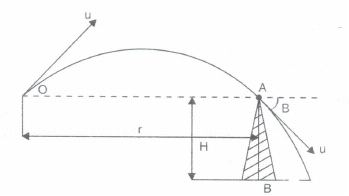
\(r=u \ cos \theta .{2u \ sin \theta \over g}={u^2 \ sin 2\theta \over g}\)
Thus r, U and \(\theta\) must be related according to the relation
g r = u2 sin 2\(\theta\)
At point A, the velocity of the ball is again u at an angle \(\theta\) to the horizontal. The horizontal distance x at which the ball strikes the ground from the foot of the tower is the horizontal distance covered with a horizontal velcoity u cos\(\theta\) in the time the ball falls vertically through a distance H starting with an initial vertically downward velocity u sin \(\theta\)and having a vertically downward acceleration g. If t is this time, we have
H=(u sin \(\theta\)) t + \({1\over2}g \ t^2\)
or g t2 + 2 u sin \(\theta\) t - 2H = 0
or t= \({-2 u sin \theta \pm \sqrt{4 \ u^2 sin ^2 \theta +8g H}\over 2g}\)
or t= \({-2 u sin \theta \pm 2\sqrt{ \ u^2 sin ^2 \theta +2g H}\over 2g}\)
t= \({1\over g}[{-u \ sin \theta \pm \sqrt{ \ u^2 sin ^2 \theta +2g H}}]\)
Thus \(x=u \ cos \theta \ t={u \ cos \theta \over g}[\sqrt{ \ u^2 sin ^2 \theta +2g H}-u\ sin \theta]\)
The angle of projection \(\theta\) for which x is minimum for a given value of u is given by
\({dx\over d \theta}=0\)
Thus, \({u \ cos \theta \over g}[{u^22sin \theta cos \theta \over \sqrt{u^2sin ^2\theta+2 \ g \ H}}-u \ cos \theta]+[\sqrt{u^2sin^2\theta+2 \ g H}-u \ sin \ \theta] ({-u \ sin \theta\over g})=0\)
or \({u^2sin2 \theta cos \theta \over \sqrt{gu^2sin ^2\theta+2 \ g \ H}}-{u \ cos^2 \theta \over g}-{ \ sin \theta\over g}\sqrt {u^2sin^2\theta+2 \ g H}+{u \ sin^2 \theta\over g}=0\)
or\({u^2sin 2\theta cos \theta \over \sqrt{u^2sin ^2\theta+2 \ g \ H}}- sin \theta \sqrt {u^2sin^2\theta+2 \ g H}-u \ cos 2 \theta=0\)
or \({u^2sin \theta cos \theta}- sin \theta \sqrt {u^2sin^2\theta+2 \ g H}-u \ cos 2 \theta\sqrt{u^2sin ^2\theta+2 \ g \ H}=0\)
The angle of projection for which x is minimum is a solution of this equation.
18.
The vector vb representing the velocity of the motorboat and the vector vc representing the water current are shown in directions specified by the problem. Using the parallelogram method of addition, the resultant R is obtained in the direction shown in the figure.
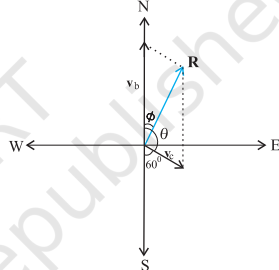
We can obtain the magnitude of R using the Law of cosine
\(R=\sqrt{v_{\mathrm{b}}^{2}+v_{\mathrm{c}}^{2}+2 v_{\mathrm{b}} v_{\mathrm{c}} \cos 120^{\circ}}\)
\(=\sqrt{25^{2}+10^{2}+2 \times 25 \times 10(-1 / 2)} \cong 22 \mathrm{~km} / \mathrm{h}\)
To obtain the direction, we apply the Law of sines
\(\frac{R}{\sin \theta}=\frac{v_{c}}{\sin \phi} \text { or, } \sin \phi=\frac{v_{c}}{R} \sin \theta\)
\(=\frac{10 \times \sin 120^{\circ}}{21.8}=\frac{10 \sqrt{3}}{2 \times 21.8} \cong 0.397\)
\(\phi \cong 23.4^{\circ}\)
19.
(d)
inclined to each other at an angle of 45°
20.
(a)
20 cm
21.
(a)
2:1
22.
(b)
5, 13
23.
(c)
\(\frac{1}{2}\)

11th Standard CBSE Syllabus & Materials
11th Standard CBSE
CBSE 11th Business Studies Forms of Business Organisation Sample Question Papers Study Material - QB365 Set A
NEW11th Standard CBSE
CBSE 11th Business Studies Business, Trade and Commerce Sample Question Papers Study Material - QB365 Set A
NEW11th Standard CBSE
CBSE 11th Physics Waves Sample Question Papers Study Material - QB365 Set A
NEW11th Standard CBSE
CBSE 11th Physics Kinetic Theory Sample Question Papers Study Material - QB365 Set A



CBSE 11th Standard CBSE Subjects
CBSE Standards









