
 100% FREE ACCESS
11th Standard CBSE Syllabus & Materials
11th Standard CBSE
CBSE 11th Economics PART-A - Presentation of Data - New Sample Question Papers Study Material - QB365 Set A
NEW11th Standard CBSE
CBSE 11th Economics PART-A - Organisation of Data - New Sample Question Papers Study Material - QB365 Set A
NEW11th Standard CBSE
CBSE 11th Economics PART-A - Collection of Data - New Sample Question Papers Study Material - QB365 Set A
NEW11th Standard CBSE
CBSE 11th Economics PART-A - Introduction to Economics and Statistics - New Sample Question Papers Study Material - QB365 Set A
NEW11th Standard CBSE
CBSE 11th Business Studies International Trade Sample Question Papers Study Material - QB365 Set A
NEW11th Standard CBSE
CBSE 11th Business Studies Evolution and Fundamentals of Business Sample Question Papers Study Material - QB365 Set A

Published on: 04/09/2019
Work, Energy and Power
Download CBSE Class 11th Standard CBSE Physics question papers, sample papers, important questions, and previous year solved papers in PDF format. Get free study materials, NCERT solutions, and exam preparation resources for Class 11th Standard CBSE Physics
Questions + Answers key
Take MCQ Physics Test
1.
A trolley of mass 300 kg carrying a sand bag of 25 Kg is moving uniformly with a speed of 27km/h on a frictionless track. After a while , sand starts leaking out of a whole on the floor of the trolley at the rate of 0.052 kg-1.What is the speed of the trolley after the entire sand bag is empty?
2.
Does potential energy of spring decrease/ increase when it is compressed or stretched?
3.
A molecule in a gas container hits a horizontal wall with speed 200 m s–1 and angle 30° with the normal, and rebounds with the same speed. Is momentum conserved in the collision ? Is the collision elastic or inelastic ?
4.
Is the total linear momentum conserved during the short time of an elastic of two balls?
5.
What is the coefficient of restitution?
6.
How much work is done by mass M moving once around a horizontal circle of radius r?
7.
A block of mass 1.2 kg moving at a speed of 20cm/s collides head-on with a similar block kept at rest. The coefficient of restitution is 3/5, find the loss of kinetic energy during collision.
8.
Work done by a body against friction always results in a loss of its kinetic/potential energy
9.
In a nuclear reactor, a neutron of high speed (typically 107 ms-1) must be slowed to 103 ms-1 so that it can have a high probability of interacting with isotope \(_{ 92 }^{ 325 }{ U }\)and causing it to fission.
Show that a neutron can lose most of its kinetic energy in an elastic collision with light nucleus like deuterium or carbon which has a mass of only a few times the neutron mass. The material making up the light nuclei, usually heavy water (D2O) or graphite is called a moderator.
10.
A body is moving unidirectionally under the influence of a source of constant power. Its displacement in time t is proportional to
t1/2
t
t3/2
t2
11.
A body is initially at rest. It undergoes one-dimensional motion with constant acceleration. The power delivered to it at time t is proportional to
t1/2
t
t3/2
t2
1.
In present problem, there are no net external forces. the sand is slowly leaking downwards from the whole. Consequently, normal reaction acting vertically upwards also slowly decreases.
But it does not do any work because it is at right angle to trolley's motion. Thus, there is no change in speed of the trolley and it will continue among moving with a uniform speed of 27 kmh-1
2.
When a spring is compressed or stretched, potential energy of the spring increase in both cases. This is because work is done by us in compression as well as stretching
3.
Let us consider the mass of the molecule be m and that of wall be M. The wall remains at rest due to its large mass. Resolving momentum of the molecule along x-axis and y-axis, we get
The x-component of momentum of molecule
= mu cos \(\theta\) = - m 200 cos 30° = -100\(\sqrt { 3 } \)m
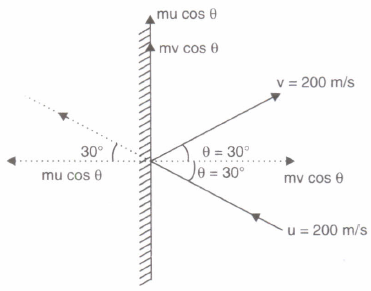
y-component of the molecule
= mu sin \(\theta\) = m \(\times\) 200 \(\times\) sin 30° = 100 m
Before collision: x-component of total momentum (wall + molecule)
= 0 + (-100\(\sqrt { 3 } \) m) = -100 \(\sqrt { 3 } \) m
y- component of momentum (wall + molecule) = 0 + 100 m = 100 m
After collision: x-component of the momentum (wall + molecule)
= 0 + m 200 cos 30° = 100 \(\sqrt { 3 } \) m
and y-component = 0 + m 100 sin 30° = 100 m
We find that momentum of the (molecule + wall) system is conserved. The wall has a recoil momentum such that momentum of the wall + momentum of outgoing molecule equals the momentum of the incoming molecule.
Initial kinetic energy \(\left( \frac { 1 }{ 2 } { mu }^{ 2 } \right) \) is the same as final K.E. \(\left( \frac { 1 }{ 2 } { mv }^{ 2 } \right) \)of the molecule as u = v = 200 m/s i.e., thus, the collision is elastic collision.
4.
During the short interval of an elastic collision, total linear momentum is conserved.
5.
The value is almost always less than one due to initial translational kinetic energy being lost to rotational kinetic energy, plastic deformation, and heat. It can be more than 1 if there is an energy gain during the collision from a chemical reaction, a reduction in rotational energy, or another internal energy decrease that contributes to the post-collision velocity.
\(\text { Coefficient of restitution }(e)=\frac{\mid \text { Relative velocity after collision } \mid}{\mid \text { Relative velocity before collision } \mid}\)
6.
In physics, circular motion is a movement of an object along the circumference of a circle or rotation along a circular path. It can be uniform, with constant angular rate of rotation and constant speed, or non-uniform with a changing rate of rotation. The rotation around a fixed axis of a three-dimensional body involves circular motion of its parts. The equations of motion describe the movement of the center of mass of a body.
7.
Here, \(m_1=1.2 \mathrm{~kg}, u_1=20 \mathrm{~cm} / \mathrm{s}, m_2=1.2 \mathrm{~kg}, u_2=0\)
If v1 and v2 are velocities of the two blocks after collision, then accordin to the principle of conservation of momentum, \(m_1 u_1+m_2 u_2=m_1 v_1+m_2 v_2\)
\(1.2 \times 20+0=1.2 v_1+1.2 v_2 \therefore v_1+v_2=20(\mathrm{~cm} / \mathrm{s}) \ldots(\mathrm{i})\)
velocity of approach \(=u_1-u_2=20 \mathrm{~cm} / \mathrm{s}\), velocity of separation \(=v_2-v_1\)
By definition, \(e=\frac{v_2-v_1}{u_1-u_2}\)
\(\frac{3}{5}=\frac{v_2-v_1}{20} \therefore v_2-v_1=\frac{20 \times 3}{5}=12 \text {.. }\)
From (i) and (ii), \(v_1=4 \mathrm{~cm} / \mathrm{s}, v_2=16 \mathrm{~cm} / \mathrm{s}\)
Loss in K.E.
\( =\frac{1}{2} m_1 u_1^2-\frac{1}{2}\left(m_1\right) v_1^2-\frac{1}{2} m_2 v_2^2=\frac{1}{2} \)
\( \times 1.2\left(\frac{20}{100}\right)^2-\frac{1}{2}(1.2)\left(\frac{4}{100}\right)^2-\frac{1}{2} \times 1.2\left(\frac{16}{100}\right)^2 \)
\( =2.4 \times 10^{-2}-0.096 \times 10^{-2}-1.536 \times 10^{-2}\)
\(7.7\times { 10 }^{ -3 }\)
8.
Friction always opposes motion. Hence, work done by a body against friction cause loss in its kinetic energy
9.
Here, m1 = mass of neutron = m
m2 = mass of target nucleus = M
u1 = u and u2 = 0
Now, \({ v }_{ 2 }=\frac { { 2 }m_{ 1 } }{ { m }_{ 1 }{ +m }_{ 2 } } .{ u }_{ 1 }+\frac { { m }_{ 2 }-{ m }_{ 2 } }{ { m }_{ 1 }+{ m }_{ 2 } } .{ u }_{ 2 }\)
\(=\frac { 2m }{ m+M } .u+0=\frac { 2mu }{ m+M } \)
Initial KE of mass m, \({ K }_{ 1 }=\frac { 1 }{ 2 } { m }_{ 1 }{ u }_{ 1 }^{ 2 }=\frac { 1 }{ 2 } m{ u }^{ 2 }\)
Final KE of mass M, \({ K }_{ 2 }=\frac { 1 }{ 2 } { m }_{ 2 }{ u }_{ 2 }^{ 2 }=\frac { 1 }{ 2 } M{ \left( \frac { 2mu }{ m+M } \right) }^{ 2 }=\frac { 2M{ m }^{ 2 }{ u }^{ 2 } }{ { \left( m+M \right) }^{ 2 } } \)
Fraction of the initial KE transferred,
\(f=\frac { { K }_{ 2 } }{ { K }_{ 1 } } =\frac { 2M{ m }^{ 2 }{ u }^{ 2 } }{ { \left( m+M \right) }^{ 2 } } \times \frac { 2 }{ m{ u }^{ 2 } } =\frac { 4mM }{ { \left( m+M \right) }^{ 2 } } \)
For deuterium, M = 2m, therefore
\(f=\frac { 4m\times 2m }{ { \left( m+2m \right) }^{ 2 } } =\frac { 8 }{ 9 } \simeq 0.9\)
About 90% of the neutron's energy is transferred to deuterium.
10.
(b)
t
11.
(b)
t

11th Standard CBSE Syllabus & Materials
11th Standard CBSE
CBSE 11th Business Studies Forms of Business Organisation Sample Question Papers Study Material - QB365 Set A
NEW11th Standard CBSE
CBSE 11th Business Studies Business, Trade and Commerce Sample Question Papers Study Material - QB365 Set A
NEW11th Standard CBSE
CBSE 11th Physics Waves Sample Question Papers Study Material - QB365 Set A
NEW11th Standard CBSE
CBSE 11th Physics Kinetic Theory Sample Question Papers Study Material - QB365 Set A



CBSE 11th Standard CBSE Subjects
CBSE Standards









