
 100% FREE ACCESS
11th Standard CBSE Syllabus & Materials
11th Standard CBSE
CBSE 11th Economics PART-A - Presentation of Data - New Sample Question Papers Study Material - QB365 Set A
NEW11th Standard CBSE
CBSE 11th Economics PART-A - Organisation of Data - New Sample Question Papers Study Material - QB365 Set A
NEW11th Standard CBSE
CBSE 11th Economics PART-A - Collection of Data - New Sample Question Papers Study Material - QB365 Set A
NEW11th Standard CBSE
CBSE 11th Economics PART-A - Introduction to Economics and Statistics - New Sample Question Papers Study Material - QB365 Set A
NEW11th Standard CBSE
CBSE 11th Business Studies International Trade Sample Question Papers Study Material - QB365 Set A
NEW11th Standard CBSE
CBSE 11th Business Studies Evolution and Fundamentals of Business Sample Question Papers Study Material - QB365 Set A

Published on: 27/09/2019
Work, Energy and Power
Download CBSE Class 11th Standard CBSE Physics question papers, sample papers, important questions, and previous year solved papers in PDF format. Get free study materials, NCERT solutions, and exam preparation resources for Class 11th Standard CBSE Physics
Questions + Answers key
Take MCQ Physics Test
1.
Tejveer is the medical student in Meerut. His grandfather went to Meerut to visit his grandson. In the evening his grandfather asked him about the heartbeats and pulse. He also eager to know what is the difference between the heartbeats of mammals relative to monkey. Tejveer being a medical student explained all about it very well.
(i) What values of Tejveer displayed here?
(ii) What is the scale factor of human relative to monkey?
(iii) What is the monkey's heart rate?
2.
A block of mass m moving with speed v compresses a spring through a distance x before its speed is halved. What is the value of spring constant?
3.
An electric fan of mass 2 kg falls from the ceiling of a lift moving down with uniform speed of 2 ms-1. It hits the floor of the lift (length of the lift = 2m) and does not rebound. How much heat will be produced by the impact?
4.
A ball bounces to 80% of its original height. What fraction of its mechanical energy is lost in each bounce?
5.
A body of mass 2kg is initially at rest. A constant force of 5 N acts on it for 10s. Calculate the average power of the force.
6.
Draw a graph showing variation of potential energy, kinetic energy and the total energy of a body freely falling on Earth from a height h.
7.
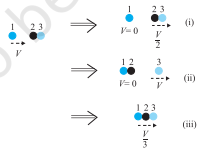
Two identical ball bearings in contact with each other and resting on a frictionless table are hit head-on by another ball bearing of the same mass moving initially with a speed v. If the collision is elastic, which of the following (figure) is a possible result after collision?
8.
When a 300 g mass is hung from a vertical spring, it stretches from equilibrium by 10 cm.What work is required to stretch it by next 5 cm?
9.
A family uses 8 kW of power. (a) Direct solar energy is incident on the horizontal surface at an average rate of 200 W per square meter. If 20% of this energy can be converted to useful electrical energy, how large an area is needed to supply 8 kW? (b) Compare this area to that of the roof of a typical house.
10.
A body of mass 3 kg is under a constant force, which causes a displacement S in metre in it, given by the relation S = \(\frac{1}{3}\) t2, where t is in an second. Find the work done by the force in 2s.
11.
The rate of change of total momentum of a many particle systems is proportional to the external force/sum of the internal forces on the system.
12.
Work done by a body against friction always results in a loss of its kinetic/potential energy
13.
Under the correct alternative.
Whan a conservation force does positive work on a body, the potential energy of the body increase decrease/remains unaltered.
14.
The blades of windmill sweep out a circle of area A.
(i) If the wind flows at a velocity v perpendicular to the circle, what is the mass of the air passing through it in time t?
(ii) What is the kinetic energy of the air?
(iii) Assume that the windmill converts 25% of the wind's energy v=36km/h and density of the air is 1.2 kg m. What is the el;ectrical power produced?
1.
(I) Values are: Intelligence, dedication, loving, social and cooperative.
(ii) Human heart rate is about 70 beats /min and scale factor is 2.5.
(iii) Monkey's heart rate = 70 x 2.5 = 175.
2.
Initial Kinetic energy = \(\frac { 1 }{ 2 } { mv }^{ 2 }\)
Final Energy = \(\frac { 1 }{ 2 } m{ \left( \frac { v }{ 2 } \right) }^{ 2 }+\frac { 1 }{ 2 } { kx }^{ 2 }\)
By the principle of conservation of energy,
\(\frac { 1 }{ 2 } { mv }^{ 2 }=\frac { 1 }{ 2 } \frac { { mv }^{ 2 } }{ 4 } +\frac { 1 }{ 2 } { k }x^{ 2 }\)
\(\therefore \quad K=\frac { 3{ mv }^{ 2 } }{ 4{ x }^{ 2 } } \)
3.
Mass of the fan, m = 2 Kg
Length of the elevator, h = 2 m.
The kinetic energy acquired by the fan during its fall is:
E = mgh = 2 \(\times\) 9.8 \(\times\) 2 = 39.2 J
The amount of heat produced will also be 39.2 J, as in accordance with the law of conservation of energy, whole of the kinetic enery will be converted into heat.
4.
Let the ball fall from a height, h then
K.E. of ball at the time of just striking the ground = P.E. of ball at height h
\(\Rightarrow\) K = mgh
Similarly on rebounding the ball moves to a maximum height h', then K.E. of ball on rebounding
K' = P.E. of ball at a height h' = mgh'
\(\therefore\) Loss of K.E. due to the rebounce K-K' = mgh - mgh' = mg(h-h')
\(=mg\left( h-\frac { 80 }{ 100 } h \right) =mgh\times (0.2)\)
\(\therefore\) Fractional loss in K.E. of ball in each rebounce = \(\frac { K-K' }{ K } =\frac { mgh\times (0.2) }{ mgh } =0.2\)
= 0.2 \(\times\) 100% = 20%
5.
Here, m = 2 kg, u = 0, F = 5N, t = 10s,
\(\therefore\) Acceleration produced in the body
\(a=\frac { F }{ m } =\frac { 5 }{ 2 } =2.5\) ms-2
Velocity attained by the body after 10s is
v = u + at = 0 + 2.5 \(\times\) 10 = 25 ms-1
\(\therefore\) Work done = chage in K.E.
\(=\frac { 1 }{ 2 } { mv }^{ 2 }-\frac { 1 }{ 2 } { mv }^{ 2 }\)
\(=\frac { 1 }{ 2 } \times 2\times 625-0=625\ J\)
\(\therefore\) p = \(\frac { W }{ t } =\frac { 625 }{ 10 } \)
\(\Rightarrow\) p = 62.5 Js-1 = 62.5 W.
6.
Graphs depicting variation of (i) gravitational potential energy (P.E.), (ii) kinetic energy (K.E.),and (iii) the total sum of potential and kinetic energies for a freely falling body are as shown in adjoining Fig. From the graphs, it is clear that:
(a) Gravitational potential energy decreases as the body falls downwards and is zero at the Earth.
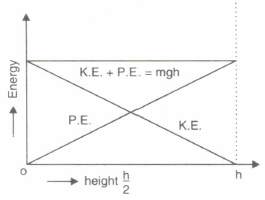
(b) Kinetic energy increases as the body falls downwards and is maximum when the body just strikes the ground.
(c) The sum of kinetic and potential energies remains constant at all points during its free fall.
7.
Let m be the mass of each ball bearing. Before collision, total K.E. of the system
\(=\frac { 1 }{ 2 } { mv }^{ 2 }+0=\frac { 1 }{ 2 } { mv }^{ 2 }\)
After collision, K.E. of the system is
Case I, \({ E }_{ 1 }=\frac { 1 }{ 2 } (2m){ (v/2) }^{ 2 }=\frac { 1 }{ 4 } { mv }^{ 2 }\)
Case II, \({ E }_{ 2 }=\frac { 1 }{ 2 } { mv }^{ 2 }\)
Case III, \({ E }_{ 3 }=\frac { 1 }{ 2 } (3m)({ v/3) }^{ 2 }=\frac { 1 }{ 6 } { mv }^{ 2 }\)
Thus, case II is the only possibility since K.E. is conserved in this case.
8.
We can calculate spring constant of spring by first information.
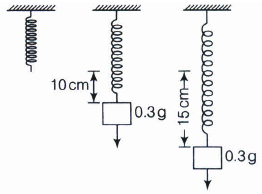
Work done by a vertical spring is = 0.3 g = k[10\(\times \) 10-2]
2 = k\(\times \)0.1\(\Rightarrow \) k = \(\frac { 3 }{ 0.1 } =30\frac { N }{ m } \)
Extra work required to stretch it by next 5 cm.
W = \(\frac { 1 }{ 2 } k{ x }_{ 2 }^{ 2 }\)-\(\frac { 1 }{ 2 } k{ x }_{ 1 }^{ 2 }\)
W = \(\frac { 1 }{ 2 } \times 30\left[ { \left( 15\times { 10 }^{ -2 } \right) }^{ 2 }-{ \left( 10\times { 10 }^{ -2 } \right) }^{ 2 } \right] \)
W = 15[225-100] \(\times { 10 }^{ -4 }\) = 15\(\times \)125\(\times { 10 }^{ -4 }\) J
W = 0.1875 J
9.
(a) Power used by family, P = 8 kW = 8000 W
As only 20% of solar energy can be converted to useful electrical energy, hence power to be supplied by solar energy \(\frac { 8000\quad W }{ 20% } =40000\quad W\) As solar energy is incident at a rate of 200 Wm-2 hence the area needed \(A=\frac { 40000\quad W }{ 200\quad W{ m }^{ 2 } } =200{ m }^{ 2 }\)
(b) The area needed is comparable to roof are of a large sized house.
10.
Work done by the force = force\( \times \)displacement
or W = F \( \times \) S
But from Newton's 2nd law , we have
Force = mass\( \times \)acceleration
i.e. F = ma ...(ii)
hence , from Eqs (i) and (ii), we get
W = m( \(\frac{d^2s}{dt^2}\) ) S [ \(\because\) a = [ \(\frac{d^2s}{dt^2}\)]........(iii)
now, we have
S = \(\frac{1}{3}\)t2
\(\therefore\) \(\frac{d^2s}{dt^2}\) = \(\frac{d}{dt}\)[\(\frac{d}{dt}\)( \(\frac{1}{3}\)t2)]
= \( \frac{d}{dt}\) \( \times \)( \(\frac{2}{3}\)t )
= \( \frac{2}{3}\)\(\frac{dt}{dt}\)
= \(\frac{2}{3}\)
Hence Eq. (iii) becomes
W = \( \frac{2}{3} \)ms
= \(\frac{2}{3}\)\( \times \) m\( \times \)\(\frac{1}{3}\)t2
= \(\frac{2}{9}\)mt2
We have , m = 3 kg , t = 2s
\(\therefore\) W = \(\frac{2}{9}\)\( \times \)3\( \times \)(2)2
= \(\frac{8}{3}\) J
11.
The total (net) momentum can change only when some net external force acts on the system. Hence, its rate of change is proportional to the external force.
12.
Friction always opposes motion. Hence, work done by a body against friction cause loss in its kinetic energy
13.
The potential energy decrease, because
\(\Delta\)U=-\(\int { F.dx } \)If work done by conservation force is p[ositive, then obviously \(\Delta\)U is -ve
14.
(i) Area swept by blades of windmill = A and wind velocity = v|
\(\therefore \) Volume of air passing per unit time = Av
\(\therefore \) Mass of air passing per unit time = Avp
and mass of air passing in time t, M = Avpt
(ii) KE of said quantity of air , K = \(\frac { 1 }{ 2 } { Mv }^{ 2 }=\frac { 1 }{ 2 } { Aptv }^{ 3 }\)
(iii)
If efficiency of windmill be 25%, then Output electrical power = 25% of input power
\(\frac { 25 }{ 100 } \times \frac { 1 }{ 2 } Ap{ v }^{ 3 }\)
As \(A={ 30m }^{ 2 },\ v=36\ km/h\ =36\times \frac { 5 }{ 18 } m/s\)
\(\\ =10m/s\ and\ p=1.2\ { kgm }^{ -3 }\)
\(\\ \therefore Output\ electrical\ power=\frac { 25 }{ 100 } \times \frac { 1 }{ 2 } \times 30\times 1.2\times ({ 10 })^{ 3 }\)
\(\\ =4500\quad W=4.5\ kW\ 1kW=1000W]\)

11th Standard CBSE Syllabus & Materials
11th Standard CBSE
CBSE 11th Business Studies Forms of Business Organisation Sample Question Papers Study Material - QB365 Set A
NEW11th Standard CBSE
CBSE 11th Business Studies Business, Trade and Commerce Sample Question Papers Study Material - QB365 Set A
NEW11th Standard CBSE
CBSE 11th Physics Waves Sample Question Papers Study Material - QB365 Set A
NEW11th Standard CBSE
CBSE 11th Physics Kinetic Theory Sample Question Papers Study Material - QB365 Set A



CBSE 11th Standard CBSE Subjects
CBSE Standards









