
 100% FREE ACCESS
11th Standard CBSE Syllabus & Materials
11th Standard CBSE
CBSE 11th Economics PART-A - Presentation of Data - New Sample Question Papers Study Material - QB365 Set A
NEW11th Standard CBSE
CBSE 11th Economics PART-A - Organisation of Data - New Sample Question Papers Study Material - QB365 Set A
NEW11th Standard CBSE
CBSE 11th Economics PART-A - Collection of Data - New Sample Question Papers Study Material - QB365 Set A
NEW11th Standard CBSE
CBSE 11th Economics PART-A - Introduction to Economics and Statistics - New Sample Question Papers Study Material - QB365 Set A
NEW11th Standard CBSE
CBSE 11th Business Studies International Trade Sample Question Papers Study Material - QB365 Set A
NEW11th Standard CBSE
CBSE 11th Business Studies Evolution and Fundamentals of Business Sample Question Papers Study Material - QB365 Set A

Published on: 16/09/2019
Work, Energy and Power
Download CBSE Class 11th Standard CBSE Physics question papers, sample papers, important questions, and previous year solved papers in PDF format. Get free study materials, NCERT solutions, and exam preparation resources for Class 11th Standard CBSE Physics
Questions + Answers key
Take MCQ Physics Test
1.
A bullet of mass 20 g is moving with a speed of 150 m S-1. It strikes a target and is brought to rest after piercing 10 cm into it. Calculate the average force of resistance offered by the target.
2.
If mechanical work is done on a body, will its kinetic energy increase or decrease?
3.
The momentum of an object is doubled. How does its K.E. change?
4.
What is a headon collision?
5.
What happens when two identical objects moving in mutually opposite directions suffer all elastic collision?
6.
Give an example of negative work.
7.
Why is the work done by centripetal force zero?
8.
What is the elastic potential energy stored in a spring?
9.
What is the significance of the -ve sign in W = - mgd?
10.
A vertical spring with constant 200 N/m has a light platform on its top. When a 500 g mass is kept on the platform spring compresses 2.5 cm.Mass is now pushed down 7.50 cm further and released. How far above later position will the mass fly? (g = 10 ms-1).
11.
A trolley of mass 300 kg carrying a sand bag of 25 Kg is moving uniformly with a speed of 27km/h on a frictionless track. After a while , sand starts leaking out of a whole on the floor of the trolley at the rate of 0.052 kg-1.What is the speed of the trolley after the entire sand bag is empty?
12.
A steel spring of spring constant 150 N/m is compressed from its natural position through a mud wall 1m thick, the speed of bullet drops to 100m/s. Calculate the average resistance of the wall. Neglect friction of air.
13.
A spring balance reads forces in Newtons. The scale is 20 cm long and read from 0 to 60 N. Find potential energy of spring when the scale reads 20 N.
14.
Can a body have without momentum? If yes, then explain how they are related with each other?
15.
Calculate the velocity of the bob of a simple pendulum at its mean position if it is able to rise to a vertical height of 10 cm. [g = 9.8 m/s2]
1.
Here m = 20 g = 0.02 kg, u = 150 m s-1, v = 0 and s = 10 cm = 0.1 m
According to work-kinetic energy theorem, we have
K-K' = W = Fs
\(\therefore \quad \frac { 1 }{ 2 } { mu }^{ 2 }-0=Fs\Rightarrow F=\frac { { mu }^{ 2 } }{ 2s } =\frac { 0.02\times { (150) }^{ 2 } }{ 2\times 0.1 } =2250\ N.\)
2.
The kinetic energy of the body will increase when work is done on it in accordance with the work-energy theorem.
3.
K.E. becomes four times.
4.
Collision in which the colliding particles move along the same straight line path before as well as after the collision, is called headon collision.
5.
The objects mutually exchange their velocities as a consequence of collision.
6.
Work done against the gravitational force.
7.
Because centripetal force is perpendicular to the displacement of the body.
8.
Energy stored in a spring is \(\frac { 1 }{ 2 } { kx }^{ 2 }\)
9.
Negative sign indicates that the work is done against the force.
10.
When the external force is removed after the push, the mass gets detached when spring obtain its natural length and say, mass m rises h height from the pushed position.
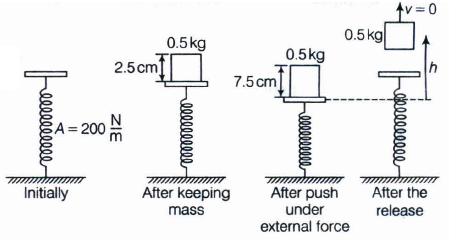
Loss in potential energy of spring = Gain in gravitational potential energy
\(\frac { 1 }{ 2 } k[{ x }^{ 2 }]\ =mgh\)
\(\frac { 1 }{ 2 } \times 200[{ 0.1 }^{ 2 }]\quad =0.5\times 10\times h\)
1 = 5 h \(\Rightarrow \) h = 0.2 m
11.
In present problem, there are no net external forces. the sand is slowly leaking downwards from the whole. Consequently, normal reaction acting vertically upwards also slowly decreases.
But it does not do any work because it is at right angle to trolley's motion. Thus, there is no change in speed of the trolley and it will continue among moving with a uniform speed of 27 kmh-1
12.
0.12 J
13.
We can calculate the spring constant of spring, as it ios extended by 20 cm under 60 N force.
F = kx \(\Rightarrow\)60 = k\(\times\) 20 \(\times\)10-2
k = 300 N/m
At a force of 20 N, the extension in spring is
F = kx \(\Rightarrow\) 20 = 300x
x = \(\frac { 2 }{ 30 } =\frac { 1 }{ 15 } m\)
14.
Yes, when p = 0
Then K = \(\frac { { p }^{ 2 } }{ 2m } \\\)=0
But E = K + U = U (potential energy) which may or may not be zero.
15.
\(\left.\begin{array}{l}\text { K.E. of the } \\ \text { bob at its } \\ \text { mean position }\end{array}\right\}=\left\{\begin{array}{l}\text { P.E. at } \\ \text { its highest } \\ \text { position }\end{array}\right.\)
i.e., \(\frac{1}{2} m v^2=m g h\)
Velocity of the bob
\(v =\sqrt{2 g h} \)
\(=\sqrt{2 \times 9.8 \times 10} \)
\(=\sqrt{1.96} \)
\(v =1.4 \mathrm{~m} / \mathrm{s}\)

11th Standard CBSE Syllabus & Materials
11th Standard CBSE
CBSE 11th Business Studies Forms of Business Organisation Sample Question Papers Study Material - QB365 Set A
NEW11th Standard CBSE
CBSE 11th Business Studies Business, Trade and Commerce Sample Question Papers Study Material - QB365 Set A
NEW11th Standard CBSE
CBSE 11th Physics Waves Sample Question Papers Study Material - QB365 Set A
NEW11th Standard CBSE
CBSE 11th Physics Kinetic Theory Sample Question Papers Study Material - QB365 Set A



CBSE 11th Standard CBSE Subjects
CBSE Standards









