
 100% FREE ACCESS
11th Standard CBSE Syllabus & Materials
11th Standard CBSE
CBSE 11th Economics PART-A - Presentation of Data - New Sample Question Papers Study Material - QB365 Set A
NEW11th Standard CBSE
CBSE 11th Economics PART-A - Organisation of Data - New Sample Question Papers Study Material - QB365 Set A
NEW11th Standard CBSE
CBSE 11th Economics PART-A - Collection of Data - New Sample Question Papers Study Material - QB365 Set A
NEW11th Standard CBSE
CBSE 11th Economics PART-A - Introduction to Economics and Statistics - New Sample Question Papers Study Material - QB365 Set A
NEW11th Standard CBSE
CBSE 11th Business Studies International Trade Sample Question Papers Study Material - QB365 Set A
NEW11th Standard CBSE
CBSE 11th Business Studies Evolution and Fundamentals of Business Sample Question Papers Study Material - QB365 Set A

Published on: 03/08/2019
System of Particles and Rotational Motion
Download CBSE Class 11th Standard CBSE Physics question papers, sample papers, important questions, and previous year solved papers in PDF format. Get free study materials, NCERT solutions, and exam preparation resources for Class 11th Standard CBSE Physics
Questions + Answers key
Take MCQ Physics Test
1.
What is moment of inertia of a solid sphere about its diameter?
2.
Two satellites of equal masses are orbiting at different heights. Will their moments of inertia be the same or different?
3.
Which component of a force does not contribute towards torque
4.
If a string of a rotating stone breaks, in which direction will the stone move?
5.
Does tile radius of gyration depend on the angular velocity of the body?
6.
Find the centre of mass of a triangular lamina.
7.
A faulty balance with unequal arms has its beam horizontal. Area the weights of the two pans equal?
8.
The speed of the whirl wind in a tornado is alarmingly high. Why?
9.
If ice on poles melts, then what is the change in duration of day?
10.
Two boys of the same weight it at the opposite ends of a diameter of a rotating circular table. What happens to the speed of rotation if they move nearer to the axis of rotation?
11.
Why does a solid sphere have smaller moment of inertia than a hollow cylinder of same mass and radius about an axis passing through their axis of symmetry?
12.
A person is standing on a rotating table with metal spheres in his hands. If he withdraw his hands to his chest, what will be the effect on his angular velocity?
13.
If a cube is melted and is casted into a sphere, does moment of inertia about an axis through centre of mass increase or decrease.
14.
A ballet dancer stretches her hand out for slowing down. Name the conservation obeyed.
15.
A ball is moving with a velocity of 10m/s. Suddenly, it breaks into two equal parts. What will be the speed of centre of mass of the system after explosion?
16.
Angular momentum of a system is conserved if its M.I. is changed. ls its rotational K.E. also conserved?
17.
lf earth contracts to half its radius, what would be the duration of the day?
18.
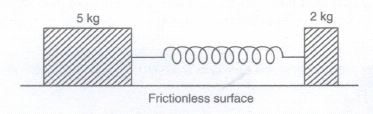
Fig. shows two blocks of masses 5kg and 2kg placed on a frictionless surface and connected by a spring. An external kick gives a velocity 14 m/s to the heavier block in the direction of lighter one. Deduce (a) the velocity gained by the centre of mass and (b) the separate velocities of the two blocks in the centre of mass coordinates just after the kick.
19.
A rope of negligible mass is wound round a hollow cylinder of mass 3 kg and radius 40 cm. What is the angular acceleration of the cylinder if the rope is pulled with a force of 30 N ? What is the linear acceleration of the rope ? Assume that there is no slipping.
20.
Two bodies of masses 1 kg and 2 kg are located at (1, 2) and (-1, 3), respectively. Calculate the coordinates of the centre of mass.
21.
Three identical spheres each of radius r and mass m are placed touching each other on a horizontal floor. Locate the position of centre of mass of the system.
22.
Locate the centre of mass of a system of particles of mass m1 = 1 kg, m2 = 2 kg and m3 = 3 kg, situated at the corners of an equilateral triangle of side 1.0 metre.
23.
Discuss the rolling motion of a cylinder on an inclined plane.
24.
In given pulley mass system, mass m1 = 500 g, m2 = 460 g and the pulley has a radius of 5 cm. When released from rest, heavier mass falls through 7.50 cm in 5 s. There is no slippage between pulley and string.
(i) What is magnitude of acceleration of mass?
(ii) What is magnitude of pulley's angular acceleration?
25.
A loaded spring gun of mass M fires a 'shot' of mass m with a velocity \(\vartheta \) at an angle of elevation \(\theta\). The gun is initially at rest on a horizontal frictionless surface. After firing, the centre of mass of the gun-shot system
moves with a velocity \(\vartheta \) m / M
moves with velocity \(\frac { \vartheta m }{ M } \)cos \(\theta\) in the horizontal direction
remains at rest
moves with a velocity \(\frac { \vartheta (M-m) }{ (M+m) } \) in the horizontaI direction.
26.
A particle performing uniform circular motion has angular momentum L. If its angular frequency is doubled and its kinetic energy halved, then the new angular momentum is
4L
\(\frac { L }{ 2 } \)
\(\frac { L }{ 4 } \)
2L
27.
A man of mass M is standing at the centre of a rotating turn table rotating with an angular velocity w. The man holds two 'dumb bells' of mass M/4 each in each of his two hands. If he stretches his arms to a horizontal position, the turn table acquires a new angular velocity w' where
\(\omega\)' = 2 \(\omega\)
\(\omega\)' =\(\omega\)/2
\(\omega\)' > \(\omega\)
\(\omega\)' < \(\omega\)
28.
A cylindrical solid of mass M has raidus R and length L. Its moment of inertia about a generator is:
\(N\left( \frac { L }{ R } +\frac { { R }^{ 2 } }{ 4 } \right) \)
\(\frac { 1 }{ 2 } { MR }^{ 2 }\)
\(\frac { 3 }{ 2 } { MR }^{ 2 }\)
\(M\left( \frac { { L }^{ 2 } }{ 3 } +\frac { { R }^{ 2 } }{ 4 } \right) \)
29.
A couple produces a:
pure linear motion
pure rotational motion
none of the above.
both linear and rotational motion
1.
I = \(\frac { 2 }{ 5 } \)MR2 where M is the mass and R is radius of the solid sphere.
2.
The moments of inertia will be different on account of different distances.
3.
The radial component of a force does not contribute towards torque.
4.
The stone will move along the tangent at the point of breaking.
5.
No, \(K=\sqrt { \frac { 1 }{ M } } \)
6.
The lamina (∆LMN) may be subdivided into narrow strips each parallel to the base (MN) as shown in Fig
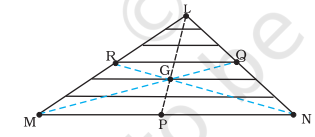
By symmetry each strip has its centre of mass at its midpoint. If we join the midpoint of all the strips we get the median LP. The centre of mass of the triangle as a whole therefore, has to lie on the median LP. Similarly, we can argue that it lies on the median MQ and NR. This means the centre of mass lies on the point of concurrence of the medians, i.e. on the centroid G of the triangle.
7.
They are of unequal mass. Their masses are in the inverse ratio of the arms of the balance.
8.
In a whirl wind, the air from nearby region gets concentrated in a small space thereby decreasing the value moment of inertia considerably. Since \(I\omega \)= constant, due to decrease in moment of inertia, the angular speed becomes quite high.
9.
Molten ice from poles into ocean and so mass is going away from axis of rotation. So, moment of inertia of earth increases and to conserve angular momentum, angular velocity (\(\omega \)) decreases. So, time period of rotation increases (\(T=2\pi /\omega \) ). So, net effect of global warming is increasing in the duration of day.
10.
The moment of inertia of the system (circular table + two boys) decreases. To conserve angular momentum (\(L=I\omega =constant\)), the speed of rotation of the circular table increases.
11.
All mass of a hollow cylinder at a distance R from axis of rotation. Whereas in case of a sphere, most of mass lies at a distance less than R from axis of rotation. As moment of inertia is \(\sum M_{ i }{ R }_{ i }^{ 2 }\), so sphere as a lower value of moment of inertia.
12.
When the person withdraws his chest, his moment of inertia decreases. No external torque is acting on the system. So, to conserve angular momentum, the angular velocity increases.
13.
Moment of inertia of a sphere is less than that of a cube of same mass.
14.
This is based on the conservation of angular momentum.
15.
10 m/s
16.
Kinetic energy of rotation = \(\frac { 1 }{ 2 } I{ \omega }^{ 2 }=\frac { 1 }{ 2 } (I\omega )=\frac { 1 }{ 2 } L\omega \)
L= Iω is constant if moment of inertia (I) of the system changes. It means as I changes, then ω also changes to keep Iω= constant. Hence K.E. of rotation also changes with the change in I. In other words, rotation K.E. is not conserved.
17.
According to the law of conservation of angular momentum
I1ω1 =I2ω2 ⇒ \(\frac { { I }_{ 1 } }{ { T }_{ 1 } } =\frac { { I }_{ 2 } }{ { T }_{ 2 } } \)
or T2 =\(\frac { { I }_{2 } }{ { I }_{ 1 } } { T }_{ 1 }\)
I1 =\(\frac { 2 }{ 5 } \)MR2,I2=\(\frac { 2 }{ 5 } M\left( \frac { R }{ 2 } \right) ^{ 2 }\)
∴ T1 =\(\frac { 1 }{ 4 } \times 24\)=6 hr
18.
(a)The velocity of centre of mass \(\upsilon \)cm is given by the expression
\(\upsilon _{ cm }=\frac { { m }_{ 1 }{ \upsilon }_{ 1 }+{ m }_{ 2 }{ \upsilon }_{ 2 } }{ { m }_{ 1 }+{ m }_{ 2 } } \)
Here m1 = 5 kg, m2 = 2 kg \(\upsilon _{ 1 }\)=14m/s ,\(\upsilon _{ 2 }\) =0
Substituting these values, we get
\(\upsilon \)cm =\(\frac { 5\times 14+2\times 0 }{ 5+2 } \) =10m/s
(b)We know that the centre of mass coordinate reference frame is one in which centre of mass is at rest. So the velocity of heavier block in this frame just after the kick is
\(\upsilon '_{ 1 }={ \upsilon }_{ 2 }-{ \upsilon }_{ cm }\) =14 - 10 = 4 m/s
and that of lighter block is
\(\upsilon '_{ 2 }={ \upsilon }_{ 1 }-{ \upsilon }_{ cm }\) = 0 - 10 = -10 m/s
19.
Torque on cylinder, \(\tau =force\times radius\)
\(=30\times 40=12N-m\)
Moment of inertia of hollow cylinder about its axis
\(I={ MR }^{ 2 }=3\times { \left( 0.4 \right) }^{ 2 }=0.48kg-{ m }^{ 2 }\)
Also, \(\tau =I\alpha \Rightarrow \alpha \frac { \tau }{ I } \)
\(\therefore \alpha =\frac { 12 }{ 0.48 } =25{ s }^{ -2 }\)
Linear acceleration of rope
\(\alpha =\frac { F }{ m } =\frac { 30 }{ 3 } =10m/{ s }^{ 2 }\).
20.
\(Given,\ { m }_{ 1 }=1kg,{ m }_{ 2 }=2kg\)
\( { x }_{ 1 }=1m,{ x }_{ 2 }=-1m\)
\( { y }_{ 1 }=2m,{ y }_{ 2 }=3m\)
\(\\ \therefore \quad { x }_{ CM }=\frac { { m }_{ 1 }{ x }_{ 1 }+{ m }_{ 2 }{ x }_{ 2 } }{ { m }_{ 1 }+{ m }_{ 2 } } =\frac { 1\times 1+2\times -1 }{ 1+2 } \)
\(=\frac { 1-2 }{ 3 } =\frac { -1 }{ 3 } =-0.33\)
\(\\ and\ { y }_{ CM }=\frac { { m }_{ 1 }{ y }_{ 1 }+{ m }_{ 2 }{ y }_{ 2 } }{ { m }_{ 1 }+{ m }_{ 2 } } =\frac { 1\times 2+2\times 3 }{ 1+2 } \)
\(\\=\frac { 2+6 }{ 3 } =\frac { 8 }{ 3 } =2.66\)
Thus, the coordinates of the centre of mass are (-0.33, 2.66).
21.
Step 1: Draw diagram showing coordinates of the spheres.

Step 2: Find coordinates of centre of mass.
Formula used: \(x_{C M}=\frac{m_1 x_1+m_2 x_2}{m_1+m_2}\) and
\(\mathrm{y}_{\mathrm{CM}}=\frac{\mathrm{m}_1 \mathrm{y}_1+\mathrm{m}_2 \mathrm{y}_2}{\mathrm{~m}_1+\mathrm{m}_2}\)
x - coordinates of center of mass
\( x_{c m}=\frac{m \times 0+m \times 2 R+m R}{3 m} \)
\( x_{c m}=R \)
\( y-\text { coordinates of center of mass } \)
\( y_{c m}=\frac{m \times 0+m \times 0+m R}{3 m} \)
\( x_{c m}=\frac{R}{\sqrt{3}}\)
Hence coordinates are, \(\left(R, \frac{R}{\sqrt{3}}\right)\)
22.
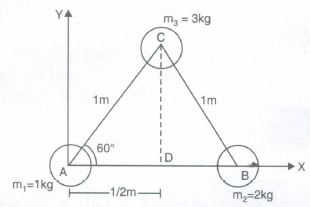
Consider an equilateral triangle of side 1 m as shown in fig. Take X and Y axes as shown in fig.
By the definition of centre of mass, we have
\(\vec { x } \) =\(\frac { { m }_{ 1 }{ x }_{ 1 }{ +m }_{ 2 }{ x }_{ 2 }+{ m }_{ 3 }{ x }_{ 3 } }{ { m }_{ 1 }{ +m }_{ 2 }+{ m }_{ 3 } } \)
and \(\vec { y } =\frac { { m }_{ 1 }y_{ 1 }{ +m }_{ 2 }y_{ 2 }+{ m }_{ 3 }y_{ 3 } }{ { m }_{ 1 }{ +m }_{ 2 }+{ m }_{ 3 } } \)
Here, m1 = 1 kg, m2= 2kg and m3 = 3 kg
[x1= 0,y1= 0] [x2 =1,y2= 0] and [x3= 0.5 y3 = \(\frac { \sqrt { 3 } }{ 2 } \)]
Here y3 = CD = AC sin 60o = \(\frac { \sqrt { 3 } }{ 2 } \)
\(\bar { x } \) = \(\frac { 1\times 0+2\times 1+3\times 0.5 }{ 1+2+3 } =\frac { 3.5 }{ 6 } m\)
and \(\vec { y } =\frac { 1\times 0+2\times 0+3\times \left( \frac { \sqrt { 3 } }{ 2 } \right) }{ 1+2+3 } =\frac { \sqrt { 3 } }{ 4 } m\)
The co-ordinates of centre of mass are \(\left( \frac { 3.5 }{ 6 } ,\frac { \sqrt { 3 } }{ 4 } \right) \)
23.
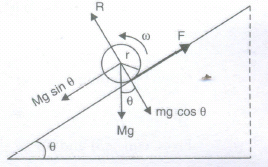
Consider a spherical body of mass M and radius r, rolling down on an inclined plane without slipping. Let the angle of inclination of the plane is \(\theta\) with the horizontal (Seefig.)
It \(\omega\) be the angular velocity of the body, then the linear velocity of the body is
\(v=r\omega\)................1
The various forces acting on the body are:
(a) The weight (Mg) of the body in the vertically downward direction
(b) Normal reaction (R) of the surface of the plane on the body which acts vertically upward.
(c) The force of friction (F) which acts opposite to the direction of motion of the body. Resolve Mg into two components:
\(\rightarrow\) Mg cos 8 is the horizontal component, which is equal and opposite to the normal reaction
i.e, R=Mg cos \(\theta\) .............2
\(\rightarrow\) Mg sin 8 is the vertical component, which acts in the direction of the motion of the body
\(\therefore\) Net force acting in the direction of motion of the body = Mg sin\(\theta\) - F
Let a = acceleration of the body
Therefore, equation of motion of the body is given by,
Ma = Mg sin \(\theta\) - F ...........3
The external torque acting on the body is produced by the force of friction (F) and its lever arm is r (the radius of the spherical body) [The lines of action of Mg and R pass through the centre of mass of body and hence do not contribute anything to the torque about the centre of mass].
\(\therefore \tau=Fr\)..........4
If \(\alpha\) be the angular acceleration produced in the body whose moment of inertia is I, then
\(\tau=I\alpha\)............5
From eqns (iv) and (v), we get
\(Fr=I\alpha\ or\ F=I\frac{\alpha}{r}\)................6
Using eqn. (vi) in eqn. (iii), we get
\(\therefore Ma=Mgsin\theta-I\frac{\alpha}{r}\)
\(a=r\alpha\ or \alpha=\frac{a}{r}\)
\(\therefore Ma=Mgsin\theta-I\frac{a}{r^2}\Rightarrow a=gsin\theta-\frac{Ia}{Mr^2}\)
\(a(1+\frac{I}{Mr^2})=gsin\theta\)
\(a=\frac{gsin\theta}{1+(\frac{I}{Mr^2})}\)
\(\alpha=\frac{a}{r}=\frac{gsin\theta}{r[1+\frac{I}{Mr^2}]}\)
Substituting this value in eqn. (vi), we get
\(F=\frac{I}{r}.\frac{gsin\theta}{r[1+\frac{I}{Mr^2}]}=\frac{Igsin\theta}{r^2[1+\frac{I}{Mr^2}]}\)
This is the force of friction, required by the body to roll down an inclined plane without slipping.
24.
(i) a = 6 x 10⁻² m/s2
(ii) \(\alpha \) = 1.20 rad/s2
25.
(c)
remains at rest
26.
(c)
\(\frac { L }{ 4 } \)
27.
(d)
\(\omega\)' < \(\omega\)
28.
(c)
\(\frac { 3 }{ 2 } { MR }^{ 2 }\)
29.
(b)
pure rotational motion

11th Standard CBSE Syllabus & Materials
11th Standard CBSE
CBSE 11th Business Studies Forms of Business Organisation Sample Question Papers Study Material - QB365 Set A
NEW11th Standard CBSE
CBSE 11th Business Studies Business, Trade and Commerce Sample Question Papers Study Material - QB365 Set A
NEW11th Standard CBSE
CBSE 11th Physics Waves Sample Question Papers Study Material - QB365 Set A
NEW11th Standard CBSE
CBSE 11th Physics Kinetic Theory Sample Question Papers Study Material - QB365 Set A



CBSE 11th Standard CBSE Subjects
CBSE Standards









