
 100% FREE ACCESS
11th Standard CBSE Syllabus & Materials
11th Standard CBSE
CBSE 11th Economics PART-A - Presentation of Data - New Sample Question Papers Study Material - QB365 Set A
NEW11th Standard CBSE
CBSE 11th Economics PART-A - Organisation of Data - New Sample Question Papers Study Material - QB365 Set A
NEW11th Standard CBSE
CBSE 11th Economics PART-A - Collection of Data - New Sample Question Papers Study Material - QB365 Set A
NEW11th Standard CBSE
CBSE 11th Economics PART-A - Introduction to Economics and Statistics - New Sample Question Papers Study Material - QB365 Set A
NEW11th Standard CBSE
CBSE 11th Business Studies International Trade Sample Question Papers Study Material - QB365 Set A
NEW11th Standard CBSE
CBSE 11th Business Studies Evolution and Fundamentals of Business Sample Question Papers Study Material - QB365 Set A

Published on: 04/03/2020
11th Standard Chemistry Board Exam Model Question 2019-2020
Download CBSE Class 11th Standard CBSE Chemistry question papers, sample papers, important questions, and previous year solved papers in PDF format. Get free study materials, NCERT solutions, and exam preparation resources for Class 11th Standard CBSE Chemistry
Questions + Answers key
Take MCQ Chemistry Test
1.
Define electrochemical cell
2.
What is the unit of coefficient of viscosity?
3.
What do you mean by biochemical oxygen demand (BOD)?
4.
Which of the following compounds will show cis-trans isomerism?
CH2= CBr2
5.
Rotation around carbon-carbon single bond of ethane is not completely free. Justify the statement.
6.
Identify A, B, C, and D and give their chemical formulae.
A + NaOH\( \rightarrow\) NaCla + NH3 + H2O
7.
What properties of water make it useful as a solvent? What type of compounds can it disolve.
8.
Identify the oxidant and reductant in each of the following reactions.
(a) MnO-4 (aq) + C2H5OH(aq) \(\rightarrow \) Mn2 + (aq) + CH3COOH(aq)
(b) Zn(s) + 2H+(aq) → pb(s) + CO(g)
(c) pbO(s) + C(s) → pb(s) + CO(g)
9.
Which of the species have similar shape and why? \({ { NO }_{ 2 }^{ - } },{ { NO }_{ 2 }^{ + } },{ CO }_{ 2 },{ O }_{ 3 }\)
10.
A porton is moving with kinetic energy 5 x 10-27 J.What is the velocity of the porton?
11.
Calculate the number of gram of oxygen in 0.10 mole of \({ Na }_{ 2 }{ CO }_{ 3 }.{ 10H }_{ 2 }O.\)
12.
Apart from tetrahedral geometry, another possible geometry for CH4 is square planar with the four H atoms at the corners of the square and the C atom at its centre. Explain why CH4 is not square planar ?
13.
At 1127 K and 1 atmosphere pressure, a gaseous mixture of co and CO2 in equilibrium with solid carbon has 90.55% CO by mass.
C(s) + CO2(g) ⇌ 2CO(g)
Calculate Kc or the reaction at the above temperature.
14.
Dr.Sharma , cardiologist suggested his patienta to take more potassium ions for healthy heart. potassium ions are the most abundant cations within cell fluids, where they activate many enzymes, participate in the oxidation of glucose to pro duse ATP While sodiun ions are responsible for the transmission for nerve signals. What are the sources of potassium ?
15.
Calculate the mass of oxygen which will be liberated by the decomposition of 200mL of this solution.
16.
If 5.0 cm3 of H2O2 liberates 0.508 g of iodine from an acidified potassium iodide solution, then calculate the strength of H2O2 in term of volume strength at STP.
17.
Identify the steps involved in the following cyclic process. Temperature at A, B and F is T1 and at C, D and E is T2. Given T1>T2
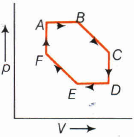
18.
Graphically show the total work done in an expansion when the state of an ideal the state of an ideal gas is changed reversibly and isothermally from(pi,Vi) to (pf,Vf). With the help of a pV plot compare the work done in the above case with that carried out against a constant pressure pf .
19.
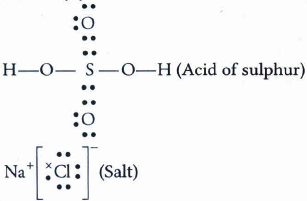
Rahul, a brilliant science student, was very keen to do experiments and get knowledge from them. One day he took some sugar and salt separately and added some acid of sulfur (which is generally used for toilet cleaning) and notice the changes. He got confused as he expected that the reaction of salt should be faster. Next day he asked about his experiment to his science teacher, who clarity the reason for the result he got. He got satisfied.
Draw the electron dot structure of acid of sulphur and salt.
20.
Write the name and the atomic number of the following elements.
(i) The third alkali metal
(ii) The fourth alkaline earth metal
(iii) The sixth element of second transition series
(iv) The second inner transition element
(v) The fifth noble gas.
21.
The threshold frequency ν0 for a metal is 7.0 ×10¹⁴ s–1. Calculate the kinetic energy of an electron emitted when radiation of frequency ν =1.0 ×10¹⁵ s–1 hits the metal.
22.
Balance the following equation.\(Fe+{ H }_{ 2 }O\rightarrow { Fe }_{ 3 }{ O }_{ 4 }+{ H }_{ 2 }\)
23.
(a) Which is more suitable method for the purification of a compound in liquid state which decomposes at or below its boiling point?
(b) How will you separate a mixture of ammonium chloride and common salt?
24.
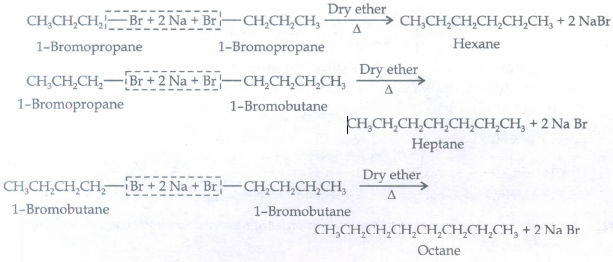
Why is Wurtz reaction not preferred for preparation of alkanes containing odd number of carbon atoms? Illustrate your answer by taking one example.
25.
Consider a voltaic cell constructed with the following substances
Cr3+(aq) + 3e- \(\rightarrow\)Cr(s)
MnO4- (aq) + 8H+(aq) + 5e- \(\rightarrow\)Mn2+ (aq) + 4H2O(l)
Eo = -0.74V
Eo= +1.51V
(a) Which substances are oxidised and reduced in this cell?
(b) Which are the negative and positive electrode?
26.
Express the following up to four significant figures. '32.3928'
27.
Write balanced equation for
\({ B }_{ 2 }H_{ 6 }+NH_{ 3 }\rightarrow \)
28.
Rohan heard that instructions were given to the laboratory attendent to store particular chemical, i.e. keep it in the dark room, add some urea in it, and keep it away from dust. This chemical acts as an oxidising as well as a reducing agent in both acidic and alkaline media.This chemical is important for use in the pollution control treatment of domestic and industrial effluents.
Write the name of this compound.
29.
A gas is enclosed in the room. The temperature, pressure, density, and the number of moles respectively are t \(^{o}\)C, p atm, g cm-3 and n moles. What will be the values of pressure, temperature, density, and the number of moles, if an equal volume of gas at pressure (p) and temperature (t) is let inside the same room?
30.
What is meant by the term bond order? Calculate the bond order of : N2, O2, O2 +, \({ O }_{ 2 }^{ - }\)
31.
A molecule of O2 and that of SO2 travel with the same velocity.What is the ratio of their wavelengths?
32.
A chemist dissolves an excess of BaSO4 in pure water at 25°C if its Ksp = 1 x 10⁻¹⁰ what is the concentration of barium in the water?
10-4 M
10-5 M
10-15 M
10-6 M
33.
Baeyer's reagent is ______.
aqueous KMnO4
neutral KMnO4
alkaline KMnO4
aqueous bromine water
34.
The reaction

carbocation formation
free-radical mechanism
carbanion formation
none of these
35.
The energy needed to remove a single electron (most loosely bound) from an isolated gaseous atom is called _______.
ionisation energy
electronegativity
kinetic energy
electron affinity
36.
Which of the following is used in photoelectric cells?
Na
K
Li
Cs
37.
The cleansing action of soaps and detergents is due to
internal friction
high hydrogen bonding
viscosity
surface tensions
38.
Which of the following is a purely acidic oxide?
Si02
Sn02
PbO
Mn02
39.
Which of the following acid is most abundant in acid rain?
HCl
HNO3
H2SO4
Organic acid
40.
The oxidation number of the carboxylic carbon atom in CH3 COOH is ______.
+2
+4
+1
+3
41.
Out of the following, intramolecular hydrogen bonding exists in ______.
water
H2S
4-nitrophenol
2-nitrophenol
42.
Zeolite is
hydrated sodium aluminium silicate - Na2Al2Si2O8.xH2O
hydrated ferric oxide
sodium hexametaphosphate
sodium tetraborate
43.
An aqueous solution of borax is
neutral
amphoteric
basic
acidic
44.
In halogens, which of the following, increases from iodine to fluorine?
Bond length
Electronegativity
The ionization energy of the element
Oxidizing power
45.
The enthalpies of all elements in their standard states are: _______.
unity
zero
<0
different for each element
46.
12 g of Mg will react completely with an acid to give: _______.
1 mole of O2
\(\frac { 1 }{ 2 } \)mole of H2
1 mole of H2
2 mole of H2
1.
Electrochemical cell is a device in which the redox reaction is carried indirectly and the decrease in free energy appears as electrical energy
2.
Poise.
3.
The amount of oxygen required by bacteria to break down the organic matter present in a certain volume of a sample of water is called biochemical oxygen demand (BOD). The amount of BOD in the water is a measure of the amount of organic matter in water, in terms of how much oxygen will be required to break it down biologically. Clean water would have BOD value of less than 5 ppm.
4.
For exhibiting cis-trans (or geometrical isomerism, a molecule must fulfil the following condition.
The groups attached to each double bonded carbon atom must be different.
5.
Rotation around C-C single bond is not completely free and it is restricted due to repulsions between the electron clouds of C-H bonds in the adjacent carbon atoms. Therefore, ethane exixts in infinate number of conformations. Out of these, two extreme conformations are staggered and eclipsed.
6.
NH4Cl + NaOH \(\rightarrow\) NaCl + NH3 + H2O
Thus, A is ammonium chloride.
7.
High dipole moment and high dielectric constant, these are the two properties of water which make it useful as a solvent It can dissolve both ionic compounds as well as those covalent compounds which can form hydrogen bonds with water such as ethyl alchol, sugar, glucose etc.
8.
(a) MnO-4 loses oxygen, therfore it is an oxidant while C2H5OH gains oxygen, therefore it is a reductant.
(b) Zn is reductant whilr hydrogen (H) is oxidant
(c) pbO is oxidant while C is reductant
9.
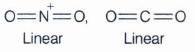
\({ NO }_{ 2 }^{ + }\)and CO2 are sp hybridized, therefore, they have linear shape.
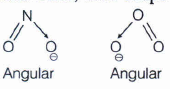
\({ { NO }_{ 2 }^{ - } }\) and O3 are sp2 hybridised.Both have lone pair of electrons but in former case it is not donated. Thus, their shape is angular.
10.
Mass of proton
\(\frac { 1.008\times 10^{ -3 } }{ 6.02\times 10^{ 23 } } kg=1.67\times 10^{ -27 }kg\)
\(KE=\frac { 1 }{ 2 } mv^{ 2 }\)
\(v=\frac { 2KE }{ m } =\frac { 2\times 5\times 10^{ -27 } }{ 1.67\times 10^{ -27 } } =5.98\)
11.
Step 1:
From the formula, we can say that,
1 mol of Na2CO3.10H2O contains 10+3 = 13 moles O atoms
we have 0.1 moles of Na2CO3.10H2O
So, we will have 13 x 0.1 = 1.3mol O atoms
Step 2:
Since, 1 mole O atoms = 6.022 x 10²³atoms
1.3 mol O atoms = 1.3 x 6.022 x 1023 = 0.78 x 1024 O atoms.
Hence, the number of oxygen atoms in 0.10 mole of Na2CO3.10H2O are 0.78×1024.
12.
Electronic configuration of carbon atom: C: σ1s2 2s2 2p2.
In the excited state, the orbital picture of carbon can be represented as:
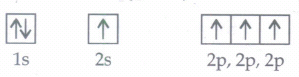
Hence, carbon atom undergoes sp3 hybridization in CH4 molecule and takes a tetrahedral shape.
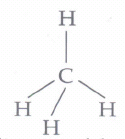
For a square planar shape, the hybridization of the central atom has to be dsp3. However, an atom of carbon does not have d-orbitals to undergo dsp3 hybridization. Hence, the structure of CH4 is tetrahedral.
13.
Step I: Calculation of Kp for the reaction
Let the total mass of the gaseous mixture = 100 g
Mass of CO in the mixture = 90.55 g
Mass of CO2 in the mixture = (100 - 90.55) = 9.45 g
No. of moles of CO = \(\frac { 90.55g }{ (28g\ mol^{ -1 }) } \) = 3.234 mol
No. of moles of CO2 = \(\frac { 9.45 }{ (44g\ mol^{ -1 }) } \) = 0.215 mol
Pco in the mixture = \(\frac { (3.234\ mol) }{ (3.234 + 0.215) } \times 1atm\) = \(\frac { (3.234\ mol) }{ (3.449\ mol) } \times 1atm\) = 0.938 atm
Pco2 in the mixture = \(\frac { (0.215\ mol) }{ (3.449\ mol) } \times 1atm\) = 0.062 atm
C(s) + CO2(g) ⇌ 2CO(g)
Eqm. pressure 0.062atm 0.938atm
Kp = \(\frac { { p }^{ 2 }CO }{ pCO_{ 2 } } =\frac { (0.938\ atm{ ) }^{ 2 } }{ (0.062\ atm) } \) = 14.19 atm
Step II. Calculation of K2 for the reaction.
\(K_{ c }=\frac { K_{ p } }{ (RT)^{ \Delta ng } } \)
Kp = 14.19 atm, R = 0.0821 L atm K-1 mol-1, T = 1127 K ; Δng = 2 - 1 = 1
Kc = \(K_{ c }=\frac { (14.19\ atm) }{ (0.0821\ L\ atm\ K^{ -1 }\ mol^{ -1 })\times (1127K)^{ 1 } } \) = 6.46
14.
Kala chana , soya bean and sprouted lentils are the sources of iron potassium and proteins
15.
0.2 L(or 200 mL) of 5M solution will contain
\(\frac { 340\times0.2 }{ 2 } =34g{ H }_{ 2 }{ O }_{ 2 }\)
\(\underset { 2\times 34=68g }{ { 2H }_{ 2 }O_{ 2 } } \rightarrow { 2H }_{ 2 }O+\underset { 2\times 16=32g }{ { O }_{ 2 } } \)
\(\because \ 68g \ { H }_{ 2 }O_{ 2 }\) on decomposition will give 32g\(O_{ 2 }\)
\(\therefore \ 34g \ { H }_{ 2 }O_{ 2 }\) on decomposition will give
\(\frac { 32\times 34 }{ 68 } =16g{ O }_{ 2 }\)
16.
The reaction of H2O2 with acidified KI Solution.
\(2KI+{ H }_{ 2 }{ SO }_{ 4 }+{ H }_{ 2 }{ O }_{ 2 }\longrightarrow { K }_{ 2 }{ SO }_{ 4 }+{ I }_{ 2 }+2{ H }_{ 2 }O\)
\( 34 \ g \ 254 \ g\)
\( 5 \ { cm }^{ 3 } \ 0.508 \ g\)
\(254 \ g \ af \ { I }_{ 2 } \ is \ liberated \ by \ { H }_{ 2 }{ O }_{ 2 }=34g\)
\(0.508 \ g \ { I }_{ 2 } \ is \ liberated \ by \ { H }_{ 2 }{ O }_{ 2 }=\frac { 34 }{ 254 } \times 0.508=0.068g\)
\(Now,5{ cm }^{ 3 } \ of \ { H }_{ 2 }{ O }_{ 2 } \ contains=0.068g \ of\quad { I }_{ 2 }\)
\(then,1{ cm }^{ 3 } \ of \ { H }_{ 2 }{ O }_{ 2 } \ contains=\frac { 0.068 }{ 5 } =0.0136g \ of \ { I }_{ 2 }\)
\( now,\ 2{ H }_{ 2 }{ O }_{ 2 }\longrightarrow 2{ H }_{ 2 }O+{ O }_{ 2 }\)
\( 68g \ 22400mL \ at \ STP\)
\( 68g \ of \ { H }_{ 2 }{ O }_{ 2 } \ gives \ 22400mL \ { O }_{ 2 } \ at \ STP\)
\(1{ cm }^{ 3 } \ or \ 0.0136g \ of \ { H }_{ 2 }{ O }_{ 2 } \ give \ { O }_{ 2 } \ at \ STP\)
\( =\frac { 22400 }{ 68 } \times 0.0136\)
\( =4.48mL \ of \ STP\)
\( \therefore \ Strength \ of \ { H }_{ 2 }{ O }_{ 2 }=4.48 \ volumes\)
17.
(i) A\(\rightarrow \)B (Temperature and pressure are constant).
\(\therefore \) It is isothermal and isobaric process.
(ii) B\(\rightarrow \) C It is adiabatic expansion in which temperature falls from T1 and T2.
(iii) C\(\rightarrow \)D (Temperature and volume are constant)
\(\therefore \) This process is isothermal and isochoric.
(iv) D \(\rightarrow \)E (Temperature and pressure are constant)
\(\therefore \) It is isothermal and isobaric contraction.
(v) E\(\rightarrow \)F (It is adiabatic compression in which temperature increases from T2 to T1)
(vi) F\(\rightarrow \)A (Temperature and volume are constant)
\(\therefore \) It is isothermal and isochoric process.
18.
(i) Total work done in an expansion when the state of an ideal gas is changed reversibly and isothermally from (p i ,V i) to ( p f ,V f). Reversible work is represented by the combined areas ABC and BCViVf.
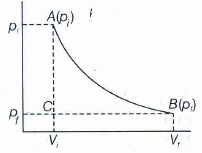
(ii) Work against constant pressure, pf is represented by the area BCViVf .Work(i) > Work (ii)
19.
20.
(i) Potassium, K (Z = 19)
(ii) Strontium, Sr (Z = 38)
(iii) Ruthenium, Ru (Z = 44)
(iv) Praseodymium, Pr (Z = 59 )
(v) Xenon, Xe(Z = 54 )
21.
According to Einstein's equation \(KE=\frac { 1 }{ 2 } { m_{e}v }^{ 2 }=h(v-{ v }_{ o })\)
\(=\left( 6.626\times { 10 }^{ -34 }Js \right) (1.0\times { 10 }^{ 15 }{ s }^{ -1 }-7.0\times { 10 }^{ 14 }{ s }^{ -1 })\)
\( =\left( 6.626\times { 10 }^{ -34 }Js \right) (100\times { 10 }^{ 14 }{ s }^{ -1 }-7.0\times { 10 }^{ 14 }{ s }^{ -1 })\)
\(=\left( 6.626\times { 10 }^{ -34 }Js \right) \times (3.0\times { 10 }^{ 14 }{ s }^{ -1 })=1.988\times { 10 }^{ -19 }J\)
22.
Step I As the question is already in skeletal form of the equation, so, a step I is completed.
Step II changing the elementary substance hydrogen to atomic form
\(Fe+{ H }_{ 2 }O\rightarrow { Fe }_{ 3 }{ O }_{ 4 }+{ 2H }\)
Step III \({ Fe }_{ 3 }{ O }_{ 4 }\) has the largest number of atoms, To balance this, multiply \({ H }_{ 2 }O\) by 4 balance oxygen atoms. In 4 molecules of \({ H }_{ 2 }O\)there are 8 atoms of H which are balanced by multiplying H on RHS by 8.
\(3Fe+{ 4H }_{ 2 }O\rightarrow { Fe }_{ 3 }{ O }_{ 4 }+{ 8H }\)
Step IV Converting H-atom to molecular form.
\(3Fe+{ 4H }_{ 2 }O\rightarrow { Fe }_{ 3 }{ O }_{ 4 }+{ 8H }\)
Step V The number of Fe, H and O atoms on both the sides of the equation respectively 3,8 and 4. The equation obtained is a balanced chemical equation.
23.
(a) Distillation under reduced pressure or vacuum distillation
(b) Sublimation.
24.
For preparation of alkanes containing odd number of carbon atoms, a mixture of two alkyl halides has to be used. Since two alkyl halides can react in three different ways, therefore, a mixture of three alkanes instead of the desired alkane would be formed. For example, the Wurtz reaction between 1-bromopropane and 1-bromobutane gives a mixture of three alkanes i.e., hexane, heptane and octane as shown below:
25.
(a) Cr is getting oxidised and Mn\({ O }_{ 4 }^{ - }\) is getting reduced.
(b) Cr is negative electrode, Pt in Mn\({ O }_{ 4 }^{ - }\)-acts as positive electrode
26.
32.39
27.
(a) \(B_{ 2 }H_{ 6 }+2NH_{ 3 } \rightarrow \ 2BH_{ 3 }.NH_{ 3 }\)
Borane-ammonia complex (adduct)
or \([BH_{ 2 }(NH_{ 3 })_{ 2 }]^{ + }[BH_{ 4 }]^{ - }\)
(b) \(3{ B }_{ 2 }{ H }_{ 6 }+6NH_{ 3 } \ \rightarrow \) \(3[BH_{ 2 }(NH_{ 3 })_{ 2 }]^{ + }[BH_{ 4 }]^{ - } \ \underrightarrow { \Delta } \ 2B_{ 3 }{ N }_{ 3 }{ H }_{ 6 }+12{ H }_{ 2 }\)
Borazine (inorganic enzene)
28.
The name of the compound is hydrogen peroxide, \({ H }_{ 2 }O_{ 2 }\) It acts as an oxidising agent as well as reducing agent in both acidic and basic nedium.
29.
(a) Pressure will be doubled (2p. atm).
(b) Temperature will remain same
(c) Density will remain same (d g cm-3).
(d) Number of moles will be doubled i.e.2n.
30.
Bond order is defined as one half the difference between the number of electron present in the bonding and anti-bonding orbitals, i.e
Bond order (BO) \(=\frac { 1 }{ 2 } ({ N }_{ b }-{ N }_{ a })\)
A positive bond order means a stable molecule while a negative or zero bond order means an unstable molecule.
Stability of a molecule \(\propto \) bond order
Bond length \(\propto \) \(\frac { 1 }{ bond \ order } \)
Bond order values 1,2 or 3 corresponding to single, double or triple bonds respectively.
31.
\(\lambda _{ O_{ 2 } }/\lambda _{ SO_{ 2 } }=2 \ (because \ \lambda =\frac { h }{ mv } ,i.e.\lambda \propto \frac { 1 }{ m } \) and mass of SO2 molecule viz.64 u is double than that of O2 molecule viz.32 u).
32.
(c)
10-15 M
33.
(c)
alkaline KMnO4
34.
(b)
free-radical mechanism
35.
(a)
ionisation energy
36.
(d)
Cs
37.
(d)
surface tensions
38.
(a)
Si02
39.
(c)
H2SO4
40.
(d)
+3
41.
(d)
2-nitrophenol
42.
(a)
hydrated sodium aluminium silicate - Na2Al2Si2O8.xH2O
43.
(c)
basic
44.
(c)
The ionization energy of the element
45.
(b)
zero
46.
(b)
\(\frac { 1 }{ 2 } \)mole of H2

11th Standard CBSE Syllabus & Materials
11th Standard CBSE
CBSE 11th Business Studies Forms of Business Organisation Sample Question Papers Study Material - QB365 Set A
NEW11th Standard CBSE
CBSE 11th Business Studies Business, Trade and Commerce Sample Question Papers Study Material - QB365 Set A
NEW11th Standard CBSE
CBSE 11th Physics Waves Sample Question Papers Study Material - QB365 Set A
NEW11th Standard CBSE
CBSE 11th Physics Kinetic Theory Sample Question Papers Study Material - QB365 Set A



CBSE 11th Standard CBSE Subjects
CBSE Standards









