
 100% FREE ACCESS
11th Standard CBSE Syllabus & Materials
11th Standard CBSE
CBSE 11th Economics PART-A - Presentation of Data - New Sample Question Papers Study Material - QB365 Set A
NEW11th Standard CBSE
CBSE 11th Economics PART-A - Organisation of Data - New Sample Question Papers Study Material - QB365 Set A
NEW11th Standard CBSE
CBSE 11th Economics PART-A - Collection of Data - New Sample Question Papers Study Material - QB365 Set A
NEW11th Standard CBSE
CBSE 11th Economics PART-A - Introduction to Economics and Statistics - New Sample Question Papers Study Material - QB365 Set A
NEW11th Standard CBSE
CBSE 11th Business Studies International Trade Sample Question Papers Study Material - QB365 Set A
NEW11th Standard CBSE
CBSE 11th Business Studies Evolution and Fundamentals of Business Sample Question Papers Study Material - QB365 Set A

Published on: 04/03/2020
11th Standard Chemistry Board Exam Sample Question 2020
Download CBSE Class 11th Standard CBSE Chemistry question papers, sample papers, important questions, and previous year solved papers in PDF format. Get free study materials, NCERT solutions, and exam preparation resources for Class 11th Standard CBSE Chemistry
Questions + Answers key
Take MCQ Chemistry Test
1.
Discuss the principle and method of softening of hard water by synthetic ion-exchange resins.
2.
Explain why alkyl groups act as electron donors when attached to a π system.
3.
A large number of fish are suddenly found floating dead on a lake. There is no evidence of toxic dumping but you find an abundance of phytoplankton. Suggest a reason for the fish kill.
4.
An alkane has a molecule mass of 72. Give all the possible structural isomers along with their IUPAC names.
5.
A tetravalent element forms monoxide and dioxide withoxygen. When air is passed over heated element(1273 K), Producer gas is obtained. Monoxide of the element is powerful reducing agent and reduces ferric oxide to iron. Identify the element and write formulas of its monoxide and dioxide.
Write chemical equations for the formation of prodecur gas and reduction of ferric oxide with the monoxide.
6.
Present a comparative account of the alkali and akaline earth metals with respect to the following characteristics.
Tendency to form ionic/covalent compounds
7.
How much volume of 0.1M \(C{ H }_{ 3 }COOH\)Should be added to 50 ml of 0.2 m \(C{ H }_{ 3 }COOH\)Solution to prepare a buffer solution of Ph 4.91
8.
A 5 L cylinder contained 10 moles of oxygen gas at 27oC.Due to sudden leakage through the hole, all the gas escaped into the atmosphere and the cylinder got empty.If the atmospheric pressure is 1.0 atmosphere, calculate the work done by the gas(1 L atm = 101.3 J)
9.
Calculate the volume of 1.00 mol L-1 aqueous solution of sodium hydroxide that is neutralised by 200mL of 2.00mol L-1 aqueous hydrochloric acid and the mass of sodium chloride obtained. Neutralisation reaction is \(NaOH(aq)+HCl(aq)\longrightarrow NaCl(aq)+H_{ 2 }O(l)\)
10.
Calculate the number of moles in the following
(a) 7.85 g of iron
(b) 4.68 mg of silicon
(c) 65.6 \( \mu\) g of carbon
11.
Using the standard electrode potentials given in the Table , predict if the reaction between the following is feasible:
(a) Fe3+ (aq) and I-(aq)
(b) Ag+(aq) and Cu(s)
(c) Fe3+(aq)and Cu(s)
(d) Ag(s) and Fe3+(aq)
(e) Br2 (aq) and Fe2+(aq)
12.
Have you ever observed any water pollution in your area? What measures would you suggest to control it?
13.
Reema takes milk every day . She also take curd and other milk products.She takes green leafy vegitables and fruits also. An adult body contains about 25g of magnesium and 1200 g of calcium and 5 g of iron .these elements must be a part of our diet. All enzymes that utilize ATP in phosphate transfer required magnesium as co-factor. the main pigment for the absorption of light in plants is chlorophyll, which contains magnesium. were as Anita does not like milk and takes lot of junk food.
How are green lefy vegitables rich in magnesium?
14.
Scientist of UK has designed the cars, working on hydrogen fuel cells instead of petrol engines. Here hydrogen is used as sources of electrical energy i.e. a reaction of hydrogen and oxygen is used to generate electrical energy. It has many advantages over the conventional fossil fuels and electric power generation.
What is the efficiency of the fuel cell as the comparison to other conventional fuels?
15.
Give ion electron equations for the reactions.
Oxidation of ferrous ions to ferric ions by hydrogen peroxide both in acidic and basic media.
16.
Balance the following equation by the oxidation number method.
\({ I }_{ 2 }+{ S }_{ 2 }{ O }_{ 3 }^{ 2- }\longrightarrow { I }^{ - }+{ S }_{ 4 }{ O }_{ 6 }^{ 2- }\)
17.
Calculate the degree of ionization of 0.05M acetic acid if its pKa value is 4.74. How is the degree of dissociation affected when its solution also contains (a) 0.01M (b) 0.1M in HCl ?
18.
For oxidation of iron, \(4Fe(s)+{ 3O }_{ 2 }(g)\rightarrow 2{ Fe }_{ 2 }{ O }_{ 3 }(s)\) entropy change is -549.4 JK-1mol-1 at 298K. Inspite of negative entropy change of this reaction, why is the reaction spontaneous? (\({ \triangle }_{ r }{ H }^{ \circleddash }\)for this reaction is -1648 x 103 Jmol-1)
19.
A given mass of a gas collected over water at 25\(^{0}\)C has a pressure of 500 mm Hg.Calculate the pressure if its volume is reduced to half of its original volume(aqueous tension at 25\(^{0}\)C = 24mm of Hg)
20.
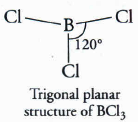
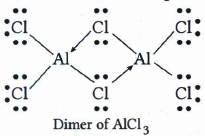
Give reason why BCl3 is planar and anhydrous AlCl3 is tetrahedral?
21.
Write the significance/applications of dipole moment.
22.
Write the name and the atomic number of the following elements.
(i) The third alkali metal
(ii) The fourth alkaline earth metal
(iii) The sixth element of second transition series
(iv) The second inner transition element
(v) The fifth noble gas.
23.
Calculate the wavelength for the emission transition if it starts from the orbit having radius 1.3225 nm and ends at 211.6 pm. Name the series to which this transition belongs and the region of the spectrum.
24.
The density of the water at room temperature is 0.1 g / mL. How many molecules are there in a drop of water if its volume is 0.05 mL?
25.
What happens when alkali metals are dissolved in ammonia?
26.
What is the nature of classical smog?
27.
What happens when crystals of washing soda are exposed to air?
28.
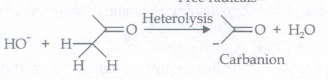
For the following bond cleavages, use curved-arrows to show the electron flow and classify each as homolysis or heterolysis. Identify reactive intermediate produced as free radical, carbocation and carbanion.
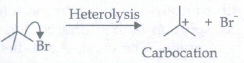
29.
What do you understand by laminar flow of a liquid?
30.
Write the important conditions required for the linear combination of atomic orbitals to form molecular orbitals.
31.
How is empirical formula of a compound related to its molecular formula?
32.
Which of the following compounds will show cis-trans isomerism?
CH2= CBr2
33.
A compound A of boron reacts with NMe3 to give an adduct B which on hydrolysis gives a compound C and hydrogen gas. Compound C is an acid. Identify the compounds A, B and C. Give the reactions involved.
34.
Arrange the following metals in the order in which they displace each other from the solution of their salts. Al, Cu, Fe, Mg and Zn.
35.
Carbon monoxide is allowed to expand isothermally and reversibly from 10\({ m }^{ 3 }\) to 20\({ m }^{ 3 }\) at 300K and work obtained is 4.754kJ. Calculate the number of moles of carbon monoxide.
36.
Electromagnetic radiation of wavelength 242 nm is just sufficient to ionise the sodium atom. Calculate the ionisation energy of sodium in kJ mol–1.
37.
The equilibrium expression, Kc= [CO2] represents the reaction.
C(s) + O2(g) ⇌ CO2(g)
CaCO3(s) ⇌ CaO(s) + CO2(g)
CO(g) + \(\frac { 1 }{ 2 } \) O2(g) ⇌ CO2(g)
CaO(s) + CO2(g) ⇌ CaCO3(s)
38.
For an endothermic reaction ______.
\(\Delta\)H is-ve
\(\Delta\)H is+ve
\(\Delta\)H is zero
none of these
39.
Tolueue reacts with chlorine in the presence of light to give ______.
benzyl choride
benzoyl chloride
p-chlorotoluene
o-chlorotoluene
40.
The hybridization state of a carbocation is ______.
Sp4
sp3
sp2
sp
41.
Cathode rays are deflected by _______.
electric field only
electric and magnetic field
magnetic field only
none of these
42.
With rise in temperature, the surface tension of a liquid
decreases
increases
remaining the same
none of the above
43.
Which of the following molecules have zero dipole moment?
CS2
CO2
CCl2
CH2Cl2
44.
In the ethylene molecule the two carbon atoms have the oxidation numbers.
-1, -1
-2, -2
-1, -2
+2,-2
45.
The pollutant released in Bhopal gas tragedy was
Ammonia
Mustard gas
Nitrous oxide
Methyl isocyanate
46.
The molecule Ne2 does not exist because ______.
Nb > Na
Nb = Na
Nb < Na
None of these
47.
The decomposition of H2O2 is retarded by
acetanilide
glycerol
sodium bicarbonate
oxalic acid
48.
Which one of the following alkaline earth metal carbonates is thermally most stable
MgCO3
CaCO3
SrCO3
BaCO3
49.
Which of the following is arranged in order of increasing radius?
K+ (aq) < Na + (aq) < Li+ (aq)
K+ (aq) > Na + (aq) > Zn2+ (aq)
K+ (aq) > Li+ (aq) > Na + (aq)
Li+ (aq) < Na + (aq) < K+ (aq)
50.
The empirical formula of sucrose is _______.
CH2O
CHO
C12H22 O11
C(H2 O)2
1.
Cation exchange resins have large organic molecule with SO3H group which are insoluble in water. Ion exchange resin (RSO3H) is changed to RNa on treatment with NaCl. The resin exchange Na+ ions with Ca2+ and Mg2+ ions present in hard water and make it soft.
\(2RNa(s)+{ M }^{ 2+ }(aq)\longrightarrow { R }_{ 2 }M(s)+2{ Na }^{ + }(aq)\)
where, M = Mg, Ca.
The resins can be regenerated by adding aqueous NaCl solution.
2.
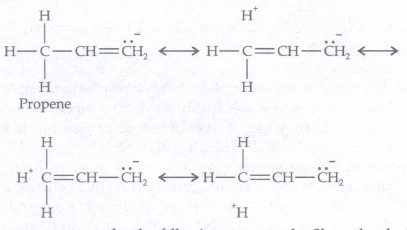
Due to hyperconjugation, alkyl groups act as electron donors when attached to a \(\pi\)-system as shown below:
3.
Large quantities of phosphates and nitrates increase the growth of phytoplanktons. These phytoplankton use so much oxygen that it is not sufficiently available for other organism to use in respiration. Moreover, a large consume the oxygen dissolved in water, Microorganisms may become so abundant that they from a mat covering on the water surface and thereby preventing photosynthesis. In all these processes concentration of dissolved oxygen in water decreases. When the concentration of dissolved oxygen of water is below 6 ppm, the growth of fish gets inhibited and they cannot survive.
4.
The general formula of alkanes is CnH2n+2=12xn+1x(2n+2)=72 or 12n+2n+2=72 or n=5
Thus, the molecular formula of the alkane is C5H12. For structural isomers and their IUPAC names.
5.
Producer gas is a mixture of CO and N2, therefore, the tetravalent element is carbon and its monoxide and dioxide are CO and CO2 respectively.
\(2C(s)+\underbrace { O_{ 2 }(s)+4N_{ 2 }(g) }_{ Air } \overset { 1273k }{ \rightarrow } \underbrace { 2CO(g)+4N_{ 2 }(g) }_{ Producer \ gas } \)
The carbon monoxide is a strong reducing agent and reduces ferric oxide to iron.
\(Fe_{ 2 }O_{ 3 }(s)+3CO(g)\overset { \Delta }{ \rightarrow } 2Fe(s)+3CO_{ 2 }(g)\)
6.
| Alkali metals | Alkaline earth metals |
| All alkali metals except Li form ionic compounds | All alkaline earth metals except Be form ionic compounds |
7.
\( According \ to \ hendrson's \ equation\)
\(PH={ Pk }_{ a }=log\cfrac { [salt] }{ [acid] } \)
\( pH=4.91,{ Pk }_{ a }=4.76\)
\(4.91=4.76+log\cfrac { [salt] }{ [acid] }\)
\(log\cfrac { [NaAc] }{ AcH } =antilog\)
\(V=\cfrac { 0.2\times 50 }{ 0.1\times 1.41 } =70.92ml\)
\( Volume \ of \ 0.1 \ m \ Acid \ required=70.92\)
8.
\( V_{\text {initial }}=5 \mathrm{~L}, T=27^{\circ} \mathrm{C}=27+273 \mathrm{~K}=300 \mathrm{~K} \)
\( \mathrm{~V}_{\text {final }}=\frac{\mathrm{nRT}}{\mathrm{P}}=\frac{10 \times 0.0821 \times 300}{1.0}=246.3 \mathrm{~L} \)
\( \Delta \mathrm{V}=\Delta_{\text {firinal }}-\mathrm{V}_{\text {instial }}=246.3-5=241.3 \mathrm{~L} \)
\( \mathrm{w}_{\text {exp }}=-\mathrm{P} \Delta \mathrm{V}=-1 \times 241.3 \mathrm{~L} \text { atm }=-241.3 \times 101.3 \mathrm{~J} \)
\(=-24443.7 \mathrm{~J} \text {. } \)
9.
volume of 1.00 m NaOH = 400 mL and mass and of NaCl produced = 23.4 g
10.
(a) Moles of iron = \( \frac{ mass \ of \ iron }{atomic mass}\)
= \(\frac{7.85}{55.8}\)
= 0.141 mol
(b) Moles of silicon = \(\frac{ mass \ of \ silicon}{atomic mass}\)
= \(\frac{4.68 \times10^{-3}}{28.1} \)
= 1.67\( \times\) 10-4 mol
(c) Moles of carbon = \(\frac{mass \ of \ carbon }{atomic mass}\)
= \(\frac{65.6\times10^{-6}}{12}\)
= 5.47 \(\times\) 10-6 mol
11.
(a) It may be noted that for oxidation reactions, i.e., Eq. (i), the sign of the llectrode potential as given in Table B.l is reversed. To get the equation for the overall reaction, the number of electrons lost in Eq. (i) and gained in Eq. (ii) must be cancelled. To do so, Eq. (ii) is multiplied by 2 and added to Eq. (i). Further, it may be noted that whenever any half reaction equation is multiplied by any integer, its electrode potential is not multiplied by that integer. Thus
Overall reaction: 2Fe3+(aq) + 2I-(aq) \(\rightarrow\) 2Fe2+(aq) + 12(s);EO= + 0.23 V
Since the EMF for the above reaction is positive, therefore, the above reaction is feasible.
(b) The possible reaction between Ag+(aq) and Cu(s) is
Cu(s) + 2Ag+(aq) \(\rightarrow\) Cu2+(aq) + 2Ag(s)
The above redox reaction can be split into the following two half reactions. Writing electrode potential for each half reaction from Table , we have
Oxidation Cu(s) \(\rightarrow\) Cu2+(aq) + 2e-; Eo= -0.34 V
Reduction: Ag+(aq) + e- \(\rightarrow\) Ag(s)] x 2; Eo= + 0.80 V
(c) Overall reaction: Cu(s) + 2Ag+(aq) \(\rightarrow\) Cu2+(aq) + 2Ag(s); po = +0.46 V
Since the EMF of the above reaction comes out to be positive, therefore, the above reaction is feasible.
(c) Suppose the reaction between Fe3+(aq) and Cu(s) occurs according to the following equation.
Cu(s) + 2Fe3+(aq) \(\rightarrow\) 3Cu2+(aq) + 2Fe2+(aq)
The above reaction can be split into the following two half reactions. Writing electrode potential for each half reaction from Table , we have,
Oxidation: Cu(s) \(\rightarrow\) Cu2+(aq) + 2e-; Eo = -0.34 V
Reduction: Fe3+(aq) + e- \(\rightarrow\) Fe2+(aq)] x 2; Eo= +0.77 V
(d) Overall reaction: Cu(s) + 2Fe3+(aq) \(\rightarrow\) Cu2+(aq) + 2Fe2+(aq); Eo = +0.43 V
Since the EMF of the reaction is positive, therefore, the above reaction is feasible. Alternatively, if the reaction between Fe3+(aq) and Cu(s) occurs according to the following equation.
3Cu(s) + 2Fe3+(aq) \(\rightarrow\) 3Cu2+(aq) + 2Fe(s)
The EMF of the reaction comes out to be - Ie, i.e., -0.376 V (-0.34 V - 0.036 V) and hence this reaction is not feasible.
(d) Suppose the reaction between Ag(s) and Fe3+ (aq) occurs according to the following equation:
Ag(s) + Fe3 + (aq) \(\rightarrow\) Ag + (aq) + Fe2+(aq)
The above reaction can be split into the following two half reactions. Writing electrode potential for each half reaction from Table , we have,
Oxidation: Ag(s) \(\rightarrow\) Ag+(aq) + e-; Eo = -0.80 V
Reduction: Fe + (aq) + e- \(\rightarrow\) Fe2+(aq); Eo = +0.77 V
(e) Overall reaction: Ag(s) + Fe3+(aq) \(\rightarrow\) Ag+(aq) + Fe2+(aq); Eo= -0.03 V
Since the EMF of the reaction is negative, therefore, the above reaction is not feasible.
Alternatively, the reaction between Ag(s) and Fe3+(aq) may occur according to the following equation
3Ag(s) + Fe3+(aq) \(\rightarrow\) 3Ag+(aq) + Fe(s)
On similar lines, we can calculate the e.m.f. of this reaction comes to be even more negative, i.e., -0.836 V, and hence this redox reaction is also not feasible.
(e) Suppose the reaction between Br2(aq) and Fe2+(aq) occurs according to the following equation:
Br2(aq) + 2Fe2+(aq) \(\rightarrow\) 2Br-(aq) + 2Fe3+(aq)
The above reaction can be split into the following two half reactions. Writing electrode potential for each half reaction from the Table 8.1, we have
Oxidation: Fe2+(aq) \(\rightarrow\) Fe3+(aq) + e-] x 2; Eo = -0.77 V
Reduction: Br2(aq) + 2e- \(\rightarrow\) 2Br-(aq); Eo = +1.09 V
12.
Yes, polluted water is the water whose quality has been degraded by the addition of substance such as chemical effluents, metal residues, sewage, oil, fertilisers, detergents, etc.
It can be controlled by the following methods.
(i) Industrial waste discharge from paper, fertilisers, should not be allowed to get mixed in water bodies such as river, lakes, etc.
(ii) Non-biodegradable detergents should be used for cleaning of clothes
(iii) The ph of water should be checked.
(iv) Excessive use of fertilisers should be prevented.
(v) oils spills should be avoided as much as possible
(vi) Domestic waste water should be properly discharged and treated.
(vii) Avoid the use of DDT, malathion at home.
(viii) Waste water should be treated in sewage treatment plant.
13.
Chlorophyll presents in green leafy vegotables, contains magnisium
14.
The efficiency of fuel cells is 70% whereas other conventional cells are only 40% efficient.
15.
(a) In acidic medium
\({ 2Fe }^{ 2+ }(aq)+2{ H }^{ + }(aq)+{ H }_{ 2 }{ O }_{ 2 }(aq)\rightarrow 2{ Fe }^{ 3+ }(aq)+2{ H }_{ 2 }O(l)\)
(b) In basic medium
\({ 2Fe }^{ 2+ }(aq)+{ H }_{ 2 }{ O }_{ 2 }(aq)\rightarrow 2{ Fe }^{ 3+ }(aq)+2{ OH }^{ - }(aq)\)
16.
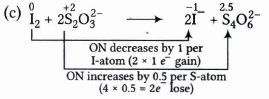
(Multiply \({ S }_{ 2 }{ O }_{ 3 }^{ 2- }\) by 2 because there are 4 S-atoms in \({ S }_{ 4 }{ O }_{ 6 }^{ 2- }\) ion). Increase and decrease in oxidation number is already balanced. Charge and oxygen atoms are also balanced. This represents a balanced redox reaction.
17.
(a) \(\because { pK }_{ a }=-log{ K }_{ a }\)
\( \because 4.74=-log{ K }_{ a }\)
\(or \ { K }_{ a }= \ antilog \ \bar { 5 } .26=1.82\times { 10 }^{ -5 }\)
\( From \ \alpha =\sqrt { \frac { { K }_{ a } }{ C } }\)
\( \alpha =\sqrt { \frac { 1.82\times { 10 }^{ -5 } }{ 0.05 } } =\sqrt { 0.364\times { 10 }^{ -3 } } =\sqrt { 3.64\times { 10 }^{ -4 } }\)
\( \alpha =1.908\times { 10 }^{ -2 }\)
In the presence of 0.01 M H+
\({ CH }_{ 3 }COOH\rightleftharpoons { CH }_{ 3 }CO{ O }^{ - }+{ H }^{ + }\)
\( Initiaconc.\ 0.05M\ \quad 0 \quad 0\)
\( Equili.conc.0.05 \ -C\alpha \quad C\alpha \quad (C\alpha +0.01)\approx 0.01\)
\( \left[ { CH }_{ 3 }COOH \ is \ a \ weak \ acid \ and \ HCl \ is \ a \ strong \ acid,so \ we \ can \ assume \ that \ (C\alpha +0.01)\approx 0.01 \right] \)
\(\because \ { K }_{ a }=\frac { \left[ { CH }_{ 3 }CO{ O }^{ - } \right] \left[ { H }^{ + } \right] }{ \left[ { CH }_{ 3 }COOH \right] } \)
\(\therefore 1.82\times { 10 }^{ -5 }=\frac { C\alpha \times 0.01 }{ 0.05 }\)
\(or \ C\alpha =\frac { 1.82\times { 10 }^{ -5 }\times 0.05 }{ 0.01 }\)
\(or \ 0.05\times \alpha =9.1\times { 10 }^{ -5 }\)
\(\therefore \alpha =\frac { 9.1\times { 10 }^{ -5 } }{ 0.05 } =1.82\times { 10 }^{ -3 }\)
(b) \(\because { pK }_{ a }=-log{ K }_{ a }\)
\( \because 4.74=-log{ K }_{ a }\)
\( or \ { K }_{ a }= \ antilog \ \bar { 5 } .26=1.82\times { 10 }^{ -5 }\)
\(From \ \alpha =\sqrt { \frac { { K }_{ a } }{ C } }\)
\( \alpha =\sqrt { \frac { 1.82\times { 10 }^{ -5 } }{ 0.05 } } =\sqrt { 0.364\times { 10 }^{ -3 } } =\sqrt { 3.64\times { 10 }^{ -4 } } \)
\( \alpha =1.908\times { 10 }^{ -2 }\)
In the presence of 0.1 M HCl
\(Similarly,\ { K }_{ a }=\frac { \left[ { CH }_{ 3 }CO{ O }^{ - } \right] \left[ { H }^{ + } \right] }{ \left[ { CH }_{ 3 }COOH \right] } \)
\( 1.82\times { 10 }^{ -5 }=\frac { C\alpha \times 0.1 }{ 0.05 } \)
\( \left[ { H }^{ + } \right] =(C\alpha +0.1M)\approx 0.1M\)
\((because \ 0.1M \ HCl \ =0.1 \ M \ { H }^{ + }ions)\)
\(C\alpha =\frac { 1.82\times { 10 }^{ -5 }\times 0.05 }{ 0.1 } =0.91\times { 10 }^{ -5 }\)
\( \alpha =\frac { 0.91\times { 10 }^{ -5 } }{ 0.05 } =1.82\times { 10 }^{ -4 }\)
In the presence of strond acid, dissociation of weak acid i.e. CH3COOH decreases due to common ion effect.
18.
One decides the spontaneity of a reaction by considering
\(\triangle { S }_{ total }(\triangle { S }_{ sys }+\triangle { S }_{ surr })\). For calculating ∆Ssurr, we have to consider the heat absorbed by the surroundings which is equal to – \({ \triangle }_{ r }{ H }^{ \circleddash }\). At temperature T, entropy change of the surroundings is
\(\triangle { S }_{ surr }=\frac { { \triangle }_{ r }{ H }^{ \circleddash } }{ T } \) (At constant pressure)
\( =\frac { (-1648\times { 10 }^{ 3 }J{ mol }^{ -1 } }{ 298K } \)
= 5530.20 JK-1mol-1
Thus, total entropy change for this reaction
\(\triangle { S }_{ total }=5530 \ J{ K }^{ -1 }{ mol }^{ -1 }+(-549.4 \ J{ K }^{ -1 }{ mol }^{ -1 })\)
\(=4980.6\ J{ K }^{ -1 }{ mol }^{ -1 }\)
This shows that the above reaction is spontaneous.
19.
Initial condition Final condition
Let, V1= V \({ V }_{ 2 }=\frac { V }{ 2 } \)
p1= 500 - 24 = 476 mm og Hg p2 =?
According to Boyle's law (temperature is constant)
p1V1 = p2V2
\({ p }_{ 2 }=\frac { { p }_{ 2 }{ V }_{ 1 } }{ { V }_{ 2 } }\) = \(\frac { 476XV }{ V/2 } m\)
= 2 x 476 mm of Hg
= 952 mm of Hg
20.
In Bcl3 molecule, B-atom acquire sp2 hybridisation.
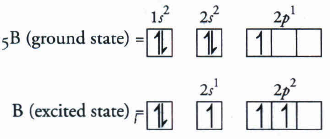
One s and one p-orbitals undergo hybridisation to form three equivalent sp2 hybrid orbitals.
The three sp2 hybrid orbitals are used to from \(\sigma \) -bonds with three Cl-atoms to give trigonal planar structure.
Anhydrous AlCl3 exists in the form of dimer Al2Cl6. In Al2Cl6 each A1 atom is surround by four bond pairs. As a result they assumes tetrahedral disposition.
21.
The applications of dipole moment are
(a) The dipole moment helps to predict whether a molecule is polar or non-polar. As μ = q × d greater is the magnitude of dipole moment, higher will be the polarity of the bond. For non-polar molecules, the dipole moment is zero.
(b) The percentage of ionic character can be calculated as Percentage of ionic character \(=\frac { { \mu }_{ observed } }{ { \mu }_{ ionic } } \times 100\)
(c) Symmetrical molecules have zero dipole moment although they have two or more polar bonds.
(d) It helps to distinguish between cis and trans-isomers. Usually cis-isomer has higher dipole moment than trans-isomer.
(e) It helps to distinguish between ortho, meta and para-isomers. Dipole moment of para-isomer is zero. Dipole moment of ortho-isomer is greater than that of.
22.
(i) Potassium, K (Z = 19)
(ii) Strontium, Sr (Z = 38)
(iii) Ruthenium, Ru (Z = 44)
(iv) Praseodymium, Pr (Z = 59 )
(v) Xenon, Xe(Z = 54 )
23.
Radius of nth orbit H like species, \({ r }_{ n }=\frac { 52.9({ n }^{ 2 }) }{ Z } pm\)
\({ r }_{ 1 }=1.3225nm=1322.5pm=\frac { 52.9{ n }_{ 1 }^{ 2 } }{ Z } \)
\( { r }_{ 2 }=211.6pm=\frac { 52.9{ n }_{ 2 }^{ 2 } }{ Z } \)
\(\frac { { r }_{ 1 } }{ { r }_{ 2 } } =\frac { 1322.5 }{ 211.6 } =\frac { { n }_{ 1 }^{ 2 } }{ { n }_{ 1 }^{ 2 } } \Rightarrow \frac { { n }_{ 1 }^{ 2 } }{ { n }_{ 1 }^{ 2 } } =6.25 \ or \ \frac { { n }_{ 1 } }{ { n }_{ 2 } } =2.5\)
If \({ n }_{ 1 }{ =5,n }_{ 2 }=2,\) then, the transition is from 5th orbit to 2nd orbit and it belongs to Balmer series.
\(\overline { v } =\frac { 1 }{ \lambda } =1.09677\times 10^{ 7 }\left( \frac { 1 }{ { n }_{ 1 }^{ 2 } } -\frac { 1 }{ { n }_{ 1 }^{ 2 } } \right) m^{ -1 }\)
\( \frac { 1 }{ \lambda } =1.09677\times 10^{ 7 }\left( \frac { 1 }{ { 2 }^{ 2 } } -\frac { 1 }{ 5^{ 2 } } \right) m^{ -1 }\)
\(\frac { 1 }{ \lambda } =1.09677\times 10^{ 7 }\times \frac { 21 }{ 100 } =2.303\times 10^{ -9 }m=434nm\)
It belongs to visible region.
24.
Volume of a drop of water = 0.05 mL
Mass of a drop of water = volume \(\times\) density
= ( 0.05 mL ) \(\times\)(1.0g / mL)
= 0.05 g
Gram molecular mass of water ( H2O ) = 2\(\times\)1 + 16 = 18 g ;
18 g of water = 1 mol
\(\therefore\) 0.05 g of water = \(\frac{1 mol}{(18 g)}\)\(\times\) ( 0.05 g )
= 0.0028 mol
\(\because\) 1 mole of water conmtains molecules = 6.022 \(\times\)1023
0.0028 mole of water will contain molecules
= 6.022 \(\times\)1023\(\times\)0.0028 = 1.68 \(\times\)1021 molecules
25.
They form blue coloured solution. The solution is paramagnetic in nature.
26.
Reducing.
27.
Monohydrate (Na2CO3·H2O) is formed as a result of efflorescence.
28.
29.
The type of flow in which there is regular gradation of velocity in passing from one layer to the next is called laminar flow.
30.
(i) The combining atomic orbitals should have comparable energies.
For example, Is orbital of one atom can combine with Is atomic orbital of another atom, 2s can combine with 2s.
(ii) The combining atomic orbitals must have proper orientations. So that they are able to overlap to a considerable extent.
(iii) The extent of overlapping should be large.
31.
Molecular formula = (Empirical formula)n
where n is positive integer.
32.
For exhibiting cis-trans (or geometrical isomerism, a molecule must fulfil the following condition.
The groups attached to each double bonded carbon atom must be different.
33.
Since, compound a of boron reacts with NMe3 to form an adduct B. Thus, compound A is a Lewis acid. Since adduct B on hydrolysis gives an acid C and hydrogen gas, therefore, A is B2H6 and C is boric acid.
\(B_{ 2 }{ H }_{ 6 }+2NMe_{ 3 }\rightarrow 2BH_{ 3 }.NMe_{ 3 }\)
Diborate(A) Adduct(B)
\(BH3.NMe_{ 3 }+3H_{ 2 }O\rightarrow H_{ 3 }BO_{ 3 }+NMe_{ 3 }+6{ H }_{ 2 }\)
Boric acid(C)
34.
EoAI3+ / AI = -.166V, EoCu2+ / Cu =+ 0.34 V
EFe2+ / Fe = - 0.44 V, EMg2+ / Mg = - 2.36 V
and EoZn2+ / Zn = - 0.76 V
A metal with more negative value of Eored is a stronger reducing agent than those which have less negative or positive value of Eored .Therefore, Mg can displace all the given metals from their aqueous salt solutions.AI can displace all metals from their aqueous salt solutions.Zinc can displace Fe and Cu from their aqueous salt solutions and Fe can displace only Cu from its aqueous salt solution. Hence, the orderin which they can display each other from the solution of their salts is as follows.
Mg, AI, Zn, Fe, Cu
35.
\(w=-2.303nRT \ log\frac { { V }_{ 2 } }{ { V }_{ 1 } } -4754\)
\(=-2.303\times n\times 8.314\times 300\times log\frac { 20 }{ 10 }\)
\(On \ solving, \ n=2.75mol\)
36.
Given, wavelength, \(\lambda =242nm=242\times 10^{ -9 }m\)
Energy,
\(E=hv=\frac { hc }{ \lambda } =\frac { 6.626\times 10^{ -34 }Js\times 3.0\times { 10 }^{ 8 }ms^{ -1 } }{ 242\times { 10 }^{ -9 }m }\)
\(E=0.0821\times { 10 }^{ -17 }J/atom\)
This energy is sufficient for ionisation of one Na atom, so it is the ionisation energy of Na.
\(E=6.023\times { 10 }^{ 23 }\times 0.0821\times { 10 }^{ -17 }J/mol\)
\(\\ E=4.945\times { 10 }^{ 5 }J/mol\)
\(=4.945\times { 10 }^{ 2 }kJ/mol\)
37.
(b)
CaCO3(s) ⇌ CaO(s) + CO2(g)
38.
(b)
\(\Delta\)H is+ve
39.
(a)
benzyl choride
40.
(c)
sp2
41.
(b)
electric and magnetic field
42.
(a)
decreases
43.
(a)
CS2
44.
(b)
-2, -2
45.
(d)
Methyl isocyanate
46.
(b)
Nb = Na
47.
(a)
acetanilide
48.
(d)
BaCO3
49.
(c)
K+ (aq) > Li+ (aq) > Na + (aq)
50.
(c)
C12H22 O11

11th Standard CBSE Syllabus & Materials
11th Standard CBSE
CBSE 11th Business Studies Forms of Business Organisation Sample Question Papers Study Material - QB365 Set A
NEW11th Standard CBSE
CBSE 11th Business Studies Business, Trade and Commerce Sample Question Papers Study Material - QB365 Set A
NEW11th Standard CBSE
CBSE 11th Physics Waves Sample Question Papers Study Material - QB365 Set A
NEW11th Standard CBSE
CBSE 11th Physics Kinetic Theory Sample Question Papers Study Material - QB365 Set A



CBSE 11th Standard CBSE Subjects
CBSE Standards









