
 100% FREE ACCESS
11th Standard Syllabus & Materials
11th Standard
TN 11th Tamil இயற்கை வேளாண்மை,சுற்றுச்சூழல் -செய்யுள் - மனோன்மணீயம் Important Questions And Answers Study Material - QB365 Set A
NEW11th Standard
TN 11th Tamil என்னுயிர் என்பேன் -துணைப்பாடம் - இசைத்தமிழர் இருவர் Important Questions And Answers Study Material - QB365 Set A
NEW11th Standard
TN 11th Tamil மொழி கலை -செய்யுள் - ஒவ்வொரு புல்லையும் Important Questions And Answers Study Material - QB365 Set A
NEW11th Standard
TN 11th Tamil பீடு பெற நில் - இலக்கணம் - பகுபத உறுப்புகள் Important Questions And Answers Study Material - QB365 Set A
NEW11th Standard
TN 11th Tamil பீடு பெற நில் - துணைப்பாடம் - வாடிவாசல் Important Questions And Answers Study Material - QB365 Set A
NEW11th Standard
TN 11th Tamil பீடு பெற நில் - செய்யுள் - குறுந்தொகை Important Questions And Answers Study Material - QB365 Set A

Published on: 27/05/2020
11th Standard Chemistry English Medium Model Question Paper Part III
Download Tamil Nadu 11th Standard Chemistry question papers, model tests, one-mark questions, important questions, and public exam papers in PDF format. Free study materials and answer keys for TN State Board students.
Questions + Answers key
Take MCQ Chemistry Test
1.
Which one of the following is an example for free radical initiators ?
Benzoyl peroxide
Benzyl alcohol
Benzyl acetate
Benzaldehyde.
2.
In SN1, the rate of the reaction depends on the ______________.
nucleophile
medium
concentration of the substrate
none of the above
3.
The shape of IF7 molecule is ___________
square planar
tetrahedral
Pentagonal bipyramidal
linear
4.
Conformation arise due to rotation around ___________
Carbon-carbon double bond
Carbon-carbon triple bond
Carbon-carbon single bond
All of these
5.
The IUPAC name of the compound CH3 – CH = CH – C ≡ CH is _________
Pent - 4 - yn-2-ene
Pent -3-en-l-yne
pent – 2– en – 4 – yne
Pent – 1 – yn –3 –ene
6.
Which one of the following binary liquid mixtures exhibits positive deviation from Raoults law ?
Acetone + chloroform
Water + nitric acid
HCl + water
ethanol + water
7.
The formation of ammonia from N2(g) and H2(g) is a reversible reaction
N2(g) + 3H2(g) ⇌ 2NH3(g) + Heat
What is the effect of increase of temperature on this equilibrium reaction ______________
equilibrium is unaltered
formation of ammonia is favoured
equilibrium is shifted to the left
reaction rate does not change
8.
On moving from left to right across a period in the periodic table, the metallic character__________.
increases
decreases
remains constant
first increases and then decreases
9.
Which of the following gas is essential for our survival?
N2
H2
O2
He
10.
Which one of the following is known as natural insulator?
FeSO4·7H2O
Na2CO310H2O
CaSO4.2H2O
CaSO4.1/2H2O
11.
The heat of formation of CO and CO2 are - 26.4 kcal and - 94 kcal, respectively. Heat of combustion of carbon monoxide will be ____________
+ 26.4 kcal
- 67.6 kcal
- 120.6 kcal
+ 52.8 kcal
12.
A macroscopic particle of mass 100 g and moving at a velocity of 100 cm S-1 will have a de Broglie wavelength of ___________
6.6 x 10⁻²⁹ cm
6.6 x 10⁻³⁰ cm
6.6 x 10⁻³¹ cm
6.6 x 10⁻³² cm
13.
Identify the correct statement(s) with respect to the following reaction :
Zn + 2HCl \(\longrightarrow\) ZnCl2 + H2
(i) Zinc is acting as an oxidant
(ii) Chlorine is acting as a reductant
(iii) Hydrogen is not acting as an oxidant
(iv) Zn is acting as a reductant
only (ii)
only (iv)
both (ii) and (iii)
both (ii) and (i)
14.
Zeolite used to soften hardness of water is hydrated _____________
Sodium aluminium silicate
Calcium aluminium silicate
Zinc aluminium borate
Lithium aluminium hydride
15.
Which bond is more polar in the following pair of molecular?
(i) H3C-H (or) H3C-Br
(ii) H3C-NH2 (or) H3C-OH
(iii) H3C-OH (or) H3C-SH
16.
Ethane burns completely in air to give CO2, while in a limited supply of air gives CO. The same gases are found in automobile exhaust. Both CO and CO2 are atmospheric pollutants
i) What is the danger associated with these gases
ii) How do the pollutants affect the human body ?
17.
Vapour pressure of a pure liquid A is 10.0 torr at 27°C. The vapour pressure is lowered to 9.0 torr on dissolving one gram of B in 20 g of A. If the molar mass of A is 200 then calculate the molar mass of B.
18.
Deduce the Vant Hoff equation.
19.
Explain the graphical representation of Boyle's law.
20.
Calculate the number of atoms / molecules present in the following 1.8 gram of water
21.
What is hydrogen bonding?
22.
The equilibrium constant of a reaction is 10, what will be the sign of ΔG? Will this reaction be spontaneous?
23.
Write balanced chemical equation for each of the following chemical reactions.
Lithium metal with nitrogen gas.
24.
In what period and group will an element with Z = 118 will be present?
25.
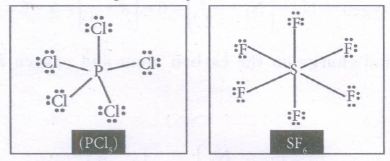
Draw the lewis structure of PCl5 and SF6
26.
What are Freons? Discuss their uses and environmental effects
27.
What are the scope of thermodynamics?
28.
Calculate the equivalent mass of the following : CO3-2,
29.
Define rate of diffusion
30.
The quantum mechanical treatment of the hydrogen atom gives the energy value:
\({ E }_{ n }=\frac { -13.6 }{ { n }_{ 2 } } ev{ \ atom }^{ -1 }\)
(i) use this expression to find ΔE between n = 3 and n = 4
(ii) Calculate the wavelength corresponding to the above transition.
31.
Explain what is meant by efflorescence.
32.
How many radial nodes for 2s, 4p, 5d and 4f orbitals exhibit? How many angular nodes?
33.
The simplest aromatic hydrocarbon C6H6 reactsⒷ on treatment with sodium hydroxide will (C6H5OH), Phenol, © as the product. Also Cl2 to giveⒶ which on reaction with sodium hydroxide gives Ⓑ.Ⓑ of molecular formula C6H6O. @ on treatment with ammonia will give C6H7N as @. Identify Ⓐ, Ⓑ, ©, and explain the reactions involved.
34.
Explain about the salient features of molecular orbital theory.
35.
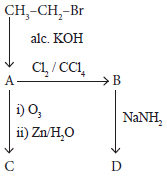
Identify the compound A, B, C and D in the following series of reactions
36.
Describe the classification of organic compounds based on their structure.
37.
Distinguish between alkali metals and alkaline earth metals.
38.
Balance the following equations by oxidation number method.
CuO + NH3 ⟶ Cu +N2 + H2O
39.
Calculate the de Broglie wavelength of an electron that has been accelerated from rest through 1potential differences of 1 KV.
40.
The enthalpy of combustion for H2, C(graphite) and CH4 are -285.8, -393.5 and -890.4 kJ mol-1respectively. Calculate the standard enthalpy of formation \(\Delta { H }_{ f }^{ 0 }\) for CH4
41.
I.E increases as we move across the period but Ionisation enthalpies (I.E) of second period of elements in the order.
Li < B < Be < C < O < N < F < Ne
Explain why?
(i) Be has higher I.E than B
(ii) O has lower I.E than N & F
42.
A group-1 metal (A) which is present in common salt reacts with (B) to give compound (C) in which hydrogen is present in –1 oxidation state. (B) on reaction with a gas (C) to give universal solvent (D). The compound (D) reacts with (A) to give (E), a strong base. Identify A, B, C, D and E. Explain the reactions.
43.
Assertion (A) : Excessive use of chlorinated pesticide causes soil and water pollution.
Reason (R) : Such pesticides are non-biodegradable.
i) Both (A) and R are correct and (R) is the correct explanation of (A)
ii) Both (A) and R are correct and (R) is not the correct explanation of (A)
iii) Both (A) and R are not correct
iv) (A) is correct but( R) is not correct
Both (A) and R are correct and (R) is the correct explanation of (A)
Both (A) and R are correct and (R) is not the correct explanation of (A)
Both (A) and R are not correct
(A) is correct but( R) is not correct
1.
(a)
Benzoyl peroxide
2.
(c)
concentration of the substrate
3.
(c)
Pentagonal bipyramidal
4.
(c)
Carbon-carbon single bond
5.
(b)
Pent -3-en-l-yne
6.
(d)
ethanol + water
7.
(c)
equilibrium is shifted to the left
8.
(b)
decreases
9.
(c)
O2
10.
(c)
CaSO4.2H2O
11.
(b)
- 67.6 kcal
12.
(c)
6.6 x 10⁻³¹ cm
13.
(b)
only (iv)
14.
(a)
Sodium aluminium silicate
15.
(i) C-Br is more polar than C-H (due to electronegativity )
(ii) C-O is more polar than C-N
(iii) C-O is more polar than C-S
16.
(i) (a) Carbon Monoxide:
Carbon monoxide is a poisonous gas produced as a result of incomplete combustion of coal are firewood. It is released into the air mainly by automobile exhaust. It binds with haemoglobin and form carboxy haemoglobin which impairs normal oxygen transport by blood and hence the oxygen carrying capacity of blood is reduced. This oxygen deficiency results in headache, dizziness, tension, Loss of consciousness, blurring of eye sight and cardiac arrest.
(b) Carbon dioxide:
Carbon dioxide is released into the atmosphere mainly by the process of respiration, burning of fossil fuels, forest fire, decomposition of limestone in cement industry etc.Green plants can convert CO2 gas in the atmosphere into carbohydrate and oxygen through a process called photosynthesis. The increased CO2 level in the atmosphere is responsible for global warming. It causes headache and nausea.
ii) a) Carbon Monoxide :
It binds with haemoglobin and form carbory haemoglobin which impairs normal oxygen transport by blood and hence the oxygen carrying capacity of blood is reduced. This oxygen deficiency results in headache, dizziness, tension, Loss of consciousness, blurring of eye sight and cardiac arrest.
b) Carbon dioxide :
It causes headache and nausea.
17.
\(P_A^o\) = 10 torr, Psolution = 9 torr
WA = 20 g WB = 1 g
MA = 200 g mol-1 MB = ?
\({\Delta P\over P_A^o}={W_B\times M_A\over M_B\times W_A}\)
\({10-9\over 10}={1\times 200\over M_B\times 20}\)
\(M_B={200\over 20}\times 10=100\ g\ mol^{-1}\)
18.
This equation gives the quantitative temperature dependence of equilibrium constant (K). The relation between standard free energy change (\(\triangle\)GO) and equilibrium constant is
\(\Delta { G }^{ 0 }=-RTln\ K\) ...(1)
We know that
\(\Delta { G }^{ 0 }=\Delta { H }^{ 0 }-T\Delta { S }^{ 0 }\)
Substituting (1) in equation (2)
\(-RTln\ K\ =\Delta { H }^{ 0 }-T\Delta { s }^{ 0 }\)
Rearranging
In \(K=\cfrac { -\Delta H^{ 0 } }{ RT } +\cfrac { { \Delta S }^{ 0 } }{ R } \) ...(3)
Differentiating equation (3) with respect to temperature
\(\cfrac { d\left( In\quad K \right) }{ dT } =\cfrac { \Delta { H }^{ 0 } }{ { RT }^{ 2 } } \) ...(4)
Equation 4 is known as differential form of Van't Hoff equation.
On integrating the equation 4, between T1 and T2 with their respective equilibrium constants K1 and K2.
\(\int _{ { k }_{ 1 } }^{ { K }_{ 2 } }{ d\left( In\ K \right) =\cfrac { \Delta { H }^{ 0 } }{ R } \int _{ { T }_{ 2 } }^{ { { T }_{ 2 } } }{ \cfrac { dT }{ { T }^{ 2 } } } } \)
\(\left[ In\quad K \right] _{ { K }_{ 1 } }^{ { K }_{ 2 } }=\cfrac { \Delta { H }^{ 0 } }{ R } \left[ -\cfrac { 1 }{ T } \right] ^{ { T }_{ 2 } }_{ { T }_{ 1 } }\)
\(In\quad { K }_{ 2 }-In\quad { K }_{ 1 }=\cfrac { \Delta { H }^{ 0 } }{ R } -\left[ \cfrac { 1 }{ { T }_{ 2 } } +\cfrac { 1 }{ { T }_{ 2 } } \right] \)
\(In\quad \cfrac { { K }_{ 2 } }{ { K }_{ 1 } } =\cfrac { \Delta { H }^{ 0 } }{ R } \left[ \cfrac { { T }_{ 2 }-{ T }_{ 1 } }{ { T }_{ 2 }{ T }_{ 1 } } \right] \)
\(log\quad \cfrac { { K }_{ 2 } }{ { K }_{ 1 } } =\cfrac { \Delta { H }^{ 0 } }{ 2.303R } \left[ \cfrac { { T }_{ 2 }-{ T }_{ 1 } }{ { T }_{ 2 }{ T }_{ 1 } } \right] \) ...(5)
Equation (5) is known as integrated form of Van't Hoff equation.
19.
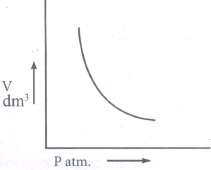
Boyle's law states that at a given temperature the volume occupied by a fixed mass of a gas is inversely proportional to its pressure.
\(V\propto\frac{1}{P}\) (T and n are fixed)
If the pressure of the gas increases, volume will decrease and if the pressure of the gas decreases, the volume will increase. So PV = Constant.
20.
Molecular mass of H20 = 18
gram molecular mass of H20 = 18g
1 mol of H20 = 18g of H20 = 6.023 x 10²³molecules of water
1.8g of H20 = \({6.023\times10^{23}\over18}\times1.8 \)
\(=6.023\times10^{22} molecules\)
21.
Hydrogen bonding is because of dipole-dipole interactions between the molecule in which hydrogen atom is covalently bonded to a highly electronegative atom.
22.
Given Keq= 10
Gas constant R = 8.314 JK-1 mol-1
T=300K
The relationship between Free energy change ΔG and equilibrium constant K is ΔGo=-RTlnK
Since K, T and R are positive values, ΔGo will be negative.
When ΔG is -ve, the process is spontaneous and feasible
23.
6Li + N2 ⟶ 2Li3 N
24.
Z = 118; [86Rn] 5f14 6d10 7s2 7p6
In the periodic table the element with Z = 118 is located in p-block,
Period no = 7 (as n = 7 for valence shell)
Group no. = 18 (group no = 10+ ns electrons + np electrons) (n - outermost shell)
25.
26.
Freons (CFC): The chloro uoro derivatives of methane and ethane are called freons.
Uses:
(i) Freons are a used as refrigerants in refrigerators and air conditioners.
(ii) It is used as a propellant for aerosols and foams
(iii) It is used as propellant for foams to spray out deodorants, shaving creams, and insecticides
27.
The scope of thermodynamics:
(i) To derive feasibility of a given process.
(ii) It also helps in predicting how far a physical (or) chemical change can proceed, until the equilibrium conditions are established.
28.
\(Equivalent \ mass ={sum \ of \ the \ atomic \ masses \ of \ atoms \ present \ in \ the \ ion \over charge \ on \ the \ ion}\)
For CO3 -2 ion
\(Equivalent \ mass ={1 x atomic \ mass \ of C + 3 x atomic \ mass \ of 'O'\over 2}\)
\(={12+3\times 16\over 2}={60\over2}=30\ g\ eq^{-1}\)
29.
It is defined as the number of molecules of a gas that get diffused in unit time.
rate of diffusion = \(\frac{Volume\ of \ the\ gas\ diffused}{time\ taken}\)
30.
\({ E }_{ n }=\frac { -13.6 }{ { n }_{ 2 } } ev{ \quad atom }^{ -1 }\)
n = 3 E3 = \(\frac { -13.6 }{ { 3 }^{ 2 } } =\frac { -13.6 }{ 9 } \)
= -1.51 ev atom-1
n = 4 E4 =\(\frac { -13.6 }{ { 4 }^{ 2 } } =\frac { -13.6 }{ 16 } \)
= -0.85 ev atom-1
\(\triangle \)E = (E4-E3) = (-0.85) - (-1.51) ev atom-1
= (-0.85 + 1.51)
= 0.66 eV atom-1
(1eV = 1.6 x 10⁻¹⁹J)
\(\triangle \)E = 0.66 x 1.6 x 10-19J
\(\triangle \)E = 1.06 x 10⁻¹⁹J
hv = 1.06 x 10⁻¹⁹J
\(\frac { hv }{ \leftthreetimes } \) = 1.06 x 10⁻¹⁹J
\(\therefore\)\( \leftthreetimes\) = \(\frac { hc }{ 1.06\times { 10 }^{ -19 }J } \)
= \(\frac { 6.626\times { 10 }^{ -34 }JS\times 3\times { 10 }^{ 8 }{ ms }^{ -1 } }{ 1.06\times { 10 }^{ -19 }J } \)
\(\lambda=1.875\times10^{-6}m\)
31.
Efflorescence is the spontaneous loss of water by a hydrated salt, which occurs when the aqueous vapor pressure of the hydrate is greater than the partial pressure of the water vapour in the air. This is the property of salts
Ex: Glauber's salt- Na2SO4·10H2O
Epsom salt - MgSO4·7H2O
32.
| Orbital | n | 1 | Radial node n-1-1 | Angular node 1 |
| 2s | 2 | 0 | 1 | 0 |
| 4p | 4 | 1 | 2 | 1 |
| 5d | 5 | 2 | 2 | 2 |
| 4f | 4 | 3 | 0 | 3 |
33.
(i) The aromatic hydrocarbon Ⓐ is Benzene, C6H6.
(ii) Benzene reacts. with Cl2 to give chlorobenzene (C6H5CI), as Ⓑ as the product.

(iii) Chlorobenzene Ⓑ acts with sodium hydroxide to give (C6HsOH) phenol, © as the product.

(iv) Chlorobenzene reacts with ammonia to give Aniline, C6H5NH2Ⓓ as the product.

34.
(i) When atoms combine to form molecules, their individual atomic orbitals lose their identity and form new orbitals called molecular orbitals.
(ii) The shape of molecular orbitals depend upon the shapes of combining atomic orbitals.
(iii) The number of molecular orbitals formed is the same as the number of combining atomic orbitals. Half the number of molecular orbitals formed will have lower energy and are called bonding orbitals, while the remaining half molecular orbitals will have higher energy and are called anti-bonding molecular orbitals.
(iv) The bonding molecular orbitals are represented as σ" (sigma), π (Pi), ઠ(delta) and the corresponding anti-bonding orbitals are called σ*π"*, 7t* and ઠ*.
(v) The electrons in the molecule are accommodated in the newly formed molecular orbitals. The filling of electrons in these orbitals follow Aufbau's Principle, Pauli's exclusion principle and Hund's rule as in the case of filling of electrons in the atomic orbitals.
(vi) Bond order gives the number of covalent bonds between the two combining atoms. The bond order of a molecule can be calculated using the following equation:
\(Bond\quad order=\cfrac { { N }_{ b }-{ N }_{ a } }{ 2 } \)
Nb = Number of electrons in bonding molecular orbitals.
Na =; Number of electrons in anti-bonding molecular orbitals.
(vii) A bond order of zero value indicates that the molecule does not exist.
35.
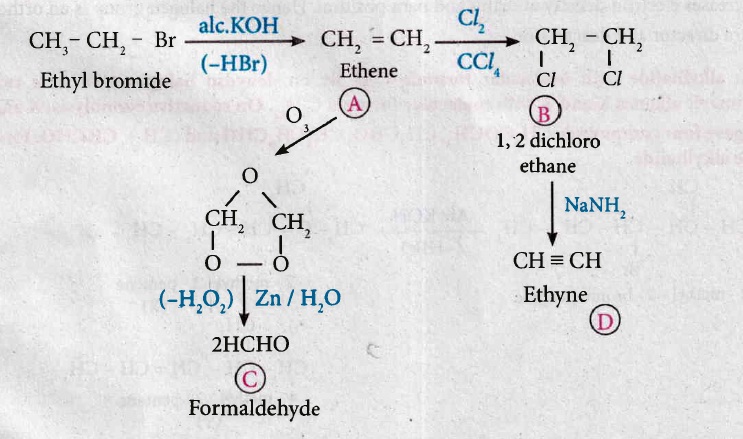
| compound | Structural formula | Name |
| A | CH2 = CH2 | Ethene |
| B | 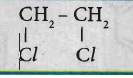 |
1,2 - dichloroethane |
| C | HCHO | Methanal |
| D | \(\mathrm{CH} \equiv \mathrm{CH}\) | Ethyne |
36.
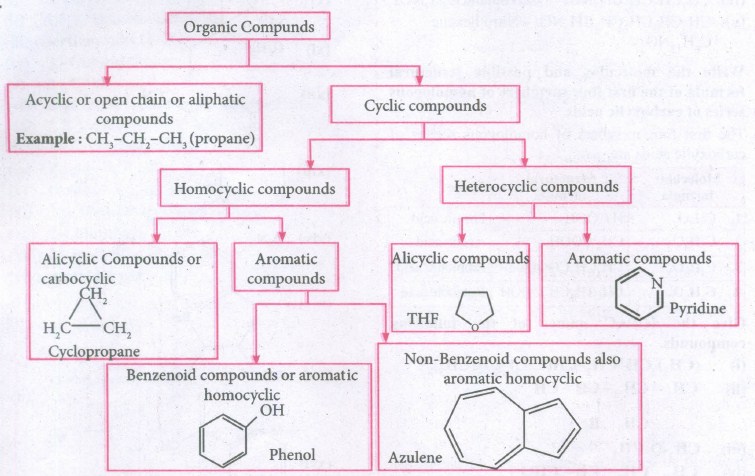
37.
| Alkali Metals | Alkaline earth metals | |
|---|---|---|
| 1. | Alkali metals are soft | Alkaline earth metals are hard |
| 2. | They have a single electron in the valence shell and their electronic configuration is [noble gas] ns1. | They have two electrons in the valence shell and their electronic configuration is [noble gas] ns2 |
| 3. | They have low melting points | They have relatively high melting points |
| 4. | Hydroxides are strongly basic. | Hydroxides are less basic |
| 5. | Carbonates do not decompose | Carbonates decompose to form oxide, when heated to high temperatures. |
| 6. | Nitrates give corresponding nitrites and oxygen as products. | Nitrates give corresponding oxides nitrogen dioxide and oxygen as products. |
| 7. | They show + 1 oxidation states. | They show +2 oxidation states |
| 8. | Their carbonates are soluble in water except Li2CO3. | Their carbonates are insoluble in water. |
| 9. | Except Li, alkali metals do not form complex compounds. | They can form complex compounds. |
38.
Step-1: To find atoms undergoing change in O.N.
\(\overset { +2-2 }{ CuO } +\overset { -3+1 }{ { NH }_{ 3 } } \rightarrow \overset { 0 }{ Cu } +\overset { 0 }{ { N }_{ 2 } } +\overset { +1-2 }{ { H }_{ 2 }O } \)
Step-2: To find total increase and decrease in O.N.
CuO ➝ Cu (decrease of 2 unit per atom)
NH3 ➝ N2 (increase of3 unit per atom)
Total decrease = 2 x 3 = 6
Total increase = 3 x 2 = 6
Step-3: To balance the total decrease and increase in O.N, multiply two by 3 and NH3 by 2.
3CuO + 2NH3 ⟶ Cu + N2 + H2O
Step-4: To balance all atoms other than 'H' and 'O'
3CuO + 2NH3 ⟶ 3Cu + N2 + H2O
Step-5: To balance 'O' atoms
3CuO + 2NH3 ⟶ 3Cu + N2 + 3H2O
hydrogen atoms balance by themselves.
Hence the final equation is
3CuO + 2NH3 ⟶ 3Cu + N2 + 3H2O
39.
Energy acquired by the electron (as kinetic energy) after being accelerated by a potential difference of 1 KV
i.e., 1000 volts = 1000 eV
= 1000 x 1.602 x 10-19 J
= 1.602 x 10⁻¹⁶ J (1 eV = 1.602 x 10⁻¹⁹ J)
Energy in Joules = charge on the electron in coulombs x potential difference in volts
i.e., Kinetic Energy (KE) = \(\frac{1}{2}\) mv2
= 1.602 x 10⁻¹⁶ J or \(\frac{1}{2}\) x 9.1 x 10⁻³¹ v2
v2 = 3.521 x 10¹⁴ or v = 1.88 x 10⁻¹ ms-1
\(\therefore \lambda=\frac{h}{mv}=\frac{6.626\times 10^{-34}kgm^2 s{-1}}{9.1\times 10^{-31}kg\times 1.88\times 10^{-1}ms^{-1}}\)
= 3.87 x 10⁻¹¹ m.
40.
\({ H }_{ 2(g) }+\frac { 1 }{ 2 } { O }_{ 2 }\longrightarrow { H }_{ 2 }{ O }_{ (1) }\quad \quad { \Delta H }^{ o }=-285.8\quad KJ\quad (1)\)
\({ C }_{ 9graphite) }+{ O }_{ 2 }\longrightarrow { CO }_{ 2 }\quad { \Delta H }^{ o }=-393.5\quad KJ\quad (2)\)
\({ CH }_{ 4(g) }+{ 2O }_{ 2 }\longrightarrow { CO }_{ 2(g) }+{ 2H }_{ 2 }{ O }_{ (1) }\quad { \Delta H }^{ o }=-890\quad KJ\quad (3)\)
equation (1) X2 + (2) - (3)
\({ C }_{ (graphite) }+{ 2H }_{ 2(g) }\longrightarrow { CH }_{ 4(g) }\quad { \Delta H }_{ f }^{ o }=-74.7\quad KJ\)
(2 x -285.8) + (-393.5) - (-890.4)
= -571.6 - 393.5 + 890.4
= -965.1 + 890.4
= -74.7 KJ
41.
(i) 4Be - 1s2 2s2 ; 5B - 1s2 2s2 2p1
(ii) 7N - 1s2 ,2s2 ,2px1, 2py1, 2pz1
8O -1s2 ,2s2 ,2px2, 2py1, 2pz1
∴ O has lower I.E. than N.
42.
The group metal - 1 which is present in common salt is sodium.
So (A) is sodium
Sodium reacts with hydrogen (B) to give, sodium hydride (C). In sodium hydride the hydrogen is present in -1 oxidation state.
\(2\underset { (A) }{ Na } +\underset { (B) }{ { H }_{ 2 } } \rightarrow 2\underset { (C) }{ NaH } \)
So (B) hydrogen and (C) is sodium hydride
H2 reacts with oxygen gas (D) to give a universal solvent, water (E) follows:
\(2\underset { (B) }{ { H }_{ 2 } } +{ O }_{ 2 }\rightarrow 2\underset { (D) }{ { H }_{ 2 }O } \)
So (E) is water. Water is the universal solvent
Water (E) reacts with sodium (A) follow to give (F), which is a strong base.
\(2\underset { (E) }{ { H }_{ 2 }O } +\underset { (A) }{ 2Na } \rightarrow 2\underset { (F) }{ NaOH } +{ { H }_{ 2 } } \)
So (F) is sodium hydroxide.
| Element / Compound | Symbol / Formula | Name |
| A | Na | Sodium |
| B | H2 | Hydrogen |
| C | NaH | Sodium hydride |
| D | H2O | Water |
| E | NaOH | Sodium hydroxide |
43.
i) Both (A) and R are correct and (R) is the correct explanation of (A)

11th Standard Syllabus & Materials
11th Standard
TN 11th Tamil பீடு பெற நில் - செய்யுள் - காவடிச்சிந்து Important Questions And Answers Study Material - QB365 Set A
NEW11th Standard
TN 11th Tamil பீடு பெற நில் - உரைநடை - மலை இடப்பெயர்கள் : ஓர் ஆய்வு Important Questions And Answers Study Material - QB365 Set A
NEW11th Standard
TN 11th Tamil மாமழை போற்றுதும் - துணைப்பாடம் - யானை டாக்டர் Important Questions And Answers Study Material - QB365 Set A
NEW11th Standard
TN 11th Tamil மாமழை போற்றுதும் - செய்யுள் - ஐங்குறுநூறு Important Questions And Answers Study Material - QB365 Set A



Tamilnadu Stateboard 11th Standard Subjects

Maths

Commerce

Economics

Biology

Business Maths and Statistics

Accountancy

Computer Science

Physics
Chemistry
Maths
Biology
Economics
Physics
Chemistry

History
Business Maths and Statistics

Computer Science
Accountancy

Computer Applications
History
Computer Technology
Commerce
Computer Applications
Computer Technology

Tamil

English

French
Tamilnadu Stateboard Standards
