
 100% FREE ACCESS
11th Standard Syllabus & Materials
11th Standard
TN 11th Tamil இயற்கை வேளாண்மை,சுற்றுச்சூழல் -செய்யுள் - மனோன்மணீயம் Important Questions And Answers Study Material - QB365 Set A
NEW11th Standard
TN 11th Tamil என்னுயிர் என்பேன் -துணைப்பாடம் - இசைத்தமிழர் இருவர் Important Questions And Answers Study Material - QB365 Set A
NEW11th Standard
TN 11th Tamil மொழி கலை -செய்யுள் - ஒவ்வொரு புல்லையும் Important Questions And Answers Study Material - QB365 Set A
NEW11th Standard
TN 11th Tamil பீடு பெற நில் - இலக்கணம் - பகுபத உறுப்புகள் Important Questions And Answers Study Material - QB365 Set A
NEW11th Standard
TN 11th Tamil பீடு பெற நில் - துணைப்பாடம் - வாடிவாசல் Important Questions And Answers Study Material - QB365 Set A
NEW11th Standard
TN 11th Tamil பீடு பெற நில் - செய்யுள் - குறுந்தொகை Important Questions And Answers Study Material - QB365 Set A

Published on: 26/09/2019
Physical and Chemical Equilibrium
Download Tamil Nadu 11th Standard Chemistry question papers, model tests, one-mark questions, important questions, and public exam papers in PDF format. Free study materials and answer keys for TN State Board students.
Questions + Answers key
Take MCQ Chemistry Test
1.
Mention the applications of equilibrium constant
2.
List out few examples of irreversible reactions (changes) taking place in our daily life activity.
3.
Deduce the Vant Hoff equation.
4.
Oxidation of nitrogen monoxide was studied at 200o C with initial pressures of 1 atm NO and 1 atm of O2. At equilibrium partial pressure of oxygen is found to be 0.52 atm calculate KP value.
5.
One mole of PCl5 is heated in one litre closed container. If 0.6 mole of chlorine is found at equilibrium, calculate the value of equilibrium constant.
6.
What is the effect of added inert gas on the reaction at equilibrium at constant volume.
7.
State Le-Chatelier principle.
8.
What is the relation between KP and KC. Give one example for which KP is equal to KC.
9.
The value of Kc for the reaction
N2O2(g) \(\rightleftharpoons \) 2NO2(g)
10.
"Rate of Melting = Rate of freezing"
When is the above condition achieved? Explain with an example
11.
Write the relationship between equilibrium constant and enthalpy.
12.
State law of mass action.
13.
The atmospheric oxidation of NO
2NO(g) + O2(g) ⇌ 2NO2(g)
was studied with initial pressure of 1 atm of NO and 1 atm of O2. At equilibrium, partial pressure of oxygen is 0.52 atm calculate Kp of the reaction.
14.
In the equilibrium reaction CaCO3(s)⇌ CaO(s) + CO2(g) whose concentration remains constant at a given temperature?
CaO
CO2
CaCO3
Both (a) and (c)
15.
For reaction, \(2A+B\rightleftharpoons 2C,\ K=x\) . Equilibrium constant for \(C\rightleftharpoons A+1/2B\) will be ____________
x
\(\cfrac { x }{ 2 } \)
\(\cfrac { 1 }{ \sqrt { x } } \)
\(\sqrt { x } \)
16.
For the formation of Two moles of SO3(g) from SO2 and O2, the equilibrium constant is K1. The equilibrium constant for the dissociation of one mole of SO3 into SO2 and O2 is __________
\(1/K_1\)
\(K_1^2\)
\(({1\over K_1})^{1/2}\)
\({K_1\over 2}\)
17.
Equimolar concentrations of H2 and I2 are heated to equilibrium in a 1 litre flask. What percentage of initial concentration of H2 has reacted at equilibrium if rate constant for both forward and reverse reactions are equal ____________
33%
66%
(33)2%
16.5%
18.
An equilibrium constant of 3.2\(\times\)10–6 for a reaction means, the equilibrium is _____________
largely towards forward direction
largely towards reverse direction
never established
none of these
19.
The equilibrium constant for a reaction at room temperature is K1 and that at 700 K is K2. If K1 > K2, then _____________
The forward reaction is exothermic
The forward reaction is endothermic
The reaction does not attain equilibrium
The reverse reaction is exothermic
20.
If Kb and Kf for a reversible reactions are 0.8 x 10⁻⁵ and 1.6 x 10⁻⁴ respectively, the value of the equilibrium constant is __________
20
0.2 x 10⁻⁴
0.05
none of these
21.
Explain the effect of concentration, pressure, temperature, catalyst and inert gas on equilibrium.
22.
Derive the Kp and Kc for the following equilibrium reaction.
\({ H }_{ 2\left( g \right) }+{ I }_{ 2\left( g \right) }\rightleftharpoons { 2HI }_{ \left( g \right) }\)
23.
28 g of Nitrogen and 6 g of hydrogen were mixed in a 1 litre closed container. At equilibrium 17 g NH3 was produced. Calculate the weight of nitrogen, hydrogen at equilibrium.
24.
Derive a general expression for the equilibrium constant KP and KC for the reaction
3H2(g) + N2(g) ⇌ 2NH3(g).
1.
The knowledge of equilibrium constant helps us to
1. Predict the direction in which the net reaction will take place
2. Predict the extent of the reaction and
3. Calculate the equilibrium concentrations of the reactants and products.
It is to be noted that these constants do not provide any information regarding the rates of the forward or reverse reactions.
2.
(i) Ripening of fruits and vegetables in few days.
(ii) Tarnishing of silver in few months.
(iii) Rusting of iron slowly.
3.
This equation gives the quantitative temperature dependence of equilibrium constant (K). The relation between standard free energy change (\(\triangle\)GO) and equilibrium constant is
\(\Delta { G }^{ 0 }=-RTln\ K\) ...(1)
We know that
\(\Delta { G }^{ 0 }=\Delta { H }^{ 0 }-T\Delta { S }^{ 0 }\)
Substituting (1) in equation (2)
\(-RTln\ K\ =\Delta { H }^{ 0 }-T\Delta { s }^{ 0 }\)
Rearranging
In \(K=\cfrac { -\Delta H^{ 0 } }{ RT } +\cfrac { { \Delta S }^{ 0 } }{ R } \) ...(3)
Differentiating equation (3) with respect to temperature
\(\cfrac { d\left( In\quad K \right) }{ dT } =\cfrac { \Delta { H }^{ 0 } }{ { RT }^{ 2 } } \) ...(4)
Equation 4 is known as differential form of Van't Hoff equation.
On integrating the equation 4, between T1 and T2 with their respective equilibrium constants K1 and K2.
\(\int _{ { k }_{ 1 } }^{ { K }_{ 2 } }{ d\left( In\ K \right) =\cfrac { \Delta { H }^{ 0 } }{ R } \int _{ { T }_{ 2 } }^{ { { T }_{ 2 } } }{ \cfrac { dT }{ { T }^{ 2 } } } } \)
\(\left[ In\quad K \right] _{ { K }_{ 1 } }^{ { K }_{ 2 } }=\cfrac { \Delta { H }^{ 0 } }{ R } \left[ -\cfrac { 1 }{ T } \right] ^{ { T }_{ 2 } }_{ { T }_{ 1 } }\)
\(In\quad { K }_{ 2 }-In\quad { K }_{ 1 }=\cfrac { \Delta { H }^{ 0 } }{ R } -\left[ \cfrac { 1 }{ { T }_{ 2 } } +\cfrac { 1 }{ { T }_{ 2 } } \right] \)
\(In\quad \cfrac { { K }_{ 2 } }{ { K }_{ 1 } } =\cfrac { \Delta { H }^{ 0 } }{ R } \left[ \cfrac { { T }_{ 2 }-{ T }_{ 1 } }{ { T }_{ 2 }{ T }_{ 1 } } \right] \)
\(log\quad \cfrac { { K }_{ 2 } }{ { K }_{ 1 } } =\cfrac { \Delta { H }^{ 0 } }{ 2.303R } \left[ \cfrac { { T }_{ 2 }-{ T }_{ 1 } }{ { T }_{ 2 }{ T }_{ 1 } } \right] \) ...(5)
Equation (5) is known as integrated form of Van't Hoff equation.
4.
2NO (g) + O2(g) ⇌ 2NO2(g)
| NO | O2 | NO2 | |
| Initial pressure | 1 | 1 | - |
| Reacted | 0.96 | 0.48 | - |
| Equilibrium partial pressure | 0.04 | 0.52 | 0.96 |
\(K_p={(p_{NO_2})^2\over (P_{NO})^2(P_{o_2})}={0.96\times 0.96\over 0.04\times 0.04\times 0.52}\)
Kp = 1.017 x 10³.
5.
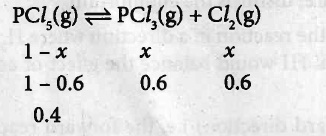
\( \therefore\left[\mathrm{PCl}_{5}\right]_{\mathrm{eq}}=0.4 \mathrm{~mol} \mathrm{dm}^{-3} ; \quad\left[\mathrm{PCl}_{3}\right]_{\mathrm{eq}}=0.6 \mathrm{~mol} \mathrm{dm}^{-3} ; \quad\left[\mathrm{Cl}_{2}\right]_{\mathrm{eq}}=0.6 \mathrm{~mol}^{-3} \)
\(\mathrm{K}_{c}=\frac{\left[\mathrm{PCl}_{3}\right]\left[\mathrm{Cl}_{2}\right]}{\left[\mathrm{PCl}_{5}\right]}=\frac{0.6 \times 0.6}{0.4}\)
Kc = 0.9 mol dm-3
6.
Addition of an inert gas to a reaction at equilibrium, at constant volume has no effect.
7.
If a system at equilibrium is disturbed, then the system shifts itself in a direction that nullifies the effect of that disturbance.
8.
i) \(K_{p}=K_{c}(R T)^{\Delta n_{g}}\)
Kp = Equilibrium constant in term of partial Pressures.
Kc = Equilibrium constant in term of concentration.
R = Gas constant; T = Temperature
\(\Delta \mathrm{n}_{\mathrm{g}}\) = Difference between the sum of number of moles of products and the sum of number of moles of reactants in gas phases.
ii) Synthesis of HI:
\( \mathrm{H}_{2(\mathrm{~g})}+\mathrm{I}_{2(\mathrm{~g})} \rightleftharpoons 2 \mathrm{HI}_{(\mathrm{g})} \)
\(\Delta n_{g}=0 \therefore K_{p}=K_{c}(R T) \Delta n_{g}\)
\(K_{p}=K_{c}(R T)^{\circ} \)
\(K_{p}=K_{c} \text {. }\)
9.
N2O2(g) \(\rightleftharpoons \) 2NO2(g)
Kc = 0.21 at 373 K. The concentrations N2O4 and NO2 are found to be 0.125 mol dm-3 and 0.5 mol dm-3 respectively at a given time. From the above information we can predict the direction of reaction as follows.
\(Q={[NO_2]^2\over [N_2O_4]}={0.5\times 0.5\over 0.125}=2\)
The Q value is greater than Kc. Hence, the reaction will proceed in the reverse direction until the Q value reaches 0.21.
10.
Let us consider the melting of ice in a closed container at 273 K. In the process the total number of water molecules leaving from and returning to the solid phase at any instant are equal.
If some ice-cubes and water are placed in a thermos flask (at 273K and 1 atm pressure), then there will be no change in the mass of ice and water. At equilibrium
Rate of melting of ice = Rate of freezing of water
\({ { H }_{ 2 }O\left( S \right) }\rightleftharpoons { H }_{ 2 }O\left( 1 \right) \)
The temperature at which the solid and liquid phases of a substance are at equilibrium is called the melting point or freezing point of that substance.
11.
The value of equilibrium constant changes with change in temperature. If K1and K2 are equilibrium constants at temperatures
T1 and T2 m-Heat of reaction at constant pressure. Then,
\(log\quad { K }_{ 2 }-log{ K }_{ 1 }=\cfrac { -1 }{ 2.303 } \left[ \cfrac { 1 }{ { T }_{ 2 } } -\cfrac { 1 }{ { T }_{ 1 } } \right] \Delta H\)
or \(log\cfrac { { K }_{ 2 } }{ { K }_{ 1 } } =\cfrac { \Delta H }{ 2.303R } \left[ \cfrac { 1 }{ { T }_{ 1 } } -\cfrac { 1 }{ { T }_{ 2 } } \right] \)
12.
At any instant, the rate of a chemical reaction, at a given temperature is directly proportional to the product of the active masses of the reactants at that instant.
Rate of the reaction \(\alpha \) [Reactant]x
13.
2 NO(g) + O2 (g) ⇌ 2NO2(g)
| NO2 | O2 | NO2 | |
| Initila Partial Pressure | 1 | 1 | - |
| Reacted | 0.96 | 0.96 | - |
| Equilibrium Partial Pressure | 0.04 | 0.52 | 0.96 |
\(K_p={P^2_{NO_2}\over P^2_{NO_2}.Po_2}\)
\(={0.96\times 0.96\over 0.04\times 0.04\times 0.52}\)
= 11.07 x 10² (atm)-1
Keq = 41.6 x 10² M-1.
14.
(d)
Both (a) and (c)
15.
(c)
\(\cfrac { 1 }{ \sqrt { x } } \)
16.
(c)
\(({1\over K_1})^{1/2}\)
17.
(a)
33%
18.
(b)
largely towards reverse direction
19.
(a)
The forward reaction is exothermic
20.
(a)
20
21.
| Condition | Stress | Direction in which equilibrium shifts |
| Concentration | Addition of reactants (increase in reactant concentration) | Forward reaction |
| Removal of products (decreas~ jn productconcentration) | Reverse reaction | |
| Addition of products (increase in product concentration) | ||
| Removal of reactants (decrease in reactant concentration) | ||
| Pressure | Increase of pressure (Decrease in volume) | Reaction that favours fewer moles of the gaseous molecules |
| Decrease of pressure (Increase in volume) | Reaction that favours more moles of the gaseous molecules |
|
| Temperature (Alters equilibrium constants | Increase (High T) | Towards endothermic reaction |
| Decrease (Low T) | Towards exothermic reaction | |
| Catalyst (Speeds up the attainment of equilibrium |
Addition of catalyst | No effect |
| Inert gas | Addition of inert gas at constant volume | No effect |
22.
Let us consider the formation of HI in which, 'a' moles of hydrogen and 'b' moles of iodine gas are allowed to react in a container of volume V. Let 'x' moles of each of H2 and I2react together to form 2x moles of HI.
\({ H }_{ 2\left( g \right) }+{ I }_{ 2\left( g \right) }\rightleftharpoons { 2HI }_{ \left( g \right) }\)
| H2 | I2 | HI | |
| Initial number of moles | a | b | 0 |
| Number of moles reached | x | x | 0 |
| Number of moles at equilibrium | a-x | b-x | 2x |
| Active mass or molar concentration at equilibrium | \(\cfrac { a-x }{ V } \) | \(\cfrac { b-x }{ V } \) | \(\cfrac { 2x }{ V } \) |
Applying law of mass action,
\({ K }_{ C }=\cfrac { { \left[ HI \right] }^{ 2 } }{ { \left[ H \right] }_{ 2 }\left[ { I }_{ 2 } \right] } \)
= \(\cfrac { \left( \cfrac { 2x }{ V } \right) ^{ 2 } }{ \left( \cfrac { a-x }{ V } \right) \left( \cfrac { b-x }{ v } \right) } =\cfrac { { 4x }^{ 2 } }{ \left( a-x \right) \left( b-x \right) } \)
The equilibrium constant Kp can also be calcu•lated as follows:
We know }he \rer~tionship between the Kc and Kp
Here the \(\Delta n_{ g }\)=np -nr = 2 - 2 =0
Hence K = Kc ;\({ K }_{ p }=\cfrac { { 4x }^{ 2 } }{ \left( a-x \right) \left( b-x \right) } \)
23.
Given \(m_{N_2}\) = 28 g \(m_{H_2}\) = 6g
V = 1 L
\((n_{N_2})_{initial}={28\over 28}=1\ mol\)
\((n_{H_2})_{initial}={6\over 2}=3\ mol\)
N2(g) + 3H2(g) ⇌ 2 NH3(g)
| N2(g) | H2(g) | NH3(g) | |
| Initial concentration | 1 | 3 | - |
| Reacted | 0.5 | 1.5 | - |
| Equilibrium concentration | 0.5 | 1.5 | 1 |
\([NH_3]=({17\over 17})=1\ mol=1\ mol\)
Weight of N2 = (no. of moles of N2) × molar mass of N2
= 0.5 x 28 = 14 g
Weight of H2 = (no. of moles of H2) × molar mass of H2
= 1.5 x 2 = 3 g
24.
Let us consider the formation of ammonia in which, 'a' moles nitrogen and 'b' moles hydrogen gas are allowed to react in a container of volume V. Let 'x' moles of nitrogen react with 3x moles of hydrogen to give 2x moles of ammonia.
\({ N }_{ 2 }\left( g \right) +3{ H }_{ 2 }\left( g \right) \rightleftharpoons { 2NH }_{ 3 }\left( g \right) \)
| N2 | H2 | NH3 | |
| Initial number of moles | a | b | 0 |
| number of moles reacted | x | 3x | 0 |
| Number of moles at equilibrium | a - x | b - 3x | 2x |
| Active mass or molaroncentration at equilibrium | \(\cfrac { a-x }{ V } \) | \(\cfrac { b-3x }{ V } \) | \(\cfrac { 2x }{ V } \) |
Applying law of mass action
\({ K }_{ C }=\cfrac { \left[ { NH }_{ 3 } \right] ^{ 2 } }{ \left[ { N }_{ 2 } \right] \left[ { H }_{ 2 } \right] ^{ 3 } } \)
= \(\cfrac { \left( \cfrac { 2x }{ V } \right) ^{ 2 } }{ \left( \cfrac { a-x }{ V } \right) \left( \cfrac { b-3x }{ V } \right) ^{ 3 } } \)
= \(\cfrac { \left( \cfrac { 4x }{ V } \right) ^{ 2 } }{ \left( \cfrac { a-x }{ V } \right) \left( \cfrac { b-3x }{ V } \right) ^{ 3 } } \)
\({ K }_{ C }=\cfrac { 4{ x }^{ 2 }{ V }^{ 2 } }{ \left( a-x \right) \left( b-3x \right) ^{ 2 } } \)
The equilibrium constant Kp can also be calculated as follows:
\({ K }_{ p }={ K }_{ C }\left( RT \right) ^{ \left( \Delta { n }_{ g } \right) }\)
\(\Delta \)ng =np - nr = 2 - 4 = -2
\({ K }_{ p }=\cfrac { { 4x }^{ 2 }{ V }^{ 2 } }{ \left( a-x \right) \left( b-3x \right) ^{ 3 } } \left( RT \right) ^{ -2 }\)
Total number of moles at equilibrium,
n = a - x + b - 3x + 2x = a + b - 2x
\({ K }_{ p }=\cfrac { { 4x }^{ 2 }{ V }^{ 2 } }{ \left( a-x \right) \left( b-3x \right) ^{ 3 } } \times \left[ \cfrac { PV }{ n } \right] ^{ -2 }\)
\({ K }_{ p }=\cfrac { { 4x }^{ 2 }{ V }^{ 2 } }{ \left( a-x \right) \left( b-3x \right) ^{ 3 } } \times \left[ \cfrac { n }{ PV } \right] ^{ 2 }\)
\({ K }_{ p }=\cfrac { { 4x }^{ 2 }{ V }^{ 2 } }{ \left( a-x \right) \left( b-3x \right) ^{ 3 } } \times \left[ \cfrac { a+b-2x }{ PV } \right] ^{ 2 }\)
\({ K }_{ p }=\cfrac { 4{ x }^{ 2 }\left( a+b\quad -2x \right) ^{ 2 } }{ { P }^{ 2 }\left( a-x \right) \left( b-3x \right) ^{ 3 } } \)

11th Standard Syllabus & Materials
11th Standard
TN 11th Tamil பீடு பெற நில் - செய்யுள் - காவடிச்சிந்து Important Questions And Answers Study Material - QB365 Set A
NEW11th Standard
TN 11th Tamil பீடு பெற நில் - உரைநடை - மலை இடப்பெயர்கள் : ஓர் ஆய்வு Important Questions And Answers Study Material - QB365 Set A
NEW11th Standard
TN 11th Tamil மாமழை போற்றுதும் - துணைப்பாடம் - யானை டாக்டர் Important Questions And Answers Study Material - QB365 Set A
NEW11th Standard
TN 11th Tamil மாமழை போற்றுதும் - செய்யுள் - ஐங்குறுநூறு Important Questions And Answers Study Material - QB365 Set A



Tamilnadu Stateboard 11th Standard Subjects

Maths

Commerce

Economics

Biology

Business Maths and Statistics

Accountancy

Computer Science

Physics
Chemistry
Maths
Biology
Economics
Physics
Chemistry

History
Business Maths and Statistics

Computer Science
Accountancy

Computer Applications
History
Computer Technology
Commerce
Computer Applications
Computer Technology

Tamil

English

French
Tamilnadu Stateboard Standards
