
 100% FREE ACCESS
11th Standard Syllabus & Materials
11th Standard
TN 11th Tamil இயற்கை வேளாண்மை,சுற்றுச்சூழல் -செய்யுள் - மனோன்மணீயம் Important Questions And Answers Study Material - QB365 Set A
NEW11th Standard
TN 11th Tamil என்னுயிர் என்பேன் -துணைப்பாடம் - இசைத்தமிழர் இருவர் Important Questions And Answers Study Material - QB365 Set A
NEW11th Standard
TN 11th Tamil மொழி கலை -செய்யுள் - ஒவ்வொரு புல்லையும் Important Questions And Answers Study Material - QB365 Set A
NEW11th Standard
TN 11th Tamil பீடு பெற நில் - இலக்கணம் - பகுபத உறுப்புகள் Important Questions And Answers Study Material - QB365 Set A
NEW11th Standard
TN 11th Tamil பீடு பெற நில் - துணைப்பாடம் - வாடிவாசல் Important Questions And Answers Study Material - QB365 Set A
NEW11th Standard
TN 11th Tamil பீடு பெற நில் - செய்யுள் - குறுந்தொகை Important Questions And Answers Study Material - QB365 Set A

Published on: 24/07/2019
Consumption Analysis
Download Tamil Nadu 11th Standard Economics question papers, model tests, one-mark questions, important questions, and public exam papers in PDF format. Free study materials and answer keys for TN State Board students.
Questions + Answers key
Take MCQ Economics Test
1.
The indifference curve are
vertical
horizontal
positive sloped
Negatively sloped
2.
Ordinal Utility can be measured by
Ranking
Numbering
Wording
None of these
3.
The Indifference curve analysis was presented by _____
Alfred Marshall
J.R. Hicks
A.C. Pigou
J.K.Easthan
4.
The concept of consumer's surplus was introduced by ____
Alfred Marshall
J.R. Hicks
A.C. Pigou
J.K. Easthan
5.
Equi - Marginal Utility means equal marginal utilities derived from the consumption of more than_____
four goods
three goods
two goods
one good
6.
According to the law of diminishing marginal utility, the utility from the consumption of each additional unit starts _____
increasing
diminishing
multiplying
none of these
7.
Utility analysis was developed by _____
Alfred Marshall and Adam Smith
Alfred Marshall and Prof. J.R. Hicks
Alfred Marshall and A.C. Pigou
Alfred Marshall and J.K.Easthan
8.
The chief exponent of the cardinal utility approach was
J.R. Hicks
R.G.D. Allen
Marshall
Stigler
9.
Choice is always constrained or limited by the _______ of our resources.
Scarcity
Supply
Demand
Abundance
10.
Pick the odd one out
Luxuries
Comforts
Necessaries
Agricultural goods
11.
What do you mean by indifference map?
12.
Define budget line.
13.
Define total utility.
14.
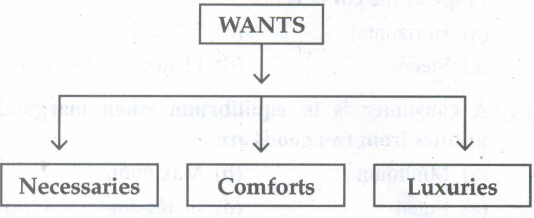
Mention the classifications of wants
15.
Define utility.
16.
Write the classification of wants.
17.
Explain the relationship between price elasticity of demand and slope of a linear demand curve.
18.
What are the assumptions of consumer's surplus?
19.
Mention the relationship between marginal utility and total utility.
20.
Describe the feature of human wants
21.
What is Indifference curve map? Explain the properties of indifference curve with diagrams.
22.
23.
Explain the condition of consumer's equilibrium using indifference curve analysis.
1.
(d)
Negatively sloped
2.
(a)
Ranking
3.
(b)
J.R. Hicks
4.
(a)
Alfred Marshall
5.
(c)
two goods
6.
(b)
diminishing
7.
(c)
Alfred Marshall and A.C. Pigou
8.
(c)
Marshall
9.
(a)
Scarcity
10.
(d)
Agricultural goods
11.
Indifference map refers to a set of indifference curves corresponding to different income levels of satisfaction.
12.
Budget line is a line showing different combinations of two goods which a consumer can attain at his given Income and Market price of the goods.
13.
It is the sum total of the marginal utilities obtained from the consumption of successive units of a commodity.
TU=MU1 +MU2 +MU3+ .....+MUn or \(\Sigma MU\)
14.
15.
(i) Want satisfying power of a commodity is called utility.
(ii) It is measured in utils.
16.
(i) Goods which are indispensable for the human being to exist in the world are called "necessaries" (for example food).
(ii) Goods which are not indispensable for life but to make our life easy, convenient and comfortable are called "comforts". (for example: TV)
(iii) Goods which are not very essential but are very costly are known as "Luxuries". (for example- Jewellery, Diamonds).
17.
The slope of a linear demand curve is given as \(\frac{\Delta p}{\Delta q}\)
(i) While price elasticity of demand is given as
\(Ed=\frac{\Delta Q}{\Delta P}\times \frac{P}{Q}\)
(ii) Hence, we can write above equation
(iii) (i) as \(Ed=\frac{1}{Slope\ of\ Demand\ Curve}\times \frac{P}{Q}\)
\(Ed=\frac{1}{\frac PQ}\times \frac{P}{Q}\)
(iv) The above equation states that there exist an inverse relationship between slope of a linear demand curve and Price elasticity of demand.
18.
(i) Cardinal utility of a commodity is measured in money terms.
(ii) Marshall assumes that there is definite relationship between expected satisfaction (utility) and realized satisfaction (actual).
(iii) Marginal utility of money is constant.
(iv) An absence of differences in income, taste, fashion etc.
(v) Independent goods and independent utilities.
(vi) Demand for a commodity depends on its price alone, it excludes other determinants of demand.
19.
| Total utility | Marginal utility |
| Increases at a diminishing rate | Goes on diminishing |
| Reaches maximum | Becomes zero |
| Diminishes | Becomes negative |
20.
Characteristics
Wants are unlimited
(i) Wants are countless and various in kinds.
(ii) When one want is satisfied another want arises.
Wants become habits
(i) When a man starts reading newspaper in the morning it becomes a habit.
Wants are satiable
(i) We can satisfy particular wants at a given time.
(ii) When one feels hungry, he takes food and that want is satisfied.
Wants are alternative
(i) There are alternative ways to satisfy a particular want (eg) idly, dosa.
Wants are competitive
(i) There is competition among wants.
(ii) So we have to choose more urgent wants and satisfy them first.
Wants are complementary
(i) Satisfaction of a particular want requires the use of more than one commodity. (eg) car and petrol.
Wants are recurring
(i) Some wants occur again and again. For ex. if we feel hungry, we take food and satisfy our want.
(ii) But after some time we again feel hungry and want food.
21.
a. Indifference Map:
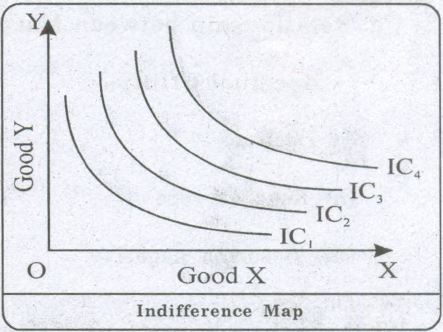
Indifference Map is a group of indifference curves for two commodities showing different levels of satisfaction. In this indifference map, it should be clearly understood that a higher indifference curve denotes higher level of satisfaction and a lower indifference curve represents lower level of satisfaction. Being rational, the consumer will always choose a higher indifference curve to get maximum satisfaction, other things being equal.
b. Properties of an Indifference curve:
i. Indifference curves slope downwards to the right
ii. Indifference curves are convex to the origin
iii. No two indifference curves can ever cut each other.
i. All indifference curves slope downwards from left to right:
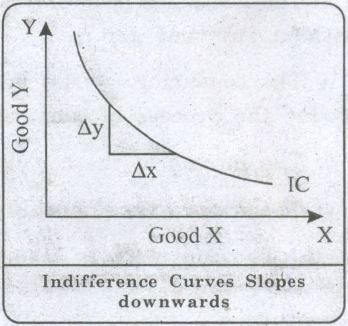
The downward slope of indifference curve must be attributed to the fact that the consumer in substituting good X by good Y, increases the amount of Y and reduces the amount of X. If the indifference curve were horizontal line running parallel to X axis then the combination which it represents is the same amount of Y but more and more of X. In that case, the satisfaction from the combination will not be equal. For the same reason, it can be said that indifference Curves will not be vertical.
ii. All indifference curves are convex to the origin:
This is because of the operation of a principle known as 'Diminishing Marginal Rate of Substitution'. The indifference curves are based on this principle. If they are concave to the origin, then it will mean that MRS is increasing. Indifference curve cannot be straight line except when the goods are perfect substitutes.
Marginal rate of substitution between X and Y refers to the amount of commodity Y to be offered in exchange for one unit of X commodity. The MRS goes on diminishing as consumer goes on substituting X for Y.
iii. No two indifference curves intersect each other:
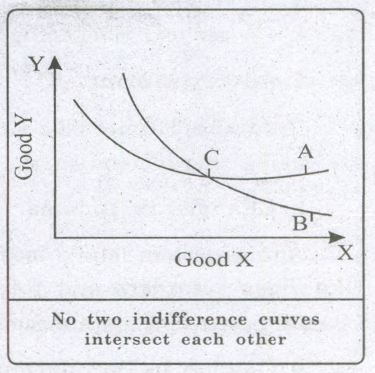
The third assumption is that no two indifference curves can ever cut each other. But in the Figure we find two indifference curves do cut each other. Point A which is on indifference curve 2 represents a higher level of satisfaction to the consumer than at point B which is on indifference curve 1. But point C lies on both curves. That means, two levels of satisfaction A and B which are unequal have become equal. That cannot be accepted. So indifference curves can never cut each other. These are the three assumptions about the shape of an indifference curve.
22.
.JPG)
23.
(i) In terms of indifference curve analysis, the consumer achieves his optimum choice when he strikes a balance between what he wishes to buy and what he can buy.
(ii) According to indifference curve analysis, a consumer is in equilibrium at a point, where the slope of the indifference curve is equal to the slope of a budget line.
(iii) Condition of consumer's Equilibrium
\(MRS_{xy}=\frac{Px}{Py}\)
(iv) Here, MRSxy = Marginal Rate of substitution between good x and y
(v) \(\frac{Px}{Py}\)= Price Ratio between good x and good y
(vi) \(MRS_{xy}=\frac{\Delta Y}{\Delta X}\) = Slope of indifference curve
(vii) At the point of equality between
\(MRS_{xy}=\frac{Px}{Py}=\) Indifference curve must be convex to the origin.
(viii) It implies that at the point of equilibrium, MRS must be diminishing.
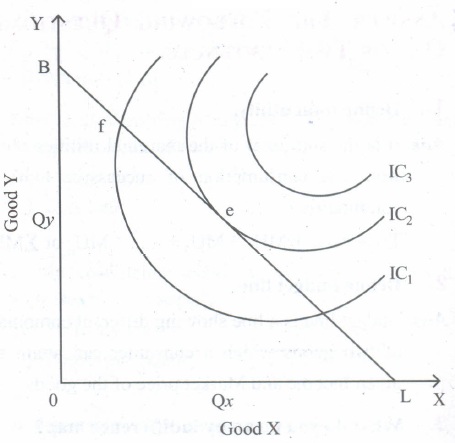
Explanation:
(i) In the above diagram BL - is Budget line.
(ii) IC1, IC2, IC3 = set of indifference curves.
(iii) consumer is in equilibrium at point 'e'. At this point, BL is tangent to IC2 signifying that \(MRS_{xy}=\frac{Px}{Py}\)
(iv) Consumer will not be in equilibrium at point f and g because they belong to lower IC.

11th Standard Syllabus & Materials
11th Standard
TN 11th Tamil பீடு பெற நில் - செய்யுள் - காவடிச்சிந்து Important Questions And Answers Study Material - QB365 Set A
NEW11th Standard
TN 11th Tamil பீடு பெற நில் - உரைநடை - மலை இடப்பெயர்கள் : ஓர் ஆய்வு Important Questions And Answers Study Material - QB365 Set A
NEW11th Standard
TN 11th Tamil மாமழை போற்றுதும் - துணைப்பாடம் - யானை டாக்டர் Important Questions And Answers Study Material - QB365 Set A
NEW11th Standard
TN 11th Tamil மாமழை போற்றுதும் - செய்யுள் - ஐங்குறுநூறு Important Questions And Answers Study Material - QB365 Set A



Tamilnadu Stateboard 11th Standard Subjects

Maths

Commerce
Economics

Biology

Business Maths and Statistics

Accountancy

Computer Science

Physics

Chemistry
Maths
Biology
Economics
Physics
Chemistry

History
Business Maths and Statistics

Computer Science
Accountancy

Computer Applications
History
Computer Technology
Commerce
Computer Applications
Computer Technology

Tamil

English

French
Tamilnadu Stateboard Standards
