
 100% FREE ACCESS
11th Standard Syllabus & Materials
11th Standard
TN 11th Tamil இயற்கை வேளாண்மை,சுற்றுச்சூழல் -செய்யுள் - மனோன்மணீயம் Important Questions And Answers Study Material - QB365 Set A
NEW11th Standard
TN 11th Tamil என்னுயிர் என்பேன் -துணைப்பாடம் - இசைத்தமிழர் இருவர் Important Questions And Answers Study Material - QB365 Set A
NEW11th Standard
TN 11th Tamil மொழி கலை -செய்யுள் - ஒவ்வொரு புல்லையும் Important Questions And Answers Study Material - QB365 Set A
NEW11th Standard
TN 11th Tamil பீடு பெற நில் - இலக்கணம் - பகுபத உறுப்புகள் Important Questions And Answers Study Material - QB365 Set A
NEW11th Standard
TN 11th Tamil பீடு பெற நில் - துணைப்பாடம் - வாடிவாசல் Important Questions And Answers Study Material - QB365 Set A
NEW11th Standard
TN 11th Tamil பீடு பெற நில் - செய்யுள் - குறுந்தொகை Important Questions And Answers Study Material - QB365 Set A

Published on: 13/05/2022
QB365 provides detailed and simple solution for every Book back Questions in class 11 Chemistry Subject. It will helps to get more idea about question pattern in every book back questions with solution.
latest Book back QuestionsDownload Tamil Nadu 11th Standard Chemistry question papers, model tests, one-mark questions, important questions, and public exam papers in PDF format. Free study materials and answer keys for TN State Board students.
Questions + Answers key
Take MCQ Chemistry Test1.
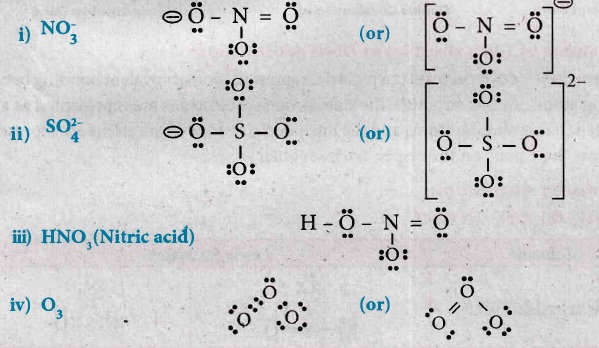
Draw the Lewis structures for the following species.
i) NO3–
ii) SO42–
iii) HNO3
iv) O3
2.
What is dipole moment ?
3.
What do you understand by Linear combination of atomic orbitals in MO theory.
4.
Draw the M.O diagram for oxygen molecule calculate its bond order and show that O2 is paramagnetic.
5.
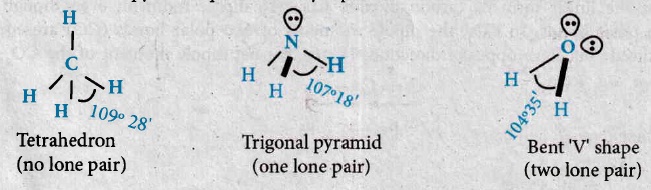
In CH4, NH3 and H2O, the central atom undergoes sp3 hybridisation - yet their bond angles are different. why ?
1.
2.
Dipole moment :
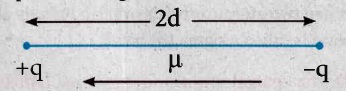
The polarity of a covalent bond can be measured in terms of dipole moment which is defined as \(\mu=q \times 2d\)
Where \(\mu\) is the dipole moment, q is the charge and 2d is the distance between the two charges.
Where p is the dipole moment, q is the charge and 2d is the distance between the two charges. The dipole moment is a vector and the direction of the dipole moment vector points from the negative charge to positive charge.
The unit for dipole moment is columb meter (C m). It is usually expressed in Debye unit (D). The conversion factor is 1 Debye = 3.336 x 10⁻³⁰ C m.
3.
Linear combination of atomic orbitals:
1. The wave functions for the molecular orbitals can be obtained by solving Schrodinger wave equation for the molecule. Since solving the Schrodinger equation is too complex, approximation methods are used to obtain the wave function for molecular orbitals. The most common method is the linear combination of atomic orbitals (LCAO).
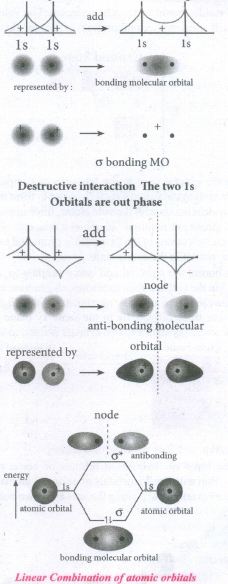
2. The atomic orbitals are represented by the wave function \(\Psi \). Let us consider two atomic orbitals represented by the wave function \(\Psi _A\) and \(\Psi _B\) with comparable energy, combines to form two molecular orbitals. One is bonding molecular orbital (\(\Psi \)bonding) and the other is antibonding molecular orbital (\(\Psi \)antibondin ). The wave functions for these" two" molecular orgitals can be obtained by the linear combination of the atomic orbitals \(\Psi _A\) and \(\Psi _B\) as beIow.
\(\Psi _{bonding}=\Psi _A+\Psi _B\\ \Psi _{antibonding}=\Psi _A-\Psi _B\)
3.The formation of bonding molecular orbital can be considered as the result of constructive interference of the atomic orbitals and the formation of antibonding molecular orbital can be the result of the destructive interference of the atomic orbitals. The formation of the two molecular orbitals from two 1s orbitals is shown below.
4.Constructive interaction : The two 1s orbitals are in phase and have the same sign.
4.
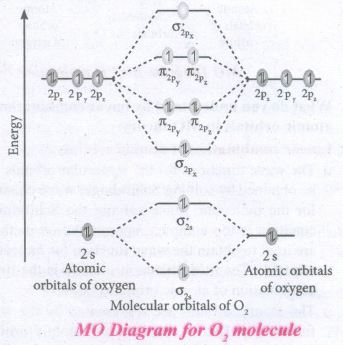
Molecular orbital diagram of oxyge molecule (O2) :
Electronic configuration of O atom 1s22s22p4
Electronic configuration of O2 molecule
\(\sigma^{2}_{1s},\sigma^{*2}_{1s},\sigma^{2}_{2s},\sigma^{*2}_{2s},\sigma^{2}_{2px},\)\(\pi^{2}_{2py},\pi^{2}_{2pz},\pi^{*1}_{2py},\pi^{*1}_{2pz}\)
Bond order=\({N_b-N_a\over2}={10-6\over2}=2\)
Molecule has two unpaired electrons hence it is paramagnetic.
5.
In CH4, NH3 and H2O the central atoms are sp3 hybridised. So, the expected structure for all these compounds are tetra hedron and the bond angles 109o 28'. But due to the presence of one ione pair of electrons on Nitrogen atom on ammonia and the two lone pairs of electrons on oxygen atom of water the structure deviates and the bond angles vary. The lone pairs of electrons occupy more space and they repel the electrons in the covalent bonds.

11th Standard Syllabus & Materials
11th Standard
TN 11th Tamil பீடு பெற நில் - செய்யுள் - காவடிச்சிந்து Important Questions And Answers Study Material - QB365 Set A
NEW11th Standard
TN 11th Tamil பீடு பெற நில் - உரைநடை - மலை இடப்பெயர்கள் : ஓர் ஆய்வு Important Questions And Answers Study Material - QB365 Set A
NEW11th Standard
TN 11th Tamil மாமழை போற்றுதும் - துணைப்பாடம் - யானை டாக்டர் Important Questions And Answers Study Material - QB365 Set A
NEW11th Standard
TN 11th Tamil மாமழை போற்றுதும் - செய்யுள் - ஐங்குறுநூறு Important Questions And Answers Study Material - QB365 Set A



Tamilnadu Stateboard 11th Standard Subjects

Maths

Commerce

Economics

Biology

Business Maths and Statistics

Accountancy

Computer Science

Physics
Chemistry
Maths
Biology
Economics
Physics
Chemistry

History
Business Maths and Statistics

Computer Science
Accountancy

Computer Applications
History
Computer Technology
Commerce
Computer Applications
Computer Technology

Tamil

English

French
Tamilnadu Stateboard Standards



