
 100% FREE ACCESS
11th Standard Syllabus & Materials
11th Standard
TN 11th Tamil இயற்கை வேளாண்மை,சுற்றுச்சூழல் -செய்யுள் - மனோன்மணீயம் Important Questions And Answers Study Material - QB365 Set A
NEW11th Standard
TN 11th Tamil என்னுயிர் என்பேன் -துணைப்பாடம் - இசைத்தமிழர் இருவர் Important Questions And Answers Study Material - QB365 Set A
NEW11th Standard
TN 11th Tamil மொழி கலை -செய்யுள் - ஒவ்வொரு புல்லையும் Important Questions And Answers Study Material - QB365 Set A
NEW11th Standard
TN 11th Tamil பீடு பெற நில் - இலக்கணம் - பகுபத உறுப்புகள் Important Questions And Answers Study Material - QB365 Set A
NEW11th Standard
TN 11th Tamil பீடு பெற நில் - துணைப்பாடம் - வாடிவாசல் Important Questions And Answers Study Material - QB365 Set A
NEW11th Standard
TN 11th Tamil பீடு பெற நில் - செய்யுள் - குறுந்தொகை Important Questions And Answers Study Material - QB365 Set A

Published on: 25/06/2021
QB365 provides detailed and simple solution for every
Creative Questions in class 11 Chemistry Subject. It will
helps to get more idea about question pattern in every Creative questions with solution.
Download Tamil Nadu 11th Standard Chemistry question papers, model tests, one-mark questions, important questions, and public exam papers in PDF format. Free study materials and answer keys for TN State Board students.
Questions + Answers key
Take MCQ Chemistry Test1.
Explain about sp hybridisation with suitable example.
2.
What are the salient features of Valence Bond (VB) theory?
3.
Explain about valence bond theory for the formation of H2 molecule.
4.
Draw the lewis structure for
Phosphoric acid
5.
Draw the lewis structure for
Sulphur trioxide (SO3)
1.
(i) Bond formation in Beryllium chloride takes place by sp hybridisation.
(ii) The valence shell of Beryllium has the electronic configuration as follows:
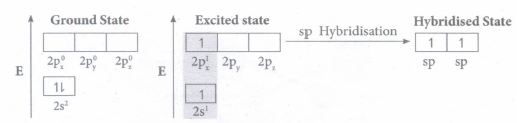
(iii) In BeCl2 both the Be-Cl bonds are equivalent and it was observed that the molecule is linear. VB theory explains this observed behaviour by sp hybridisation. One of the paired electrons in the 2s orbital gets excited to 2p orbital.
(iv) Now the 2s and 2p orbitals hybridise and produce two equivalent sp hybridised orbitals which have 50% s-character and 50% p-character. These sp hybridised orbitals are oriented in opposite direction.
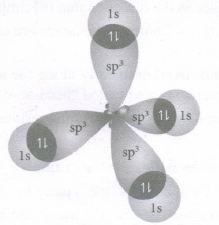
(v) Each of the sp hybridised orbitals linearly overlap with Pz orbital of the chlorine to form a covalent bond between Be and CI atoms as follow.
2.
(i) When half filled orbitals of two atoms overlap, a covalent bond will be formed between them.
(ii) The resultant overlapping orbitals are occupied by the two electrons with opposite spins. For example when H2 is formed, the two Is electron of two hydrogen atoms get paired up and occupy the overlapped orbitals.
(iii) The strength of a covalent bond depends upon the extent of overlap of atomic orbitals. Greater the overlap, larger is the energy released and stronger will be the bond formed.
(iv) Each atomic orbital has a specific direction (except s-orbital which is spherical) and hence orbital overlap takes place in the direction that maximises overlap.
(v) Depending upon the nature of overlap, the bonds are classified as c covalent bond and n covalent bond.
(vi) When two atomic orbitals overlap linearly along the axis, the resultant bond is called a sigma (c) bond. This overlap is also called "head-on-overlap" or "axial overlap".
(vii) When two atomic orbitals overlap sideways the resultant covalent bond is called a pi (n) bond.
3.
(i) Two hydrogen atoms Ha and Hb are separated by infinite distance. At this stage, there is no interaction between these two atoms and the potential energy of this system is arbitrarly taken as zero.
(ii) As these two atoms approach each other, in addition to electrostatic attractive forces between the nucleus and its own electrons, the following new forces begins to operate.
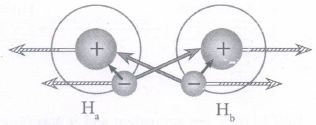
(iii) The new attractive forces (. arrows) arise between:
(a) nucleus of Ha,and valence electron of Hb (b) nucleus of Hb and the valence electron of Ha.
(iv) The new repulsive forces ( arrows) arise between:
(a) the nucleus of Ha and Hb
(b) the valence electrons of Ha and Hb.
(v) The attractive forces tend to bring Ha and Hb together whereas the repulsive forces tends to push them apart.
(vi) At the initial stage, as the two hydrogen atoms approach each other, the attractive forces are stronger than repulsive forces and the potential energy decreases.
(vii) A stage is reached where the net attractive forces are exactly balanced by repulsive forces and the potential energy of the system acquires a minimum energy.
(viii) At this stage, there is a maximum overlap between the atomic orbitals of Ha, and Hb and atoms Ha and Hb are now said to be bonded together by a covalent bond.
4.
.jpg)
5.
.jpg)

11th Standard Syllabus & Materials
11th Standard
TN 11th Tamil பீடு பெற நில் - செய்யுள் - காவடிச்சிந்து Important Questions And Answers Study Material - QB365 Set A
NEW11th Standard
TN 11th Tamil பீடு பெற நில் - உரைநடை - மலை இடப்பெயர்கள் : ஓர் ஆய்வு Important Questions And Answers Study Material - QB365 Set A
NEW11th Standard
TN 11th Tamil மாமழை போற்றுதும் - துணைப்பாடம் - யானை டாக்டர் Important Questions And Answers Study Material - QB365 Set A
NEW11th Standard
TN 11th Tamil மாமழை போற்றுதும் - செய்யுள் - ஐங்குறுநூறு Important Questions And Answers Study Material - QB365 Set A



Tamilnadu Stateboard 11th Standard Subjects

Maths

Commerce

Economics

Biology

Business Maths and Statistics

Accountancy

Computer Science

Physics
Chemistry
Maths
Biology
Economics
Physics
Chemistry

History
Business Maths and Statistics

Computer Science
Accountancy

Computer Applications
History
Computer Technology
Commerce
Computer Applications
Computer Technology

Tamil

English

French
Tamilnadu Stateboard Standards



