
 100% FREE ACCESS
11th Standard Syllabus & Materials
11th Standard
TN 11th Tamil இயற்கை வேளாண்மை,சுற்றுச்சூழல் -செய்யுள் - மனோன்மணீயம் Important Questions And Answers Study Material - QB365 Set A
NEW11th Standard
TN 11th Tamil என்னுயிர் என்பேன் -துணைப்பாடம் - இசைத்தமிழர் இருவர் Important Questions And Answers Study Material - QB365 Set A
NEW11th Standard
TN 11th Tamil மொழி கலை -செய்யுள் - ஒவ்வொரு புல்லையும் Important Questions And Answers Study Material - QB365 Set A
NEW11th Standard
TN 11th Tamil பீடு பெற நில் - இலக்கணம் - பகுபத உறுப்புகள் Important Questions And Answers Study Material - QB365 Set A
NEW11th Standard
TN 11th Tamil பீடு பெற நில் - துணைப்பாடம் - வாடிவாசல் Important Questions And Answers Study Material - QB365 Set A
NEW11th Standard
TN 11th Tamil பீடு பெற நில் - செய்யுள் - குறுந்தொகை Important Questions And Answers Study Material - QB365 Set A

Published on: 25/06/2021
QB365 provides detailed and simple solution for every
Creative Questions in class 11 Chemistry Subject. It will
helps to get more idea about question pattern in every Creative questions with solution.
Download Tamil Nadu 11th Standard Chemistry question papers, model tests, one-mark questions, important questions, and public exam papers in PDF format. Free study materials and answer keys for TN State Board students.
Questions + Answers key
Take MCQ Chemistry Test1.
Express mathematically Dalton's law of partial pressures.
2.
Explain Andrew's isotherm of carbon dioxide.
3.
Arrive at the values of gas constant (R) in dm3 atm mol-1 K-1, Pa, m3 K-1, mol-1 at JK-1 mol-1.
4.
An LPG cylinder containing 15 kg of butane at 27° C and 10 atmpressure is leaking. After one day, its pressure is decreased to 8 atm. How much quality of the gas is leaked ?
5.
The van der waal's constant 'b' for oxygen is 0.0318 L mol-1. Calculate the diameter of the oxygen molecule.
1.
Let for gases 1, 2 and 3 the partial pressure are P1, P2 and P3
Mathematically P Total = P1 + P2 + P3
when we consider the gases to behave ideally
\(P_1=n_1\frac{RT}{V}; P_2=n_2 \frac{RT}{V}; R_3=n_3 \frac{RT}{V}\)
\(P_{Total}=n_1\frac{RT}{V}+n_2 \frac{RT}{V}+n_3 \frac{RT}{V}\)
\(=(n_1+n_2+n_3) \frac{RT}{V}\)
\(P_1=n_{Total}(\frac{RT}{V})\)
The partial pressure can be expressed as mole fraction multiplied Xi by the total pressure
\(P_i=X_i P_{Total}\)
\(X_i=\frac{n_i}{\sum { n_i} }\)
=\(\frac{number\ of \ mol\ of\ the\ gas 1}{Total \ number\ of\ mol of\ all \ gases}\)
2.
The isotherms of carbon dioxide at different temperatures which is shown.in figure.
From the plots we can infer the following:
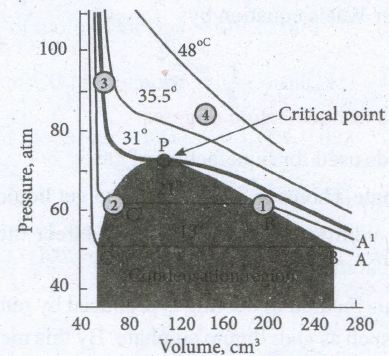
At low temperature isotherms, for example, at 13°C as the pressure increases, the volume decreases along AB and is a gas until the point B is reached. At B, a liquid separates along the line BC, both the liquid and gas co-exist and the pressure remains constant. At C, the gas is completely converted into liquid. If the pressure is higher than at C, only the liquid is compressed so, there is no significant change in the volume. The successive isotherms shows similar trend with the shorter flat region. i.e. The volume range in which the liquid and gas coexist becomes shorter. At the temperature of 31.1°C the length of the shorter portion is reduced to zero at point P. In other words, the CO2 gas is liquefied completely at this point. This temperature is known as the liquefaction temperature or critical temperature of CO2, At this point the pressure is 73 atm. Above this temperature CO2 remains as a gas at all pressure values. It is then proved that many real gases behave in a similar manner to carbon dioxide.
3.
We must calculate'R in the equation R = \(\frac{PV}{nT}\)
(R is also known as the universal gas constant)
For standard conditions in which P is 1 atm., volume 22.414 dm3. for 1 mole at273.15 (~273) K.
\(R=\frac{1 atm.\times 22.414 dm^{3}}{1 mol. \times 273.15 K}\)
= 0.0821 dm3 atm. mole-1 K-1
Where P = 105 pascal, V = 22.71 x 10⁻³ m3 for 1 mole of a gas at 273.15 K
\(R=\frac{10^{5} Pa \times 22.71 \times 10^{-3}m^{3}}{1 mol \times 273.15 K}\)
= 8.314 Pa m3 K-1 mol-1
= 8.314 x 10⁻² bar dm3 K-1 mol-1
= 8.314 J K-1 mol-1
4.
PV = nRT. Here T and V are constant.
Hence \(\frac{P_1}{P_2}=\frac{n_1}{n_2}=\frac{w_1}{w_2}\)
Where P1 and P2 are the initial and final pressures.
i.e., P1= 10 atm; P2 = 8 atm.
w1 and w2 weight of the gas present initiates and after leaking,
w1 = 15 kg : w2 = ?
\(\therefore \frac{10}{8}= \frac{15}{w_2} (or) w_2=12 kg\).
Hence, the amount of gas leaked is 15 - 12 = 3 kg.
5.
b = 4V (or) V = \(\frac{b}{4}=\frac{0.0318}{4}\) = 7.95 x 10⁻³L mol-1 = 7.95 cm3 mol-1
Volume occupied by one mole of O2 molecule
\(=\frac{7.95}{6.02\times 10^{23}}=1.32 \times 10^{-23} cm^{3}\)
Considering the molecule to be spherical, \(V=\frac{4}{3} \pi r^{3}=1.32 \times 10^{-23}cm^{3}\)
\(r^{3}=3.15\times 10^{-24}\)
Solving r = \(1.466 \times 10^{-8}\)cm
Diameter 2r = 2 x 1.466 x 10-8 cm = 2.932 x 10⁻⁸ cm
= 2.932 \(\overset {0}{A}\)

11th Standard Syllabus & Materials
11th Standard
TN 11th Tamil பீடு பெற நில் - செய்யுள் - காவடிச்சிந்து Important Questions And Answers Study Material - QB365 Set A
NEW11th Standard
TN 11th Tamil பீடு பெற நில் - உரைநடை - மலை இடப்பெயர்கள் : ஓர் ஆய்வு Important Questions And Answers Study Material - QB365 Set A
NEW11th Standard
TN 11th Tamil மாமழை போற்றுதும் - துணைப்பாடம் - யானை டாக்டர் Important Questions And Answers Study Material - QB365 Set A
NEW11th Standard
TN 11th Tamil மாமழை போற்றுதும் - செய்யுள் - ஐங்குறுநூறு Important Questions And Answers Study Material - QB365 Set A



Tamilnadu Stateboard 11th Standard Subjects

Maths

Commerce

Economics

Biology

Business Maths and Statistics

Accountancy

Computer Science

Physics
Chemistry
Maths
Biology
Economics
Physics
Chemistry

History
Business Maths and Statistics

Computer Science
Accountancy

Computer Applications
History
Computer Technology
Commerce
Computer Applications
Computer Technology

Tamil

English

French
Tamilnadu Stateboard Standards



