
 100% FREE ACCESS
11th Standard Syllabus & Materials
11th Standard
TN 11th Tamil இயற்கை வேளாண்மை,சுற்றுச்சூழல் -செய்யுள் - மனோன்மணீயம் Important Questions And Answers Study Material - QB365 Set A
NEW11th Standard
TN 11th Tamil என்னுயிர் என்பேன் -துணைப்பாடம் - இசைத்தமிழர் இருவர் Important Questions And Answers Study Material - QB365 Set A
NEW11th Standard
TN 11th Tamil மொழி கலை -செய்யுள் - ஒவ்வொரு புல்லையும் Important Questions And Answers Study Material - QB365 Set A
NEW11th Standard
TN 11th Tamil பீடு பெற நில் - இலக்கணம் - பகுபத உறுப்புகள் Important Questions And Answers Study Material - QB365 Set A
NEW11th Standard
TN 11th Tamil பீடு பெற நில் - துணைப்பாடம் - வாடிவாசல் Important Questions And Answers Study Material - QB365 Set A
NEW11th Standard
TN 11th Tamil பீடு பெற நில் - செய்யுள் - குறுந்தொகை Important Questions And Answers Study Material - QB365 Set A

Published on: 13/05/2022
QB365 provides detailed and simple solution for every Creative Questions in class 11 Economics Subject. It will helps to get more idea about question pattern in every Creative questions with solution.
latest Creative QuestionsDownload Tamil Nadu 11th Standard Economics question papers, model tests, one-mark questions, important questions, and public exam papers in PDF format. Free study materials and answer keys for TN State Board students.
Questions + Answers key
Take MCQ Economics Test1.
Discuss Thiruvalluvar's contribution to Indian economy.
2.
How to determine the rate of interest with diagram? Determination of Rate of Interest.
3.
Explain various costs incurred by the firm.
4.
Define Price Elasticity of demand and explain the different levels or degrees of price elasticity of demand.
5.
Explain the role of public sector Banks and Private Sector Banks to the economic development of India.
6.
Define 'Iso-Quant' and explain it with the help of a table and a diagram.
7.
Explain how price and output are determined under the perfect competition in the long run.
8.
State the assumption on which the explanation and analysis of production possibility curve based upon.
9.
State the various kinds of Goods.
10.
Examine whether Economics is an Art or a Science.
11.
Describe the Total Revenue concepts under various price conditions.
12.
Enumerate the determinants of Demand?
13.
Discuss the Arguments in favour of LPG?
14.
Profit is the reward for risk-taking and uncertainty-bearing.
15.
What are the Assumptions of Ricardian Theory?
16.
Explain the types of monopoly?
17.
Explain the meaning of Fixed and Variable factors and costs.
18.
Explain relationship among total Average and Marginal Products.
19.
Explain the four sources depend upon the supply of loanable funds.
20.
How is the price and output determined in the long run under monopolistic competition?
21.
Explain the market on the basis of area.
22.
Explain weakness features of Indian Economy.
23.
Explain about the natural resources.
24.
Explain about monetary and financial sector reforms.
25.
1.
Thiruvalluvar: The economic ideas of Thiruvalluvar are found in his immortal work, Thirukkural, a book of ethics. Even though scholars differ widely over the estimation of the period of Thiruvalluvar, it is generally believed that, he belongs to the Sangam age in Tamil Nadu around third century A.D. Thiruvalluvar's work is marked by pragmatic idealism. A large part of Valluvar's economic ideas are found in the second part of Thirukkural, the porutpal. It deals with wealth. Thiruvalluvar is a fundamental thinker. He believes that rains are the basic support of life. Since rain provides food, it forms the basis for stable economic life. Agriculture which is the most fundamental economic activity depends on rain, "It is rain that both ruins and aids the ruined to rise".
(i) Factors of Production: Thiruvalluvar has made many passing references about the factors of production viz., Land, Labour, Capital, Organisation, Time, Technology etc. He says, "Unfailing harvest, competent body of men, group of men, whose wealth knows no diminution, are the components of an economy". (KuraI61)
(ii) Agriculture: According to Thiruvalluvar, agriculture is the most fundamental economic activity. They are the axle-pin of the world, for on their prosperity revolves prosperity of other sectors of the economy, 'The ploughmen alone', he says "live as the freemen of the soil; the rest are mere slaves that follow on their toil" (Kural 1032). Valluvar believes that agriculture is superior to all other occupation.
(iii) Public Finance: Thiruvalluvar has elaborately explained Public Finance under the headings Public Revenue, Financial Administration and Public expenditure. He has stated these as
1) Creation of revenue,
2) Collection of revenue,
3) Management of revenue
4) Public expenditure
(iv) Public Expenditure: Valluvar has recommended a balanced budget. "It is not a great misfortune for a state if its revenues are limited, provided the expenditure is kept within bounds." He has given certain guidelines for a budgetary policy. "Budget for a surplus, if possible, balances the budget at other times, but never budget for a deficit." Valluvar advocates the following main items of public expenditure:
1) Defence
2) Public Works and
3) Social Services.
(v) External Assistance: Valluvar was against seeking external assistance. According to Kural No. 739, countries taking external assistance are not to be considered as countries at all. In other words, he advocated a self-sufficient economy.
(vi) Poverty and Begging: Valluvar consideres freedom from hunger as one of the fundamental freedoms that should be enjoyed by every citizen. According to him 'poverty' is the root cause of all other evils which would lead to ever-lasting sufferings. It is to be noted that the number of people living below poverty line, begging, sleeping on the road sides and rag picking in India has been increasing.
(vii) Wealth: Valluvar has regarded wealth as only a means and not an end. He said, "Acquire a great fortune by noble and honourable means." He condemned hoarding and described hoarded wealth as profitless richness. To him industry is real wealth and labour is the greatest resource.
(viii) Welfare State: Thiruvalluvar is for a welfare state. In a welfare state there will be no poverty illiteracy, disease and industry. The important elements of a welfare state are
1) perfect health of the people without disease
2) abundant wealth
3) good crop
4) prosperity and happiness and
5) full security for the people.
2.
According to Keynes, the rate of interest is determined by the demand for money and the supply of money. The demand for money is liquidity preference. In fact, liquidity preference for speculative motive determines rate of interest. The supply of money is determined by the policies of the Government and the Central Bank of a country. The total supply of money consists of coins, currency notes and bank deposits (Say M = 200).
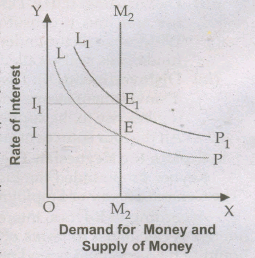
Equilibrium between Demand and Supply of Money:
The equilibrium between liquidity preference and demand for money determine the rate of interest. In short run, the supply of money is assumed to be constant Rs.200.
.PNG)
LP is the liquidity preference Curve (demand curve). M2 M2 shows the supply curve of money to satisfy speculative motive. Both curves intersect at the point E, which is the equilibrium point. Hence, the rate of interest is 2.5. If liquidity preference increases from LP to L1P1 the supply of money remains constant, & the rate of interest would increase from 01 to all. Numerical examples given above can also be used for better understanding. Total demand for money = Mt + Mp + Ms = 0.125Y + 0.125Y + (450 - 100i). Total supply of money = Rs. 200. Mt and Mp are influenced by Y. Hence for the sake of easy understanding, Ms alone can be considered Demand for money = supply of money at equilibrium point: 450 - 100i = 200; 450, - 200 = 100i; 250 = 100i; i = 250/100 = 2.5. This is equilibrium interest. In reality, interest rate is also influenced by national income and commodity sector equilibrium. However, they are not included here for making the understanding easier. Suppose LP remains constant. If the supply of money is OM2, the interest is OI2 and if the supply of money is reduced from OM2 to OM3, the interest would increase from OI2 to OI3, If the supply of money is increased from OM2 to OM4, the interest would decrease from OI2 to OI4,
Criticisms:
(i) This theory does not explain the existence of different interest rates prevailing in the market at the same time.
(ii) It explains interest rate only in the short-run.
3.
(i) Fixed Cost: It does not change with the change in the quantity of output. In other words, expenses on fixed factors remain unchanged irrespective of the level of output, whether the output is increased or decreased or even it becomes zero. For example, rent of the factory, watchman's wages, worker's salary. It is also called as 'Supplementary Cost' or 'Overhead Cost'.
(ii) Variable cost: These costs vary with the level of output. Examples of variable costs are: wages of temporary workers, cost of raw materials, fuel cost, etc., Variable cost is also called as Prime Cost, Special Cost, or Direct Cost.
(iii) Money cost: Production cost expressed in money terms is called as money cost. In other words, it is the total money expenses incurred by a firm in producing a commodity. Money cost includes the expenditures such as cost of raw materials, payment of wages and salaries, payment of rent, interest on capital, expenses on fuel and power, expenses on transportation and other types of production related costs. These costs are considered as out of pocket expenses. Money costs are also called as Prime Cost or Direct Cost or Accounting Cost or Explicit Cost.
(iv) Real cost: It refers to the payment made to compensate the efforts and sacrifices of all factor owners for their services in production. It includes the efforts and sacrifices of landlords in the use of land, capitalists to save and invest, and workers in foregoing leisure.
(v) Explicit Cost: Payment made to others for the purchase of factors of production is known as Explicit Costs. It refers to the actual expenditures of the firm to purchase or hire the inputs the firm needs. ego wages, payment of raw materials, rent, interest as capital. It is also called as Accounting Cost or Out of Pocket Cost or Money Cost.
(vi) Implicit Cost: Payment made to the use of resources that the firm already owns, is known as Implicit Cost. In simple terms, Implicit Cost refers to the imputed cost of a firm's self-owned and self-employed resources. A firm or producer may use his own land, building, machinery, car and other factors in the process of production. These costs are not recorded under normal accounting practices as no cash payments takes place. It is also called as Imputed Cost or Book Cost.
4.
Levels or Degrees of Price Elasticity of Demand
Definition: The Price Elasticity of Demand is commonly known as the elasticity of demand, which refers to the degree of responsiveness of demand to the change in the price of the commodity.
(1) Perfectly Elastic Demand \(({ E }_{ p }=\infty )\):
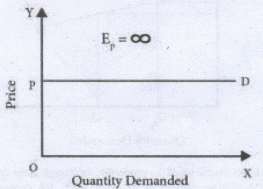
The demand is said to be perfectly elastic when a slight change in the price of a commodity causes an infinite change in its quantity demanded. Such as, even a small rise in the price of a commodity can result in greater fall in demand even to zero, In some cases a little fall in the price can result in the increase in demand to infinity. In perfectly elastic demand the demand curve is a horizontal straight line parallel to X-axis.
(2) Perfectly Inelastic Demand \(({ E }_{ p }=0)\):
When there is no change in the demand for a product due to the change in the price, then the demand is said to be perfectly inelastic
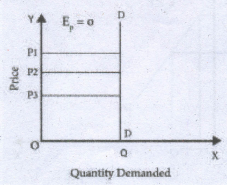
Here, the demand curve is a vertical straight line which shows that the demand remains unchanged irrespective of change in the price., i.e. quantity OQ remains unchanged at different prices, \({ P }_{ 1 }{ ,P }_{ 2 },\) and \({ P }_{ 3 }\)
(3) Relatively Elastic Demand (\({ E }_{ p }\) > 1):
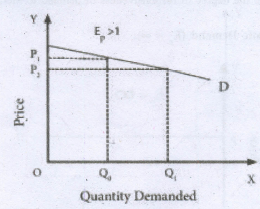
The demand is relatively elastic when the proportionate change in the demand for a commodity is greater than the proportionate change in its price. Here, the demand curve is gradually sloping which shows that a proportionate change in quantity from 5 to 10 is greater than the proportionate change in the price from 11 to 10. Change in demand is: 10 - 5/5 x 100 = 100% Change in price = 10%. Hence, it is more elastic demand.
(4) Relatively Inelastic Demand (\({ E }_{ p }\) < 1):
When the proportionate change in the demand for a product is less than the proportionate change in the price, the demand is said to be relatively inelastic.
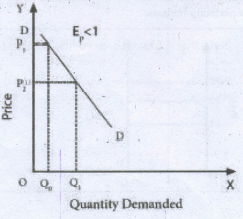
It is also called as the elasticity less than unity. Here the demand curve is steeply sloping, which shows that the change in the quantity from \(OQ_{ 0 }\) to \(OQ_{ 1 }\) is relatively smaller than the change in the price from \(OP_{ 1 }\) to \(OP_{ 2 }\)
(5) Unitary Elastic Demand (\({ E }_{ p }\) = 1):
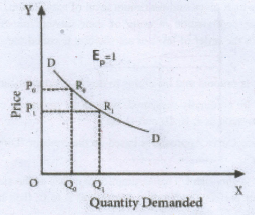
The demand is unitary elastic when the proportionate change in the price of a product results in the same proportionate change in the quantity demanded.
Here the shape of the demand curve is a rectangular hyperbola, which shows that area under the curve is equal to one.
Here \({ OP }_{ 0 }{ R }_{ 0 }{ Q }_{ 0 }={ OP }_{ 1 }{ R }_{ 1 }{ Q }_{ 1 }\)
Degrees of Price Elasticity of Demand
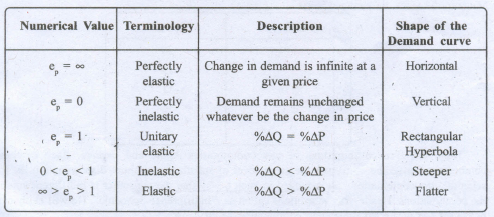
5.
Public Sector and Private sector banks
Public Sector Banks:
(i) Public sector bank is a bank in which the government holds a major portion of the shares.
(ii) Say for example, SBI is public sector bank, the government holding in this bank is 58.60%. Similarly PNB is a public sector bank, the government holds a stake of 58.87%.
(iii) Usually, in public sector banks, government holdings are more than 50 percent.
(iv) Public sector banks are classified into two categories: 1. Nationalised Banks 2. State Bank and its Associates.
(v) In case of nationalized banks, the government controls and regulates the functioning of the banking entity. Some examples are SBI, PNB, BOB, OBC, Allahabad Bank, etc.
(vi) However, the government keeps reducing the stake in PSU. banks as and when they sell shares. So, to that extent they can also become minority shareholders in these banks. This is in accordance with the privatization policy.
Private Sector Banks
(vii) In these banks, most of the equity is owned by private bodies, corporations, institutions or individuals rather than government.
(viii) These banks are managed and controlled by private promoters.
(ix) Of the total banking industry in India, public sector banks constitute 72.9% share while the rest is covered by private players. In terms of the number of banks, there are 27 public sector banks and 22 private sector banks.
(x) As part of its differentiated banking regime, RBI, the apex banking body, has given license to Payments Bank and Small Finance Banks (SFBs). This is an attempt to boost the government's Financial Inclusion drive.
(xi) As a result, Airtel Payments Bank and Paytm Payments Bank Limited have come up. How far these banks would help the poor people is not known.
6.
Definition of Iso-quant: According to Ferguson, "An iso-quant is a curve showing all possible combinations of inputs physically capable of producing a given level of output" Iso-quants are based on the following assumptions.
(1) It is assumed that only two factors are used to produce a commodity.
(2) Factors of production can be divided into small parts.
(3) Technique of production is constant.
(4) The substitution between the two factors is technically possible. That is, production function is of 'variable proportion' type rather than fixed proportion.
(5) Under the given technique, factors of production can be used with maximum efficiency
Iso-quant Schedule:
Let us suppose that there are two factors namely, labour and capital. An Iso-quant schedule shows the different combinations of these two inputs that yield the same level of output. It is seen from the table that the five combinations of labour units and units of capital yield the same level of output, i.e., 400 meters of cloth.
Table: Iso-quant
| Combination | Units of labour | Units of capital |
Output of cloth ( meters) |
| A | 2 | 30 | 400 |
| B | 4 | 22 | 400 |
| C | 6 | 16 | 400 |
| D | 8 | 12 | 400 |
| E | 10 | 10 | 400 |
Iso-quant Curve: An equal product curve represents all those combinations of two inputs which are capable of producing the same level of output. An iso-product curve can be drawn with the help of isoquant schedule
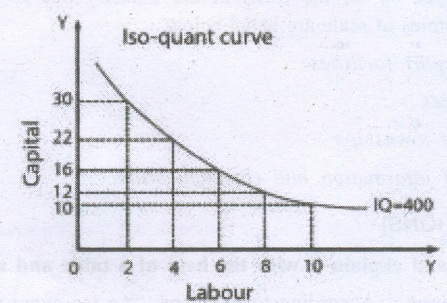
7.
Perfect Competition: Firm's Equilibrium in the Long Run (Normal Profit)
(i) In the long run, all the factors are variable. The LAC curve is an envelope curve as it contains a few average cost curves. It is a flatter U shaped one. It is also known as planning curve. First, the firms will earn only normal profit.
(ii) Secondly, all the firms in the market are in equilibrium. This means that there should neither be a tendency for the new firms to enter into the industry nor for any of the existing firms to exit from the industry.
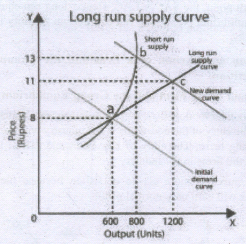
(iii) Long run supply curve is explained to determine the long run price after an increase in demand. The effect of the increase in demand in the short run is explained by the movement from point 'a' to point 'b'. The price increases from 8 to 13, and the quantity increases from 600 to 800 units. Economic profit of a firm is positive. Therefore, new firms enter the market. In the long run, new firms entry will continue until the price drops to 11 and the quantity is (1,200 units). The new long-run equilibrium is shown by point 'c', where the new demand curve intersects supply curve. At this price (level 11) and quantity (1,200 units). Due to diminishing returns, it is very difficult to increase output in the short run, as a result the price will increase to cover these higher costs of production. New firms will enter into the market. The price gradually drops to the point (11) at which each firm makes zero economic profit.
(iv) A firm under perfect competition even in the long run is a price-taker, not a price-maker. It takes the price of the product from the industry. And it superimposes its cost curves on the revenue curves.
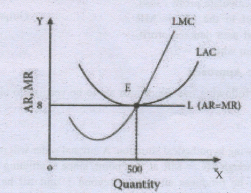
(v) Long run equilibrium of the firm is illustrated in the diagram. Under perfect competition, long run equilibrium is only at minimum point of LAC. At point E, LMC = MR = AR = LAC.
(vi) In the above diagram, average cost is equal to average revenue. The equilibrium of the firm finally rests at point E where price is 8 and output is 500. (Numbers are hypothetical) At this point, the profit of the firm is only normal. Thus conditions for long-run equilibrium of the firm is:
Price = AR = MR = Minimum AC
(vii) At the equilibrium point, the SAC > LAC. Hence, long run equilibrium price is lower than short-run equilibrium price; long-run equilibrium quantity is larger than short-run equilibrium quantity.
8.
The explanation and analysis of production possibility curve is based upon certain assumptions, some of them are following.
(i) The time period does not change. It remains the same throughout the curve.
(ii) Techniques of production are fixed.
(iii) There is full employment in the economy.
(iv) Only two goods can be produced from the given resources.
(v) Resources of production are fully mobile.
(vi) The factors of production are given in quantity and quality.
(vii) The law of diminishing returns operates in production. Every production possibility curve is based upon these. assumptions. If some of these assumptions changes or neglected, then it affects the nature of production possibility curve.
9.
Kinds of Goods (and Services)
(a) Free and Economic goods
(i) Free goods are available in nature and in abundance. Man does not need to incur any expenditure to own or use them. For example air, and sunshine. Water was also an example in the past, but at present it has exchange value. So it is not a free good.
(ii) On the other hand, economic goods are not available in plenty. They are scarce in supply. Man has to spend money to own or use them.
(b) Consumer goods and Capital goods:
(iii) Consumer goods directly satisfy human wants, TV, Furniture, Automobile, etc.
(iv) Capital-goods (also called producer's goods) don't directly satisfy the consumer wants. They help to produce consumer goods. For example, machines do not directly satisfy the consumers, but in factories, the manufacturers need them.
(c) Perishable goods and Durable goods:
(v) Perishable goods are short-lived. Their life-span is limited. For example fish, fruits, flower, etc, do not have a long life.
(vi) Durable goods and semi-durable goods have a little longer life-time than the Perishable goods. For example, a table, a chair, etc.
10.
Economics is an Art and a Science:
(i) Economics as an Art:
Art is the practical application of knowledge for achieving particular goals. Economics provides guidance to the solutions to all the economic problems. A. C. Pigou, Alfred Marshall and others regard Economics as an art.
(ii) Economics as a Science:
(a) Science is a systematic study of knowledge. All its relevant facts are collected, classified and analyzed with its scale of measurement. Using these facts, science develops the co-relationship between cause and effect.
(b) Scientific laws derived are tested through experiments, and future predictions are made. These laws are universally applicable and accepted.
(c) Economists like Robbins, Jordon and Robertson argue that Economics is a science like Physics, Chemistry, etc., since, it has several similar characteristics.
(d) Economics examines the relationships between the causes and the effects of the problems. Hence, it is rightly considered as both an art and a science. In fact, art and science are complementary to each other.
11.
Total Revenue:
Total Revenue is the amount of income received by the firm from the sale of its product. It is obtained by multiplying the price of the commodity by the number of units sold.
Total Revenue - Constant Price
| Quantity Sold (Q) | Price (P) | Total Revenue (TR) |
| 1 | 5 | 5 |
| 2 | 5 | 10 |
| 3 | 5 | 15 |
| 4 | 5 | 20 |
| 5 | 5 | 25 |
| 6 | 5 | 30 |
TR = P x Q
where,
TR denotes Total Revenue
P denotes Price and
Q denotes Quantity Sold.
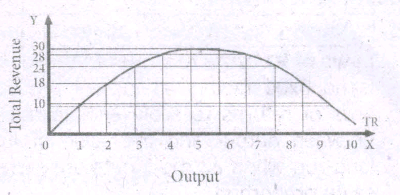
When Price is Constant, the behaviour of TR is shown in above table and diagram assuming P = 5 when P = 5, TR = PQ.
When Price is declining with increase in quantity sold (E.g imperfect competition on the goods market) the behaviour of TR can be obtained from Demand function if Q = 11 - P
TR = P Q = 1 x 10 = 10
When P = 3, Q = 8 TR = 24
When P = 0, Q = 1 TR = 10
Total Revenue - Price declining
| Quantity Sold (Q) | Price (P) | Total Revenue (TR) |
| 1 | 10 | 10 |
| 2 | 9 | 18 |
| 3 | 8 | 24 |
| 4 | 7 | 28 |
| 5 | 6 | 30 |
| 6 | 5 | 30 |
| 7 | 4 | 28 |
| 8 | 3 | 24 |
| 9 | 2 | 18 |
| 10 | 1 | 10 |
12.
Introduction: Demand is always related to price. Demand is always a specific quantity which a consumer is willing to purchase.
Demand Function: Demand depends upon price. This means demand for a commodity is a functions of price. D = f (P)
Determinants of Demand:
i. Changes in Tastes and Fashions:
The demand for some goods and services is very susceptible to changes in tastes and fashions.
ii. Changes in Weather:
An unusually dry summer results in a increase in the demand for cool drinks.
iii. Taxation and Subsidy:
The subsidies will bring down the prices. Therefore taxes reduce demand and subsidies raise demand.
iv. Changes in expectations:
Expectation of rise in price in future results in increase in demand,
v. Changes in savings:
Savings and demand are inversely related.
vi. State of Trade Activity:
During the period of boom and prosperity demand for all commodities tendes to increase. On the contrary, during time to depression, there is general slackening of demand.
vii. Advertisement:
Advertisement is a powerful instrument increasing the demand in the market.
viii. Changes in income:
An increase in family income may increase the demand for durables like video recorders and refrigerators. Equal distribution of income enables poor to get more income.
ix. Change in population:
The demand for goods depends on the size of population. An increase in population tends to increase the demand for goods and a decrease in population tends to decrease the demand (if other things remain constant).
13.
(i) Liberalization was necessitated because various licensing policies were said to be deterring the growth of the economy.
(ii) Privatization was necessitated because of the belief that the private sector was not given enough opportunities to earn more money.
(iii) Globalization was necessitated because today a developed country can grow without the help of the under developed countries. Natural and human resources of the developing countries are exploited by the developed countries and the developing economies are used as market for the finished goods of the developed countries. The surplus capital of the developed countries are invested in backward economies.
14.
a. Profits: Profits are the reward for organization or entrepreneurship. Risk-taking and uncertainty-bearing are the main functions of an entrepreneur. So we may consider profit as the reward for the above functions.
b. The Risk - bearing theory of profits: According to Prof.Hawley, profits are the reward for an entrepreneur for risk-taking. Risk-taking is an important function of an entrepreneur. Risk-taking and profit-making go together. The main criticism against this theory is that it does not make distinction between known risks and unknown risks Known risks (eg. theft, fire) can be insured against. We may say that profits are the reward for taking unknown risks. For there is a lot of uncertainty about such risks.
15.
(i) Land differs in fertility
(ii) The law of diminishing returns operates in agriculture
(iii) Theory assumes perfect competition
(iv) Land is used for cultivation only
(v) Most fertile lands are cultivated first.
16.
(i) Natural Monopoly :
Ownership of the natural raw materials (E.g. Gold mines (Africa), Coal mines, Nickel (Canada) etc.)
(ii) State Monopoly:
Single supplier of some special services (E.g.Railways in India)
(iii) Legal Monopoly :
A monopoly firm can get its monopoly power by getting patent right trade market from the government.
17.
Fixed cost and variable cost: Fixed cost and variable cost are helpful in understanding the behaviour of costs over different levels of output.
Meaning of Fixed and Variable factors and costs:
Fixed and variable factors are with reference to short run production function. Short run is a period of time over which certain factors of production cannot be changed, and such factors are called fixed factors. The costs incurred on fixed factors are called fixed costs. The factors whose quantity can be changed in the short run are variable factors, and the costs incurred on variable factors are called variable costs
Fixed costs are those which are independent of output, that is, they do not change with changes in output. These costs are a 'fixed' amount, which must be incurred by a firm in the short run whether the output is small or large. E.g. contractual rent, interest on capital invested, salaries to the permanent staff, insurance premia and certain taxes. Variable costs are those costs, which are incurred on the employment of variable factors of production whose amount can be altered in the short run. Thus the total variable costs change with the level of output. It rises when output expands and falls when output contracts. When output is nil, variable cost becomes zero. These costs include payments such as wages of labour employed, prices of raw materials, fuel and power used arid the transport costs.
18.
| Stages | Total product | Marginal Product | Average Product |
| Stage I | Initially it Increases at an increasing rate and then increases at a decreasing rate | At the beginning it increases, then reaches a maximum urn and starts to decrease | At the first instant it increases, then attains maximum |
| Stage ll | It continues to increase at a diminishing rate and reaches maximum | It continuous to diminish and becomes equal to zero | It is equal to MP and then begins to diminish |
| Stage lll | It diminishes | It becomes negative | It continues to diminish but always greater than zero(Positive) |
19.
The supply of loanable funds depends upon the following four sources.
(i) Savings (S)
(ii) Bank Credit (BC)
(iii) Dis hoarding (DH)
(iv) Disinvestment (DI)
(i) Savings (S):
1. Supply of loanable funds comes form savings.
2. Savings may be of two types.
They are
(i) "ex-ante savings" and
(ii) "ex-post savings".
(ii) Bank Credit (BC):
1. Commercial banks create credit and supply of loanable funds to the investors.
(iii) Dishoarding (DH):
1. Dishoarding means bringing out the hoarded money into use.
2. It constitutes a source of supply of loanable funds.
(iv) Disinvestment (DI):
1. Disinvestment is the opposite of investment.
2. Not providing sufficient funds for depreciation of equipment.
3. All the four sources of supply of loanable funds vary directly with the interest rate.
20.
Long run equilibrium of the firm and group equilibrium:
(i) In the short run under monopolistic competition, the firm earns supernormal profit or loss.
(ii) But in the long run, the entry of new firms will wipe out supernormal profit.
(iii) And the loss experienced by existing firms, monopolists leaving the industry.
(iv) Hence, the firm will earn the only normal profit in the long run.
(v) In the long run, AR curve is more elastic or flatter due to plenty of substitutes available.
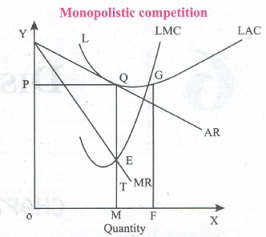
(vi) At Point E the firm achieves the equilibrium where MC = MR.
(vii) OP - Price, OM - Output
(viii) MQ - Average Cost, M = Average Revenue
\(\therefore\) MQ = MQ (AR = AC)
(ix) It means a firm earn the only normal profit in the long run.
21.
Here the market is classified not only on its geographical spread but also nature of goods.
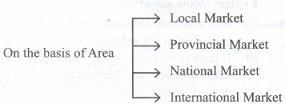
(i) Local Market:
1. The products exchanged are mostly perishable and semi-durable in nature.
2. For Example Halva in Tirunelveli.
(ii) Provincial Market:
1. Products are sold and bought in a restricted circle
2. For Example Provincial newspaper
(iii) National Market:
1. Products are sold and bought throughout a country is called national market.
2. For Example Tea, Coffee etc.
(iv) International Market:
1. Products are sold and bought at the world level are called international market.
2. For Example Petrol, Gold, etc.
22.
(a) Large Population:
(i) India stands the second largest population in the world.
(ii) Population growth rate of India is very high.
(iii) The growth rate in India is as high as 1.7 per 1000.
(iv) The annual addition of population equals the total population of Australia.
(b) Inequality and Poverty:
(i) The proportion of income and assets owned by top 10% of Indian goes on increasing.
(ii) This has led to an increase in the poverty level in the society and still a higher percentage of individuals are living below poverty line.
(c) Increasing prices of essential goods:
(i) The constant growth in the GDP and growth opportunities in the Indian economy, there have been steady increase in the prices of essential goods.
(ii) The continuous rise in prices erodes the purchasing power.
(d) Weak of Infrastructure:
There is still scarcity of the basic infrastructure like power, transport storage etc.
(e) Inadequate employment generation:
(i) The growth in production is not accompanied by creation of job.
(ii) The Indian economy is characterised by 'joblers growth'.
23.
(i) Goods and services provided by the nature are called as natural resources.
(ii) In other words, any stock or reserve that can be drawn from nature is a natural resources.
Land resources:
The area operated by large holdings (above 10 hectares) and the area operated under marginal holding (less than one hectare) has increased. This indicates is being fragmented.
Forest Resources:
India's forest cover in 2001 is 69.09 million hectare which 21.02 percent of the geographical area, of this 8.35 million hectare is very dense forest, 31.90 million moderately dense rest of the 28.84 million hectare is open forest.
Important Mineral:
"India possesses high quality iron - ore in abundance. The total reserves of iron - ore in the country are about 14.630 million tonnes of haematite and 10,619 million tonnes of magnetite
Coal and lignite:
Coal is the largest available mineral resources, India ranks third in the world after China and USA in the real of coal production.
Bauxite:
Bauxite is a main source of metal like aluminium.
Mica:
India stands first in sheet mica production and contributes 60% of mica trade in the world.
Crude Oil:
Oil is being explored in India at many places.
Gold:
India possesses only a limited gold reserve. There are only 3 main gold mine regions in our country.
Diamond:
As per UNECE the total reserves of diamond is estimated at around 4582, thousand carats which are mostly available in panna, Madhya Pradesh, Rammallakota of kunnur district of Andhra Pradesh and also in the Basin of Krishna River.
24.
(i) Monetary reforms aimed at doing away with interest rate distortions and rationalizing the structure of lending rates.
(ii) The new policy tried in many ways to make the banking system more efficient.
(a) Reserve Requirements:
(i) In mid-1991, SLR and CRR were very high.
(ii) It was proposed to cut down the SLR from 38.5% to 25% within a time span of three years.
(b) Interest rate Liberalisation :
(i) Earlier, RBI controlled the rates payable on deposits of different maturities.
(ii) The rates which could be charged for bank loans which varied according to the sector, use and size of the loan.
(iii) Earlier, it was longer term deposits after the liberalisation it was progressively extended to deposits of shorter maturity.
(c) Greater Competition:
(i) Among public sector, private sector, and foreign banks and elimination of administrative constraints.
(ii) Banks were given freedom to relocate branches.
(iii) Bank branch licensing policy in order to rationalize the existing branch network.
(iv) Guidelines for opening new private sector bank.
(v) New accounting norms regarding classification of assets and provisions of bad debts were introduced for Narasimhan Committee Report.
25.

11th Standard Syllabus & Materials
11th Standard
TN 11th Tamil பீடு பெற நில் - செய்யுள் - காவடிச்சிந்து Important Questions And Answers Study Material - QB365 Set A
NEW11th Standard
TN 11th Tamil பீடு பெற நில் - உரைநடை - மலை இடப்பெயர்கள் : ஓர் ஆய்வு Important Questions And Answers Study Material - QB365 Set A
NEW11th Standard
TN 11th Tamil மாமழை போற்றுதும் - துணைப்பாடம் - யானை டாக்டர் Important Questions And Answers Study Material - QB365 Set A
NEW11th Standard
TN 11th Tamil மாமழை போற்றுதும் - செய்யுள் - ஐங்குறுநூறு Important Questions And Answers Study Material - QB365 Set A



Tamilnadu Stateboard 11th Standard Subjects

Maths

Commerce
Economics

Biology

Business Maths and Statistics

Accountancy

Computer Science

Physics

Chemistry
Maths
Biology
Economics
Physics
Chemistry

History
Business Maths and Statistics

Computer Science
Accountancy

Computer Applications
History
Computer Technology
Commerce
Computer Applications
Computer Technology

Tamil

English

French
Tamilnadu Stateboard Standards



