
 100% FREE ACCESS
11th Standard Syllabus & Materials
11th Standard
TN 11th Tamil இயற்கை வேளாண்மை,சுற்றுச்சூழல் -செய்யுள் - மனோன்மணீயம் Important Questions And Answers Study Material - QB365 Set A
NEW11th Standard
TN 11th Tamil என்னுயிர் என்பேன் -துணைப்பாடம் - இசைத்தமிழர் இருவர் Important Questions And Answers Study Material - QB365 Set A
NEW11th Standard
TN 11th Tamil மொழி கலை -செய்யுள் - ஒவ்வொரு புல்லையும் Important Questions And Answers Study Material - QB365 Set A
NEW11th Standard
TN 11th Tamil பீடு பெற நில் - இலக்கணம் - பகுபத உறுப்புகள் Important Questions And Answers Study Material - QB365 Set A
NEW11th Standard
TN 11th Tamil பீடு பெற நில் - துணைப்பாடம் - வாடிவாசல் Important Questions And Answers Study Material - QB365 Set A
NEW11th Standard
TN 11th Tamil பீடு பெற நில் - செய்யுள் - குறுந்தொகை Important Questions And Answers Study Material - QB365 Set A

Published on: 07/06/2021
QB365 provides detailed and simple solution for every book back questions in class 11 Maths subject.It will helps to get more idea about question pattern in every book back questions with solution.
Download Tamil Nadu 11th Standard Maths question papers, model tests, one-mark questions, important questions, and public exam papers in PDF format. Free study materials and answer keys for TN State Board students.
Questions + Answers key
Take MCQ Maths Test1.
A single card is drawn from a pack of 52 cards. What is the probability that
The card will be 6 or smaller?
2.
If two coins are tossed simultaneously, then find the probability of getting (i) one head and one tail (ii) at most two tails
3.
Integrate the following with respect to x : \({x^2\over x^3}\)
4.
Differentiate the following: y = tan 3x
5.
Suppose that a matrix has 12 elements. What are the possible orders it can have? What if it has 7 elements?
6.
If \(f:[-2,2]\rightarrow B\) is given by f(x) = 2x3, then find B so that f is onto.
7.
Find the principal solution of sin \(\theta =-{\sqrt{3}\over 2}\).
8.
Find the value of \(\frac { 8! }{ 5!\times 2! } \).
9.
Write the nth term of the following sequences
\(\frac { 1 }{ 2 } ,\frac { 2 }{ 3 } ,\frac { 3 }{ 4 } ,\frac { 4 }{ 5 } ,\frac { 5 }{ 6 } \)
10.
How many chords can be drawn through 20 points on a circle?
11.
Write the equation of the lines through the point (1,-1)
(i) parallel to x + 3y - 4 = 0
(ii) perpendicular to 3x + 4y = 6
12.
Show that the sum of (m + n)th and (m - n)th term of an A.P is equal to twice the mth term.
13.
Express each of the following as a sum or difference. 2 sin 10\(\theta\) cos 2\(\theta\)
14.
A person went to a restaurant for dinner. In the menu card, the person saw 10 Indian and 7 Chinese food items. In how many ways the person can select either an Indian or a Chinese food?
15.
Discuss the nature of roots of -x2 + 3x + 1 = 0
16.
If \(\triangle ABC\) is a right triangle and if \(\angle A=\frac{\pi}{2}\), then prove that \(\sin^2B+\sin^2C=1\)
17.
Discuss the following relations for reflexivity, symmetricity and transitivity:
Let P denote the set of all straight lines in a plane. The relation R defined by "lRm if l is perpendicular to m".
18.
Discuss the following relations for reflexivity, symmetricity and transitivity :
The relation R defined on the set of all positive integers by "mRn if m divides n".
19.
Express each of the following angles in radian measure
1500
20.
Justify the trueness of the statement "An element of a set can never be a subset of itself".
21.
State whether the following sets are finite or infinite.
{x \(\in \) N : x is an even prime number}
22.
Write the following in roster form.
The set of all positive roots of the equation (x-1)(x+1)(x2-1) = 0.
23.
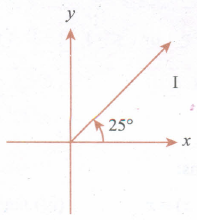
Identify the quadrant in which an angle of each given measure lies; 250
24.
25.
Evaluate \(lim_{x\rightarrow 2^-}\left\lfloor x \right\rfloor \) and \(lim_{x\rightarrow 2^+}\left\lfloor x \right\rfloor \) .
1.
P(card will be 6 or smaller)
= \(\frac{5+5+5+5}{52}=\frac{20}{52}=\frac{5}{13}\) [∵ 5 cards which are 6 or smaller from each variety]
2.
The sample space is S = {HH, HT, TH, TT}
⇒ n(S) = 4
(i) Let A be the event of getting one head and one tail, then
A = {HT, TH}
n(A) = 2
\(\therefore\) \(P(A)=\frac{n(B)}{n(S)}=\frac{4}{4}=1\)
(ii) Let A be the event of getting atmose two tails, then
\(\therefore\) B = {HH,HT,TH,TT}
\(\therefore\) \(P(B)=\frac{n(B)}{n(S)}=\frac{4}{4}=1\)
3.
\(\int{x^2\over x^3}dx=\int{1\over x}dx=log |x|+c\)
4.
y = tan 3x
Take u = 3x ⇒ \(\frac{d u}{d x}=3\)
\(y=\tan u\)
\( \frac{d y}{d x} =\frac{d y}{d u} \times \frac{d u}{d x}=\sec ^2 u(3)=\sec ^2(3 x) \cdot 3 \)
\(=3 \sec ^2(3 x)\)
5.
The number of elements is the product of number of rows and number of columns.
Therefore, we will find all ordered pairs of natural numbers whose product is 12.
Thus, all the possible orders of the matrix are 1 \(\times\) 12, 12 \(\times\) 1, 2 \(\times\)6, 6 \(\times\)2, 3 \(\times\) 4 and 4 \(\times\) 3.
Since 7 is prime, the only possible orders of the matrix are 1 \(\times\) 7 and 7 \(\times\) 1.
6.
The minimum value is f(- 2) and its maximum value is f(2) which are equal to - 16 and 16 respectively. So B = [- 16, 16].
7.
sin\(\theta =-{\sqrt{3}\over 2}\)
We know that principal value of sin\(\theta\) lies in \([-{\pi\over2},{\pi \over 2}]\).
Since, sin \(\theta =-{\sqrt{3}\over 2}\)<0, the principal value of sin θ lies in the IV quadrant.
sin\(\theta =-{\sqrt{3}\over 2}\) = -sin \(({\pi \over3})=sin(-{\pi\over 3})\)
Hence, \(\theta =-{\pi\over 3}\) is the principal solution.
8.
\(\frac { 8! }{ 5!\times 2! } =\frac { 8\times 7\times 6\times 5! }{ 5!\times 2! } =\frac { 8\times 7\times 6 }{ 2 } \) = 168
9.
Consider the terms in the numerator 1, 2, 3....
a = 1, d = 2 -1 = 1 an = a + (n-1) d
an = 1 + (n-1) (1) = 1 + n - 1 = n
The terms in the denominator are 2, 3, 4, 5, 6...
here a = 2, d = 1
an = 2 + (n-1) 1 = 2 + n -1 = n + 1
Hence nth term of the given sequence is \(\frac { n }{ n+1 } \)
10.
A chord is obtained by joining any two points on a circle
Number of chords drawn though 20 points is same as the number of ways of selecting 2 points out of 20 points.
This can be done in 20C2 ways.
Hence, total number of chords is 20C2
=\(\frac { 20! }{ 2!18! } =\frac { 20\times 19\times 18! }{ 2\times 18! } =\frac { 20\times 19 }{ 2 } \)
=\(10\times 19\) = 190.
11.
(i) Any line parallel to x + 3y - 4 = 0 will be of the form x + 3y + k = 0.
This line passes through (1, -1)
\(\therefore\) 1 + 3 (-1) + k = 0
\(\Rightarrow\) 1-3 + k = 0
\(\Rightarrow\) k - 2 = 0
\(\Rightarrow\) k = 2
\(\therefore\) The required line is x + 3y + 2 = 0
(ii) Any line perpendicular to 3x + 4y - 6 = 0 will be of the form 4x - 3y + k = 0.
This line passes through (1, -1)
\(\therefore\) 4(1) - 3(1) + k = 0
\(\Rightarrow\) 4 + 3 + k = 0
\(\Rightarrow\) k = -7
\(\therefore\) The required line is 4x - 3y - 7 = 0.
12.
Tn = a + (n - 1)d
Tm+n = a + (m + n - 1)d
& Tm-n = a + (m - n - 1)d
Tm+n + Tm-n = a + (m + n - 1)d + a + (m - n - 1)d
= 2a + d(m + n - 1 + m - n - 1)
= 2a + d(2m - 2)
= 2[a + (m - 1)d]
Tm+n + Tm-n = 2. Tm
13.
2 sin 10\(\theta\) cos 2\(\theta\) = \(\frac{1}{2}\) [sin (10\(\theta\) + 2\(\theta\)) + sin (10\(\theta\) - 2\(\theta\))]
= \(\frac{1}{2}\) [sin 12\(\theta\) + sin 8\(\theta\)]
14.
The person can select 10 Indian food in 10 ways and 7 Chinese food in 7 ways.
∴ By fundamental principle of addition, number of ways of selecting 10 Indian or 7 Chinese food is (10 + 7) = 17 ways.
15.
-x2 + 3x + 1 = 0
Given equation is -x2 + 3x + 1 = 0
Here a = -1, b = 3, c = 1
\(\therefore\) D = b2 - 4ac = 32 - 4 (-1) (1)
= 9 + 4 = 13
Since D > 0, the two roots are real and distinct.
16.
LHS = sin2B + sin2C
= sin2B +\({ \left[ sin\left( \frac { \pi }{ 2 } -B \right) \right] }^{ 2 }\)= sin2B + cos2B
= 1 = RHS
Hence proved
17.
Let l, m, n ∈ p.
Reflexivity: We cannot say l is perpendicular to l itself.
∴ l R l \(\Rightarrow \) R is not reflexive.
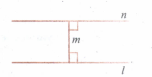
Symmetry: lRm ≠ mRl
I is perpendicular to m ⇒ m is perpendicular to l
∴ R is symmetric
Transitive: lRm and mRn ≠ lRn.
l is perpendicular to m and m is perpendicular to n.
⇒ l is perpendicular to n.
∴ R is not transitive.
⇒ R is only symmetric.
18.
The relation R defined on the set of all positive integers by "mRn" if m divides n".
Given relation is "mRn if m divides n".
Reflexivity : mRm since m divides m for all positive integers m.
\(\therefore\) R is reflexive.
Symmetricity: mRn \(\Rightarrow\) nRm.
m divides n \(\Rightarrow\) n divides m but 'n' does not divide 'm'
\(\therefore\) R is not symmetric
Transitive : mRn and nRp \(\Rightarrow\) mRp.
m divides n and n divides p \(\Rightarrow\) m divides p.
\(\therefore\) R is transitive.
\(\therefore\) R is reflexive, and transitive.
19.
1500
1500 = 150 \(\times\) \(\frac { \pi }{ 180 } =\frac { 5\pi }{ 6 } \)
20.
Let P = {a, b, c, d}
Each and every element of the set P can be a subset of the set itself
Eg: {a}, {b}, {c}, {d}.
Hence, the given statement is not true.
21.
Let A = { x \(\in \) N: x is an even prime number}
\(\Rightarrow\) A = {2}
\(\Rightarrow\) A is a finite set.
22.
The set of all positive roots of the equation (x-1)(x+1)(x2-1)=0.
Let B = { the set of positive roots of the equation (x-1)(x+10(x2-1)=0}
\(\Rightarrow\) x = 1, -1
B = {1}.
23.
Sin 250 is an acute angle, 250 lies in the I quadrant
24.
25.
The greatest integer function f(x) =\(\left\lfloor x \right\rfloor \) is defined as the greatest integer lesser than or equal to x.
\(lim_{x\rightarrow 2^-}\left\lfloor x \right\rfloor =1\) and \(lim_{x\rightarrow 2^+}\left\lfloor x \right\rfloor =2\) .

11th Standard Syllabus & Materials
11th Standard
TN 11th Tamil பீடு பெற நில் - செய்யுள் - காவடிச்சிந்து Important Questions And Answers Study Material - QB365 Set A
NEW11th Standard
TN 11th Tamil பீடு பெற நில் - உரைநடை - மலை இடப்பெயர்கள் : ஓர் ஆய்வு Important Questions And Answers Study Material - QB365 Set A
NEW11th Standard
TN 11th Tamil மாமழை போற்றுதும் - துணைப்பாடம் - யானை டாக்டர் Important Questions And Answers Study Material - QB365 Set A
NEW11th Standard
TN 11th Tamil மாமழை போற்றுதும் - செய்யுள் - ஐங்குறுநூறு Important Questions And Answers Study Material - QB365 Set A



Tamilnadu Stateboard 11th Standard Subjects
Maths

Commerce

Economics

Biology

Business Maths and Statistics

Accountancy

Computer Science

Physics

Chemistry
Maths
Biology
Economics
Physics
Chemistry

History
Business Maths and Statistics

Computer Science
Accountancy

Computer Applications
History
Computer Technology
Commerce
Computer Applications
Computer Technology

Tamil

English

French
Tamilnadu Stateboard Standards



