
 100% FREE ACCESS
11th Standard Syllabus & Materials
11th Standard
TN 11th Tamil இயற்கை வேளாண்மை,சுற்றுச்சூழல் -செய்யுள் - மனோன்மணீயம் Important Questions And Answers Study Material - QB365 Set A
NEW11th Standard
TN 11th Tamil என்னுயிர் என்பேன் -துணைப்பாடம் - இசைத்தமிழர் இருவர் Important Questions And Answers Study Material - QB365 Set A
NEW11th Standard
TN 11th Tamil மொழி கலை -செய்யுள் - ஒவ்வொரு புல்லையும் Important Questions And Answers Study Material - QB365 Set A
NEW11th Standard
TN 11th Tamil பீடு பெற நில் - இலக்கணம் - பகுபத உறுப்புகள் Important Questions And Answers Study Material - QB365 Set A
NEW11th Standard
TN 11th Tamil பீடு பெற நில் - துணைப்பாடம் - வாடிவாசல் Important Questions And Answers Study Material - QB365 Set A
NEW11th Standard
TN 11th Tamil பீடு பெற நில் - செய்யுள் - குறுந்தொகை Important Questions And Answers Study Material - QB365 Set A

Published on: 30/09/2018
Important 2mark -chapter 3,4
Download Tamil Nadu 11th Standard Physics question papers, model tests, one-mark questions, important questions, and public exam papers in PDF format. Free study materials and answer keys for TN State Board students.
Questions + Answers key
Take MCQ Physics Test1.
A body of mass 5 kg is thrown up vertically with a kinetic energy of 1000 J. If acceleration due to gravity is 10 ms-1, find the height at which the kinetic energy becomes half of the original value.
2.
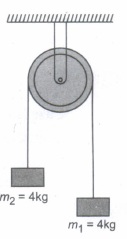
Two masses m1 = 5 kg and m2 = 4 kg tied to a string are hanging over a light frictionless pulley. What is the acceleration of each mass when left free to move? (g = 10 ms-2).
3.
State the two conditions under which a force does not work?
4.
Lubricants are used between the two parts of a machine. Why?
5.
Define unit of power.
6.
Calculate the force acting on a body which changes the momentum of the body at the rate of 1 kg-m/s2.
7.
Wheels are made circular. Why?
8.
Consider an object of mass 50 kg at rest on the floor. A Force of 5 N is applied on the object but it does not move. What is the frictional force that acts on the object?
9.
A particle of mass 2 kg experiences two forces, \(\vec { { F }_{ 1 } } =5\hat { i } +8\hat { j } +7\hat { k } \) and \(\vec { { F }_{ 2 } } =3\hat { i } -4\hat { j } +3\hat { k } \). What is the acceleration of the particle?
10.
A force \(\vec F=\vec i+2\vec j+3\vec k\) k acts on a particle and displaces it through a distance \(\vec S=4\vec i+6\vec j\). Calculate the work done if force and work done are in the same direction?
11.
A variable force F = kx2 acts on a particle which is initially at rest. Calculate the work done by the force during the displacement of the particle from x = 0 m to x = 4 m. (Assume the constant k = 1 N m-2)
12.
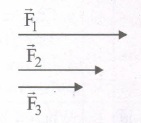
Which is the greatest force among the three force \(\vec { { F }_{ 1 } } ,\vec { { F }_{ 2 } } ,\vec { { F }_{ 3 } } \), shown below:
13.
A stone of mass 1kg is whirled in a circular path of radius 1m. Find out the tension in the string if the linear velocity is 10m/s.
14.
A block of mass 5kg resting on a frictionless plane. It is struck by a jet releasing water at a rate of 3kg/s at a speed of 4 m/s. Calculate the initial acceleration of the block?
15.
A lighter body collides with much more massive body at rest. Prove that the direction of lighter body is reversed and massive body remains at rest.
16.
What are non-conservative forces?
17.
How many joules make up one erg?
18.
When a work is said to be done? Give some example.
19.
Why a metal ball rebounds better than a rubber ball?
20.
A spark is produced, when two stones are struck against each other. Why?
21.
A gardener pushes a lawn roller through a distance of 20m. if he applies a force of 20 kg wt in a direction inclined at 60° to the grounds, find the work done by him. Take g = 9.8 ms-2.
22.
A man weighing 60 kg climbs up a staircase carrying a load of 20 kg on his head. The stair case has 20 steps each of height 0.2 m. lf he takes 10s to climb, find his power.
23.
The potential energy of a spring when stretched through a distance x is 10J. What is the amount of work done on the same spring to stretch it through on additional distance x?
24.
Action and reaction forces do not balance each other why?
25.
What is the angle between frictional force and instantaneous velocity of a body moving over a rough surface?
26.
What is normal reaction?
27.
What is frictional force?
28.
What are the forces acting on the vehicle when it moves in circulated road?
29.
What are the forces acting on the sliding object?
30.
A person rides a bike with a constant velocity \(\overset { \rightarrow }{ v } \) with respect to ground and another biker accelerates with acceleration \(\overset { \rightarrow }{ a } \) with respect to ground. Who can apply Newton's second law with respect to a stationary observer on the ground?
31.
What is free body diagram? What are the steps to be followed for developing free body diagram.
32.
Define inertia of motion.
33.
A motor cyclist is going in a vertical circle. What is the necessary condition so that he may not fall down?
34.
Define gravitational potential energy.
35.
Define Potential energy. Write the expression of it.
36.
37.
Why is it necessary to bend knees while jumping from greater height?
38.
The earth moving around the sun in a circular orbit is acted upon by a force and hence work must be done on the earth. Do you agree with this statement?
39.
Can a body have energy without momentum?
40.
State Newton's First Law.
1.
Mass m = 5 kg
K.E E = 1000 J
g = 10 ms-2
At a height 'h', mgh = \(\frac { E }{ 2 } \)
\(5\times 10\times h=\frac { 1000 }{ 2 } \)
\(h=\frac { 500 }{ 50 } =10\ m\)
2.
a=\(\frac { { m }_{ 1 }-{ m }_{ 2 } }{ { m }_{ 1 }+{ m }_{ 2 } } \times g=\frac { 5-4 }{ 5+4 } \times 10=\frac { 1 }{ 9 } \)=1.1 ms-2.
3.
(i) Displacement is zero or it is perpendicular to force.
(ii) Conservative force moves a body over a closed path.
4.
To reduce friction and so to reduce wear and tear.
5.
The unit of power is watt. One watt is defined as the power when one joule of work is done in one second.
6.
As F = rate change of momentum
F = 1 kg-m/s2 = 1N
7.
Rolling friction is less than sliding friction.
8.
When the object is at rest, the external force and the static frictional force are equal and opposite.
The magnitudes of these two forces are equal fs=Fext
Therefore, the static frictional force acting on the object is
fs = 5N
The direction of this frictional force is opposite to the direction of Fext.
9.
We use Newton's second law, \(\vec { F_{ net } } =m\vec { a } \) where \({ \vec { F } }_{ net }=\vec { { F }_{ 1 } } +\vec { { F }_{ 2 } } \). From the above equations the acceleration is \(\vec { a } =\frac { \vec { { F }_{ net } } }{ m } \), where
\(\vec { { F }_{ net } } =(5+3)\hat { i } +(8-4)\hat { j } +(7+3)\hat { k } \)
\({ \vec { F } }_{ net }=8\hat { i } +4\hat { j } +10\hat { k } \)
\(\vec { a } =\left( \frac { 8 }{ 2 } \right) \hat { i } +\left( \frac { 4 }{ 2 } \right) \hat { j } +\left( \frac { 10 }{ 2 } \right) \hat { k } \)
\(\vec { a } =4\hat { i } +2\hat { j } +5\hat { k } \).
10.
Force \(\vec F=\vec i+2\vec j+3\vec k\)
Distance \(\vec S=4\vec i+6\vec j\)
Work done \(\vec F.\vec S=(\vec i2\vec j+3\vec k).(4\vec i+6\vec j)=4+12+0=16J\)
11.
Work done, \(W-\int^{x_f}_{x_i}F(x)dx=k\int_0^4x^2 dx={64\over 3}Nm\)
12.
Force is a vector and magnitude of the vector is represented by the length of the vector. Here \(\vec { { F }_{ 1 } } \) has greater length compared to other two. So \(\vec { { F }_{ 1 } } \) is largest of the three.
13.
T = \(\frac { mv^{ 2 } }{ R } =\frac { 1\times (10)^{ 2 } }{ 1 } \) = 100N
14.
Formula: F=\(V\frac { dm }{ dt } \) = 4\(\times\)3 =12N
∴ \(a=\frac { F }{ m } \) = \(\frac { 12 }{ 5 } \)= 2.4 m/s2
15.
The first body is very much lighter than the second body \(\left( { m }_{ 1 }<<{ m }_{ 2 },\frac { { m }_{ 1 } }{ { m }_{ 2 } } <<1 \right) \)then the ratio \(\frac { { m }_{ 1 } }{ { m }_{ 2 } } \approx 0\) and also if the target is at rest (u2=0)
Dividing numerator and denominator of equation \({ v }_{ 1 }=\left( \frac { { m }_{ 1 }-{ m }_{ 2 } }{ { { m }_{ 1 }+m }_{ 2 } } \right) { u }_{ 1 }+\left( \frac { { 2m }_{ 2 } }{ { { m }_{ 1 }+m }_{ 2 } } \right) { u }_{ 2 }\) by m2 we get
\({ v }_{ 1 }=\left( \frac { \frac { { m }_{ 1 } }{ { m }_{ 2 } } -1 }{ \frac { { m }_{ 1 } }{ { m }_{ 2 } } +1 } \right) { u }_{ 1 }+\left( \frac { 2 }{ \frac { { m }_{ 1 } }{ { m }_{ 2 } } +1 } \right) \left( 0 \right) \)
\({ v }_{ 1 }=\left( \frac { 0-1 }{ 0+1 } \right) { u }_{ 1 }\)
v1=-u1
Similarly, dividing numerator and denominator of equation
\({ v }_{ 2 }=\left( \frac { { 2m }_{ 1 } }{ { { m }_{ 1 }+m }_{ 2 } } \right) { u }_{ 1 }+\left( \frac { { m }_{ 2 }-{ m }_{ 1 } }{ { { m }_{ 1 }+m }_{ 2 } } \right) { u }_{ 2 }\), by m2, we get
\({ v }_{ 2 }=\left( \frac { 2\frac { { m }_{ 1 } }{ { m }_{ 2 } } }{ \frac { { m }_{ 1 } }{ { m }_{ 2 } } +1 } \right) { u }_{ 1 }+\left( \frac { 1-\frac { { m }_{ 1 } }{ { m }_{ 2 } } }{ \frac { { m }_{ 1 } }{ { m }_{ 2 } } +1 } \right) \left( 0 \right) \)
\({ v }_{ 2 }=\left( 0 \right) { u }_{ 1 }+\left( \frac { 1-\frac { { m }_{ 1 } }{ { m }_{ 2 } } }{ \frac { { m }_{ 1 } }{ { m }_{ 2 } } +1 } \right) \left( 0 \right) \)
v2=0
16.
A force is said to be non-conservative if the work done by or against the force in moving a body depends upon the path between the initial and final positions. This means that the value of work done is different in different paths.
17.
107 erg = 1 Joule
1 erg = 10-7 Joule
18.
Work is said to be done by the force when the force applied on a body displaces it. Eg: Horse pulls a cart, engine pulls a train.
19.
When a rubber ball hits a massive object, say, earth, the ball is distorted. A large amount of heat is generated in the ball by the rubbing of the rubber molecules against each other. This effect is essentially absent in a hard material. So, a metal ball would often lose less energy upon collision than would a rubber ball.
20.
The work done in striking the two stones against each other gets converted into heat. This appears as a spark.
21.
Here, F =20 kg wt = 20\(\times\)9.8 N,
S = 20m, \(\theta\) = 60°
W = F, \(\cos\theta\) = 20\(\times\)9.8\(\times\)20\(\times\)cos60°
=20\(\times\)9.8\(\times\)20\(\times\)0.5 = 1960J
22.
m = 60 + 20 = 80 kg
h = 20\(\times\)0.2 = 4m
g = 9.8 ms-2, t = 10s
\(P={W\over t}={mgh \over t}={80\times 9.8 \times 4 \over 10}={3136 \over 10}=313.6W\)
23.
P.E of the spring when stretched through a distance x,
\(U={1\over2}{kx}^{2}=10J\)
When x becomes lx, the potential energy will be
\(u'={1\over2}k(2x)^2=4\times{1\over2}{kx}^{2}=4\times10=40J\)
\(\therefore\) Workdone = u' - u = 40 - 10 = 30 J
24.
Action and reaction acts on different bodies.
25.
Force of friction always opposes the relative motion. ∴ θ = 1800
26.
It is the force of reaction on the body due to the surface on which it is placed. It always acts perpendicular to the point of contact.
27.
Frictional force which always opposes the relative motion between an object and the surface where it is placed.
28.
(i) Gravitational force (mg) acting downwards
(ii) Normal force (mg) acting upwards
(iii) Frictional force (Fs) acting horizontally Inwards along the road.
29.
Downward gravitational force (mg), Normal force perpendicular to inclined surface (N).
30.
(i) Second biker cannot apply Newton's second law, because he is moving with acceleration \(\overset { \rightarrow }{ a } \) with respect to Earth (he is not in inertial frame).
(ii) But the first biker can apply Newton's second law because he is moving at constant velocity with respect to Earth (he is in inertial frame).
31.
Free body diagram is a simple tool to analyse the motion of the object using Newton's laws.
The following systematic steps are followed for developing the free body diagram:
(i) Identify the forces acting on the object.
(ii) Represent the object as a point.
(iii) Draw the vectors representing the forces acting on the object.
32.
The inability of an object to change its state of uniform speed (constant speed) on its own is called inertia of motion.
33.
The necessary condition is \(\frac{mv{2}}{r} \ge mg\) i.e. v\(\ge \sqrt{rg}\) at the highest point and \(v>\sqrt{5gr}\) at the lowest point.
34.
The gravitational potential energy (U) at some height h is equal to the amount of work required to take the object from ground to that height h with constant velocity.
35.
(i) Potential energy of an object at a point P is defined as the amount of work done by an external force in moving the object at constant velocity from the point 0 (initial location) to the point P (final location).
(ii) At initial point O potential energy can be taken as zero.
(iii) Mathematically, potential energy is defined as \(U=\int { { \vec { F } }_{ a } } .\vec { dr } \)
where the limit of integration ranges from initial, location point O to final location point P.
36.
37.
During the jump, our feet at once come to rest and for this smaller time (F = Impulse / time) a large force acts on feet. If we bend the knees slowly, the value of time of impact increases and less force acts on our feet. So we get less hurt.
38.
The statement is wrong. The earth revolves around the sun under the force of attraction of the sun. This force (centripetal) is always perpendicular to the motion of the earth. Therefore, \(\theta\) = 90° and W = FS cos 90° = 0.Hence, sun does to work on the earth.
39.
Yes, there is ail internal energy in a body due to the thermal agitation of the particles of the body, while the vector sum of the momenta of the moving particles may be zero.
40.
Every object continues to be in the state of rest or of uniform motion (constant velocity) unless there is external force acting on it.

11th Standard Syllabus & Materials
11th Standard
TN 11th Tamil பீடு பெற நில் - செய்யுள் - காவடிச்சிந்து Important Questions And Answers Study Material - QB365 Set A
NEW11th Standard
TN 11th Tamil பீடு பெற நில் - உரைநடை - மலை இடப்பெயர்கள் : ஓர் ஆய்வு Important Questions And Answers Study Material - QB365 Set A
NEW11th Standard
TN 11th Tamil மாமழை போற்றுதும் - துணைப்பாடம் - யானை டாக்டர் Important Questions And Answers Study Material - QB365 Set A
NEW11th Standard
TN 11th Tamil மாமழை போற்றுதும் - செய்யுள் - ஐங்குறுநூறு Important Questions And Answers Study Material - QB365 Set A



Tamilnadu Stateboard 11th Standard Subjects

Maths

Commerce

Economics

Biology

Business Maths and Statistics

Accountancy

Computer Science
Physics

Chemistry
Maths
Biology
Economics
Physics
Chemistry

History
Business Maths and Statistics

Computer Science
Accountancy

Computer Applications
History
Computer Technology
Commerce
Computer Applications
Computer Technology

Tamil

English

French
Tamilnadu Stateboard Standards

