
 100% FREE ACCESS
11th Standard Syllabus & Materials
11th Standard
TN 11th Tamil இயற்கை வேளாண்மை,சுற்றுச்சூழல் -செய்யுள் - மனோன்மணீயம் Important Questions And Answers Study Material - QB365 Set A
NEW11th Standard
TN 11th Tamil என்னுயிர் என்பேன் -துணைப்பாடம் - இசைத்தமிழர் இருவர் Important Questions And Answers Study Material - QB365 Set A
NEW11th Standard
TN 11th Tamil மொழி கலை -செய்யுள் - ஒவ்வொரு புல்லையும் Important Questions And Answers Study Material - QB365 Set A
NEW11th Standard
TN 11th Tamil பீடு பெற நில் - இலக்கணம் - பகுபத உறுப்புகள் Important Questions And Answers Study Material - QB365 Set A
NEW11th Standard
TN 11th Tamil பீடு பெற நில் - துணைப்பாடம் - வாடிவாசல் Important Questions And Answers Study Material - QB365 Set A
NEW11th Standard
TN 11th Tamil பீடு பெற நில் - செய்யுள் - குறுந்தொகை Important Questions And Answers Study Material - QB365 Set A

Published on: 07/06/2021
QB365 provides detailed and simple solution for every Book back Questions in class 11 Physics Subject. It will helps to get more idea about question pattern in every book back questions with solution.
Download Tamil Nadu 11th Standard Physics question papers, model tests, one-mark questions, important questions, and public exam papers in PDF format. Free study materials and answer keys for TN State Board students.
Questions + Answers key
Take MCQ Physics Test1.
Discuss the law of transverse vibrations in stretched strings.
2.
Describe the vertical oscillations of a spring.
3.
What are the limitations of the first law of thermodynamics?
4.
What is capillarity? Obtain an expression for the surface tension of a liquid by capillary rise method.
5.
Derive the expression for gravitational potential energy.
6.
State and prove parallel axis theorem.
7.
Arrive at an expression for elastic collision in one Dimension and discuss various cases.
8.
Describe the method of measuring angle of repose.
9.
10.
Check the correctness of the equation\(\frac { 1 }{ 2 } \)mv2 = mgh using dimensional analysis method.
1.
There are three laws of transverse vibrations of stretched strings which are given as follows:
(i) The law of length : For a given wire with tension T (which is fixed) and mass 'per unit' length Il (fixed) the frequency varies inversely with the vibrating length. Therefore
\(f∝{1\over l}⇒f={C\over l}\)
⇒ l x f = C, where C is a constant
(ii) The law of tension: For a given vibrating length I (fixed) and mass per unit length Il (fixed) the frequency varies directly with the square root of the tension T,
f∝√T
⇒ f = A√T, where A is a constant
(iii) The law of mass : For a given vibrating length I (fixed) and tension T (fixed) the frequency varies inversely with the square root of the mass per unit length μ
\(f∝{1\over\sqrt\mu}\)
\(⇒f={B\over \sqrt{\mu}}\) where B is a constant
2.
(i) Consider a massless spring with stiffness constant or force constant k attached to a ceiling.
(ii) Let the length of the spring before loading mass m be L. If the block of mass m is attached to the other end of spring, then the spring elongates by a length I.
(iii) Let F1 Ibe the restoring force due to stretching of spring. Due to mass m, the gravitational force acts vertically downward. We can draw free-body diagram for this system. When the system is under equilibrium,
F1+mg = 0
(iv) But the spring elongates by small displacement l therefore,
F1 ∝ 1=> F1 = - kl
Substituting equation in equation, we get
-kl+ mg = 0
mg = kl
or
\(\frac { m }{ k } =\frac { l }{ g } \)
(v) Suppose we apply a very small external force is applied on the mass such that the mass further displaces downward by a displacement y, then it will oscillate up and down. Now, the restoring force due to this stretching of spring (total extension of spring is y + 1 ) is
F2∝(y+l)
F2 = - k (y + l) == -ky - kl
Since, the mass moves up and down with \(\frac { { d }^{ 2 }y }{ dt^{ 2 } } \) acceleration by drawing the free body diagram for this case, we get \(-ky-kl+mg=m\frac { d^{ 2 }y }{ { dt }^{ 2 } } \)
(vi) The net force acting on the mass due to this stretching is
F = F2 + mg
F = - ky - kl + mg
The gravitational force opposes the restoring force. Substituting equation in equation, we get
F = -ky - kl + kl = -ky
Applying Newton's law, we get
m\(\frac { { d }^{ 2 }y }{ dt^{ 2 } } \)=ky
\(\frac { { d }^{ 2 }y }{ dt^{ 2 } } =\frac { k }{ m } \)y
(v) The above equation is in the form of simple harmonic differential equation. Therefore, we get the time period as
T=\(2\pi \sqrt { \frac { m }{ k } } \)
(vi) The time period can be rewritten using equation
\(2\pi \sqrt { \frac { m }{ k } } =2\pi \sqrt { \frac { l }{ g } } \)
The acceleration due to gravity g can be computed from the formula g = \(4{ \pi }^{ 2 }\left( \frac { l }{ { T }^{ 2 } } \right) \)ms-1.
3.
The first law of thermodynamics explains well the inter convertibility of heat and work. But it does not indicate the direction of change.
For example:
(a) When a hot object is in contact with a cold object, heat always flows from the hot object to cold object but not in the reverse direction. According to first law, it is possible for the energy to flow from hot object to cold object or from cold object to hot object. But in nature the direction of heat flow is always from higher temperature to lower temperature.
(b) When brakes are applied, a car stops due to friction and the work done against friction is converted into heat. But this heat is not reconverted to the kinetic energy of the car. So the first law is not sufficient to explain many of natural phenomena.
4.
Consider a capillary tube which is held vertically in a beaker containing water; the water rises in the capillary tube to a height h due to surface tension.
The surface tension force FT, acts along the tangent at the point of contact .downwards and its reaction force upwards. Surface tension T, is resolved into two 'components
(i) Horizontal component T sinθ and
(ii) Vertical component T cosθ acting upwards, all along the whole circumference of the meniscus. Total upward force = (T cosθ) (2πr) = 2πrT cosθ where S is the angle of contact, r is the radius of the tube. Let p be the density of water and h be the height to which the liquid rises inside the tube. Then,
(the volume of liquid column in the tube, V = (Volume of the liquid column of radius r height h)+
(Volume of liquid of radius r and height r - Volume of the hemisphere of radius r)
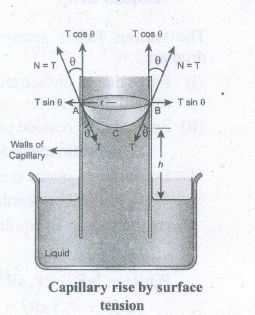
The upward force supports the weight of the liquid column above the free surface, therefore,
\(2\pi rT cos\theta=\pi r^{2} (h+\frac{1}{3}r)\rho g \Rightarrow T= \frac{r(h+\frac{1}{3}r)\rho g}{2 cos \theta}\)
If the capillary is a very fine tube of radius (i.e., radius is very small) then \(\frac{r}{3}\) can be neglected3
when it is compared to the height h. Therefore,
\(T=\frac{r\rho gh}{2 cos \theta}\)
5.
Consider the Earth and mass system, with r, the distance between the mass m and the Earth's centre. Then the gravitational potential energy,
\(\mathrm{U}=-\frac{G M_{e} m}{r}\) ......(1)
Here r = Re + h, where Re is the radius of the Earth. h is the height above the Earth's surface.
\(\mathrm{U}_{\mathrm{c}}=-G \frac{M_{e} m}{\left(R_{e}+h\right)}\) .......(2)
If h << Re, equation can be modified as
\(\mathrm{U} =-G \frac{M_{e} m}{\mathrm{R}_{e}\left(1+h / R_{e}\right)}
\)
\(\mathrm{U} =-G \frac{M_{e} m}{\mathrm{R}_{e}}\left(1+h / R_{e}\right)^{-1}\) .......(3)
By using Binomial expansion and neglecting the higher order terms, we get
\(\mathrm{U}=-G \frac{M_{e} m}{\mathrm{R}_{e}}\left(1-\frac{h}{R_{e}}\right)\) ........(4)
We know that, for a mass m on the Earth's surface,
\(G \frac{M_{e} m}{\mathrm{R}_{e}}=m g \mathrm{R}_{e}\) ........(5)
Substituting equation (5) in (4) we get
\(\mathrm{U}=-\mathrm{mg} \mathrm{R}_{e}+\mathrm{mgh}\) .......(6)
It is clear that the first term in the above expression is independent of the height h. For example, if the object is taken from height h1 to h2 then the potential energy at h1 is
\(\mathrm{U}\left(\mathrm{h}_{1}\right)=-\mathrm{mg} \mathrm{} \mathrm{R}_{\mathrm{e}}+\mathrm{mgh}_{1}\) .......(7)
and the potential energy at h2 is
\(\mathrm{U}\left(\mathrm{h}_{2}\right)=-\mathrm{mg} \mathrm{} \mathrm{R}_{\mathrm{e}}+\mathrm{mgh}_{2}\) .....(8)
The potential energy difference between h1 and h2 is
\(U\left(h_{2}\right)-U\left(h_{1}\right)=m g\left(h_{1}-h_{2}\right)\) .......(9)
6.
(i) Parallel axis theorem states that the moment of inertia of a body about any axis is equal to the sum of its moment of inertia about a parallel axis through its center of mass and the product of the mass of the body and the square of the perpendicular distance between the two axes.
(ii) If IC is the moment of inertia of the body of mass M about an axis passing through the center of mass, then the moment of inertia I about a parallel axis at a distance d from it is given by the relation,
I = IC + Md2
(iii) Let us consider a rigid body as shown in Figure. Its moment of inertia about an axis AB passing through the center of mass is IC DE is another axis parallel to AB at a perpendicular distance d from AB. The moment of inertia of the body about DE is I. We attempt to get an expression for I in terms of IC For this, let us consider a point mass m on the body at position x from its center of mass.
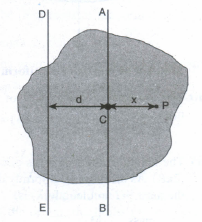
(iv) The moment of inertia of the point mass about the axis DE is, m(x + d)2. The moment of inertia I of the whole body about DE is the summation of the above expression.
\(I=\sum { m\left( x+d \right) ^{ 2 } } \)
This equation could further be written as,
\(I=\sum { m\left( { x }^{ 2 }+{ d }^{ 2 }+2xd \right) } \)
\(I=\sum { \left( { mx }^{ 2 }+m{ d }^{ 2 }+2dmx \right) } \)
\(I=\sum { { mx }^{ 2 }+\sum { m{ d }^{ 2 } } +2d\sum { mx } } \)
(v) Here, \(\sum { mx^{ 2 } } \) is the moment of inertia of the body about the center of mass. Hence,
IC = \(\sum { mx= } 0\) because, x can take positive and negative values with respect to the axis AB. The summation \(\left( \sum { mx } \right) \) will be zero.
Thus, I = Ic + \(\sum { md^{ 2 } } \) = IC + \(\left( \sum { m } \right) d^{ 2 }\)
(vi) Here, \(\sum { m } \) is the entire mass M of the object \(\left( \sum { m=M } \right) \)
I = IC + Md2
Hence the parallel axis theorem is proved.
7.
Consider two elastic bodies of masses m1 and m2 moving in a straight line (along positive x-direction) on a frictionless horizontal.
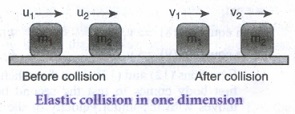
| Mass | Initial Velocity | Final Velocity |
| Mass m1 | u1 | v1 |
| Mass m2 | u2 | v2 |
(i) In order to have collision, we assume that the mass m1 moves faster than mass m2 i.e., u1 > u2 For elastic collision, the total linear momentum and kinetic energies of the two bodies before and after collision must remain the same.
| Momentum of mass m1 | Momentum of mass m2 | Total linear momentum | |
| Before collision | Pi1 = m1u1 | Pi2 = m2u2 | Pi = pi1 + Pi2 Pi = m1u1 + m2u2 |
| After collision | Pf1 = m1v1 | Pf2 = m2v2 | Pf = Pf1 + Pf2 Pf = m1v1 + m2v2 |
From the law of conservation of linear momentum,
Total momentum before collision (pi) = Total momentum after collision (Pf)
Further,
m1u1 + m2u2 = m1v1 + m2vs ...........(1)
or
m1 (u1 - v1) = m2 (v2 - u2) ...............(2)
| Kinetic energy of mass m1 | Kinetic energy of mass m2 | Total kinetic energy | |
| KEi = KEi1 + KEi2 | |||
| Before collision |
KEi1 = \(\frac { 1 }{ 2 } { m }_{ 1 }{ u }_{ 1 }^{ 2 }\) | KEi2 = \(\frac { 1 }{ 2 } { m }_{ 1 }{ u }_{ 2 }^{ 2 }\) | KEi = \(\frac { 1 }{ 2 } { m }_{ 1 }{ u }_{ 1 }^{ 2 }\) + \(\frac { 1 }{ 2 } { m }_{ 1 }{ u }_{ 2 }^{ 2 }\) KEi = KEi1 + KEi2 |
| After collision | KEf1 = \(\frac { 1 }{ 2 } { m }_{ 1 }{ v }_{ 1 }^{ 2 }\) | KEf2 = \(\frac { 1 }{ 2 } { m }_{ 1 }{ v }_{ 2 }^{ 2 }\) | KEf1 = \(\frac { 1 }{ 2 } { m }_{ 1 }{ v }_{ 1 }^{ 2 }\) + \(\frac { 1 }{ 2 } { m }_{ 1 }{ v }_{ 2 }^{ 2 }\) |
For elastic collision,
Total kinetic energy before collision KEi = Total kinetic energy after collision KEf.
\(\frac { 1 }{ 2 } { m }_{ 1 }{ u }_{ 1 }^{ 2 }+\frac { 1 }{ 2 } { m }_{ 2 }{ u }_{ 2 }^{ 2 }=\frac { 1 }{ 2 } { m }_{ 1 }{ v }_{ 1 }^{ 2 }+\frac { 1 }{ 2 } { m }_{ 2 }{ v }_{ 2 }^{ 2 }\) ................(3)
After simplifying and rearranging the terms,
\({ m }_{ 1 }\left( { u }_{ 1 }^{ 2 }-{ v }_{ 1 }^{ 2 } \right) ={ m }_{ 2 }\left( { v }_{ 2 }^{ 2 }-{ u }_{ 2 }^{ 2 } \right) \)
Using the formula a2 - b2 = (a + b) (a - b), we can rewrite the above equation as
m1 (u1 + v1) (u1 - v1) = m2 (v2 + u2) (v2 - u2) .................(4)
Dividing equation (4) by (2) gives,
\(\frac { { m }_{ 1 }\left( { u }_{ 1 }+{ v }_{ 1 } \right) \left( { u }_{ 1 }-{ v }_{ 1 } \right) }{ { m }_{ 1 }\left( { u }_{ 1 }-{ v }_{ 1 } \right) } =\frac { { m }_{ 2 }\left( { u }_{ 2 }+{ v }_{ 2 } \right) \left( { u }_{ 2 }-{ v }_{ 2 } \right) }{ { m }_{ 2 }\left( { u }_{ 2 }-{ v }_{ 2 } \right) } \)
u1 + v1 = v2 + u2
u1 - u2 = v2 - v1 .............(5)
Equation (5) can be rewritten as
(u1 - u2) = -(v1 - v2)
This means that for any elastic head on collision, the relative speed of the two elastic bodies after the collision has the same magnitude as before collision but in opposite direction. Further note that this result is independent of mass.
Rewriting the above equation for v1 and v2,
v1 = v2+ u2 - u1 .........(6)
or
v2 = u1 + v1 - u2 ............(7)
To find the final velocities v1 and v2:
Substituting equation (7) in equation (2) gives the velocity of m1 as
m1 (u1 - vI) = m2 (u1 + v1 - u2 - u2)
m1 (u1 - v1) = m2 (u1 + v1 - 2u2)
m1u1 - m1v1 = m2u1 + m2v1 - 2m2u2
m1u1 - m2u1 + 2m2u2 = m1v1 + m2v1
(m1 - m2)u1 + 2m2u2 = (m1 + m2) v1
or \({ v }_{ 1 }=\left( \frac { { m }_{ 1 }-{ m }_{ 2 } }{ { m }_{ 1 }+{ m }_{ 2 } } \right) { u }_{ 1 }+\left( \frac { { 2m }_{ 2 } }{ { m }_{ 1 }+{ m }_{ 2 } } \right) { u }_{ 2 }\) ............(8)
Similarly, by substituting (6) in equation (2) or substituting equation (8) in equation (7), we get the final velocity of m2 as
\({ v }_{ 2 }=\left( \frac { { 2m }_{ 1 } }{ { m }_{ 1 }+{ m }_{ 2 } } \right) { u }_{ 1 }+\left( \frac { { m }_{ 2 }-{ m }_{ 1 } }{ { m }_{ 1 }+{ m }_{ 2 } } \right) { u }_{ 2 }\) ............... (9)
Case 1:
When bodies has the same mass i.e., m1 = m2,
equation (8) \(\Rightarrow { v }_{ 1 }=\left( 0 \right) { u }_{ 1 }+\left( \frac { { 2m }_{ 2 } }{ { 2m }_{ 2 } } \right) { u }_{ 2 }\)
v1 = u2 ...........................(10)
equation (9) \(\Rightarrow { v }_{ 2 }=\left( \frac { { 2m }_{ 1 } }{ { 2m }_{ 1 } } \right) { u }_{ 1 }+\left( 0 \right) { u }_{ 2 }\)
v2 = u1 ..........................(11)
The equations (10) and (11) show that in one dimensional elastic collision when two bodies of equal mass collide after the collision their velocities are exchanged.
Case 2:
When bodies have the same mass i.e., m1 = m2 and second body (usually called target) is at rest (u2 = 0),
By substituting m1 = m2 = and u2 = 0 in equations (8) and (9).
we get,
from equation (8) => v1 = 0 (..................... 12)
from equation (9) => v2 = u1 ( .................. 13)
Equations (12) and (13) show that when the first body comes to rest the second body moves with the initial velocity of the first body.
Case 3:
The first body is very much lighter than the second body
\(\left( { m }_{ 1 }<{ m }_{ 2 },\frac { { m }_{ 1 } }{ { m }_{ 2 } } <1 \right) \) then the ratio \(\frac { { m }_{ 1 } }{ { m }_{ 2 } } = 0\) and also if the target is at rest (u2 = 0)
Dividing numerator and denominator of equation (8) by m2, we get
\({ v }_{ 1 }=\left( \frac { \frac { { m }_{ 1 } }{ { m }_{ 2 } } -1 }{ \frac { { m }_{ 1 } }{ { m }_{ 2 } } +1 } \right) { u }_{ 1 }+\left( \frac { 2 }{ \frac { { m }_{ 1 } }{ { m }_{ 2 } } +1 } \right) \left( 0 \right) \)
\({ v }_{ 1 }=\left( \frac { 0-1 }{ 0+1 } \right) { u }_{ 1 }\)
v1 = - u1 ............................(14)
Similarly,
Dividing numerator and denominator of equation (9) by m2, we get
\({ v }_{ 2 }=\left( \frac { 2\frac { { m }_{ 1 } }{ { m }_{ 2 } } }{ \frac { { m }_{ 1 } }{ { m }_{ 2 } } +1 } \right) { u }_{ 1 }+\left( \frac { 1-\frac { { m }_{ 1 } }{ { m }_{ 2 } } }{ \frac { { m }_{ 1 } }{ { m }_{ 2 } } +1 } \right) \left( 0 \right) \)
\({ v }_{ 2 }=\left( 0 \right) { u }_{ 1 }+\left( \frac { 1-\frac { { m }_{ 1 } }{ { m }_{ 2 } } }{ \frac { { m }_{ 1 } }{ { m }_{ 2 } } +1 } \right) \left( 0 \right) \)
v2 = 0 ..............................(15)
The equation (14) implies that the first body which is lighter returns back (rebounds) in the opposite direction with the same initial velocity as it has a negative sign. The equation (15) implies that the second body which is heavier in mass continues to remain at rest even after collision. For example, if a ball is thrown at a fixed wall, the ball will bounce back from the wall with the same velocity with which it was thrown but in opposite direction.
Case 4:
The second body is very much lighter than the first body
\(\left( { m }_{ 2 }<<{ m }_{ 1 },\frac { { m }_{ 2 } }{ { m }_{ 1 } } <<1 \right) \) then the ratio \(\frac { { m }_{ 2 } }{ { m }_{ 1 } } = 0\) and also if the target is at rest (u2 = 0).
Dividing numerator and denominator of equation 8 by m1 we get
\({ v }_{ 1 }=\left( \frac { 1-\frac { { m }_{ 2 } }{ { m }_{ 1 } } }{ 1+\frac { { m }_{ 2 } }{ { m }_{ 1 } } } \right) { u }_{ 1 }+\left( \frac { 2\frac { { m }_{ 2 } }{ { m }_{ 1 } } }{ 1+\frac { { m }_{ 2 } }{ { m }_{ 1 } } } \right) \left( 0 \right) \)
\({ v }_{ 1 }=\left( \frac { 0-1 }{ 0+1 } \right) { u }_{ 1 }+\left( \frac { 0 }{ 1+0 } \right) \left( 0 \right) \)
v1 = u1 .....................(16)
Dividing numerator and denominator of equation (14) by m1 we get
\({ v }_{ 2 }=\left( \frac { 2 }{ 1+\frac { { m }_{ 2 } }{ { m }_{ 1 } } } \right) { u }_{ 1 }+\left( \frac { \frac { { m }_{ 2 } }{ { m }_{ 1 } } -1 }{ 1+\frac { { m }_{ 2 } }{ { m }_{ 1 } } } \right) \left( 0 \right) \)
\({ v }_{ 2 }=\left( \frac { 2 }{ 1+0 } \right) { u }_{ 1 }\)
v2 = 2u1 ....................(17)
The equation (16) implies that the first body which is heavier continues to move with the same initial velocity. The equation (17) suggests that the second body which is lighter will move with twice the initial velocity of the first body. It means that the lighter body is thrown away from the point of collision.
8.
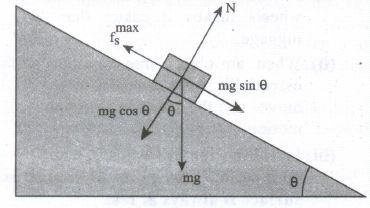
Consider an inclined plane on which an object is placed as shown in the figure, Let the angle which this plane makes with the horizontal be ፀ. For small angle of ፀ, the object may not slide down. As ፀ is increased, for a particular value of ፀ, the object begins to slide down. This value is called angle of repose. Hence, the angle of repose is the angle of the inclined plane with the horizontal such that an object placed on it begins to slide.
9.
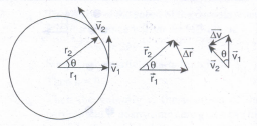
10.
Dimension formula for
\(\frac { 1 }{ 2 } \)mv2 = [M][LT-1]2 = [ML2T-2]
Dimension formula for
mgh = [M][LT-2][L] = [ML2T-2]
[ML2T-2] = [ML2T-2]
Both sides are dimensionally the same, hence the equations \(\frac { 1 }{ 2 } \)mv2 = mgh is dimensionally correct

11th Standard Syllabus & Materials
11th Standard
TN 11th Tamil பீடு பெற நில் - செய்யுள் - காவடிச்சிந்து Important Questions And Answers Study Material - QB365 Set A
NEW11th Standard
TN 11th Tamil பீடு பெற நில் - உரைநடை - மலை இடப்பெயர்கள் : ஓர் ஆய்வு Important Questions And Answers Study Material - QB365 Set A
NEW11th Standard
TN 11th Tamil மாமழை போற்றுதும் - துணைப்பாடம் - யானை டாக்டர் Important Questions And Answers Study Material - QB365 Set A
NEW11th Standard
TN 11th Tamil மாமழை போற்றுதும் - செய்யுள் - ஐங்குறுநூறு Important Questions And Answers Study Material - QB365 Set A



Tamilnadu Stateboard 11th Standard Subjects

Maths

Commerce

Economics

Biology

Business Maths and Statistics

Accountancy

Computer Science
Physics

Chemistry
Maths
Biology
Economics
Physics
Chemistry

History
Business Maths and Statistics

Computer Science
Accountancy

Computer Applications
History
Computer Technology
Commerce
Computer Applications
Computer Technology

Tamil

English

French
Tamilnadu Stateboard Standards



