
 100% FREE ACCESS
11th Standard Syllabus & Materials
11th Standard
TN 11th Tamil இயற்கை வேளாண்மை,சுற்றுச்சூழல் -செய்யுள் - மனோன்மணீயம் Important Questions And Answers Study Material - QB365 Set A
NEW11th Standard
TN 11th Tamil என்னுயிர் என்பேன் -துணைப்பாடம் - இசைத்தமிழர் இருவர் Important Questions And Answers Study Material - QB365 Set A
NEW11th Standard
TN 11th Tamil மொழி கலை -செய்யுள் - ஒவ்வொரு புல்லையும் Important Questions And Answers Study Material - QB365 Set A
NEW11th Standard
TN 11th Tamil பீடு பெற நில் - இலக்கணம் - பகுபத உறுப்புகள் Important Questions And Answers Study Material - QB365 Set A
NEW11th Standard
TN 11th Tamil பீடு பெற நில் - துணைப்பாடம் - வாடிவாசல் Important Questions And Answers Study Material - QB365 Set A
NEW11th Standard
TN 11th Tamil பீடு பெற நில் - செய்யுள் - குறுந்தொகை Important Questions And Answers Study Material - QB365 Set A

Published on: 07/06/2021
QB365 provides detailed and simple solution for every Book back Questions in class 11 Physics Subject. It will helps to get more idea about question pattern in every book back questions with solution.
Download Tamil Nadu 11th Standard Physics question papers, model tests, one-mark questions, important questions, and public exam papers in PDF format. Free study materials and answer keys for TN State Board students.
Questions + Answers key
Take MCQ Physics Test1.
Derive the expression for mean free path of the gas.
2.
Derive the ratio of two specific heat capacities of monoatomic, diatomic and triatomic molecules.
3.
Explain in detail the kinetic interpretation of temperature.
4.
Derive the expression of pressure exerted by the gas on the walls of the container.
5.
1.
(i) We know from postulates of kinetic theory that the molecules of a gas are in random motion and they collide with each other.
(ii) Between two successive collisions, a molecule moves along a straight path with uniform velocity.
(iii) This path is called mean free path. Consider a system of molecules each with diameter d. Let n be the number of molecules per unit volume.
(iv) Assume that only one molecule is in motion,and all others are at rest.
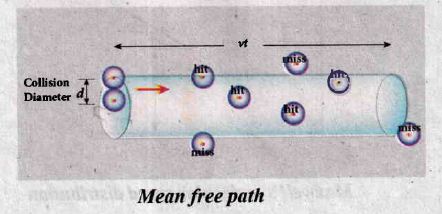
(v) If a molecule moves with average speed v in a time t, the distance travelled is vt.
(vi) In this time t, consider the molecule to move in an imaginary cylinder of volume nd2vr.
(vii) It collides with any molecule. whose center is within this cylinder. Therefore, the number of collisions is equal to the number of molecules in the volume of the imaginary cylinder.
(viii) It is equal to \(\pi\)d2vtn. The total path length divided by the number of collisions in time t is the mean free path.
Mean free pat, \(\lambda =\frac{distance \ travelled}{Number \ of \ collisions}\)
\(\lambda =\frac { vt }{ n{ \pi d }^{ 2 }vt } =\frac { 1 }{ n{ \pi d }^{ 2 } } \) ...(1)
(ix) Though we have assumed that only one molecule is moving at a time and other molecules are at rest, in actual practice all the molecules are in random motion.
(x) So the average relative speed of one molecule with respect to other molecules has to be taken into account. After some detailed calculations (you will learn in higher classes) the correct expression for mean free path .
\(\therefore \ \lambda =\frac { 1 }{ \sqrt { 2 } n{ \pi d }^{ 2 } } \) ...(2)
(xi) The equation (1) implies that the mean free path is inversely proportional to number density.
(xii) When the number density increases the molecular collisions increases and it decreases the distance travelled by the molecule before collisions:
Case1: Rearranging the equation (2) using 'm' (mass of the molecule)
\(\therefore \ \lambda =\frac { 1 }{ \sqrt { 2 } n{ \pi d }^{ 2} mm } \)
But mn = mass per unit volume = p (density of the gas)
\(\therefore \ \lambda =\frac { 1 }{ \sqrt { 2 } n{ \pi d }^{ 2 } p} \)
Also we know that PV = NkT
P =\(\frac{N}{V}\)KT= nKT
\(\therefore n =\frac{P}{KT}\)
Substituting n = \(\frac{P}{KT}\) in equation, we get
\(\lambda =\frac { 1 }{ \sqrt { 2 } n{ \pi d }^{ 2 }P } \)
2.
Monoatomic molecule
Average kinetic energy of a molecule
\(=\left[\frac{3}{2} k T\right]\)
Total energy of a mole of gas \(=\frac{3}{2} k T \times N_{A}=\frac{3}{2} R T\)
For one mole, the molar specific heat at constant volume
\(\mathrm{C}_{\mathrm{V}} =\frac{d U}{d t}=\frac{d}{d t}\left[\frac{3}{2} R T\right]
\)
\(\mathrm{C}_{\mathrm{V}} =\left[\frac{3}{2} R\right]
\)
\(\mathrm{C}_{\mathrm{P}} =\mathrm{C}_{\mathrm{V}}+\mathrm{R}
\)
\(=\frac{3}{2} R+R=\frac{5}{2} R\)
The ratio of specific heats,
\(=\frac{C_{p}}{C_{v}}=\frac{\frac{5}{2} R}{\frac{3}{2} R}=\frac{5}{3}=1.67\)
Diatomic molecule
Average kinetic energy of a diatomic molecule at low temperature \(=\frac{5}{2} k T\). Total energy of one mole of gas
\(=\frac{5}{2} k T \times N_{A}=\frac{5}{2} R T\)
(Here, the total energy is purely kinetic)
For one mole specific heat at constant volume
\(\mathrm{C}_{\mathrm{V}}=\frac{d U}{d T}=\left[\frac{5}{2} R T\right]=\frac{5}{2} R\)
But \(C_{P}=C_{v}+R\)
\(=\frac{5}{2} R+R=\frac{7}{2} R\)
\(\therefore \gamma=\frac{C_{p}}{C_{v}}=\frac{\frac{7}{2} R}{\frac{5}{2} R}=\frac{7}{5}=1.40\)
Energy of a diatomic molecule at high temperature is equal to \(\frac{7}{2} \mathrm{RT}\)
\(C_{v} =\frac{d U}{d t}=\left[\frac{7}{2} R T\right]=\frac{7}{2} R
\)
\(\therefore C_{p} =C_{v}+R=\frac{7}{2} R+R
\)
\(C_{P} =\frac{9}{2} R\)
Note that the CV and CP are higher for diatomic molecules than the mono atomic molecules. It implies that to increase the temperature of diatomic gas molecules by \(1^{\circ} \mathrm{C}\) it require more heat energy than mono atomic molecules.
\(\therefore \gamma=\frac{C_{P}}{C_{V}}=\frac{\frac{9}{2} R}{\frac{7}{2} R}=\frac{9}{7}=1.28\)
Triatomic molecule
a) Linear molecule
\(\text {Energy of one mole } =\frac{7}{2} k T \times N_{A}=\frac{7}{2} R T
\)
\(C_{v} =\frac{d U}{d T}
\)
\(=\frac{d}{d t}\left[\frac{7}{2} R T\right]
\)
\(C_{v} =\frac{7}{2} R
\)
\(C_{P} =C_{v}+R=\frac{7}{2} R+R=\frac{9 R}{2}\)
\(\therefore \gamma=\frac{C_{P}}{C_{V}}=\frac{\frac{9}{2} R}{\frac{7}{2} R}=\frac{9}{7}\)
= 1.28
b) Non-linear molecule
\(\text {Energy of a mole } =\frac{6}{2} k T \times N_{A}=\frac{6}{2} R T=3 R T
\)
\(C_{V} =\frac{d U}{d T}=3 R
\)
\(C_{V} =C_{V}+\mathrm{R}
\)
\(=3 R+R=4 R \)
\(\therefore \gamma =\frac{C_{p}}{C_{v}}=\frac{4 R}{3 R}=\frac{4}{3}=1.33\)
Note that according to kinetic theory model of gases the specific heat capacity at constant volume and constant pressure are independent of temperature. But in reality it is not sure. The specific heat capacity varies with the temperature.
3.
To understand the microscopic origin of temperature in the same way.
Rewrite the equations
\(\mathrm{P} =\frac{1}{3} n m \overline{v^{2}} \text { or } P \frac{1}{3} \frac{N}{V} m \overline{v^{2}} \quad \text { as }\left[n=\frac{N}{V}\right] \\
\)
\(\mathrm{P} =\frac{1}{3} n m \overline{v^{2}} \text { or } P \frac{1}{3} \frac{N}{V} m \overline{v^{2}} \\
\)
\(\mathrm{PV} =\frac{1}{3} N m \overline{v^{2}}\) ....(1)
Comparing the equation (1) with ideal gas equation PV = Nkt
\(\mathrm{NkT} =\frac{1}{3} N m \overline {v^{2} }
\)
\(\mathrm{kT} =\frac{1}{3} m v\overline v^{2}\) ....(2)
Multiply the above equation by 3 / 2 on both sides,
\(\frac{3}{2} k T=\frac{1}{2} m \overline v^{2}\)
R.H.S of the equation is called average kinetic energy of a single molecule \((\overline{KE})\)
The average kinetic energy per molecule
\(\overline{K E}=\frac{3}{2} k T
\)
\(\frac{3}{2} k T =\frac{1}{2} \overline{m v^{2}}\)
Implies that the temperature of a gas is a measure of the average translational kinetic energy per molecule of the gas.
4.
A molecule of mass m moving with a velocity \(\vec{v}\) having components \(\left(v_{x}, v_{y}, v_{z}\right)\) hits the right side wall. Since we have assumed that the collision is elastic, the particle rebounds with same speed and its x-component is reversed. The components of velocity of the molecule after collision are \(\left(-v_{x}, v_{y}, v_{z}\right)\)
The x-component of momentum of the molecule before collision = mvx
The x-component of momentum of the molecule after collision = mvx
The change in momentum of the molecule in x direction
= Final momentum - initial momentum
= \(-\mathrm{mv}_{\mathrm{x}}-\mathrm{mv}_{\mathrm{x}} \)
= \(-2 \mathrm{mv}_{\mathrm{x}}\)
According to law of conservation of linear momentum, the change in momentum of the wall \(=2 \mathrm{mv}_{\mathrm{x}}\)
The number of molecules hitting the right side wall in a small interval of time ∆t is calculated as follows.
The molecules within the distance of vx∆t from the right side wall and moving towards the right will hit the wall in the time interval ∆t. The number of
molecules that will hit the right side wall in a time interval ∆t is equal to the product of volume \(\left(\mathrm{Av}_{x} \Delta t\right)\)and number density of the molecules (n). Here A is area of the wall and n is number of molecules per unit volume \(\left(\frac{N}{V}\right)\). We have assumed that the number density is the same throughout the cube.
Not all the n molecules will move to the right, therefore on an average only half of the n molecules move to the right and the other half moves towards left side. The number of molecules that hit the right side wall in a time interval
\(\Delta t=\frac{n}{2} A v_{x} \Delta t\) .....(1)
In the same interval of time ∆t, the total momentum transferred by the molecules.
\(\Delta \dot{p} =\frac{n}{2} A v_{x} \Delta t \times 2 m v_{x} \)
\(=A v_{x}^{2} m n \Delta t\) ....(2)
From Newton's second law, the change in momentum in a small interval of time gives rise to force.
The force exerted by the molecules on the wall (in magnitude)
.JPG)
\(\mathrm{F} =\frac{\Delta p}{\Delta t} \)
\(=n m A v_{x}^{2} \) ...(3)
Pressure, P = force divided by the area of the wall.
.JPG)
\(\mathrm{P} =\frac{F}{A} \)
\(=n m v_{x}{ }^{2}\)
Since all the molecules are moving completely in random manner, they do not have same speed. So we can replace the term vx2 by the average \(\overline{v_{x}^{2}}\)
\(\mathrm{P}=\frac{F}{A}=n m v_{x}^{2} \)
\(\mathrm{P}=n m \overline{v_{x}^{2}}\)
Since the gas is assumed to move in random direction, it has no preferred direction of motion. (the effect of gravity on the molecules is neglected). It implies that the molecule has same average speed in all the three direction. So.\( \overline{v_{x}^{2}}=\overline{v_{y}^{2}}=\overline{v_{x}^{2}}\).
The mean square speed is written as
\(\overline{v^{2}}=\overline{v_{\dot{x}}^{2}}+\overline{v_{y}^{2}}+\overline{v_{z}^{2}}=\overline{3 v_{x}^{2}} \)
\(\overline{v_{x}^{2}}=\frac{1}{3} \overline{v^{2}} \)
\(\mathrm{P}=n m \overline{v_{x}^{2}} \)
\(\mathrm{P}=\frac{1}{3} n m \overline{v^{2}} \text { or } P \frac{1}{3} \frac{N}{V} m \overline{v^{2}} \quad \text { as }\left[n=\frac{N}{V}\right]\)
5.

11th Standard Syllabus & Materials
11th Standard
TN 11th Tamil பீடு பெற நில் - செய்யுள் - காவடிச்சிந்து Important Questions And Answers Study Material - QB365 Set A
NEW11th Standard
TN 11th Tamil பீடு பெற நில் - உரைநடை - மலை இடப்பெயர்கள் : ஓர் ஆய்வு Important Questions And Answers Study Material - QB365 Set A
NEW11th Standard
TN 11th Tamil மாமழை போற்றுதும் - துணைப்பாடம் - யானை டாக்டர் Important Questions And Answers Study Material - QB365 Set A
NEW11th Standard
TN 11th Tamil மாமழை போற்றுதும் - செய்யுள் - ஐங்குறுநூறு Important Questions And Answers Study Material - QB365 Set A



Tamilnadu Stateboard 11th Standard Subjects

Maths

Commerce

Economics

Biology

Business Maths and Statistics

Accountancy

Computer Science
Physics

Chemistry
Maths
Biology
Economics
Physics
Chemistry

History
Business Maths and Statistics

Computer Science
Accountancy

Computer Applications
History
Computer Technology
Commerce
Computer Applications
Computer Technology

Tamil

English

French
Tamilnadu Stateboard Standards



