
 100% FREE ACCESS
11th Standard Syllabus & Materials
11th Standard
TN 11th Tamil இயற்கை வேளாண்மை,சுற்றுச்சூழல் -செய்யுள் - மனோன்மணீயம் Important Questions And Answers Study Material - QB365 Set A
NEW11th Standard
TN 11th Tamil என்னுயிர் என்பேன் -துணைப்பாடம் - இசைத்தமிழர் இருவர் Important Questions And Answers Study Material - QB365 Set A
NEW11th Standard
TN 11th Tamil மொழி கலை -செய்யுள் - ஒவ்வொரு புல்லையும் Important Questions And Answers Study Material - QB365 Set A
NEW11th Standard
TN 11th Tamil பீடு பெற நில் - இலக்கணம் - பகுபத உறுப்புகள் Important Questions And Answers Study Material - QB365 Set A
NEW11th Standard
TN 11th Tamil பீடு பெற நில் - துணைப்பாடம் - வாடிவாசல் Important Questions And Answers Study Material - QB365 Set A
NEW11th Standard
TN 11th Tamil பீடு பெற நில் - செய்யுள் - குறுந்தொகை Important Questions And Answers Study Material - QB365 Set A

Published on: 24/06/2021
QB365 provides detailed and simple solution for every
Creative Questions in class 11 Physics Subject. It will helps to get more idea about question pattern in every Creative questions with solution.
Download Tamil Nadu 11th Standard Physics question papers, model tests, one-mark questions, important questions, and public exam papers in PDF format. Free study materials and answer keys for TN State Board students.
Questions + Answers key
Take MCQ Physics Test1.
Find the moment of inertia of a uniform rod about an axis which is perpendicular to the rod and touches anyone end of the rod.
2.
Write the comparison of translational and rotational quantities?
3.
Derive an expression for work done by Torque?
4.
Find the expression for radius of gyration?
5.
Write the principle used in beam balance and define Mechanical Advantage.
1.
The concepts to form the integrand to find the moment of inertia are to be followed. Now, the origin is fixed to the left 'end of the rod and the limits are to be taken from 0 to l.
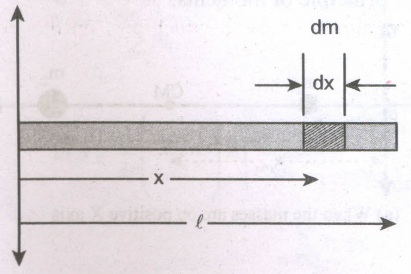
I = \(\frac { M }{ l } \int _{ 0 }^{ l }{ { x }^{ 2 }dx } =\frac { M }{ l } \left[ \frac { { x }^{ 3 } }{ 3 } \right] _{ 0 }^{ l }=\frac { M }{ l } \left[ \frac { { l }^{ 3 } }{ 3 } \right] \)
I = \(\frac { 1 }{ 3 } \)Ml2
2.
| S.No | Transitional Motion | Rotational motion about a fixed axis |
| 1. | Displacement, x | Angular displacement, \(\theta\) |
| 2. | Time, t | Time, t |
| 3. | Velocity, v=\(\frac { dx }{ dt } \) | Angular velocity \(\omega =\frac { d\theta }{ dt } \) |
| 4. | Acceleration, a=\(\frac { dv }{ dt } \) | Angular acceleration \(\alpha =\frac { d\omega }{ dt } \) |
| 5. | Mass,m | Moment of inertia, I |
| 6. | Force, F =ma | Torque, ፒ=Iα |
| 7. | Linear momentum, p = mv | Angular momentum, L=Iω |
| 8. | Impulse, F Δt =Δp | Impulse, ፒΔt=ΔL |
| 9. | Work done, w=F s | Work done, w=ፒ\(\theta\) |
| 10. | Kinetic energy KE=\(\frac { 1 }{ 2 } \)mv2 | Kinetic energy KE =\(\frac { 1 }{ 2 } \)Iω2 |
| 11. | Power, P = F v | Power, P =ፒω |
3.
(i) Consider a rigid body rotating about a fixed axis. A point the body rotating about an axis perpendicular to the plane of the page. A tangential force F is applied on the body.
(ii) It produces a small displacement ds on the body. The work done (dw) by the force is,
dw=Fds
(iii) As the distance ds, the angle of rotation d\(\theta\) and radius r are related by the expression
ds=r d\(\theta\)
The expression for work done now becomes,
dw=F ds; dw=F r d\(\theta\)
(iv) The term (Fr) is the torque ፒ produced by the force on the body.
dw=\(\tau\)d\(\theta\)
This expression gives the work done by the external torque ፒ, which acts on the body rotating about a fixed axis through an angle d\(\theta\).
4.
(i) A rotating rigid body with respect to any axis, is considered to be made up of point masses m1, m2, m3, ... mn at perpendicular distances (or positions) r1, r2, r3....rn respectively.
(ii) The moment of inertia of that object can be written as,
I=\(\sum { { m }_{ i }{ r }_{ i }^{ 2 } } ={ m }_{ 1 }{ r }_{ 1 }^{ 2 }+{ m }_{ 2 }{ r }_{ 2 }^{ 2 }+{ m }_{ 3 }{ r }_{ 3 }^{ 2 }+....+{ m }_{ n }{ r }_{ n }^{ 2 }\)
If all the n number of individual masses to be equal,
m=m1=m2=m3=....=mn
then,
I=\({ mr }_{ 1 }^{ 2 }+{ mr }_{ 2 }^{ 2 }+{ mr }_{ 3 }^{ 2 }+...+{ mr }_{ n }^{ 2 }\)
=\(m({ r }_{ 1 }^{ 2 }+{ r }_{ 2 }^{ 2 }+{ r }_{ 3 }^{ 2 }+...+{ r }_{ n }^{ 2 })\)
=\(nm\left( \frac { { r }_{ 1 }^{ 2 }+{ r }_{ 2 }^{ 2 }+{ r }_{ 3 }^{ 2 }+...+r_{ n }^{ 2 } }{ n } \right) \)
I=MK2
where, nm is the total mass M of the body and K is the radius of gyration.
K=\(\sqrt { \frac { { r }_{ 1 }^{ 2 }+{ r }_{ 2 }^{ 2 }+{ r }_{ 3 }^{ 2 }+...+{ r }_{ n }^{ 2 } }{ n } } \)
(iii) The expression for radius of gyration indicates that it is the root mean square (rms) distance of the particles of the body from the axis of rotation.
5.
(i) The principle for beam balance used for weighing goods with the condition d1 = d2 ; F1 =F2·
\(\therefore \frac { { F }_{ 1 } }{ { F }_{ 2 } } =\frac { { d }_{ 2 } }{ { d }_{ 1 } } \)
(ii) If F1 is the load and F2 is our effort, we get advantage when, d1 < d2. This implies that F1>F2. Hence, we could lift a large load with small effort. The ratio \(\left( \frac { { d }_{ 2 } }{ d_{ 1 } } \right) \) is called mechanical advantage of the simple lever The pivoted point is called fulcrum. Mechanical Advantage (MA)=\(\frac { { d }_{ 2 } }{ { d }_{ 1 } } \) .

11th Standard Syllabus & Materials
11th Standard
TN 11th Tamil பீடு பெற நில் - செய்யுள் - காவடிச்சிந்து Important Questions And Answers Study Material - QB365 Set A
NEW11th Standard
TN 11th Tamil பீடு பெற நில் - உரைநடை - மலை இடப்பெயர்கள் : ஓர் ஆய்வு Important Questions And Answers Study Material - QB365 Set A
NEW11th Standard
TN 11th Tamil மாமழை போற்றுதும் - துணைப்பாடம் - யானை டாக்டர் Important Questions And Answers Study Material - QB365 Set A
NEW11th Standard
TN 11th Tamil மாமழை போற்றுதும் - செய்யுள் - ஐங்குறுநூறு Important Questions And Answers Study Material - QB365 Set A



Tamilnadu Stateboard 11th Standard Subjects

Maths

Commerce

Economics

Biology

Business Maths and Statistics

Accountancy

Computer Science
Physics

Chemistry
Maths
Biology
Economics
Physics
Chemistry

History
Business Maths and Statistics

Computer Science
Accountancy

Computer Applications
History
Computer Technology
Commerce
Computer Applications
Computer Technology

Tamil

English

French
Tamilnadu Stateboard Standards



