
 100% FREE ACCESS
11th Standard Syllabus & Materials
11th Standard
TN 11th Tamil இயற்கை வேளாண்மை,சுற்றுச்சூழல் -செய்யுள் - மனோன்மணீயம் Important Questions And Answers Study Material - QB365 Set A
NEW11th Standard
TN 11th Tamil என்னுயிர் என்பேன் -துணைப்பாடம் - இசைத்தமிழர் இருவர் Important Questions And Answers Study Material - QB365 Set A
NEW11th Standard
TN 11th Tamil மொழி கலை -செய்யுள் - ஒவ்வொரு புல்லையும் Important Questions And Answers Study Material - QB365 Set A
NEW11th Standard
TN 11th Tamil பீடு பெற நில் - இலக்கணம் - பகுபத உறுப்புகள் Important Questions And Answers Study Material - QB365 Set A
NEW11th Standard
TN 11th Tamil பீடு பெற நில் - துணைப்பாடம் - வாடிவாசல் Important Questions And Answers Study Material - QB365 Set A
NEW11th Standard
TN 11th Tamil பீடு பெற நில் - செய்யுள் - குறுந்தொகை Important Questions And Answers Study Material - QB365 Set A

Published on: 13/05/2022
QB365 provides detailed and simple solution for every Book back Questions in class 11 Physics Subject. It will helps to get more idea about question pattern in every book back questions with solution.
latest Book back QuestionsDownload Tamil Nadu 11th Standard Physics question papers, model tests, one-mark questions, important questions, and public exam papers in PDF format. Free study materials and answer keys for TN State Board students.
Questions + Answers key
Take MCQ Physics Test1.
Discuss in detail the energy in simple harmonic motion.
2.
Describe the vertical oscillations of a spring.
3.
Discuss the simple pendulum in detail.
4.
What is meant by angular harmonic oscillation? Compute the time period of angular harmonic oscillation.
5.
Consider the Earth as a homogeneous sphere of radius R and a straight hole is bored in it through its centre. Show that a particle dropped into the hole will execute a simple harmonic motion such that its time period is \(T=2\pi \sqrt { \frac { R }{ g } } \).
1.
a. Expression for Potential Energy For the simple harmonic motion, the force and the displacement are related by Hooke's law
\(\vec { F } =-k\vec { r } \)
(i) Since force is a vector quantity, in three dimensions it has three components. Further, the force in the above equation is a conservative force field; such a force can be derived from a scalar function which has only one component. In one dimensional case
F = -kx .....(i)
(ii) As we have discussed in unit 4 of volume I, the work done by the conservative force field is independent of path. The potential energy U can be calculated from the following expression.
F = \(\frac { dU }{ dx } \) .......(2)
Comparing (1) and (2). we get
-\(\frac { dU }{ dx } \) = -kx
dU = kxdx
(iii) This work done by the force F during a small displacement dx stores as potential energy
U(x)=\(\int _{ 0 }^{ x }{ kx'dx=\frac { 1 }{ 2 } (x')^{ 2 }{ |_{ 0 }^{ x } } } =\frac { 1 }{ 2 } kx^{ 2 }\) ....(3)
From equation \(\sqrt { \frac { k }{ m } } \) , we can substitute the value of force constant k=ω2 in equation (3)
where ω is the natural frequency of the oscillating system. For the particle executing simple harmonic motion from equation y =A sin ωt,
we get x =A sin ωt
U(t)=\(\frac { 1 }{ 2 } mv_{ x }^{ 2 }=\frac { 1 }{ 2 } m\left( \frac { dx }{ dty } \right) ^{ 2 }\) ......(4)
This variation of U is shown below.
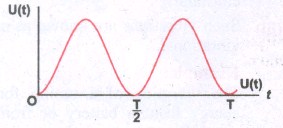
Variation of potential energy with time t
b. Expression for Kinetic Energy
KE = \(\frac { 1 }{ 2 } mv_{ x }^{ 2 }=\frac { 1 }{ 2 } m\left( \frac { dx }{ dy } \right) ^{ 2 }\)
(i) Since the particle is executing simple harmonic motion, from equation
y =A sin ωt
x =A sin ωt
Therefore, velocity is
vx =\(\frac { dx }{ dt } \)Aω cosωt
\(A\omega \sqrt { 1-\left( \frac { x }{ A } \right) ^{ 2 } } \)
vx = \(\omega \sqrt { { A }^{ 2 }-{ x }^{ 2 } } \) ....(5)
Hence
KE = \(\frac { 1 }{ 2 } mv_{ x }^{ 2 }=\frac { 1 }{ 2 } m{ \omega }^{ 2 }({ A }^{ 2 }-{ x }^{ 2 })\) ...(6)
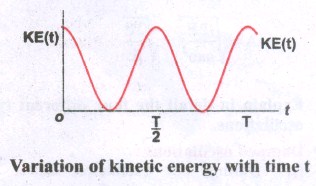
KE = \(\frac { 1 }{ 2 } m{ \omega }^{ 2 }A^{ 2 }cos^{ 2 }\omega t\) ....(7)
This variation with time is shown below.
c. Expression for Total Energy
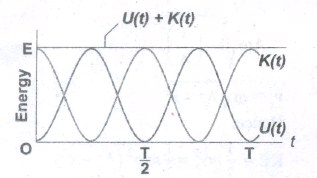
(i) Total energy is the sum of kinetic energy and potential energy
E = KE+U ..............(8)
E = \(\frac { 1 }{ 2 } m{ \omega }^{ 2 }=\frac { 1 }{ 2 } m{ \omega }^{ 2 }({ A }^{ 2 }-{ x }^{ 2 })\)
Hence excelling x2 term,
E = \(\frac { 1 }{ 2 } m{ \omega }^{ 2 }A^{ 2 }\) = constant .....(9)
(ii) Alternatively, from equation (4), and equation (7), we get the total energy as
E =\(\frac { 1 }{ 2 } m{ \omega }^{ 2 }A^{ 2 }sin^{ 2 }\omega t+\frac { 1 }{ 2 } m{ \omega }^{ 2 }A^{ 2 }cos^{ 2 }\omega t\)
= \(\frac { 1 }{ 2 } m{ \omega }^{ 2 }A^{ 2 }(sin^{ 2 }\omega t+cos^{ 2 }\omega t)\)
(iii) From trigonometry identity,
sin2ωt+cos2ωt_=1
E = \(\frac { 1 }{ 2 } m{ \omega }^{ 2 }A^{ 2 }\) = constant
which gives the law of conservation of total energy. This is depicted.
(iv) Thus the amplitude of simple harmonic oscillator, can be expressed in terms of total energy.
A =\(\sqrt { \frac { 2E }{ m{ \omega }^{ 2 } } } =\sqrt { \frac { 2E }{ k } } \) .
2.
(i) Consider a massless spring with stiffness constant or force constant k attached to a ceiling.
(ii) Let the length of the spring before loading mass m be L. If the block of mass m is attached to the other end of spring, then the spring elongates by a length I.
(iii) Let F1 Ibe the restoring force due to stretching of spring. Due to mass m, the gravitational force acts vertically downward. We can draw free-body diagram for this system. When the system is under equilibrium,
F1+mg = 0
(iv) But the spring elongates by small displacement l therefore,
F1 ∝ 1=> F1 = - kl
Substituting equation in equation, we get
-kl+ mg = 0
mg = kl
or
\(\frac { m }{ k } =\frac { l }{ g } \)
(v) Suppose we apply a very small external force is applied on the mass such that the mass further displaces downward by a displacement y, then it will oscillate up and down. Now, the restoring force due to this stretching of spring (total extension of spring is y + 1 ) is
F2∝(y+l)
F2 = - k (y + l) == -ky - kl
Since, the mass moves up and down with \(\frac { { d }^{ 2 }y }{ dt^{ 2 } } \) acceleration by drawing the free body diagram for this case, we get \(-ky-kl+mg=m\frac { d^{ 2 }y }{ { dt }^{ 2 } } \)
(vi) The net force acting on the mass due to this stretching is
F = F2 + mg
F = - ky - kl + mg
The gravitational force opposes the restoring force. Substituting equation in equation, we get
F = -ky - kl + kl = -ky
Applying Newton's law, we get
m\(\frac { { d }^{ 2 }y }{ dt^{ 2 } } \)=ky
\(\frac { { d }^{ 2 }y }{ dt^{ 2 } } =\frac { k }{ m } \)y
(v) The above equation is in the form of simple harmonic differential equation. Therefore, we get the time period as
T=\(2\pi \sqrt { \frac { m }{ k } } \)
(vi) The time period can be rewritten using equation
\(2\pi \sqrt { \frac { m }{ k } } =2\pi \sqrt { \frac { l }{ g } } \)
The acceleration due to gravity g can be computed from the formula g = \(4{ \pi }^{ 2 }\left( \frac { l }{ { T }^{ 2 } } \right) \)ms-1.
3.
A pendulum is a mechanical system which exhibits periodic motion. It has a bob with mass m suspended by a long string (assumed to be massless and in extensible string) and the other end is fixed on a stand as shown in figure. (a). At equilibrium, the pendulum does not oscillate and hangs vertically downward. Such a position is known as mean position or equilibrium position. When a pendulum is displaced through a small displacement from its equilibrium position and released, the bob of the pendulum executes to and fro motion. Let l be the length of the pendulum which is taken as the distance between the point of suspension and the centre of gravity of the bob. Two forces act on the bob of the pendulum at any displaced position, as shown in the figure.
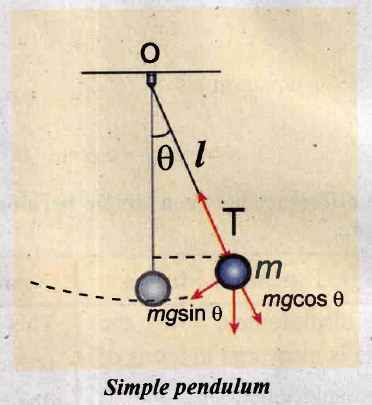
(i) The gravitational force acting on the body \((\vec{F}=\mathrm{m} \vec{g})\) which acts vertically downwards.
(ii) The tension in the string \(\vec{T}\)which acts along the string to the point of suspension.
Resolving the gravitational force into its components:
a) Normal component: The component along the string but in opposition to the direction of tension, \(F_{a s}=m g \cos \theta\).
b) Tangential component: The component perpendicular to the string i.e., along tangential direction of arc of swing, \(F_{p s}=m g \sin \theta\).
Therefore, The normal component of the force is, along the string,
\(T-W_{a s}=m \frac{v^{2}}{l}\)
Here v is speed of bob
\(\mathrm{T}-\mathrm{mg} \cos \theta=\mathrm{m} \frac{v^{2}}{l}\)
From the Figure, we can observe that the tangential component \(\mathrm{W}_{\mathrm{ps}}\) of the gravitational force always points towards the equilibrium position, i.e., the direction in which it always points opposite to the direction of displacement of the bob from the mean position. Hence, in this case, the tangential force is nothing but the restoring force. Applying Newton's second law along tangential direction, we have
\(m \frac{d^{2} s}{d t^{2}}+F_{p s} =0 \Rightarrow m \frac{d^{2} s}{d t^{2}}=F_{p s}
\)
\(m \frac{d^{2} s}{d t^{2}} =m g \sin \theta\) ......(1)
where, s is the position of bob which is measured along the arc. Expressing arc length in terms of angular displacement i.e.,
\(s =l \theta
\) .....(2)
\(\text {then its acceleration, } \frac{d^{2} s}{d t^{2}} =l \frac{d^{2} \theta}{d t^{2}}\) .....(3)
Substituting equation (3) in equation (1) we get
\(l \frac{d^{2} \theta}{d t^{2}}=-g \sin \theta
\)
\(\frac{d^{2} \theta}{d t^{2}}=-\frac{g}{l} \sin \theta\) ....(4)
Because of the presence of sin θ in the above differential equation, it is a non-linear differential equation (Here, homogeneous second order). Assume "the small oscillation approximation". sin θ ≈ θ, the above differential equation becomes linear differential equation.
.JPG)
\(\frac{d^{2} \theta}{d t^{2}}=-\frac{g}{l} \theta\) ....(5)
This is the well known oscillatory differential equation. Therefore, the angular frequency of this oscillator (natural frequency of this system) is
\(\omega^{2} =\frac{g}{l}
\) ....(6)
\(\Rightarrow \omega=\sqrt{\frac{g}{l}} \text { in } \mathrm{rad} \mathrm{s}^{-1}\) .....(7)
The frequency of oscillations is
\(\mathrm{f}=\frac{1}{2 \pi} \sqrt{\frac{\mathrm{g}}{l}} \text { in } \mathrm{Hz}\) .....(8)
and time period of oscillation is
\(T=2 \pi \sqrt{\frac{l}{g}} \text { in second }\) ......(9)
4.
When a body is allowed to rotate freely about a given axis then the oscillation is known as the angular oscillation.
The point at which the resultant torque acting on the body is taken to be zero is called mean position. If the body is displaced from the mean position, then the resultant torque acts such that it is proportional to the angular displacement and this torque has to tendency to bring the body towards the mean position.
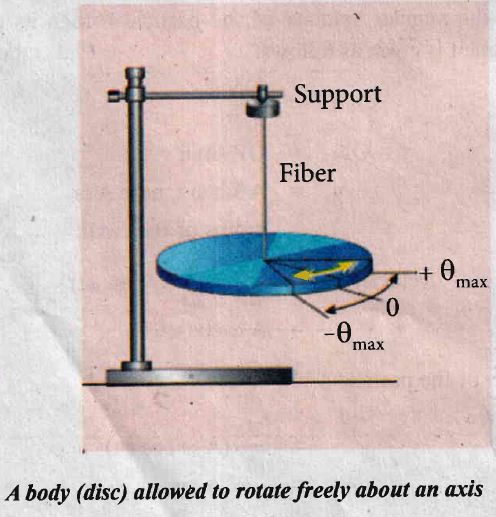
Let \(\theta \) be the angular displacement of the body and the resultant torque \( \tau \) acting on the body is
\(\vec { r } \propto \vec { \theta } \) .....(1)
\(\vec { r } =-k\vec { \theta } \) .....(2)
K is the restoring torsion constant, which is torque per unit angular displacement. If I is the moment of inertia of the body and \(\alpha\) is the angular acceleration then
\(\vec { \tau } =l\vec { \alpha } =-k\vec { \theta } \)
But \(\vec { \alpha } =\frac { { d }^{ 2 }\vec { \theta } }{ dt^{ 2 } } \) and therefore
\( \frac { { d }^{ 2 }\vec { \theta } }{ dt^{ 2 } } =\frac { K }{ I } \vec { \theta } \) .....(3)
This differential equation resembles simple harmonic differential equation. So, comparing equation (3) with simple harmonic motion given in equation,
we have \(\omega =\sqrt { \frac { k }{ l } } \) rad s-1 .....(4)
The frequency of the angular harmonic motion (from equation) is
f = \(\frac { 1 }{ 2\pi } \sqrt { \frac { k }{ l } } \) Hz .....(5)
The time period (from equation) is
T = \(2\pi \sqrt { \frac { 1 }{ k } } \) second ...(6)
5.
Mass of the Earth = M
Radius of the Earth = R
Suppose a body of mass m is dropped into the hole the depth below the surface = d
Acceleration due to gravity
\(g^{\prime}=g\left(1-\frac{d}{R}\right)=g\left(\frac{R-d}{R}\right)\)
If y is the distance of a particle from the centre of the Earth, then R-d=y
\(\therefore g^{\prime}=g \frac{y}{R}\)
Force acting on the particle is
\(\mathrm{F}=-M g^{\prime}
\)
\(\mathrm{F}=-\frac{M g}{R} y
\)
\(\therefore F \propto y
\)
\(\mathrm{F}=\mathrm{Mg}
\)
\(\mathrm{y}=\mathrm{R}
\)
∴ Force constant \(\mathrm{k}=\frac{F}{y}=\frac{m g}{R}\)
∴ Time period of oscillation of the particle is
\(\mathrm{T}=2 \pi \sqrt{\frac{M}{K}}=2 \pi \sqrt{\frac{M}{\frac{M g}{R}}}=2 \pi \sqrt{\frac{R}{g}}\)

11th Standard Syllabus & Materials
11th Standard
TN 11th Tamil பீடு பெற நில் - செய்யுள் - காவடிச்சிந்து Important Questions And Answers Study Material - QB365 Set A
NEW11th Standard
TN 11th Tamil பீடு பெற நில் - உரைநடை - மலை இடப்பெயர்கள் : ஓர் ஆய்வு Important Questions And Answers Study Material - QB365 Set A
NEW11th Standard
TN 11th Tamil மாமழை போற்றுதும் - துணைப்பாடம் - யானை டாக்டர் Important Questions And Answers Study Material - QB365 Set A
NEW11th Standard
TN 11th Tamil மாமழை போற்றுதும் - செய்யுள் - ஐங்குறுநூறு Important Questions And Answers Study Material - QB365 Set A



Tamilnadu Stateboard 11th Standard Subjects

Maths

Commerce

Economics

Biology

Business Maths and Statistics

Accountancy

Computer Science
Physics

Chemistry
Maths
Biology
Economics
Physics
Chemistry

History
Business Maths and Statistics

Computer Science
Accountancy

Computer Applications
History
Computer Technology
Commerce
Computer Applications
Computer Technology

Tamil

English

French
Tamilnadu Stateboard Standards



