
 100% FREE ACCESS
11th Standard CBSE Syllabus & Materials
11th Standard CBSE
CBSE 11th Economics PART-A - Presentation of Data - New Sample Question Papers Study Material - QB365 Set A
NEW11th Standard CBSE
CBSE 11th Economics PART-A - Organisation of Data - New Sample Question Papers Study Material - QB365 Set A
NEW11th Standard CBSE
CBSE 11th Economics PART-A - Collection of Data - New Sample Question Papers Study Material - QB365 Set A
NEW11th Standard CBSE
CBSE 11th Economics PART-A - Introduction to Economics and Statistics - New Sample Question Papers Study Material - QB365 Set A
NEW11th Standard CBSE
CBSE 11th Business Studies International Trade Sample Question Papers Study Material - QB365 Set A
NEW11th Standard CBSE
CBSE 11th Business Studies Evolution and Fundamentals of Business Sample Question Papers Study Material - QB365 Set A

Published on: 04/03/2020
11th Standard Mathematics Board Exam Model Question 2019-2020
Download CBSE Class 11th Standard CBSE Mathematics question papers, sample papers, important questions, and previous year solved papers in PDF format. Get free study materials, NCERT solutions, and exam preparation resources for Class 11th Standard CBSE Mathematics
Questions + Answers key
Take MCQ Mathematics Test
1.
Find the equation of the ellipse whose major axis on x-axis, passing through points (4, 3) and (6,2).
2.
Find the mean deviation about the mean of the following data:
| Classes | 5-6 | 6-7 | 7-8 | 8-9 | 9-10 | 10-11 |
| Frequencies | 8 | 20 | 12 | 6 | 3 | 1 |
3.
Find the coordinates of the foci, the vertices, the length of major axis, the minor axis, the eccentricity and the length of the latus rectum of the ellipse.
16x2 +y2 = 16
4.
In a circle of diameter 40 cm, the length of a chord is 20 cm. Find the length of minor arc of the chord.
5.
Express the complex number in the form a+ib: (1-i)4
6.
Find the radian measures corresponding to the following degree measures:-47o30'
7.
Evaluate the following limits \(\lim _{z \rightarrow 1} \frac{z^{\frac{1}{3}}-1}{z^{\frac{1}{6}}-1}\)
8.
Solve 5x - 3 < 7 when
(i) x is an integer,
(ii) x is a real number
9.
Find all pairs of consecutive even positive integers both of which are larger than 10 such that their sum is less than 28.
10.
A die is thrown 500 times with frequencies for the outcomes 1,2,3,4,5 and 6 as given in the following table
| Outcome | 1 | 2 | 3 | 4 | 5 | 6 |
| Frequency | 110 | 115 | 100 | 50 | 45 | 80 |
Find the probability of getting outcome 3?
11.
Two dice are rolled. Let E1, E2, and E3 be the events of getting a sum of 4, 5 and respectively.
Which events are elementary events?
12.
Calculate the mean deviation about median for the following data.
| Class | 0-10 | 10-20 | 20-30 | 30-40 | 40-50 | 50-60 |
| Frequency | 6 | 7 | 15 | 16 | 4 | 2 |
13.
If p and q are two statements given by
p : 25 is a multiple of 5.
q : 25 is a multiple of 8.
Write the compound statement by using the connective 'and' and check its validity.
14.
Write down the contrapositive of the following statements.
If PT Usha stands first in 200 m race, then she will be awarded.
15.
Evaluate the following limits \(\lim _{x \rightarrow 0} \frac{\log \left(1+x^{3}\right)}{\sin ^{3} x}\)
16.
Find the equation of the set of points which are equidistant from the points (1, 2, 3) and (3, 2, –1).
17.
Find the values of x, if the distance between two points (x,-8,4) and (3,-5,4) is 5
18.
Determine \(\angle B\) of the triangle with vertices A(-2,1), B(2,3) and C(-2,-4).
19.
Find the distance between following parallel lines.
l (x + y) + h = 0 and l (x + y) - r = 0
20.
If x,y,z are positive integers, then prove that (x + y)(y + z)(z + x) > 8xyz.
21.
Write first five terms of sequence
(ii) an = 2n2- n + 1
22.
Using binomial theorem, expand the following expansions.
\((1+x+{ x }^{ 2 })^{ 3 }\)
23.
Draw the shape of the hyperbola \(\frac { { y }^{ 2 } }{ 9 } -\frac { { x }^{ 2 } }{ 27 } =1\) and find their centre, transverse axis, conjugate axis, value of c, vertices, directrices, foci,eccentricity and latusrectum.
24.
In how many ways can 5 girls and 3 boys be seated in a row so that no two boys are together?
25.
In a monthly test, the teacher decides that there will be three questions, one from each of the Exercise 7, 8 and 9 of textbook. If there are 11 questions in Exercise 7, 15 in Exercise 8 and 10 in Exercise 9, in how many ways can three questions be selected ?
26.
Prove that \(\sum _{ t=1 }^{ n-1 }{ t(t+1) } =\frac { n(n-1)(n+1) }{ 3 } \) , for all natural numbers \(n\ge 2\)
27.
Let \(\lambda\) be a non-zero number and f : R \(\rightarrow\) R be a function defined by \(f(x)=\frac { x }{ \lambda } \forall x\epsilon R\). Find\(\left( \frac { 1 }{ \lambda } \right) f\)
28.
Let f(x)=x2 and g(x)=2x+1 be two real functions.Find \(\left(\frac{f}{g}\right)(x)\)
29.
If A = {x : x = n2 , n = 1,2,3}, then find the number of proper subsets.
30.
Write the following intervals in set-builder from
[-23,5)
31.
Find the derivative of \(\frac { { (px }^{ 2 }+qx+r) }{ ax+b } \) (it is to be understood that a, b, c, d, p, q, rand s are fixed non-zero constants and m and n are integers)
32.
If 22Pr+1: 20Pr+2 = 11:52, find r.
33.
Prove the following: tan x = \({4\tan x(1-\tan^2 \ x)\over 1-6\ \tan^2 \ x+\tan^4 \ x}\)
34.
One card is drawn from a well-shuffled deck of 52 cards.Calculate the probability that the card will be
a black card
35.
Calculate mean and variance of the given data.
| xi | 2 | 4 | 6 | 8 | 10 | 12 | 14 | 16 |
| fi | 4 | 4 | 5 | 15 | 8 | 5 | 4 | 5 |
36.
Evaluate sin ( x + 1)
37.
Find the coordinates of centroid of \(\Delta ABC\) , where vertices are A(x1, y1, z1), B(x2, y2, z2) and C(x3, y3, z3).
38.
The cable of a uniformly loaded suspension bridge hangs in the form of a parabola. The roadway which is horizontal and 100 m long is supported by vertical wires attached to the cable, the longest wire being 30 m and the shortest being 6 m. Find the length of a supporting wire attached to the roadway 18 m from the middle.
39.
Which of the lines 2x - y + 3 = 0 and ax - 4y - 7 = 0, is farther from the origin?
40.
If x, 2y and 3z are in AP, where the distinct numbers x, y, z are in GP, then find the common ratio of the GP.
41.
If the coefficients of 2nd, 3rd and 4th terms in the expansion of (1+x)n are in AP, then find the value of n.
42.
Solve the following system of inequalities.
\(\frac { 2x+1 }{ 7x-1 } \)>5, \(\frac { x+7 }{ x-8 } \)>2
43.
If z1 = 3+2i and z2 = 2-4i, then verify that \({ \left| { z }_{ 1 }+{ z }_{ 2 } \right| }^{ 2 }+ { \left| { z }_{ 1 }-{ z }_{ 2 } \right| }^{ 2 }=2({ \left| { z }_{ 1 } \right| }^{ 2 }+{ \left| { z }_{ 2 } \right| }^{ 2 })\)
44.
If z = x + iy, w = \(\frac { 1-iz }{ z-i } \) and \(|w|=1\) then show that z is purely real.
45.
In any ΔABC,prove that \({ a }^{ 3 }sin(B-C)+{ b }^{ 3 }sin(C-A)+{ C }^{ 3 }sin(A-B)=0\)
46.
Determine the domain and range of the relation R, where R = {(2x+3, x3)} : x is a prime number less than 10}.
47.
If X = {a,b,c,d} and Y = {f,b,d,g}, then find
Y - X
48.
Prove the following by using the principle of mathematical induction for all n ∊ N:a+ar+ar2+.......+arn-1 =\(\frac { a({ r }^{ n }-1) }{ r-1 } \)
49.
Give three examples of sentences which are not statements. Give reasons for the answers.
50.
Prove that \(1+2+3......n<\frac { 1 }{ 8 } { (2n+1) }^{ 2 }\) , for all natural numbers n.
51.
By giving a counter example, shows that the following statement is not true.
p: If all the angles of a triangle are equal, than the triangle is an obtuse angled triangle.
52.
Prove by the principle of mathematical induction that, for all \(n\in N\),4nwhen divided by 3, the remainder is always 1.
53.
Show that \(\frac { 1\times { 2 }^{ 2 }+2\times { 3 }^{ 2 }+...+n\times (n+1)^{ 2 } }{ { 1 }^{ 2 }\times 2+{ 2 }^{ 2 }3+...+{ n }^{ 2 }\times (n+1) } =\frac { 3n+5 }{ 3n+1 } \).
54.
Find the value of \(\left( { a }^{ 2 }+\sqrt { { a }^{ 2 }-1 } \right) ^{ 4 }+({ a }^{ 2 }-\sqrt { { a }^{ 2 }-1)^{ 4 } } \)
55.
Find the lengths of the medians of the triangle with vertices A (0, 0, 6), B (0,4, 0) and (6, 0, 0).
56.
A rod of length 12cm moves with its ends always touching the coordinate axes. Determine the equation of the locus of a point P on the rod, which is 3 cm from the end in contact with the x-axis.
57.
Find the equation of the line passing through the point of intersection of the lines x - 3y + 1 = 0 and 2x + 5y - 9 = 0 and whose distance from the origin is √5.
58.
Find if \(^{ 5 }P_{ r }=^{ 6 }P_{ r-1 }\)
59.
Show that a real value of x will satisfy the equation \(\frac{1-ix}{1+ix}=a-ib\) if a + b2 = 1where a and b are real.
60.
Calculate the mean deviation about median age for the age distribution of 100 persons gives below:
| Age | 16-20 | 21-25 | 26-30 | 31-35 | 36-40 | 41-45 | 46-50 | 51-55 |
| Number | 5 | 6 | 12 | 14 | 26 | 12 | 16 | 9 |
[Hint Convert the given data into continuous frequency distribution by subtracting 0.5 from the lower limit and adding 0.5 to the upper limit of each class interval]
61.
Refer to question 6 above, state true or false (give reason for your answer)
(i) A and B are mutually exclusive
(ii) A and B are mutually exclusive and exhaustive
(iii) A = B'
(iv) A and C are mutually exclusive
(v) A and B' are mutually exclusive
(vi) A', B', C are mutually exclusive and exhaustive.
62.
Solve the inequalities graphically x+y \(\ge\) 4, 2x - y > 0
63.
Find the domain of the function f given by f(x)=\(1\over \sqrt{[x]^2-[x]-6}\)
64.
If f(x) =\({x+1\over x-1}\) is a real function,\(\neq\) 1, then \(f[f\{f(2)\}]\) is ______.
-1
-3
3
4
65.
If A, B, C are in A.P. then \({sinA-sinC\over cosC-cosA}\) is equal to ______.
sin B
cot B
sin 2B
cot 2B
66.
If A = {x : x is a multiple of 3} and B = {x : x is a multiple of 5} then A - B is _____.
\(A\cap B\)
\(A-\bar B\)
\(\bar A\cap\bar B\)
\(\overline {A\cap B}\)
67.
The sum of infinity of the G.P. a, ar, ar2, ar3, ...... \(\infty\) is ______.
\(\frac{a-1}{1-r}\)
\(\frac{a}{1-r}\)
\(\frac{2a}{1-r}\)
\(\frac{a}{1-r^2}\)
68.
\(\overset{lim}{x\rightarrow 0} \frac{sin2x}{x}\) is _______.
3
\(\frac{1}{3}\)
2
\(\frac{1}{2}\)
69.
The circle x2+y2+2gx+2fy+c = 0 does not intersect x − axis if ______.
\(g^{ 2 }>c\)
\(g^{ 2 }
\(g^{ 2 }>2c\)
\(g^{ 2 }<2c\)
70.
If in the expansion of (a + b)n and (a + b)n + 3, the ratio of the coefficients of second and third terms and third and fourth terms respectively are equal then n is _____.
2
8
5
none of these
71.
The ratio in which the line joining (4, -3, 2) and (6, -5, -1) is divided by YZ-plane is _______.
2 : 3
2 : -3
-2 : 3
none of these
72.
The vertices of a triangle are (6, 0), (0, 6) and (6, 6). The distance between its circumcentre and centriod is ______.
√3
2√3
√2
none of these
73.
Six boys and six girls sit in a row. The probability that all girls sit together is _______.
\(\frac { 1 }{ 132 } \)
\(\frac { 1 }{ 105 } \)
\(\frac { 1 }{ 142 } \)
\(\frac { 1 }{ 165 } \)
1.
\(\frac { { x }^{ 2 } }{ 52 } +\frac { { y }^{ 2 } }{ 13 } =1\)
2.
0.97
3.
The equation of given ellipse is
16x2 + y2 =16
i.e. \(\frac { { 16x }^{ 2 } }{ 16 } +\frac { { y }^{ 2 } }{ 16 } \)=1 ⇒ \(\frac { { x }^{ 2 } }{ 1 } +\frac { { y }^{ 2 } }{ 16 } \)=1
Now 16> 1 ⇒ a2 = 16 and b2 = 1
So the equation of ellipse in standard form is
\(\frac { { y }^{ 2 } }{ { a }^{ 2 } } +\frac { { x }^{ 2 } }{ { b }^{ 2 } } \)=1
∴ a2 = 16 ⇒ a = 4 and b2 = 1⇒ b = 1
We know that c=\(\sqrt { { a }^{ 2 }-b^{ 2 } } \)
∴ c=\(\sqrt { 16-1 } =\sqrt { 15 } \)
∴ Coordinates of foci are (0,± c) i.e. (0, ±\(\sqrt { 15 } \))
Coordinates of vertices are (0, ±a) i.e. (0, ±4)
Length of major axis = 2a = 2 x 4 = 8
Length of minor axis = 2b = 2 x 1 = 2
Eccentricity (e) =\(\frac { c }{ a } =\frac { \sqrt { 15 } }{ 4 } \)
Length of latus rectum =\(\frac { 2{ b }^{ 2 } }{ a } =\frac { 2\times 1 }{ 4 } =\frac { 1 }{ 2 } \) .
4.
Here, diameter AB=40cm
Radius OA=20cm
Chord AC = 20cm
\(\therefore\) \(\triangle\) AOC is an equilateral triangle
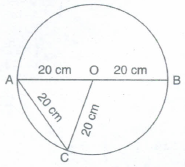
So \(\angle\)AOC = 60° =\(({60\times \pi \over 180})^C=({\pi\over 3})^C\)
We know that \(\theta ^c={l\over r}\)
\(\frac{\pi}{3}=\frac{\widehat{\mathrm{AB}}}{20} \Rightarrow \widehat{\mathrm{AB}}=\frac{20 \pi}{3} \mathrm{~cm}\)
\(\therefore {\pi\over 3}={l\over 20}\Rightarrow l={20\pi\over 3}cm\)
5.
(1-i)4 =[(1-i)2]2 = (1+i2-2i)2
= (1-1-2i)2 = (-2i)2
= 4i2=4\(\times\)-1 =-4
6.
- 47° 30' = -\((47{30\over 60})^c=-({95\over 2})^o\)
\(=-({95\over 2}\times{\pi\over 180})^c=-({19\pi\over 72})^c\)
7.
Here \(\lim _{z \rightarrow 1} \frac{z^{\frac{1}{3}}-1}{z^{\frac{1}{6}}-1}\)\([\frac{0}{0} form]\)
= \(\overset{lim}{z\rightarrow 1} \frac{(z^{1/6})^{2}-(1)^{2}}{z^{1/6}-1}\)
=\(\overset{lim}{z\rightarrow 1}=\frac{(z^{1/6}+1)(z^{1/6}-1)}{(z^{1/6}-1)}\)
=\(\overset{lim}{z\rightarrow 1} z^{1/6}+1=(1)^{1/6}+1\)
=1+1=2.
8.
Here 5x - 3 < 7
5x < 7 + 3 \(\Rightarrow\) 5x < 10
Dividing both sides by 5, we have x < 2
(i) When x is an integer then values of x that make the statement true are ..., -3, -2, -1, 0, 1
The solution set of inequality is {..., -3, -2, -1,0, I}.
(ii) When x is a real number. The solution set of inequality is x \(\epsilon \) (-\(\infty\),2)
9.
Let x and x + 2 be two consecutive even positive integers.
Then x > 10 and x + x + 2 < 28 \(\Rightarrow\) x > 10 and 2x + 2 < 28 \(\Rightarrow\) x > 10 and 2x < 28 -2
x > 10 and x < 13 \(\Rightarrow\) 10 < x < 13 \(\Rightarrow\) x = 12
Thus required pair of even integers is (12, 14).
10.
Here, Total frequnecy=Total number of times a die is thrown
=500
and a number of observed frequency, A
= Number of time the outcome 3 is thrown =100
Probability of getting outcome 3,
\(P(A) = \frac { Number\quad of\quad observed\quad frequency }{ Total\quad frequency } \)
\(=\frac { 100 }{ 500 } \)
\(=\frac { 1 }{ 5 } \)
11.
E1={(1,3),(2,2), (3,1)}
E2={(1,4),(2,3),(3,2),(4,1)}
E3={(1,5),(2,4),(3,3),(5,1),(4,2)}
No event
12.
Let us make the following table from the given data.
| Class | fi | cf | Mid-point (xi) |
\(\left| { { x }_{ i } }{ -M } \right| \) | \({ { f }_{ i } }\left| { { x }_{ i } }{ -M } \right| \) |
| 0-10 | 6 | 6 | 5 | 23 | 138 |
| 10-20 | 7 | 13 | 15 | 13 | 91 |
| 20-30 | 15 | 28 | 25 | 3 | 45 |
| 30-40 | 16 | 44 | 35 | 7 | 112 |
| 40-50 | 4 | 48 | 45 | 17 | 68 |
| 50-60 | 2 | 50 | 55 | 27 | 54 |
| Total | 50 | 508 |
Here,
Which item lies in the cumulative frequency 28. Therefore, 20-30 is the median class.
So, we have, l = 20, cf = 13, f = 15, h = 10 and N = 50
Now, median, M = \(l+\frac { \frac { N }{ 2 } -cf }{ f } \times h\)
= \(20+\frac { 25-13 }{ 15 } \times 10\)
= 20 + 8 = 28
Hence, the mean deviation about median is given by
MD(M) = \(\frac { 1 }{ N } \sum _{ i=1 }^{ 6 }{ { { f }_{ i } } } \left| { { x }_{ i } }{ -{ M } } \right| =\frac { 1 }{ 50 } \times 508=10.16\)
Hence, the mean deviation about median is 10.16.
13.
The compound statement is '25 is a multiple of 5 and 8'.
Since, 25 is a multiple of 5 but it is not a multiple of 8.
Therefore, p is true but q is not true. Hence, the compound statement is not true. i.e. the statement 'p and q' is not a valid statement.
14.
If PT Usha is not awarded, then she does not stand first in 200 m race.
15.
\(\lim _{x \rightarrow 0} \frac{\log \left(x^{3}+1\right)}{x^{3}} \times \frac{x^{3}}{\sin ^{3} x} A n s .1\)
16.
Let A(x, y, z) be any point which is equidistant from points A(1, 2, 3) and B (3, 2, -1).
Then AB = \(\sqrt { { \left( x-1 \right) }^{ 2 }+{ \left( y-2 \right) }^{ 2 }+{ \left( z-3 \right) }^{ 2 } } \)
AC = \(\sqrt { { \left( x-3 \right) }^{ 2 }+{ \left( y-2 \right) }^{ 2 }+{ \left( z+1 \right) }^{ 2 } } \)
It is given that AB = AC
\(\therefore\) \(\sqrt { { \left( x-1 \right) }^{ 2 }+{ \left( y-2 \right) }^{ 2 }+{ \left( z-3 \right) }^{ 2 } } \)= \(\sqrt { { \left( x-3 \right) }^{ 2 }+{ \left( y-2 \right) }^{ 2 }+{ \left( z+1 \right) }^{ 2 } } \)
\(\Rightarrow { \left( x-1 \right) }^{ 2 }+{ \left( y-2 \right) }^{ 2 }+{ \left( z-3 \right) }^{ 2 }\ =\ { \left( x-3 \right) }^{ 2 }+{ \left( y-2 \right) }^{ 2 }+{ \left( z+1 \right) }^{ 2 }\)
\(\Rightarrow\) x2+ 1 - 2x + z2 + 9 - 6z = x2 + 9 - 6x + z2 + 1 + 2z
\(\Rightarrow\) - 2x - 6z + 10 = - 6x + 2z + 10
\(\Rightarrow\) -2x - 6z + 6x - 2z = 0
\(\Rightarrow\) 4x - 8z = 0
\(\Rightarrow\) x - 2z = 0.
17.
Given points are (x,-8,4) and (3,-5,4) and distance between these points = 5
\(\therefore \sqrt { { (x-3) }^{ 2 }+{ { (-8+5) }^{ 2 } }+{ (4-4) }^{ 2 } } =5\)
\(\Rightarrow \sqrt { { (x-3) }^{ 2 }+{ { (-3) }^{ 2 } }+0 } =5\)
\(\Rightarrow\)(x - 3)2 + 9 + 0 = 25 [ on squaring both sides]
\(\Rightarrow\)(x - 3)2 = 16 \(\Rightarrow\) (x - 3)2 = (4)2
\(\Rightarrow\) x - 3 = \(\pm \)4 [ taking square root on both sides]
\(\therefore \) x = 7 or -1
18.
\(\text{Slope of line, }AB=\frac { 3-1 }{ 2+2 } =\frac { 2 }{ 4 } =\frac { 1 }{ 2 } ={ m }_{ 1 }(say)\)
\(\text{Slope of line, } BC=\frac { -4-3 }{ -2-2 } =\frac { 7 }{ 4 } ={ m }_{ 2 }\)
\(\therefore tanB=\left| \frac { { m }_{ 2 }-{ m }_{ 1 } }{ 1+{ m }_{ 1 }{ m }_{ 2 } } \right| =\left| \frac { \frac { 7 }{ 4 } -\frac { 1 }{ 2 } }{ 1+\frac { 1 }{ 2 } .\frac { 7 }{ 4 } } \right| \)
\(Ans.\angle B={ tan }^{ -1 }\left( \frac { 2 }{ 3 } \right) \)
19.
Given parallel lines are
lx + ly + h = 0 and lx + ly - r =0
On comparing with Ax + By + C1 = 0
and Ax + By + C2 = 0 we get
A = l, B = l, C1 = h, C2 = -r
\(\therefore \) Required distance \(=\frac { \left| { C }_{ 1 }-{ C }_{ 2 } \right| }{ \sqrt { { A }^{ 2 }+{ B }^{ 2 } } } =\left| \frac { h+r }{ \sqrt { l^{ 2 }+{ l }^{ 2 } } } \right| =\left| \frac { h\quad +\quad r }{ \sqrt { 21 } } \right| \)
20.
We know that, AM \(\ge \) GM
\(\frac { x+y }{ 2 } >\sqrt { xy } ,\frac { y+z }{ 2 } >\sqrt { yz } and\quad \frac { z+x }{ 2 } >\sqrt { zx } \)
On multiplying the above inequalities, we get
\(\frac { x+y }{ 2 } .\frac { y+z }{ 2 } .\frac { y+z }{ 2 } >\sqrt { (xy)(yz)(zx) } \)
or (x + y)(y + z)(z + x) > 8xyz
21.
We have, an = 2n2- n + 1
On putting n = 1, we get
a1 = 2(1)2- 1 + 1 = 2 - 1 + 1 = 2
On putting n = 2, we get
a2= 2(2)2- 2 + 1 = 8 - 2 + 1 = 7
On putting n = 3, we get
a3 = 2(3)2- 3 + 1 = 18 - 3 + 1 = 16
On putting n = 4, we get
a4 = 2(4)2- 4 + 1 = 32 - 4 + 1 = 29
On putting n = 5, we get
a5 = 2(5)2- 5 + 1 = 50 - 5 + 1 = 46
Hence, the first five terms of the given sequence are 2, 7, 16, 29 and 46.
22.
\((1+x+{ x }^{ 2 })^{ 3 }=[(1+x)+{ x }^{ 2 }]^{ 3 }\)
\(=^{ 3 }{ C }_{ o }(1+x)^{ 3 }+^{ 3 }{ C }_{ 1 }(1+x)^{ 2 }({ x }^{ 2 })^{ 1 }+^{ 3 }{ C }_{ 2 }(1+x)({ x }^{ 2 })^{ 2 }+^{ 3 }{ C }_{ 3 }({ x }^{ 2 })^{ 3 }\)
\(={ x }^{ 6 }+3{ x }^{ 5 }+6{ x }^{ 4 }+7{ x }^{ 3 }+6{ x }^{ 2 }+3x+1\)
23.
Given equation of hyperbola is \(\frac { { y }^{ 2 } }{ 9 } -\frac { { x }^{ 2 } }{ 27 } =1\)
On comparing with \(\frac { { y }^{ 2 } }{ { a }^{ 2 } } -\frac { { x }^{ 2 } }{ { b }^{ 2 } } =1\) we get
a2=9, b2=27 or \(a=3,b=3\sqrt { 3 } \)
(ii) Centre (0,0)
(iii) Transverse axis, \(2a=2\times 3=6\)
(iv) Conjugate axis, \(2b=2\times 3\sqrt { 3 } =6\sqrt { 3 } \)
(v) Value of \(c=\sqrt { { a }^{ 2 }+{ b }^{ 2 } } =\sqrt { 9+27 } =\sqrt { 36 } =6\)
(vi) Vertices = \((0,\pm a)=(0,\pm 3)\)
(vii) Directions, \(y=\pm \frac { { a }^{ 2 } }{ c } =\pm \frac { 9 }{ 6 } =\pm \frac { 3 }{ 2 } \)
(viii) Foci = \((0,\pm c)=(0,\pm 6)\)
(ix) Eccentricity, \(e=\frac { c }{ a } =\frac { 6 }{ 3 } =2\)
(x) Length of latusrectum \(=\frac { { 2b }^{ 2 } }{ a } =\frac { 2\times 27 }{ 3 } =18\)
24.
Let us first seat the 5 girls. This can be done in 5! ways. For each such arrangement, the three boys can be seated only at the cross marked places.
× G × G × G × G × G ×.
There are 6 cross marked places and the three boys can be seated in 6P3 ways.
Hence, by multiplication principle, the total number of ways
\(=5 ! \times{ }^{6} \mathrm{P}_{3}=5 ! \times \frac{6 !}{3 !}\)
= 4 × 5 × 2 × 3 × 4 × 5 × 6 = 14400.
25.
Clearly, from Excercise 7, one question can be selected in 11 ways.
From Exercise 8, one question can be selected in 15 ways.
and from Exercise 9, one question can be selected in 10 ways.
Since, each operation is performed after performing the previous operation, so we use fundamendal principle of multiplication.
\(\therefore \) Number of ways of selecting three questions
= 11 \(\times\)15 \(\times\)10 = 1650
26.
Consider :\(P(k) : \sum _{ t=1 }^{ k-1 }{ t(t+1) } =\frac { k(k-1)(k+1) }{ 3 } k\ge 2\)
P(k):1.2+2.3+3.4+....+(k-1)k \(=\frac { k(k-1)(k+1) }{ 3 } \)
Now P(k+1):1.2+2.3+3.4+...+(k1)k+k(k+1)
\(=\frac { k(k-1)(k+1) }{ 3 } +k(k+1)\)
\(=\frac { k(k+1)(k+2) }{ 3 } k\ge 2\)
27.
Clearly,f(x)=\(\lambda f,\lambda ^{ 2 }f\) and \(\left( \frac { 1 }{ \lambda } \right) f\)are function from R to itself
=\(\left( \frac { 1 }{ \lambda } f \right) (x)=\frac { 1 }{ \lambda } .f(x)=\frac { 1 }{ \lambda } \times \frac { x }{ \lambda } =\frac { x }{ \lambda ^{ 2 } } ,\forall x\epsilon R\)
28.
\((f+g)(x)=x^{2}+2 x+1,(f-g)(x)=x^{2}-2 x-1,\)
\((\text { fg })(x)=x^{2}(2 x+1)=2 x^{3}+x^{2},\left(\frac{f}{g}\right)(x)=\frac{x^{2}}{2 x+1}, x \neq-\frac{1}{2} \)
29.
Here, A = {1,4,5} \(\Rightarrow \) n(A) = 3
Number of proper subsets = 2n - 1 = 7
30.
[-23, 5)= {x:x \(\in\) R, -23\(\le\) x <5}
31.
Here f(x)=\(\frac { { (px }^{ 2 }+qx+r) }{ ax+b } \)
\(\therefore f(x)=\frac { d }{ dx } \left[ \frac { { px }^{ 2 }+qx+r }{ ax+b } \right] \)
\( =\frac { (ax+b)\frac { d }{ dx } ({ px }^{ 2 }+qx+r)-({ px }^{ 2 }+qx+r)\frac { d }{ dx } (ax+b) }{ { (ax+b) }^{ 2 } } \)
\( =\frac { (ax+b)(2px+q)-({ px }^{ 2 }+qx+r)(a) }{ { (ax+b) }^{ 2 } } \)
\(=\frac { { 2px }^{ 2 }+aqx+2bpx+bq-{ apx }^{ 2 }-apx-ar }{ { (ax+b) }^{ 2 } } \)
\(=\frac { { apx }^{ 2 }+2bpx+bq-ar }{ { (ax+b) }^{ 2 } } \)
32.
Here 22Pr+1: 20Pr+2=11:52
\(\Rightarrow \frac { 22! }{ (21-r)! } \times \frac { (18-r)! }{ 20! } =\frac { 11 }{ 52 } \)
\(\Rightarrow \frac { 22\times 21\times 20! }{ (21-r)(20-r)(19-r)(18-r)! } \times \frac { (18-r)! }{ 20! } =\frac { 11 }{ 52 } \)
\(\Rightarrow \frac { 22\times 21 }{ (21-r)(20-r)(19-r) } =\frac { 11 }{ 52 } \)
\(\Rightarrow (21-r)(20-r)(19-r)=2\times 21\times 52\)
\(\Rightarrow (21-r)(20-r)(19-r)=14\times 13\times 12\)
\(\Rightarrow (21-r)(20-r)(19-r)\)
= (21-7)(20-7)(19-7)
\(\Rightarrow\) r = 7
33.
We have
\(L.H.S =tan \ 4x={2tan\ 2x\over 1-tan^2 \ 2x }\)
\([\because tan 2A={2tan A\over 1-tan^2A} ]\)
\(={2.{2tan \ x\over 1-tan ^2x}\over 1-({2tan \ x\over 1-tan^2 \ x})^2}\)
\(={{4 tan x\over 1-tan^2 x}\over {(1-tan^2 \ x)^2-4tan^2 \ x \over (1-tan^2 \ x)^2}}\)
\(={4tan \ x \over 1-tan^2 x} \times {(1-tan^2 x)^2\over 1+tan^4x-2tan ^2-4tan^2 x}={4tan \ x(1-tan^2 \ x)\over 1-6tan^2 \ x+tan ^4 \ x}\)
=R.H.S
34.
\(\frac { 1 }{ 2 } \)
35.
Ans : 9,15.08
36.
\({ f }^{ ' }(x)=\lim_ { h\rightarrow 0 }{ lim } \frac { sin(x+h+1)-sin(x+1) }{ h } \)
\(=\lim_ { h\rightarrow 0 }{ lim } \frac { 2cos\left( \frac { x+h+1+x+1 }{ 2 } \right) sin\left( \frac { x+h+1-x-1 }{ 2 } \right) }{ h } \)
\(=\lim_ { h\rightarrow 0 }{ lim } \frac { 2cos\frac { 2x+h+2 }{ 2 } sin\frac { h }{ 2 } }{ 2\times \frac { h }{ 2 } } \)
\(cos(x+1)\)
37.
Let D be the mid-point of BC and E be the centroid of \(\Delta ABC\), which divides AD in the ratio of 2:1
\(\left( \frac { { x }_{ 1 }+{ x }_{ 2 }+{ x }_{ 3 } }{ 3 } ,\frac { { y }_{ 1 }+{ y }_{ 2 }+{ y }_{ 3 } }{ 2 } \frac { { z }_{ 1 }+{ z }_{ 2 }+{ z }_{ 3 } }{ 2 } \right) \)
38.
Here, wire are vertical.
Let equation of the parabola be in the form
\({ x }^{ 2 }=4ay\) ...(i)
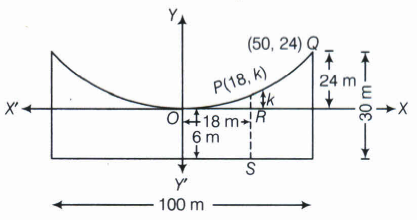
Focus is at the middle of the cable and shortest and longest vertical supports are 6 m and 30 m and roadway in 100 m long.
Clearly, the coordinates of Q(50, 24) will satisfy Eq.(i)
\(\therefore \quad (50)^{ 2 }=4a\times 24\Rightarrow 2500=96a\Rightarrow a=\frac { 2500 }{ 96 } \)
\(Hence,from\quad Eq.(i),\quad { x }^{ 2 }=4\times \frac { 2500 }{ 96 } y\Rightarrow { x }^{ 2 }=\frac { 2500 }{ 24 } y\)
Let PR=km
Then, point\ P(18,k) will satisfy the equation of parabola.
\(\therefore \quad From\quad Eq.(i),\quad (18)^{ 2 }=\frac { 2500 }{ 24 } \times k\)
\(\Rightarrow 324=\frac { 2500 }{ 24 } k\Rightarrow k=\frac { 324\times 24 }{ 2500 } =\frac { 324\times 6 }{ 625 } =\frac { 1944 }{ 625 } \)
\( \Rightarrow k=3.11\)
Therefore Required length= 6+k=6+3.11=9.11m(approx.)
39.
\({ P }_{ 1 }=\frac { \left| 0+0+3 \right| }{ \sqrt { { \left( -2 \right) }^{ 2 }+{ \left( 1 \right) }^{ 2 } } } =\frac { 3 }{ \sqrt { 5 } } \)
\({ P }_{ 2 }=\frac { \left| 0+0-7 \right| }{ \sqrt { { \left( 1 \right) }^{ 2 }+{ \left( -4 \right) }^{ 2 } } } =\frac { 7 }{ \sqrt { 17 } } \)
Again, \({ P }_{ 1 }=\frac { 3 }{ \sqrt { 5 } } \times \frac { \sqrt { 17 } }{ \sqrt { 17 } } =\sqrt { \frac { 153 }{ 85 } } \)
and \({ P }_{ 2 }=\frac { 7 }{ \sqrt { 17 } } \times \frac { \sqrt { 5 } }{ \sqrt { 5 } } =\sqrt { \frac { 245 }{ 85 } } \)
\(\therefore \sqrt { \frac { 245 }{ 85 } } >\sqrt { \frac { 153 }{ 85 } } \Rightarrow { P }_{ 2 }>{ P }_{ 1 }\)
Ans. x - 4y - 7 = 0 is farther.
40.
Since, x , 2y and 3z are in AP.
\(\therefore \) 4y = x + 3z
And x, y, z are in GP.
\(\therefore \) y = rx and z = xr2
On putting the value of y and z in Eq. (i), we get
4xr = x + 3xr2
\(\Rightarrow \) 3r2 - 4r + 1 = 0
r = \(\frac { 1 }{ 3 } \) [\(\because \) r = 1 is not possible]
41.
Coefficient of 2nd, 3rd and 4th terms are nC1 , nC2 and nC3 respectively. Given nC1 , nC2 and nC3 are in AP.
2 nC2=nC1+nC3
\(\therefore \) Ans: n=7
42.
\(\frac { 2x+1 }{ 7x-1 } -5>0,\frac { x+7 }{ x-8 } -2>0 \Rightarrow \frac { -33x+6 }{ 7x-1 } >0\frac { -x+23 }{ (x-8) } >0\)
\(\Rightarrow (-33x+6)(7x-1)>0,(-x+23)(x-8)>0\)
\(\\ \Rightarrow x>7,x<23\)
43.
We have, z1 = 3+2i and z2 = 2-4i
Now, LHS= \({ \left| { z }_{ 1 }+{ z }_{ 2 } \right| }^{ 2 }+ { \left| { z }_{ 1 }-{ z }_{ 2 } \right| }^{ 2 }\)
On substituting the value of z1 and z2, we get
LHS = \({ \left| { z }_{ 1 }+{ z }_{ 2 } \right| }^{ 2 }+ { \left| { z }_{ 1 }-{ z }_{ 2 } \right| }^{ 2 }=2({ \left| { z }_{ 1 } \right| }^{ 2 }+{ \left| { z }_{ 2 } \right| }^{ 2 })\)
\(={ \left| 3+2i+2-4i \right| }^{ 2 }+\left| 3+2i+2-4i \right| \)
\( ={ \left| 5-2i \right| }^{ 2 }+{ \left| 1+6i \right| }^{ 2 }={ (5) }^{ 2 }+{ (-2) }^{ 2 }+{ (1) }^{ 2 }+{ (6) }^{ 2 }\)
\( [if\quad z=a+ib,\quad then\quad { \left| z \right| }^{ 2 }={ a }^{ 2 }+{ b }^{ 2 }]\)
\(=25+4+1+36\)
\(\because \quad LHS=66\quad ......(i)\)
\(and\ RHS=2({ \left| { z }_{ 1 } \right| }^{ 2 }+{ \left| { z }_{ 2 } \right| }^{ 2 } =2({ \left| 3+2i \right| }^{ 2 }+{ \left| 2-4i \right| }^{ 2 })\)
\(=2[{ (3) }^{ 2 }+{ (2) }^{ 2 }+{ (2) }^{ 2 }+{ (-4) }^{ 2 }]\)
\(=2(9+4+4+16) =2\times 33\)
\(\because \quad RHS=66\quad ....(ii)\)
From Eq (i) and (ii), we get LHS = RHS.
Hence proved.
44.
We have,
\(|w|=1\ \Rightarrow \frac { |1-iz| }{ |z-i| } =1\)
\(\Rightarrow |1-iz|=|z-i|\)
\(\Rightarrow |1+y-ix|=|x+i(y-1)|\)
45.
\(LHS={ K }^{ 3 }si{ n }^{ 3 }\quad A\quad sin(B-C)+k^{ 3 }si{ n }^{ 3 }\quad Bsin(C-A)+{ k }^{ 3 }si{ n }^{ 3 }Csin(A-B)\)
\(={ K }^{ 3 }[si{ n }^{ 2 }\quad AsinAsin(B-C)+{ Sin }^{ 2 }Bsin\quad Bsin(C-A)+{ Sin }^{ 2 }CsinCsin(C-A)]\)
\(={ K }^{ 3 }si{ n }^{ 3 }\quad A\quad sin(B+C)sin(B-C)+[{ Sin }^{ 2 }Bsin(C+A)+{ sin }(C-A)+{ Sin }^{ 2 }Csin(A+B)sin(A-B)]\)
\(={ K }^{ 3 }si{ n }^{ 3 }\quad A\quad sin(B+C)sin(B-C)+[{ Sin }^{ 2 }Bsin(C+A)+{ sin }(C-A)+{ Sin }^{ 2 }Csin(A+B)sin(A-B)]\)
\(x = {-b \pm \sqrt{b^2-4ac} \over 2a}={ K }^{ 3 }\times 0=RHS\)
46.
Domain = {7, 9, 13, 17} Range = {8, 27, 125, 343}
47.
\(Y-X=\{ f,g\} \)
-S.png)
48.
Let P(n) = :a+ar+ar2+.......+arn-1 = \(\frac { a({ r }^{ n }-1) }{ r-1 } \)
For n =1
P(1) = arn-1 = \(\frac { a({ r }^{ 1 }-1) }{ r-1 } \)
⇒ a =a
∴ P(1) is true
Let P(n) be true for n = k
∴ P(k) = a+ar+ar2+.....+ark-1
= \(\frac { a({ r }^{ k }-1) }{ r-1 } \)...(i)
For n = k+1
R.H.S = \(\frac { a({ r }^{ k+1 }-1) }{ r-1 } \)
L.H.S =\(\frac { a({ r }^{ n }-1) }{ r-1 } \)+αrk [Using (i)]
= \(\frac { { ar }^{ k } }{ r-1 } -\frac { a }{ r-1 } +{ ar }^{ k }\)
= \({ ar }^{ k }\left( \frac { 1 }{ r-1 } +1 \right) -\frac { a }{ r-1 } \)
= \({ ar }^{ k }\left( \frac { r }{ r-1 } \right) -\frac { a }{ r-1 } \)
= \(\frac { { ar }^{ k+1 } }{ r-1 } -\frac { a }{ r-1 } =\frac { { ar }^{ k+1 }-a }{ r-1 } \)
= \(\frac { { a(r }^{ k+1 }-1) }{ r-1 } \)
∴ P(k + 1) is true
Thus P(k) is true ⇒ P(k + 1) is true
Hence by principle of mathematical induction, P(n) is true for all n ∊ N
49.
The three examples of sentences, which are not statements, are as follows.
(i) He is a doctor.
It is not evident from the sentence as to whom ‘he’ is referred to. Therefore, it is not a statement.
(ii) Geometry is difficult.
This is not a statement because for some people, geometry can be easy and for some others, it can be difficult.
(iii) Where is she going?
This is a question, which also contains ‘she’, and it is not evident as to who ‘she’ is. Hence, it is not a statement.
50.
Step I Let P(n) be the given statement.
i.e P(n) :\(1+2+3......n<\frac { 1 }{ 8 } { (2n+1) }^{ 2 }\)
Step II For n=1 , we have
\(n<\frac { 1 }{ 8 } {[ (2(1)+1)] }^{ 2 }\) \(\Rightarrow \) 1< \(\frac { 9 }{ 8 } \) which is true.
Thus, P(1) is true.
Step III Let us assume that P(k) is true.
i.e. P(k):\(1+2+3......k<\frac { 1 }{ 8 } { (2k+1) }^{ 2 }\)........(i)
Step IV Now we shall prove the statement for n=k+1.For this, we have to show that
\(1+2+3......(k+1)<\frac { 1 }{ 8 } { [2(k+1)+1] }^{ 2 }\)
from Eq.(i) , We have
\(1+2+3......k<\frac { 1 }{ 8 } { (2k+1) }^{ 2 }\)
\(1+2+3......k+(k+1)<\frac { 1 }{ 8 } { (2k+1) }^{ 2 }+(k+1)\) [adding (k+1) on both sides]
\(=\frac { 1 }{ 8 } { [(2k+1) }^{ 2 }+8(k+1)]\)
\(\frac { 1 }{ 8 } { [4k }^{ 2 }+1+4k+8k+8]=\frac { 1 }{ 8 } { [4k }^{ 2 }+12k+9]\)
\(\frac { 1 }{ 8 } { (2k+3) }^{ 2 }=\frac { 1 }{ 8 } { [2(k+1)+1] }^{ 2 }\)
\(\Rightarrow \) \(1+2+3......k+1<\frac { 1 }{ 8 } { [2(k+1)+1] }^{ 2 }\)
Thus P(K+1) is true whenever P(k) is true.
Hence, by principle of mathematical induction P(n) is true for all natural numbers, \(n\ge 3\)
51.
p: All the angles of a triangle are equal.
q: the triangles is an obtuse angled triangled.
We have to show that if p then \(\sim \) q. Take each angle equal to \({ 60 }^{ \circ }\), it means they are acute angle.
Hence, we conclude that the given statement is false.
52.
Consider \(P(k) : { 4 }^{ k }=3\lambda +1\)
Now,
P(k+1) :\({ 4 }^{ k+1 }={ 4 }^{ k }.4=(3\lambda +1)4\)
\(=12\lambda +4=3(4\lambda +1)+1\)
53.
\(\frac { 1\times { 2 }^{ 2 }+2\times { 3 }^{ 2 }+...+n\times (n+1)^{ 2 } }{ { 1 }^{ 2 }\times 2+{ 2 }^{ 2 }3+...+{ n }^{ 2 }\times (n+1) } \)
=\(\frac { \Sigma n(n+1)^{ 2 } }{ \Sigma n^{ 2 }(n+1) } =\frac { \Sigma n({ n }^{ 2 }+2n+1) }{ \Sigma ({ n }^{ 3 }+n^{ 2 }) } \)
=\(\frac { \Sigma ({ n }^{ 3 }+2{ n }^{ 2 }+n) }{ \Sigma ({ n }^{ 3 }+{ n }^{ 2 }) } =\frac { \Sigma { n }^{ 3 }+2\Sigma { n }^{ 2 }+\Sigma n }{ \Sigma { n }^{ 3 }+\Sigma { n }^{ 2 } } \)
=\(\frac { \frac { { n }^{ 2 }(n+1)^{ 2 } }{ 4 } +\frac { 2n(n+1)(2n+1) }{ 6 } +\frac { n(n+1) }{ 2 } }{ \frac { { n }^{ 2 }(n+1)^{ 2 } }{ 4 } +\frac { n(n+1)(2n+1) }{ 6 } } \)
=\(\frac { \frac { n(n+1) }{ 2 } \left[ \frac { n(n+1) }{ 2 } +\frac { 2(2n+1) }{ 3 } +1 \right] }{ \frac { n(n+1) }{ 2 } \left[ \frac { n(n+1) }{ 2 } +\frac { 2n+1 }{ 3 } \right] } \)
=\(\frac { 3n^{ 2 }+11n+10 }{ 3{ n }^{ 2 }+7n+2 } =\frac { 3{ n }^{ 2 }+6n+5n+10 }{ 3{ n }^{ 2 }+6n+n+2 } \)
=\(\frac { 3n(n+2)+5(n+2) }{ 3n(n+2)+1(n+2) } \)
=\(\frac { (n+2)(3n+5) }{ (n+2)(3n+1) } =\frac { 3n+5 }{ 3n+1 } \).
54.
Putting a2=x and \(\sqrt { { a }^{ 2 }-1 } \) =y, we have
\(\left( { a }^{ 2 }+\sqrt { { a }^{ 2 }-1 } \right) ^{ 4 }+({ a }^{ 2 }-\sqrt { { a }^{ 2 }-1)^{ 4 } } \)
=(x+y)4+(x-y)4
=[4C0x4+4C1x3y+4C2x2y2+4C3xy3+4C4y4]+[4C0x4-4C1x3y+4C2x2y2-4C3xy3-4C4y4]
=2[4C0x4+4C2x2y2+4C4y4]
=2[x4+6x2y2+y4]
=2[a2)4+6(a2)2\(\left( \sqrt { { a }^{ 2 }-1 } \right) ^{ 2 }\)+\(\left( \sqrt { { a }^{ 2 }-1 } \right) ^{ 4 }\)]
=2[a8+6a4(a2-1)+(a2-1)2]
=2[a8+6a6-6a4+a4-2a2+1]
=2[a8+6a6-5a4-2a2+1]
55.
Here A(0,0, 6), B(0,4, 0) and C(6, 0, 0) are vertices of \(\triangle \)ABC
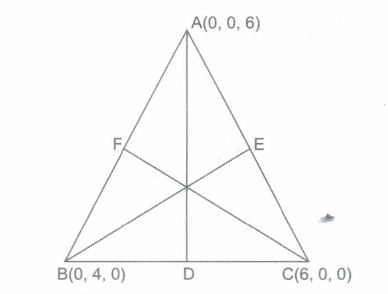
Now D is mid point of BC
\(\therefore \) Coordinates of D is \(\left( \frac { 0+6 }{ 2 } ,\frac { 4+0 }{ 2 } ,\frac { 0+0 }{ 2 } \right) \)= (3,2,0)
\(\therefore \quad AD=\sqrt { (0-3)^{ 2 }+(0-2)^{ 2 }+(6-0)^{ 2 } } \)
=\(\sqrt { 9+4+36 } =\sqrt { 7 } \) units.
Also E is mid point of AC
\(\therefore \) Coordinates of E is \(\left( \frac { 0+6 }{ 2 } ,\frac { 0+0 }{ 2 } ,\frac { 6+0 }{ 2 } \right) \)= (3,0,3)
\(\therefore \quad BE=\sqrt { (0-3)^{ 2 }+(4-0)^{ 2 }+(0-3)^{ 3 } } \)
\(=\sqrt { 9+16+9 } =\sqrt { 34 } \)units.
Also F is mid point of AB
\(\therefore \) Coordiates of F is \(\left( \frac { 0+0 }{ 2 } ,\frac { 0+4 }{ 2 } ,\frac { 6+0 }{ 2 } \right) \)=(0,2,3)
\(\therefore \) CF=\(\sqrt { (6-0)^{ 2 }+(0-2)^{ 2 }+(0-3)^{ 2 } } \)
\(=\sqrt { 36+4+9 } =7\)units.
56.
Let AB be a rod of length 12 cm and P(x, y) be any point on the rod such that PA = 3 cm and PB = 9 cm.
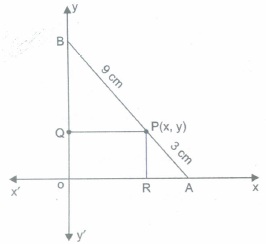
Let AR = a and BQ = b
Then ΔARP ~ ΔPQB
∴ \(\frac { AR }{ PQ } =\frac { AP }{ PB } \)
∴ \(\frac { a }{ x } =\frac { 3 }{ 9 } \) ⇒ 9a=3a ⇒ a=\(\frac { x }{ 3 } \)
and \(\frac { BQ }{ BP } =\frac { PR }{ PA } \)
∴ \(\frac { b }{ 9 } =\frac { y }{ 3 } \) ⇒ 3b=9y ⇒ b=3y
Now OR + AR = x + a = x+\(\frac { x }{ 3 } =\frac { 4x }{ 3 } \)
OB = OQ + BQ = y + b = y + 3y = 4y
In right angled ΔAOB
AB2= OA2+ OB2
∴ (12)2 = \(\left( \frac { 4x }{ 3 } \right) ^{ 2 }\)+(4y)2
⇒ 144=\(\frac { 16{ x }^{ 2 } }{ 9 } \)+16y2
⇒ \(\frac { 16{ x }^{ 2 } }{ 9\times 144 } +\frac { 16{ y }^{ 2 } }{ 144 } \) =1 ⇒ \(\frac { { x }^{ 2 } }{ 81 } +\frac { { y }^{ 2 } }{ 9 } \)=1
which is required locus of point P and which represents an ellipse.
57.
The given lines are x - 3y + 1 = 0 and 2x + 5y - 9 = 0
Equation ofany line that passes through the point ofintersection ofthe given lines is
(x - 3y + 1) + k (2x + 5y - 9) = 0 ...(i)
⇒ (1 + 2k) x + (5k - 3) y + 1 - 9k = 0
Now using the formula to find the perpendicular distance from (x1, y1) to ax + by + C = 0
\(d=\left| ax_1+by_1+c\over \sqrt{a^2+b^2}\right|\)
We get
\(\left| (1+2k)\times0+(5k-3)\times0+(1-k)\over \sqrt{(1+2k)^2+(5k-3)^21}\right|=\sqrt{5}\)
\(⇒{(1-9k)\over\sqrt{(1+2k)^2+(5k-3)^2}}=\sqrt{5}\)
squaring both sides, we get
(1-9k)2 = 5[(1+2k)2 + (5k-3)2]
1+81k2 - 18k = 5[1+4k2+4k+25k2 + 9 - 30k]
⇒ 1+81k2 - 18k = 50 + 145k2 - 130k
⇒ 64k2 - 112k + 49 = 0
⇒ (8k - 7)2 = 0
⇒ \(k={7\over8}\)
Now substituting the value of k in equation (i), we get
(x - 3y + 1) + \(7\over8\)(2x + 5y - 9) = 0
8x - 24y + 8 + 14x + 35y - 63 = 0
⇒ 22x + 11y - 55 = 0
⇒ 2x + y - 5 = 0
58.
\(\therefore \frac { 5! }{ (5-r)! } =\frac { 6! }{ (7-r)! }\)
\( \Rightarrow \frac { 5! }{ (5-r)! } =\frac { 6\times 5! }{ (7-r)(6-r)(5-r)! }\)
\( \Rightarrow 1=\frac { 6 }{ (7-r)(6-r) } \)
\(\Rightarrow { r }^{ 2 }-13r+42=6\)
\(\Rightarrow { r }^{ 2 }-13r+36=0\)
\( \Rightarrow { r }^{ 2 }-{ 9r }-4r+36=0\)
\(\Rightarrow r(r-9)-4(r-9)=0\)
\(\Rightarrow (r-9)(r-4)=0\)
\( \Rightarrow r=9\quad or\quad r=4\)
\(Now\quad r=9\quad is\quad not\quad possible\quad because\quad r>n\)
\(Thus\quad r=4\)
59.
Here \(\frac{1-ix}{1+ix}=a-ib\) By componendo and dividendo,
we have \(\frac{1-ix+1+ix}{1-ix-1-ix}=\frac{a-ib+1}{a-ib-1}\)
\(\Rightarrow \frac{2}{-2ix}=\frac{1+a-ib}{-(1-a+ib)}\)
\(\Rightarrow \frac{1}{ix}=\frac{1+a-ib}{1-a+ib}\)
\(\Rightarrow ix=\frac{1-a+ib}{1+a-ib}\times\frac{1+a+ib}{1+a+ib}\)
\(\Rightarrow ix=\frac{1-a^2-b^2+2ib}{(1+a)^2-i^2b^2}\)
\(\Rightarrow ix=\frac{1-a^2-b^2+2ib}{(1+a)^2+b^2}\)
\(=\frac{1-a^2-b^2}{(1+a)^2+b^2}+\frac{2b}{(1+a)^2+b^2}i\)
If a2 + b2 = 1 then
\(x=\frac{2b}{(1+a)^2+b^2}\) which is real.
60.
| Age | Mid values xi | fi | c.f | |xi-38| | fi|xi-38| |
| 16-20 | 18 | 5 | 5 | 20 | 100 |
| 21-25 | 23 | 6 | 11 | 15 | 90 |
| 26-30 | 28 | 12 | 23 | 10 | 120 |
| 31-35 | 33 | 14 | 37 | 5 | 70 |
| 36-40 | 38 | 26 | 63 | 0 | 0 |
| 41-45 | 43 | 12 | 75 | 5 | 60 |
| 46-50 | 48 | 16 | 91 | 10 | 160 |
| 51-55 | 53 | 9 | 100 | 15 | 135 |
| 100 | 735 |
\(\frac{N}{2}=\frac{100}{2}=50\)
∴ Median class is 35.5-40.5
∴ Median =\(35.5+\frac { 50-37 }{ 26 } \times 5=35.5+2.5=38\)
M.D. about median
\(=\frac { 1 }{ N } \sum _{ i=1 }^{ n }{ { f }_{ i }\left| { x }_{ i }-M \right| } =\frac { 1 }{ 100 } \times 735=7.35\)
61.
Taking A, B, C events from question 6 above we have
\(i)\ A\cap B=\phi \)
Thus A and B are mutually exclusive and exhaustive events.
∴ True.
\( ii)\ A\cap B\ =\phi \ and\ A\cap B=S\)
Thus A and B are mutually exclusive and exhaustive events.
∴ True.
(iii) B′={(2,1),(2,2),(2,3),(2,4),(2,5),(2,6),(4,1),(4,2),(4,3),(4,4),(4,5),(4,6),(6,1),(6,2),(6,3),(6,4),(6,5),(6,6)}=A.
∴ True.
(iv) A∩C = {(2,1)(2,2)(2,3)(4,1)}=ϕ
Thus A and C are not mutually exclusive events.
∴ False
(v) A∩B′ = A ≠ ϕ
Thus A and B are not mutually exclusive events.
(vi) Since A′ = B and B′ = A, A∩B = ϕ
B∩C = {(1,1),(1,2),(1,3),(1,4),(3,1),(3,2)} ≠ ϕ
A∩C = {(2,1)(2,2)(2,3)(4,1)} = ϕ
Thus A′, B′ and C are not mutually exclusive.
∴ False.
62.
The given inequality ix x + y \(\ge\) 4
Draw the gtaph of the line x + y = 4

Total of value satisfying the equation x +y = 4
| x | 3 | 2 |
| y | 1 | 2 |
Putting (0, 0) in the given inequation, we have 0 + 0 \(\ge\) 4 \(\Rightarrow\) 0 \(\ge\) 4 which is false
\(\therefore\) Half plane of x + y \(\ge\) 4 is away from origin
Also the given inequality is 2x - y > o.
Draw the graph of the line 2x - y = o.
Table of values satisfying the equation
2x -y =0
| x | 1 | 2 |
| y | 2 | 4 |
Putting (3, 0) in the given inequation, we have
2 x 3 - 0 > 0 => 6 > 0, which is true.
\(\therefore\) Half plane of 2x - y > 0 containing (3,0)
63.
(-\(\infty\), -2) \(\cup\) (4,\(\infty\))
64.
(c)
3
65.
(b)
cot B
66.
(b)
\(A-\bar B\)
67.
(b)
\(\frac{a}{1-r}\)
68.
(c)
2
69.
(a)
\(g^{ 2 }>c\)
70.
(c)
5
71.
(c)
-2 : 3
72.
(c)
√2
73.
(a)
\(\frac { 1 }{ 132 } \)

11th Standard CBSE Syllabus & Materials
11th Standard CBSE
CBSE 11th Business Studies Forms of Business Organisation Sample Question Papers Study Material - QB365 Set A
NEW11th Standard CBSE
CBSE 11th Business Studies Business, Trade and Commerce Sample Question Papers Study Material - QB365 Set A
NEW11th Standard CBSE
CBSE 11th Physics Waves Sample Question Papers Study Material - QB365 Set A
NEW11th Standard CBSE
CBSE 11th Physics Kinetic Theory Sample Question Papers Study Material - QB365 Set A



CBSE 11th Standard CBSE Subjects
CBSE Standards









