
 100% FREE ACCESS
11th Standard CBSE Syllabus & Materials
11th Standard CBSE
CBSE 11th Economics PART-A - Presentation of Data - New Sample Question Papers Study Material - QB365 Set A
NEW11th Standard CBSE
CBSE 11th Economics PART-A - Organisation of Data - New Sample Question Papers Study Material - QB365 Set A
NEW11th Standard CBSE
CBSE 11th Economics PART-A - Collection of Data - New Sample Question Papers Study Material - QB365 Set A
NEW11th Standard CBSE
CBSE 11th Economics PART-A - Introduction to Economics and Statistics - New Sample Question Papers Study Material - QB365 Set A
NEW11th Standard CBSE
CBSE 11th Business Studies International Trade Sample Question Papers Study Material - QB365 Set A
NEW11th Standard CBSE
CBSE 11th Business Studies Evolution and Fundamentals of Business Sample Question Papers Study Material - QB365 Set A

Published on: 04/03/2020
11th Standard Mathematics Board Exam Sample Question 2020
Download CBSE Class 11th Standard CBSE Mathematics question papers, sample papers, important questions, and previous year solved papers in PDF format. Get free study materials, NCERT solutions, and exam preparation resources for Class 11th Standard CBSE Mathematics
Questions + Answers key
Take MCQ Mathematics Test
1.
Find the value of (1.02)6corrrect to five decimal places using binomial theorem.
2.
Find the sum to infinity of the G.P.\(\frac { -5 }{ 4 } ,\frac { 5 }{ 16 } ,\frac { -5 }{ 64 } \),...
3.
A circular wire of radius 7.5 cm is cut and bent so as to lie along the circumfeence of a hoop whose radius is 120 cm. Find in degrees the angle which is subtended at the centre of the hoop.
4.
Find the general solution for each of the following equations:cosec x = - 2
5.
The analysis of daily wages paid to workers in two firms A and B belonging to the same industry are:
| firm A | Firm B | |
| Number of workers | 812 | 910 |
| Daily wages | 80 | 92 |
| Variance | 16 | 25 |
(i) Which firm A or B pays more in total daily wages?
(ii) Which A or B shows greater variability in wages?
6.
If \(\frac { 1 }{ 6! } +\frac { 1 }{ 7! } =\frac { x }{ 8! } \), find x
7.
If E and F are events such that P(E)=\(\frac { 1 }{ 4 } \) , P(F)=\(\frac { 1 }{ 2 } \) and P(E and F)=\(\frac { 1 }{ 8 } \)find.
i) P(E and F) ii) P(not E and not F)
8.
If A and B are mutually exclusive exhaustive events such that P(B) = 3P(A); Find P(A).
9.
Find the equation of the parabola whose, vertex is at (0, 0) and focus is at (5, 0).
10.
Taking the set of natural numbers as the universal set, write down the complement of the following set: {x : x is a prime number}
11.
Find the distance between the following pairs of points: (5, 6, 7) and (2, 3, 4)
12.
Find the equation of the circle which passes through the point of intersection of the lines 3x - 2y - 1 = 0 and 4x + y - 27 = 0 and whose centre is (2, -3).
13.
If A = {1, 2, 3}, B = {3, 4} and C = {1, 3, 5}, find A x (B \(\cup\) C)
14.
The mean and standard deviation of some data for the time taken to complete a test are calculated with the following results. Number of observation =25, mean=18.2s , standard deviation=3.25 s. Further, another set of 15 observation=3.25 s .Further, another set of 15 Observations,\({ x }_{ 1 },{ x }_{ 2 },.....{ x }_{ 15 }\) also in seconds is now available and we have\(\sum _{ i=1 }^{ 15 }{ { x }_{ i }=279 } \) and \(\sum _{ i=1 }^{ 15 }{ { x }_{ 1 }^{ 2 } } =5524\) Calculate the standard derivation based on all 40 observation
15.
Consider the statement, S : 80 is a multiple of 5 and 4. Check its validity.
16.
Write negation
Mridul is cruel or he is strict.
17.
Evaluate the following limits \(\lim _{x \rightarrow 1} \frac{x-1}{\log _{e} x}\)
18.
Find the derivative of the following functions.
\(\frac { { x }^{ 5 }-cosx }{ sinx } \)
19.
Find the ratio in which the line segment joining the points (4, 8, 10) and (6, 10, -8) is divided by YZ-plane.
20.
Find the distance of the point (2, 3) from the line 2x-3y+9=0 measure along a line x-y+1=0.
21.
the length of the perpendicular from the origin to a line is 7 and the line makes an angle of 120\(^{o}\) with the positive direction of Y - axis. Find the equation of the line.
22.
If a,b and c be positive numbers, then prove that a2 + b2 + c2 is greater than ab + bc + ca.
23.
Prove that there is no term involving y6 in the expansion of \(\left( 2y^{ 2 }-\frac { 3 }{ y } \right) ^{ 11 }\), where \(y\neq 0\).
24.
If 15Cr : 15Cr-1=11:5 Find r
25.
Solve \(|x-2|\ge 6\).
26.
Find the argument of the complex number\(\frac { 1+3i }{ 1-2i } \)
27.
Prove that \(\sum _{ t=1 }^{ n-1 }{ t(t+1) } =\frac { n(n-1)(n+1) }{ 3 } \) , for all natural numbers \(n\ge 2\)
28.
If p(n): "49n +16n +k is divisible by 64 for n\(\epsilon \)N" is true, then find the least negative integral value of K.
29.
Find the domain of \(f\left( x \right) =\frac { 1 }{ \sqrt { x+\left| x \right| } } \)
30.
In a group of 65 people, 40 like nutrition Indian food, 10 like both Indian nutrition food and fast food.How many like only fast food?What is your opinion about this set of people?
31.
One card is drawn from a well-shuffled deck of 52 cards.Calculate the probability that the card will be
not an ace
32.
The frequency distribution
| x | A | 2A | 3A | 4A | 5A | 6A |
| f | 2 | 1 | 1 | 1 | 1 | 1 |
Where, A is a positive integer, has a variance of 160. Determine the value of A.
33.
Evaluate e2x
34.
Three points A(1,2,3), B(0,4,1) and C(-1,-1,-3) are the vertices of \(\Delta ABC\). Find the point in which the bisector of \(\angle BAC\) meets BC.
35.
Find the equation of the hyperbola whose one directrix is x + =9, the corresponding focus is (2,2) and eccentricity is 2.
36.
Show that the points A(7,10),B(-2,5) and C(3,-4) are the vertices of an isosceles right angled triangle.
37.
If in an AP, Sn=qn2 and Sm=qm2, where Sr denotes the sum of r terms of the AP, then find Sq
38.
If there is a term independent of x, in the expansion of\({ \left( { x }^{ 2 }+\frac { 1 }{ x } \right) }^{ n }\), then show that the term is\(\frac { n! }{ \left( \frac { n }{ 3 } \right) !\left( \frac { 2n }{ 3 } \right) ! } \).
39.
The straight lines l1, l2 and l3 are parallel and lie in the same plane. A total numbers of m points are taken on l1 : n points on l2 : k points on l3 . Find the maximum number of triangles formed with vertices at these points.
40.
Solve graphically \(4x+3y\ge 12\quad and\quad 4x-5y\ge -20\)
41.
Solve \(5{ x }^{ 2 }-4ix+9=0\)
42.
Find the value of \(\sqrt { -25 } +3\sqrt { -4 } +2\sqrt { -9 } \)
43.
Prove that \(cos\frac { \pi }{ 7 } cos\frac { 2\pi }{ 7 } cos\frac { 4\pi }{ 7 } =\frac { -1 }{ 8 } \)
44.
Is g = {(2, 3), (4, 5), (6, 7)} a function? If this is described by the formula \(g(x)=\alpha x+2\beta \) then what values would be assigned to a \(\alpha \quad and\quad \beta \) ?
45.
Write the following statement in five different ways, conveying the same meaning.
p :If a triangle is equiangular, then it is an obtuse angled triangle.
46.
Prove that 2n<(n+2)! for all natural numbers n.
47.
Prove by the principle of mathematical induction that for all n∊N \(\frac { 1 }{ 1.2 } +\frac { 1 }{ 2.3 } +\frac { 1 }{ 3.4 } +...+\frac { 1 }{ n(n+1) } =\frac { n }{ (n+1) } \)
48.
Give three examples of sentences which are not statements. Give reasons for the answers.
49.
Evaluate: \(\overset{Lt}{x\rightarrow 0} [tan(\frac{\pi}{4}+x)]^{\frac{1}{cotx}}\)
50.
Find the middle terms in the expansions of \(\left( 3-\frac { { x }^{ 3 } }{ 6 } \right) ^{ 7 }\)
51.
Find the equation of the circle with radius 5 whose centre lies on x-axis and passes through the point (2,3).
52.
Find the general solutions of the following equations:
sec x-1 = (\(\sqrt{2}\) - 1) tan x where x ± (2n + 1)\(\pi\over2\), n \(\in\) Z.
53.
Find a point in XY plane which is equidistant from three points (2, 0, 3), (0, 3, 2) and (0, 0, 1).
54.
Find the number of 4-digit numbers that can be formed using the digits 1, 2, 3, 4, 5 if no digit is repeated. How many of these will be even?
55.
Convert the following in the polar form \(\frac { 1+3i }{ 1-2i } \)
56.
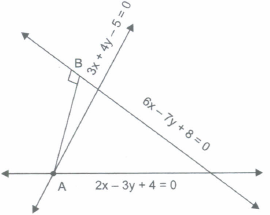
A person standing at the junction (crossing) of two straight paths represented by the equations 2x – 3y + 4 = 0 and 3x + 4y – 5 = 0 wants to reach the path whose equation is 6x – 7y + 8 = 0 in the least time. Find equation of the path that he should follow.
57.
Find the sum of integers from 1 to 100 that are divisible by 2 or 5.
58.
Find the C.V of the following data:
| Size (in m) | 10-15 | 15-20 | 20-25 | 25-30 | 30-35 | 35-40 |
| No.of items | 2 | 8 | 20 | 35 | 20 | 15 |
59.
A die is thrown, find the probability of following events:
(i) A prime number will appear.
(ii) A number greater than or equal to 3 will appear.
(iii) A number less than or equal to one will appear.
(iv) A number more than 6 will appear.
(v) A number less than 6 will appear.
60.
Show that the following four conditions are equivalent:
(i) A ⊂ B
(ii) A - B = ф
(iii) A \(\cup\) B =B
(iv) A \(\cap\) B =A
61.
Solve the inequalities graphically x +y \(\le\) 6, x + y \(\ge\) 4
62.
Find the domain and range of the following real functions
(i) \(f(x)=-|x|\)
(ii) \(f(x)=\sqrt{9-x^2}\)
63.
If R is a relation from a finite set A having m elements to a finite set B having n elemen.ts, then the number of relations from A to B is ______.
2mn
2mn-1
2mn
mn
64.
If sin \(\theta\) + sin \(\phi\)= \(\alpha\) and cos\(\theta\) - cos\(\phi\)= b then tan\({\theta -\phi\over 2}\) is equal to ______.
\(\sqrt{a^2+b^2}\)
\(-{a\over b}\)
\(-{b\over a}\)
\(1\over \sqrt{a^2-b^2}\)
65.
For any two sets A and B, (A - B) \(\cup\) (B - A)=_____.
(A - B) \(\cup\) A
(B - A) \(\cup\) B
(A \(\cup\) B) - (A \(\cap\) B)
(A \(\cup\) B) \(\cap\) (A \(\cap\) B)
66.
\(\overset{lim}{x\rightarrow \frac{\pi}{2}} \) (sec x-tan x) is equal to ______.
0
1
2
3
67.
The four distinct points (0,0), (2,0), (0,−2) and (k,−2) are concyclic if k is equal to ______.
-1
-2
2
0
68.
The coefficient of x5y8 in the expansion of (x + y)13 is _____.
13C5
13C8
8C5
None of the these
69.
In the three dimensional space the equation x2 - 7x + 12 = 0 represents ______.
pair of straight lines
curves
planes
none of these
70.
If p be the length of the perpendicular from the origin to the line \({x\over a}+{y\over b}=1\) then ______.
\({1\over p^2}=a^2 + b^2\)
\({1\over p^2}={1\over a^2} +{1\over b^2}\)
p2 = a2 + b2
none of these
71.
If first and last terms ofanAP. are 3 and 18 and the sum of its terms is 84, then number of terms will be ______.
5
6
7
8
72.
Standard deviation of a data is given by ______.
\(σ=\sqrt{{1\over N}\sum fd^2-\left({1\over N}\sum fd\right)^2}\)
\(σ=\sqrt{\left({1\over N}\sum fd\right)^2-{1\over N}\sum fd^2}\)
\(σ=\sqrt{{1\over N}\sum fd^2-{1\over N}\sum fd^2}\)
None of these
73.
Two die are thrown simulatneously. The probability of getting a total of 5 is _______.
\(\frac { 1 }{ 16 } \)
\(\frac { 1 }{ 10 } \)
\(\frac { 1 }{ 9 } \)
\(\frac { 1 }{ 6 } \)
1.
1.12616
2.
a = \(\frac { -5 }{ 4 } \) and r = \(\frac { -1 }{ 4 } \)
S\(\infty\) = \(\frac { a }{ 1-r } =\frac { \frac { -5 }{ 4 } }{ 1-\left( \frac { -1 }{ 4 } \right) } =-1\)
3.
22° 30'
4.
Here cosec x = - 2 \(\Rightarrow\)sin x =-\(1\over2\),
which is negative, so x lies in third or fourth quadrant.
\(\therefore\) sin x =\(-{1\over2}=-sin 30^o\)
= sin (180° + 30°) or sin (360° - 30°)
= sin 210° or sin 330°
= \(sin {7x\over 6}or sin {11\pi\over 6}\)
Hence the principal solutions are \({7\pi\over 6},{11\pi\over 6}\)
Now sin x=-sin\({\pi\over 6}\)
\(\Rightarrow \) x= n\(\pi\)+(-1)n\(({7\pi\over6})\) where n\(\in\)Z.
5.
(i) Firm B
(ii) Firm B.
6.
\(\frac { 1 }{ 6! } +\frac { 1 }{ 7! } =\frac { x }{ 8! } \)
\(\Rightarrow \ \frac { 1 }{ 6! } +\frac { 1 }{ 7\times 6! } =\frac { x }{ 8\times 7\times 6! } \)
\(\Rightarrow \ \frac { 1 }{ 6! } [1+\frac { 1 }{ 7 } ] \ =\frac { 1 }{ 6! } [\frac { x }{ 8\times 7 } ]\)
\(\Rightarrow \ \frac { 8 }{ 7 } =\frac { x }{ 8\times 7 } \ \Rightarrow \ x=64\)
7.
\(\text{Here} P(E)=\frac { 1 }{ 4 } ,P(F)=\frac { 1 }{ 2 } \)
\(\text{and } P(E\cap F)=\frac { 1 }{ 8 } \)
(i) we know that
\(P(E\cup F)=P(E)+P(F)-P(E\cap F)=\frac { 1 }{ 4 } +\frac { 1 }{ 2 } -\frac { 1 }{ 8 } =\frac { 2+4-1 }{ 8 } =\frac { 5 }{ 8 }\)
\(\text{P(not E and not F)}=P(\overline { E } \cap \overline { F } )\)
\(=P(\overline { E\cup F) } =1-P(E\cup F)\)
\(=1-\frac { 5 }{ 8 } =\frac { 8-5 }{ 8 } =\frac { 3 }{ 8 } \)
8.
Let P(A) = x then P(B) = 3x
A and B are mutually exclusive exhaustive events
\(\therefore \ P(A\cup B)=P(A)+(B)=1\)
\(\therefore \ x+3x=1\Rightarrow 4x=1\Rightarrow x=\frac { 1 }{ 4 } \)
\(Thus\ P(A)=\frac { 1 }{ 4 } \)
9.
y2=20x
10.
Let A = {x : x is a prime number}
A' = U - A
= {x: x ∈ N} - {x: xis a prime number}
= {x : x ∈ N, x is not a prime number}
or {x : x is positive composite number and x = 1}
11.
3\(\sqrt { 3 } \) units
12.
The equation of the circle is
(x - h)2 + (y - k)2=r2
(x - 2)2 + (y + 3)2 = r2.....(i)
The given lines are 3x - 2y -1=0 ....(ii)
4x + y - 27=0 ...(iii)
Solving (ii) and (iii) we have
\(\frac { x }{ 54+1 } =\frac { y }{ -4+81 } =\frac { 1 }{ 3+8 } \Rightarrow \frac { x }{ 55 } =\frac { y }{ 77 } =\frac { 1 }{ 11 } \)
∴ x=\(\frac { 1 }{ 11 } \) x 55=5 and y=\(\frac { 1 }{ 11 } \) x 77=7
Putting these values of x andy in (i)
(5 - 2)2 + (7 + 3)2 =r2 ⇒ r2 = 9 + 100 ⇒\(\sqrt { 109 } \)
Putting value of r in
(x - 2)2 + (y + 3)2 = (\(\sqrt { 109 } \))2
⇒ x2 + 4 - 4x + y2 + 9 + 6y=109 ⇒ X2 + y2 - 4x + 6y - 96 =0
Thus required equation of circle is
x2 + y2 - 4x + 6y - 96 =0.
13.
{(1, 1), (1, 3), (1, 4), (1, 5), (2, 1), (2, 3) (2, 4), (2, 5), (3, 1), (3, 3,) (3, 4), (3, 5)}
14.
\({ n }_{ 1 }=25,\bar { { x }_{ 1 } } =18.2.{ \sigma }_{ 1 }=3.25\)
\({ n }_{ 2 }=15\sum _{ i=1 }^{ 15 }{ { x }_{ 1 } } =279\)
\(and\ \sum _{ i=1 }^{ 15 }{ { x }_{ 1 }^{ 2 } } =5524\)
\(for\ first\ set,\sum { { x }_{ 1 } } =25\times 18.2=455\)
\({ \sigma }_{ 1 }^{ 2 }=\cfrac { \sum { { x }_{ 1 }^{ 2 } } }{ 25 } -(18.2{ ) }^{ 2 }\)
\(\Rightarrow (3.25{ ) }^{ 2 }=\cfrac { \sum { { x }_{ 1 }^{ 2 } } }{ 25 } -331.24\)
\(\Rightarrow \sum { { { x }_{ 1 }^{ 2 }=25\times (10.5625+331.24) } }\)
\(=25\times 341.8025=8545.0625\)
\(For\quad combained\quad SD\quad of\quad the\quad 40\quad observations,N=40\)
\(Now,\sum { { x }_{ 1 }^{ 2 } } =5524+8545.0625=14069.0625\)
\(and\sum { { x }_{ 1 }=445+279=734 } \)
\(SD=\sqrt { \frac { 14069.0625 }{ 40 } -\left( \frac { 734 }{ 40 } \right) }\)
\(=\sqrt { 351.726-(18.35{ ) }^{ 2 } }\)
\(=\sqrt { 351.726-336.7225 } \)
\(=\sqrt { 15.0035 } =3.87\)
15.
The given compound statement is S : 80 is a multiple of 5 and 4.
The component statements of the given compound statement are
p : 80 is a multiple of 5.
and q : 80 is a multiple of 4.
Then, \(S\equiv p\wedge q\)
We know that, 80 is mutiple of 5 as well as 4.
Therefore, the statements p and q are true.
Hence, the compound statement \(S\equiv p\wedge q\) is also true
i.e. \(S\equiv p\wedge q\) is a valid statement.
16.
Mridul is neither cruel nor strict.
17.
\(\lim _{h \rightarrow 0} \frac{1+h-1}{\log _{e}(1+h)}=\frac{1}{\lim _{h \rightarrow 0} \frac{\ln (1+h)}{k}} A n s .1\)
18.
\(\frac { d }{ dx } (\frac { { x }^{ 5 }-cosx }{ sinx } )\)
\(=\frac { sinx\frac { d }{ dx } ({ x }^{ 5 }-cosx)-({ x }^{ 5 }-cosx)\frac { d }{ dx } sinx }{ \left( sinx \right) ^{ 2 } } \)
\(=\frac { sinx({ 5x }^{ 4 }+sinx)-({ x }^{ 5 }-cosx)cosx }{ { sin }^{ 2 }x } \)
\(=\frac { { 5x }^{ 4 }sinx-{ x }^{ 5 }cosx+1 }{ { sin }^{ 2 }x } \)
19.
Let YZ-plane divides the line segment joining the points A (4, 8, 10) and B (6, 10, -8) at P (x, y, z) in the ratio k : 1.
Then, coordinates of P = \(\left( \frac { 4+6k }{ k+1 } ,\frac { 8+10k }{ k+1 } ,\frac { 10-8k }{ k+1 } \right) \)
\(\left[ \therefore coordinates\quad of\quad internal\quad ration,\quad \left( \frac { { m }_{ 2 }{ x }_{ 1 }+{ m }_{ 1 }{ x }_{ 2 } }{ { m }_{ 1 }+{ m }_{ 2 } } ,\frac { { m }_{ 2 }{ y }_{ 1 }+{ m }_{ 1 }{ y }_{ 2 } }{ { m }_{ 1 }+{ m }_{ 2 } } ,\frac { { m }_{ 2 }z_{ 1 }+{ m }_{ 1 }{ z }_{ 2 } }{ { m }_{ 1 }+{ m }_{ 2 } } \right) \right] \)
Since, P lies on the YZ-plane, so its x-coordinate is zero,
\(\therefore \) \(\frac { 4+6k }{ k+1 } =0\Rightarrow k=-\frac { 2 }{ 3 } \)
Therefore, YZ-plane divides AB externally in the ratio 2 : 3
Note: If k is negative, then given points are divided externally in the ratio k : 1.
20.
Let the given point be A(2, 3), with lie on the line x-y+1=0
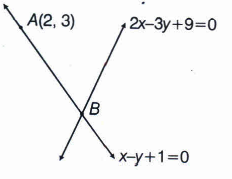
Let x - y + 1 = 0 intersect 2x - 3y + 9 = 0 at point B.
Then, required distance = length of AB = \(4\sqrt { 3 } units\)
21.
x + \(\sqrt { 3 } \)y = 14
22.
We know that, AM > GM
\(\therefore \frac { { a }^{ 2 }+{ b }^{ 2 } }{ 2 } >\sqrt { { a }^{ 2 }{ b }^{ 2 } } \Rightarrow \frac { { a }^{ 2 }+{ b }^{ 2 } }{ 2 } >ab\) ...(i)
\(similarly, \frac { { b }^{ 2 }+{ c }^{ 2 } }{ 2 } >\sqrt { { b }^{ 2 }{ c }^{ 2 } } \Rightarrow \frac { { b }^{ 2 }+{ c }^{ 2 } }{ 2 } >bc\) ...(ii)
\(and \ \frac { { c }^{ 2 }+{ a }^{ 2 } }{ 2 } >\sqrt { c^{ 2 }{ a }^{ 2 } } \Rightarrow \frac { { c }^{ 2 }+{ a }^{ 2 } }{ 2 } >ca\) ...(iii)
On adding Eqs. (i) and (iii), we get
\(\frac { { a }^{ 2 }+{ b }^{ 2 } }{ 2 } +\frac { { b }^{ 2 }+{ c }^{ 2 } }{ 2 } +\frac { { c }^{ 2 }+{ a }^{ 2 } }{ 2 } >ab+bc+ca\)
\(\Rightarrow \) a2 + b2 + c2 > ab + bc + ca
Hence proved
23.
Let (r+1)th term involve y6.
Then,
\(T_{ r+1 }=(-1)^{ r }\quad ^{ 11 }C_{ r }\quad ({ 2y }^{ 2 })^{ 11-r }\quad \left( \frac { 3 }{ y } \right) ^{ r }\)
\(=(-1)^{ r }\quad ^{ 11 }C_{ r }\quad 2^{ 11-r }\quad (y^{ 2 })^{ 11-r }.\quad 3^{ r }.y^{ -6 }\)
\(=(-1)^{ r }\quad ^{ 11 }C_{ r }\quad 2^{ 11-r }\quad (3)^{ r }\times y^{ 22-3r }\)
Since, Tr+1 involve y6 , therefore 22-3r = 6
\(\Rightarrow 3r=16\Rightarrow r=\frac { 16 }{ 3 } ,\) which is not an integer.
Hence, there is no term containing y6.
Hence proved.
24.
\(= { \frac { ^{ 15 }C_{ r } }{ ^{ 15 }C_{ r-1 } } }=\frac { 11 }{ 5 } \Rightarrow \frac { 15! }{ (15-r)!r! } \times \frac { (15-r+1)!\times (r-1)! }{ 15! } =\frac { 11 }{ 5 } \)
\(\Rightarrow \frac { (16-r) }{ r } =\frac { 11 }{ 5 } \Rightarrow 80-5r = 11r\)
16r = 80 ⇒ r = 5
25.
We have, \(|x-2|\ge 6\)
\(\Longrightarrow \)\(x-2\ge 6\) or \(x-2\le -6\) \(\left[ \because |x|\ge a\Longrightarrow x\ge a\quad or\quad x\le -a \right] \)
\(\Longrightarrow \) \(x\ge 8\quad or\quad x\le -4\)
\(\Longrightarrow \) \(x\) \(\in \) [8, \(\infty \)) or \(x\)\(\in \) (-\(\infty \), 4]
\(\Longrightarrow \) \(x\) \(\in \) [8, \(\infty \)) \(\cup \) (-\(\infty \), 4]
Hence, the required solution set is (-\(\infty \), 4] \(\cup \) [8, \(\infty \)).
26.
\(\frac { 3\pi }{ 4 } \)
27.
Consider :\(P(k) : \sum _{ t=1 }^{ k-1 }{ t(t+1) } =\frac { k(k-1)(k+1) }{ 3 } k\ge 2\)
P(k):1.2+2.3+3.4+....+(k-1)k \(=\frac { k(k-1)(k+1) }{ 3 } \)
Now P(k+1):1.2+2.3+3.4+...+(k1)k+k(k+1)
\(=\frac { k(k-1)(k+1) }{ 3 } +k(k+1)\)
\(=\frac { k(k+1)(k+2) }{ 3 } k\ge 2\)
28.
Here, the given statement is true for all n \(\in\) N, therefore it is true for n=1 also
So, we have P(1) : 49+1++K is divisible by 64,
i.e. 65+k is divisible be 64
Clearly, k should be -1 [\(\therefore \)65-1=64 is divisible by 64]
29.
We have \(f\left( x \right) =\frac { 1 }{ \sqrt { x+\left| x \right| } } \)
We know that, \(\left| x \right| =\begin{cases} x,\quad ifx\ge 0 \\ -x,ifx<0\quad \end{cases}\)
\(\therefore \quad x+\left| x \right| =\begin{cases} x+x,\quad ifx\ge 0 \\ x-x,ifx<0\quad \end{cases}\)
\( \Rightarrow x+\left| x \right| =\begin{cases} 2x,\quad ifx\ge 0 \\ 0,ifx<0\quad \end{cases}\)
Here, the function \(f\left( x \right) =\frac { 1 }{ \sqrt { x+\left| x \right| } } \) assumes real values, if \(x+\left| x \right| >0\)
\(\Rightarrow 2x>0\ \Rightarrow x>0\quad [using\quad Eq.(i)]\)
\(x\in \left( 0,\infty \right) \)
Hence, domain of \(f=\left( 0,\infty \right) \)
Note:The domain of modulus function is always R i.e.\(\left( -\infty,\infty \right) \).
30.
Let E and F denote the Indian nutrition food and fast food
Then, \(n(E\cup F)=65,n(E)=40\quad and\quad n(E\cap F)\quad =10\)
\(\because \) \(n(E\cup F)=n(E)+n(F)-n(E\cap F)\)
\(\therefore \) 65 = 40 + n(F)-10 \(\Rightarrow \) n(F)=35
\(\therefore \) Only like fast food = \(n(E)-n(E\cap F)\)= 35 10 = 25
They must balance the diet.
31.
\(\frac { 12 }{ 13 } \)
32.
Let us make the following table from the given data.
| xi | fi | fixi | \(\left( { x }_{ i }-\bar { x } \right) ^{ 2 }=\left( { x }_{ i }-\frac { 22 }{ 7 } A \right) ^{ 2 }\) | \(\left( { x }_{ i }-\bar { x } \right) ^{ 2 }{ f }_{ i }\) |
| A 2A 3A 4A 5A 6A |
2 1 1 1 1 1 |
2A 2A 3A 4A 5A 6A |
(225/49)A2 (64/49)A2 (1/49)A2 (36/49)A2 (169/49)A2 (400/49)A2 |
(450/49)A2 (64/49)A2 (1/49)A2 (36/49)A2 (169/49)A2 (400/49)A2 |
| \(N=\Sigma { f }_{ i }=7\) | \(\Sigma { f }_{ i }{ x }_{ i }=22A\) | \(\Sigma { f }_{ i }({ x }_{ i }-\bar { x } )^{ 2 }=\frac { 1190 }{ 49 } { A }^{ 2 }\) |
Hence, \(N=\Sigma { f }_{ i }=7\) and \(\Sigma { f }_{ i }{ x }_{ i }=22A\)
\(\therefore \bar { x } =\frac { \sum _{ i=1 }^{ 6 }{ { f }_{ i }{ x }_{ i } } }{ N } =\frac { 22A }{ 7 } \)
Now, variance \(=\frac { 1 }{ N } \sum _{ i=1 }^{ 6 }{ { f }_{ i }({ x }_{ 1 }-\bar { x } )^{ 2 } } \)
\(\Rightarrow \ 160=\frac { 1 }{ 7 } \left( \frac { 1120 }{ 49 } \right) { A }^{ 2 }\)
[ \(\because \) variance = 60, given]
Ans. A=7
33.
\(f\prime (x)=\lim_ { h\rightarrow 0 }{ lim } \frac { { e }^{ 2x+2h }-{ e }^{ 2x } }{ h } =\lim_ { h\rightarrow 0 }{ lim } \frac { { e }^{ 2x }({ e }^{ 2h }-1) }{ 2h } x2\)
\(=2e^{ 2x }\)
34.
\(\left( \frac { -3 }{ 10 } ,\frac { 5 }{ 2 } ,\frac { -1 }{ 5 } \right) \)
35.
\({ (x-2) }^{ 2 }+{ (y-2) }^{ 2 }=\frac { { 2 }^{ 2 }{ (x+y-9) }^{ 2 } }{ { 1 }^{ 2 }{ +1 }^{ 2 } } \)
\(\Rightarrow \) x2 + y2 - 4x - 4y + 8 = 2(x2 + y2 + 81 + 2xy -18x)
x2 + 4xy + y2 - 32x - 32y + 154 = 0
36.
First, find out the values of AB,BC,CA by distance formula and prove that \(\triangle ABC\) is an isosceles triangle, then prove that this triangle is also right-angled triangle by Converse of Pythagoras theorem.
37.
Sq=q3
38.
General term in \({ \left( { x }^{ 2 }+\frac { 1 }{ x } \right) }^{ n }\)= nCr (x2)n-r \({ \left( \frac { 1 }{ x } \right) }^{ r }\)
for term independent of x, x2n-2r-r = x0 \(\Rightarrow \) r = \(\frac { 2 }{ 3 } n\)
Required term = nCr = \(\frac { n! }{ r!\left( n-r \right) ! } \)= \(\frac { n! }{ \left( \frac { n }{ 3 } \right) !\left( \frac { 2n }{ 3 } \right) ! } \)
39.
Total number of points = m+n+k
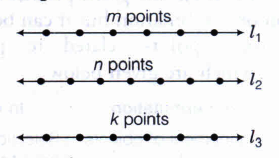
This can give m+n+kC3 number of triangles. But m points on l1, taking 3 at a time, gives mC3 combinations which produce no triangle.
Similarly, nC3 and kC3 number of triangle cannot formed.
\(\therefore \) Required number of triangles
= m+n+kC3 - mC3 - nC3 - kC3
40.
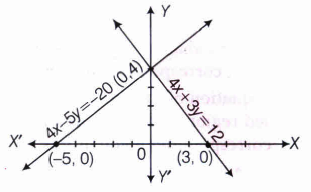
41.
\(We\ have,\ 5{ x }^{ 2 }-4ix+9=0\)
\(a=5,\quad b=-4i\quad and\quad c=9\)
\(\therefore \ x=\frac { -(-4i)\pm \sqrt { { (-4i) }^{ 2 }-4\times 5\times 9 } }{ 2\times 5 } \)
\(=\frac { -4i\pm \sqrt { { (-4i) }^{ 2 }-4\times 5\times 9 } }{ 2\times 5 }\)
\(=\frac { 4i\pm \sqrt { -16-180 } }{ 10 } \quad [\because { i }^{ 2 }=-1]\)
\(=\frac { 4i\pm \sqrt { -196 } }{ 10 } ,\quad x=\frac { 4i\pm 14i }{ 10 } \)
42.
We have, \(\sqrt { -25 } +3\sqrt { -4 } +2\sqrt { -9 } \)
\(=\sqrt { 25 } \sqrt { -1 } +3\sqrt { 4 } \sqrt { -1 } +2\sqrt { 9 } \sqrt { -1 }\)
= 5 x i + 3 x 2 x i + 2 x 3 i
= 5i + 6i + 6i
= 17i
43.
\(Let\quad A=\frac { \pi }{ 7 } ,then\)
\(LHS=cos\frac { \pi }{ 7 } cos\frac { 2\pi }{ 7 } cos\frac { { 2 }^{ 2 }\pi }{ 7 } \frac { sin{ 2 }^{ 3 }A }{ { 2 }^{ 3 }sinA }\)
\(=\frac { sin8A }{ 8sinA } =\frac { sin(7A+A) }{ 8sinA } \)
\(=\frac { sin(\pi +A) }{ 8sinA } =\frac { -sinA }{ 8sinA } \quad [\because A=\frac { \pi }{ 7 } ]\)
44.
g is a function; \(\alpha =2,\quad \beta =-1\)
45.
(i) A triangle is equiangular implies that it is an obtuse angled triangle.
(ii) A triangle is equiangular only, if it is an obtuse angled triangle.
(iii) For a triangle to be equiangular, it is necessary that it is an obtuse angled triangle.
(iv) For a triangle to be obtuse angled triangle, it is sufficient that it is equiangular.
(v) If a triangle is not obtuse angled triangle, then it is not an equiangular triangle.
46.
2k<(k+2)!\(\Rightarrow \)2k+2(k+2)!+2]
\(\Rightarrow \) (k+1)2 < 2k + 2k [(2k+1)<2k for k\(\le \)3]
\(\Rightarrow \) (k+1)2 < 2k+1
47.
Let \(\frac { 1 }{ 1.2 } +\frac { 1 }{ 2.3 } +\frac { 1 }{ 3.4 } +...+\frac { 1 }{ n(n+1) } =\frac { n }{ (n+1) } \)
For n =1
P(1) = \(\frac { 1 }{ 1(1+1) } =\frac { 1 }{ 1+1 } \Rightarrow \frac { 1 }{ 2 } =\frac { 1 }{ 2 } \)
∴ P(1) is true
Let P(n) be true for n = k
∴ P(k) = \(\frac { 1 }{ 1.2 } +\frac { 1 }{ 2.3 } +\frac { 1 }{ 3.4 } +...+\frac { 1 }{ k(k+1) } =\frac { k }{ (k+1) } \) ...(i)
For n = k+1
∴ P(k+1)= \(\frac { 1 }{ 1.2 } +\frac { 1 }{ 2.3 } +\frac { 1 }{ 3.4 } +...+\frac { 1 }{ k(k+1) } +\frac { 1 }{ (k+1)(k+2) } =\frac { k+1 }{ k+2 } \)
= \(\frac { k }{ k+1 } +\frac { 1 }{ (k+1)(k+2) } =\frac { k(k+2)+1 }{ (k+1)(k+2) } =\frac { { k }^{ 2 }+2k+1 }{ (k+1)(k+2) } \) [Using (i)]
= \(\frac { (k+1)^{ 2 } }{ (k+1)(k+2) } =\frac { k+1 }{ k+2 } \)= P(k+1) is true
Thus P(k) is true ⇒ P(k + 1) is true
Hence by principle of mathematical induction, P(n) is true for all n∊N.
48.
The three examples of sentences, which are not statements, are as follows.
(i) He is a doctor.
It is not evident from the sentence as to whom ‘he’ is referred to. Therefore, it is not a statement.
(ii) Geometry is difficult.
This is not a statement because for some people, geometry can be easy and for some others, it can be difficult.
(iii) Where is she going?
This is a question, which also contains ‘she’, and it is not evident as to who ‘she’ is. Hence, it is not a statement.
49.
\(\overset{Lt}{x\rightarrow 0} [tan(\frac{\pi}{4}+x)]^{\frac{1}{cotx}}\)=\(\overset{Lt}{x\rightarrow 0} [\frac{tan\frac{\pi}{4}+tanx}{1-tan\frac{\pi}{4}.tanx}]^{cotx}\)
=\(\overset{Lt}{x\rightarrow 0}[\frac{1+tanx}{1-tanx}]^{\frac{1}{tanx}}\) ⇒ \(\frac { \underset { \underset { tanx\rightarrow 0 }{ x\rightarrow 0 } }{ Lt } { \left[ [1+tanx \right] }^{ \frac { 1 }{ tanx } } }{ \underset { \underset { -tanx\rightarrow 0 }{ x\rightarrow 0 } }{ Lt } { \left[ { \left( 1-tanx \right) }^{ -\frac { 1 }{ taanx } } \right] }^{ -1 } } =\frac { e }{ { e }^{ -1 } } ={ e }^{ 2 }\)
Hence \(\overset{Lt}{x\rightarrow 0} [tan(\frac{\pi}{4}+x)]^{cotx}=e^{2}.\)
50.
Here n = 7, which is odd.
So the middle terms are \(\left( \frac { 7+1 }{ 2 } \right) th,\left( \frac { 7+1 }{ 2 } +1 \right) th\) are 4th and 5th terms.
The general term in the expansion of\(\left( 3-\frac { { x }^{ 3 } }{ 6 } \right) ^{ 7 }\) is
\({ T }_{ r+1 }=^{ 7 }{ C }_{ r }{ (3) }^{ 7-r }{ \left( \frac { { -x }^{ 3 } }{ 6 } \right) }^{ r }....(i)\)
Putting r = 3 and 4 in (i)
\(\therefore \quad { T }_{ 4 }=^{ 7 }C_{ 3 }{ (3) }^{ 7-3 }{ \left( \frac { { -x }^{ 3 } }{ 6 } \right) }^{ 3 }\)
\(=^{ 7 }C_{ 3 }{ (3) }^{ 4 }.{ (-1) }^{ 3 }.\frac { { x }^{ 9 } }{ { (6) }^{ 3 } } \)
\(=35\times 81\times -\frac { { x }^{ 9 } }{ 216 } =-\frac { 105 }{ 8 } { x }^{ 9 }\)
Now \({ T }_{ 5 }=^{ 7 }C_{ 4 }{ (3) }^{ 7-4 }{ \left( \frac { { -x }^{ 3 } }{ 6 } \right) }^{ 3 }\)
\(=^{ 7 }C_{ 4 }{ (3) }^{ 3 }.(-1)^{ 4 }\frac { { x }^{ 12 } }{ { (6) }^{ 4 } } \)
\(=35\times 27\times \frac { { x }^{ 12 } }{ 1296 } =\frac { 35 }{ 48 } { x }^{ 12 }\)
51.
Let the equation of the required circle be (x – h)2 + (y – k)2 = r2.
Since the radius of the circle is 5 and its centre lies on the x-axis, k = 0 and r = 5.
Now, the equation of the circle becomes (x – h)2 + y2 = 25.
It is given that the circle passes through point (2, 3).
\(\therefore(2-h)^{2}+3^{2}=25 \)
\(\Rightarrow(2-h)^{2}=25-9 \)
\(\Rightarrow(2-h)^{2}=16 \)
\(\Rightarrow 2-h=\pm \sqrt{16}=\pm 4 \)
\(\text { If } 2-h=4, \text { then } h=-2 . \)
\(\text { If } 2-h=-4, \text { then } h=6 .\)
Equation of required circle is
(x - 6)2 + (y - 0)2 = (5)2
⇒ x2 + 36 - 12x + y2 = 25
⇒ x2 + y2 - 12x + 11 = 0
When h=-2
Equation of required circle is
(x + 2)2 + (y - 0)2 = (5)2
⇒ x2 + 4 + 4x + y2 = 25
⇒ x2 + y2 + 4x - 21 = 0
52.
x=2n\(\pi +{\pi\over 4} \ or \ x=2n \pi,n \in z\)
53.
Let A(2, 0, 3), B(O, 3, 2) and C(O, 0,1) be given points.
Let P(x, y, 0) be any point in XY plane such that PA = PB = PC.
Now PA = PB => PA2 = PB2
\(\therefore \) (x - 2)2 + (y - 0)2 + (- 3)2
= (x - 0)2 + (y - 3)2 + (- 2)2
=> x2+4-4x+y2+9
=x2+y2+9-6y+4
=> 4x - 6y = 0 => 2x - 3y = 0 ....(i)
Also PB = PC => PB2 = PC2
(x - 0)2 + (y - 3)2 + (0 - 2)2 = (x - 0)2 + (y - 3)2 + (0 - 2)2
\(\therefore \)(x - 0)2 + (y - 3)2 + (0 - 2)2 = (x - 0)2 + (y - 3)2 + (0 - 1)2
=> x2+ y2 + 9 - 6y + 4
=x2+y2+1
=> 6y = 12 => y = 2
Putting value of y in (i), we have
2x-3x2=0 => x=3
Thus co-ordinates ofrequired point are (3, 2, 0).
54.
From a committee of 8 persons, a chairman and a vice chairman are to be chosen in such a way that one person cannot hold more than one position.
Here, the number of ways of choosing a chairman and a vice chairman is the permutation of 8 different objects taken 2 at a time.
Thus, required number of ways =
\({ }^{5} \mathrm{P}_{4}=\frac{5 !}{(5-4) !}=\frac{5 !}{1 !}\)
= 1x 2 x 3 x 4 x 5 = 120
Among the 4-digit numbers formed by using the digits, 1, 2, 3, 4, 5, even numbers end with either 2 or 4.
The number of ways in which units place is filled with digits is 2.
Since the digits are not repeated and the units place is already occupied with a digit (which is even), the remaining places are to be filled by the remaining 4 digits.
Therefore, the number of ways in which the remaining places can be filled is the permutation of 4 different digits taken 3 at a time.
Number of ways of filling the remaining places \(={ }^{4} \mathrm{P}_{3}=\frac{4 !}{(4-3) !}=\frac{4 !}{1 !}\)
= 4 × 3 × 2 × 1 = 24
Thus, by multiplication principle, the required number of even numbers is = 24 × 2 = 48
55.
\(\frac { 1+3i }{ 1-2i } \times \frac { 1+2i }{ 1+2i } =\frac { 1+2i+3i+6{ i }^{ 2 } }{ 1-4{ i }^{ 2 } } \)
=\(\frac { -5+5i }{ 5 } \)=-1+i
Let z = -1+i=r(cos\(\theta \)+i sin\(\theta \))
⇒ r cos\(\theta \)=-1 and r sin\(\theta \) =1 ...(i)
Squaring both sides of (i) and adding
r2(cos2\(\theta \)+sin2\(\theta \))=1+1
⇒ r2=2 ⇒ r= \(\sqrt { 2 } \)
∴ \(\sqrt { 2 } \)cos\(\theta \)=-1 and \(\sqrt { 2 } \)sin\(\theta \)=1
⇒ cos\(\theta \) =\(\frac { -1 }{ \sqrt { 2 } } \) and sin \(\theta \)=\(\frac { -1 }{ \sqrt { 2 } } \)
Since sin\(\theta \) is positive and cos\(\theta \) is negative
∴ \(\theta \) lies in second quadrant
∴ \(\theta \)=\(\pi -\frac { \pi }{ 4 } =\frac { 3\pi }{ 4 } \)
Hence polar form of z is \(\sqrt { 2 } \left( cos\frac { 3\pi }{ 4 } +isin\frac { 3\pi }{ 4 } \right) \)
56.
\(\text { The equations of the given lines are }\)
\(2 x-3 y+4=0 \ldots(1) \)
\(3 x+4 y-5=0 \ldots(2) \)
\(6 x-7 y+8=0 \ldots \text { (3) }\)
\(\text { The person is standing at the junction of the paths represented by lines (1) and } (2)\)
\(\text { On solving equations }(1) \text { and }(2), \text { we obtain } x=-\frac{1}{17} \text { and } y=\frac{22}{17} \text { . }\)
\(\text { Thus, the person is standing at point }\left(-\frac{1}{17}, \frac{22}{17}\right) \text { . }\)
\(\text { The person can reach path (3) in the least time if he walks along the }\)
\(\text { perpendicular line to (3) from point }\left(-\frac{1}{17}, \frac{22}{17}\right) \text { . }\)
\(\text { Slope of the line }(3)=\frac{6}{7}\)
\(\text { Slope of the line perpendicular to line }(3)=-\frac{1}{\left(\frac{6}{7}\right)}=-\frac{7}{6}\)
\(\text { The equation of the line passing through and having a slope of }-\frac{1}{6} \text { is given } by\)
\(\left(y-\frac{22}{17}\right)=-\frac{7}{6}\left(x+\frac{1}{17}\right) \)
\(6(17 y-22)=-7(17 x+1) \)
\(102 y-132=-119 x-7 \)
\(119 x+102 y=125\)
\(\text { Hence, the path that the person should follow is } 119 x+102 y=125\)
57.
The integers from 1 to 100 which are divisible by 2 are:
2, 4, 6, ..., 100
Here a = 2, d = 4 - 2 = 2 and an = 100
\( \because\) an = a + (n - l)d
\(\therefore\) 100 = 2 + (n - 1)2
\(\Rightarrow\) 100 - 2 = (n - 1)2
\(\Rightarrow\) (n-1) = \(\frac { 98 }{ 2 } =49\)
n = 49 + 1 = 50
Now S1 = \(\frac { 50 }{ 2 } =[2+100]\)
= 25 x 102 = 2550
Now, the integers from 1 to 100 which are divisible by 5 are 5, 10, 15, ..., 100.
Here, a = 5, d = 10 - 5 = 5 and an = 100
\(\because \) an = a + (n - l)d
\(\therefore\) 100 = 5 + (n - 1) x 5
\(\Rightarrow\) 100 - 5 = (n - 1) x 5
\(\Rightarrow\) 95 = (n - 1) x 5
\(\Rightarrow\) (n-1) = \(\frac { 95 }{ 5 } =19\) \(\Rightarrow\) n = 20
\(\therefore\) S2 = \(\frac { 20 }{ 2 } =[5+100]\)
= 10 x 105 = 1050
Also, the integers from 1 to 100 which are divisible by both 2 and 5 are:
10, 20, 30, ..., 100
Here, a = 10, d = 20 - 10 = 10 and an = 100
8ince, an = a + (n - l)d
\(\therefore\) 100 = 10 + (n - 1)10
\(\Rightarrow\) (n-1) =\(\frac { 100-10 }{ 10 } =9\)
\(\Rightarrow\) n =9 + 1 = 10
Now, S10 = \(\frac { 10 }{ 2 } \left[ 10+100 \right] \)
= 5x 100 = 550
Thus, the sum of the required integers from
58.
| Size | Mid Value xi | fi | \(u=\frac { x-27.5 }{ 5 } \) | fu | fu2 |
| 10-15 | 12.5 | 2 | -3 | -6 | 18 |
| 15-20 | 17.5 | 8 | -2 | -16 | 32 |
| 20-25 | 22.520 | -1 | -20 | 20 | 25-30 |
| 25-30 | 27.5 | 35 | 0 | 0 | 0 |
| 30-35 | 32.5 | 20 | 1 | 20 | 20 |
| 35-40 | 37.5 | 15 | 2 | 30 | 60 |
| 100 | 8 | 150 |
Mean \(\left( \bar { x } \right) =A+\frac { \sum { fu } }{ N } \times h=27.5+\frac { 8 }{ 100 } \times 5=27.5+0.4=27.9\)
Standard deviation \(\left( \sigma \right) \) \(=\frac { h }{ N } \sqrt { N\sum { { fu }^{ 2 }-{ (\sum { fu) } }^{ 2 } } } \)
\(\sigma =\frac { 5 }{ 100 } \sqrt { 100\times 150-{ (8) }^{ 2 } } =\frac { 1 }{ 20 } \sqrt { 15000-64 } =\frac { 1 }{ 24 } \times 122.21=6.11\)
\(\therefore \ C.V.=\frac { \sigma }{ x } \times 100=\frac { 6.11 }{ 27.9 } \times 100=21.89\)
59.
Here the sample space S = {I, 2, 3,4,5,6}
\(\therefore \) n(S) = 6
(i) Let A be the event of getting a prime number
A = {2, 3, 5} \(\Rightarrow \) n(A) = 3
\(Thus\ P(A)=\frac { n(A) }{ n(S) } =\frac { 3 }{ 6 } =\frac { 1 }{ 2 } \)
(ii) Let B be the event of getting a number greater than or equal to 3
B = {3, 4, 5, 6} \(\Rightarrow \) n(B) = 4
\(Thus\ P(B)=\frac { n(B) }{ n(S) } =\frac { 4 }{ 6 } =\frac { 2 }{ 3 } \)
Let C be the event of getting a number less than or equal to 1
C = {I} \(\Rightarrow \) n(C) = 1
\(Thus\ P(C)=\frac { n(C) }{ n(S) } =\frac { 1 }{ 6 } \)
(iv) Let D be the event of getting a number more than 6
\(D=\phi \Rightarrow n(D)=0\)
\(Thus\ P(D)=\frac { n(D) }{ n(S) } \frac { 0 }{ 6 } =0\)
Let E be the event of getting a number less than 6
E = {I, 2, 3, 4, 5} \(\Rightarrow \) n(E) = 5
\(Thus\ P(E)=\frac { n(E) }{ n(S) } \frac { 5 }{ 6 } \)
60.
(i) \(\Rightarrow\) (ii)
A - B = {x : x ∊ A and x ∉ B}
Since A ⊂ B
\(\therefore\) A-B= ф
(ii) \(\Rightarrow\) (iii)
A-B= ф \(\Rightarrow\) A⊂B \(\Rightarrow\) A\(\cup\)B=B
(iii) \(\Rightarrow\) (iv)
A\(\cup\)B=B \(\Rightarrow\) A⊂B \(\Rightarrow\) A\(\cap\)B=A
(iv) \(\Rightarrow\) (i)
A\(\cap\)B=A\(\Rightarrow\) A⊂B
Thus (i) \(\Leftrightarrow\) (ii) \(\Leftrightarrow\) (iii) \(\Leftrightarrow\) (iv)
61.
The given inequality is x + y \(\le\) 6
Draw the graph of the line x + y = 6.
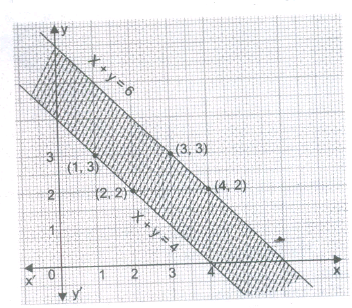
Table of value satisfying the equation x + y = 6
| x | 3 | 4 |
| y | 3 | 2 |
Putting (0, 0) in the given inequation, we have
0 + 0 \(\le\) 6 \(\Rightarrow\) 0 \(\le\) 6, which is true
Half plane of x +y \(\le\) 6 is towards origin
Also the given unequality is x +y \(\ge\)4
Draw the graph of the line x + y = 4
Table of values satisfying the equation x + y = 4
| x | 2 | 1 |
| y | 2 | 3 |
Putting (0, 0) in the given inequation, we have 0 + 0 \(\ge\) 4 \(\Rightarrow\) 0 \(\ge\) 4, which is false
Hald plane of x +y \(\ge\) 4 is awy from origin
62.
(i) Here f(x) = - IxI
The function is defined for all real values of x.
\(\therefore\) Domain of function = R
Now when x < 0, Ix I = - x
\(\therefore\) f(x) = - (- x) = x < 0
When x = 0, IxI = 0
\(\therefore\) f(x) = - I0I = 0
When x> 0, IxI = x
\(\therefore\) f(x) = - x < 0
So f(x) \(\le\)0 for all real values of x.
\(\therefore\) Range of function = (-\(\infty\), 0).
(ii) f(x) = \(\sqrt{9-x^{2}}\)
Since \(\sqrt{9-x^{2}}\) is defined for all real numbers that are greater than or equal to –3 and less than or equal to 3, the domain of f(x) is {x : –3 ≤ x ≤ 3} or [–3, 3].
For any value of x such that –3 ≤ x ≤ 3, the value of f(x) will lie between 0 and 3.
∴ The range of f(x) is {x: 0 ≤ x ≤ 3} or [0, 3].
63.
(a)
2mn
64.
(c)
\(-{b\over a}\)
65.
(c)
(A \(\cup\) B) - (A \(\cap\) B)
66.
(a)
0
67.
(c)
2
68.
(a)
13C5
69.
(c)
planes
70.
(b)
\({1\over p^2}={1\over a^2} +{1\over b^2}\)
71.
(d)
8
72.
73.
(c)
\(\frac { 1 }{ 9 } \)

11th Standard CBSE Syllabus & Materials
11th Standard CBSE
CBSE 11th Business Studies Forms of Business Organisation Sample Question Papers Study Material - QB365 Set A
NEW11th Standard CBSE
CBSE 11th Business Studies Business, Trade and Commerce Sample Question Papers Study Material - QB365 Set A
NEW11th Standard CBSE
CBSE 11th Physics Waves Sample Question Papers Study Material - QB365 Set A
NEW11th Standard CBSE
CBSE 11th Physics Kinetic Theory Sample Question Papers Study Material - QB365 Set A



CBSE 11th Standard CBSE Subjects
CBSE Standards









