
 100% FREE ACCESS
11th Standard Syllabus & Materials
11th Standard
TN 11th Tamil இயற்கை வேளாண்மை,சுற்றுச்சூழல் -செய்யுள் - மனோன்மணீயம் Important Questions And Answers Study Material - QB365 Set A
NEW11th Standard
TN 11th Tamil என்னுயிர் என்பேன் -துணைப்பாடம் - இசைத்தமிழர் இருவர் Important Questions And Answers Study Material - QB365 Set A
NEW11th Standard
TN 11th Tamil மொழி கலை -செய்யுள் - ஒவ்வொரு புல்லையும் Important Questions And Answers Study Material - QB365 Set A
NEW11th Standard
TN 11th Tamil பீடு பெற நில் - இலக்கணம் - பகுபத உறுப்புகள் Important Questions And Answers Study Material - QB365 Set A
NEW11th Standard
TN 11th Tamil பீடு பெற நில் - துணைப்பாடம் - வாடிவாசல் Important Questions And Answers Study Material - QB365 Set A
NEW11th Standard
TN 11th Tamil பீடு பெற நில் - செய்யுள் - குறுந்தொகை Important Questions And Answers Study Material - QB365 Set A

Published on: 01/10/2019
Differential Calculus - Limits and Continuity
Download Tamil Nadu 11th Standard Maths question papers, model tests, one-mark questions, important questions, and public exam papers in PDF format. Free study materials and answer keys for TN State Board students.
Questions + Answers key
Take MCQ Maths Test1.
Examine the continuity of the following:cot x + tan x
2.
Examine the continuity of the following: x + sin x
3.
Evaluate the following limits :\(lim_{x\rightarrow \infty}(1+{k\over x})^{m\over x} \)
4.
\(f(x)=tan \ x \ at \ x={\pi\over 2}.\)
5.
Evaluate the following limits :
\(lim_{x\rightarrow5}{\sqrt{x-1}-2\over x-5}\)
6.
Compute \(lim_{x\rightarrow1}{x^3-1\over x-1}\)
7.
Write a brief description of the meaning of the notation \(lim_{x\rightarrow8}f(x)=25.\)
8.
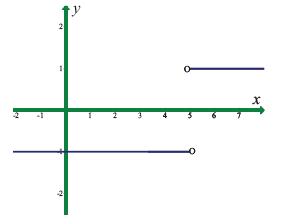
Use the graph to find the limits (if it exists). If the limit does not exist, explain why?
\(lim_{x\rightarrow5}{|x-5|\over x-5}\)
9.
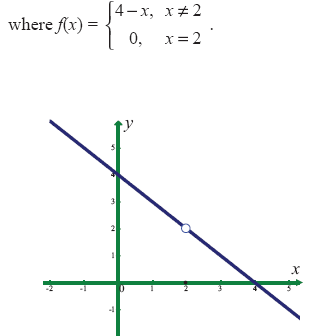
Use the graph to find the limits (if it exists). If the limit does not exist, explain why?
\(lim_{x\rightarrow2}f(x)\)
10.
In problem, using the table estimate the value of the limit
\(lim_{x\rightarrow{-3}}{\sqrt{1-x}-2\over x+3}\)
| x | -3.1 | -3.01 | -3.00 | -2.999 | -2.99 | -2.9 |
| f(x) | – 0.24845 | – 0.24984 | – 0.24998 | – 0.25001 | – 0.25015 | – 0.25158 |
11.
In problems 1-6, using the table estimate the value of the limit.
\(lim_{x\rightarrow 2}{x-2\over x^2-x-2}\)
| x | 1.9 | 1.99 | 1.999 | 2.001 | 2.01 | 2.1 |
| f(x) | 0.344820 | 0.33444 | 0.33344 | 0.333222 | 0.33222 | 0.332258 |
12.
Consider the function f(x) = \(\sqrt{x},x\ge0.\) Does\(lim_{x\rightarrow0}f(x)\) exist?
13.
Calculate \(\lim _{ x\rightarrow0}{|x| } \).
14.
A tomato wholesaler finds that the price of a newly harvested tomatoes is Rs. 0.16 per kg if he purchases fewer than 100 kgs each day. However, if he purchases at least 100 kgs daily, the price drops to Rs. 0.14 per kg. Find the total cost function and discuss the cost when the purchase is 100 kgs.
15.
Check if \(lim_{x\rightarrow-58}f(x)\)exists or not, where \(f(x)=\left\{\begin{array}{cc} \frac{|x+5|}{x+5} & , \text { for } x \neq-5 \\ 0, & \text { for } x=-5 \end{array}\right.\)
16.
The function \(f(x)= \begin{cases}\frac{x^{2}-1}{x^{3}+1} & x \neq-1 \\ P & x=-1\end{cases}\)is not defined for x = −1. The value of f(−1) so that the function extended by this value is continuous is
\({2\over3}\)
-\({2\over3}\)
1
0
17.
\(lim_{x \rightarrow 0}{e^{tan \ x}-e^x\over tan x-x}=\)
1
e
\({1\over2}\)
0
18.
If \(lim_{x \rightarrow 0}{sin \ px\over tan \ 3x}=4\) , then the value of p is
6
9
12
4
19.
If f(x) = x(-1)\(\left\lfloor 1\over x \right\rfloor \), \(x\le0\), then the value of \(lim_{x\rightarrow 0}f(x)\) is equal to
-1
0
2
4
20.
\(lim_{x\rightarrow\infty}{sin \ x \over x} \)
1
0
\(\infty\)
-\(\infty\)
1.
Let f(x) = cot x + tan x
cot x is not continuous in multiples of \(\pi\) and tan x is not continuous in (2n+1)\({\pi\over 2}\).
\(\therefore \) f(x) = cot x + tan x is not continuous in (2n+1)\({\pi\over 2}\)+\({\pi\over 2}\),
\(\Rightarrow\) f(x) is continuous in R \(-{n\pi \over2}, n \in Z.\)
2.
Let f(x)=x + sin x
Since the algebraic function x is continuous for all \(x \in R\) and the circular function sin x is continuous for all \(x \in R\).
f(x)=x + sin x is continuous for all \(x \in R\).
3.
\(lim_{x\rightarrow \infty}(1+{k\over x})^{m\over x} \)
put \({1\over x}=t\)
\(\therefore lim_{x\rightarrow \infty}(1+{k\over x})^{m\over x} =lim_{{1\over x}\rightarrow\infty}(1+kt)^{mt}\)\(=lim_{t\rightarrow 0}(1+0)^{m(0)}=lim_{t\rightarrow 0}(1)^{0}=1\)
4.
Given \(f(x)=tan \ x \ at \ x={\pi\over 2}.\)
lim f(x) = lim tan x = \(\infty\)
\( x\rightarrow{\pi^-\over 2}\) \( x\rightarrow{\pi^-\over 2}\)
\(\therefore lim_{ x\rightarrow{\pi^-\over 2}} f(x)\rightarrow \infty \ as \ x\rightarrow{\pi^-\over 2}\)
lim f(x) = lim tan x
\( x\rightarrow{\pi^+\over 2}\) \( x\rightarrow{\pi^+\over 2}\)
= \(-\infty\) [\(\because \ tan \pi =tan (90+90)=-cot 90=-\infty\)]
\(\therefore lim_{x\rightarrow{\pi^+\over 2}} f(x)\rightarrow -\infty \ as \ x\rightarrow{\pi^+\over 2}\)
5.
\(lim_{x\rightarrow5}{\sqrt{x-1}-2\over x-5}\)
Multiplying and dividing by\((\sqrt{x-1}+2)\) we get,
\(lim_{x\rightarrow5}{\sqrt{x-1}-2\over x-5}\times {\sqrt{x-1}+2\over \sqrt{x-1}+2}\)\(=lim_{x\rightarrow5}{(x-1)-4\over x-5[\sqrt{x-1}+2]}\)
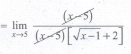
\(=lim_{x\rightarrow5}{1\over\sqrt{x-1}+2}={1\over\sqrt{5-1}+2}\)
\({1\over \sqrt{4}+2}={1\over2+2}={1\over 4}\)
\(lim_{x\rightarrow5}{\sqrt{x-1}-2\over x-5}={1\over4}\)
6.
\(lim_{x\rightarrow1}{x^3-1\over x-1}=lim_{x\rightarrow1}{x^3-1\over x-1}=3(1)^{3-1}=3.\)
7.
f(x) can be made arbitrarily close to 25 by choosing x sufficiently close to 8
but not equal to 8
Left limit of f(x) = Right limit of f(x) when x \(\rightarrow\) 8
\(lim_{x\rightarrow8^-}f(x)=lim_{x\rightarrow8^+}f(x)=25.\)
\(\therefore f(8^-)=f(8^+)=25\)
8.
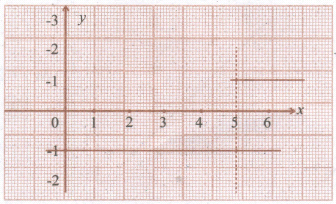
\(\frac{|x-5|}{x-5}\) approaches 1 on the right side of 5 and -1 on the left side of 5.
Hence, the limit does not exist.
9.
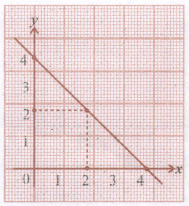
At x = 2, the value of the curve on y-axis is 2.
\(\therefore lim_{x\rightarrow2}f(x)=2\)
10.
Let \( f(x)=\frac{\sqrt{1-x}-2}{x+3}
\)
\(\therefore \lim _{x \rightarrow-3} \frac{\sqrt{1-x}-2}{x+3}=-0.250
\)
11.
Let \(
f(x)=\frac{x-2}{x^2-x-2}=\frac{x-2}{(x-2)(x+1)}=\frac{1}{x+1}
\)
\( \therefore \lim _{x \rightarrow 2} \frac{x-2}{\dot{x}^2-x-2}=\lim _{x \rightarrow 2} \frac{1}{x+1}=\frac{1}{3}=0 . \overline{3}
\)
12.
No. f(x) = \(\sqrt{x}\) is not even defined for x < 0.
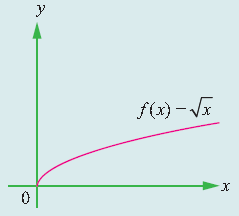
Therefore as x \(\rightarrow 0^-,lim_{x\rightarrow0^-}\sqrt{x}\) does not exist.
However, \(lim_{x\rightarrow0^+}\sqrt{x}=0.\) Therefore \(lim_{x\rightarrow0}\sqrt{x}\) does not exist.
13.
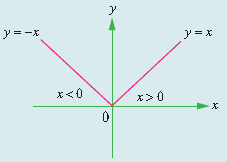
\(|x|= \begin{cases}-x & \text { if } x<0 \\ 0 & \text { if } x=0 \\ x & \text { if } x>0\end{cases}\)
If x > 0,then |x| = x, which tends to 0 as
\(x \rightarrow 0\) from the right of 0. That is, \(\lim _{ x\rightarrow0^+}{|x| } =0\)
If x < 0, then |x| = - x which again tends to 0 as x\(\rightarrow\)0. from the left of 0. That is, \(\lim _{ x\rightarrow0^-}{|x| } =0\).
Thus, \(\lim _{ x\rightarrow0^-}{|x| } =0=\lim _{ x\rightarrow0^+}{|x| }.\)
Hence \(\lim _{ x\rightarrow0}{|x| } =0\).
14.
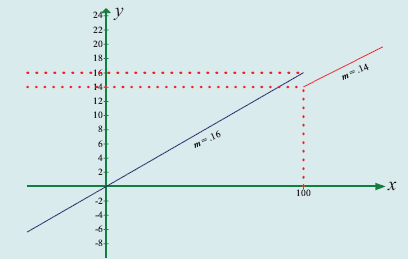
Let x denote the number of kilograms bought per day and C denote the cost. Then,
\(C(x)= \begin{cases}0.16 x, & \text { if } 0 \leq x<100 \\ 0.14 x, & \text { if } x \geq 100\end{cases}\)
The sketch of this function
It is discontinuous at x = 100 since \(lim_{x\rightarrow100^-}c(x)=16\) and \(lim_{x\rightarrow100^+}c(x)=14\)
Note that C(100) = 14. Thus,\(lim_{x\rightarrow100^-}c(x)=16\neq 14=lim_{x\rightarrow100^+}C(x)=C(100).\)
Note also that the function jumps from one finite value 14 to another finite value 16.
15.
(i) f(-5-)
For x < - 5, |x + 5| = - (x + 5)
Thus f(-5-) = \(lim_{x\rightarrow-5^- {-(x+5)\over (x+5)}}=-1\)
(ii) f(-5+)
For x > - 5, |x + 5| = (x + 5)
Thus f(-5+) = \(lim_{x\rightarrow-5^+{(x+5)\over (x+5)}}=1\)
Note that f( -5-) ≠ f( -5+). Hence the limit does not exist.
16.
\(f(-1) =\lim _{x \rightarrow-1} f(x) \)
\(=\lim _{x \rightarrow-1} \frac{x^{2}-1}{x^{3}+1} \)
\(=\lim _{x \rightarrow-1} \frac{x^{2}-(-1)^{2}}{x^{3}-(-1)^{3}}=\frac{2(-1)^{2-1}}{3(-1)^{3-1}}=\frac{-2}{3}
\)
17.
\(\lim _{x \rightarrow 0} \frac{e^{\tan x}-e^{x}}{\tan x-x}=\lim _{x \rightarrow 0} e^{x}\left(\frac{e^{\tan x-x}-1}{\tan x-x}\right)\)
\(=e^{0}(1) \quad(\because \tan x-x \rightarrow 0)\)
=1
18.
\(\lim _{x \rightarrow 0} \frac{\sin p x}{\tan 3 x}=4 \Rightarrow \frac{p}{3}=4 \Rightarrow p=12\)
19.
\(f(x)=x(-1)^{\left\lfloor\frac{1}{x}\right\rfloor}\)
\(=x(\pm 1) \left(\because\left[\frac{1}{x}\right\rfloor \text { is an integer }\right) \)
\(=\pm x \)
\(\therefore \lim _{x \rightarrow 0} f(x)=\lim _{x \rightarrow 0}(\pm x)=0\)
20.
(b)
0

11th Standard Syllabus & Materials
11th Standard
TN 11th Tamil பீடு பெற நில் - செய்யுள் - காவடிச்சிந்து Important Questions And Answers Study Material - QB365 Set A
NEW11th Standard
TN 11th Tamil பீடு பெற நில் - உரைநடை - மலை இடப்பெயர்கள் : ஓர் ஆய்வு Important Questions And Answers Study Material - QB365 Set A
NEW11th Standard
TN 11th Tamil மாமழை போற்றுதும் - துணைப்பாடம் - யானை டாக்டர் Important Questions And Answers Study Material - QB365 Set A
NEW11th Standard
TN 11th Tamil மாமழை போற்றுதும் - செய்யுள் - ஐங்குறுநூறு Important Questions And Answers Study Material - QB365 Set A



Tamilnadu Stateboard 11th Standard Subjects
Maths

Commerce

Economics

Biology

Business Maths and Statistics

Accountancy

Computer Science

Physics

Chemistry
Maths
Biology
Economics
Physics
Chemistry

History
Business Maths and Statistics

Computer Science
Accountancy

Computer Applications
History
Computer Technology
Commerce
Computer Applications
Computer Technology

Tamil

English

French
Tamilnadu Stateboard Standards

