
 100% FREE ACCESS
11th Standard CBSE Syllabus & Materials
11th Standard CBSE
CBSE 11th Economics PART-A - Presentation of Data - New Sample Question Papers Study Material - QB365 Set A
NEW11th Standard CBSE
CBSE 11th Economics PART-A - Organisation of Data - New Sample Question Papers Study Material - QB365 Set A
NEW11th Standard CBSE
CBSE 11th Economics PART-A - Collection of Data - New Sample Question Papers Study Material - QB365 Set A
NEW11th Standard CBSE
CBSE 11th Economics PART-A - Introduction to Economics and Statistics - New Sample Question Papers Study Material - QB365 Set A
NEW11th Standard CBSE
CBSE 11th Business Studies International Trade Sample Question Papers Study Material - QB365 Set A
NEW11th Standard CBSE
CBSE 11th Business Studies Evolution and Fundamentals of Business Sample Question Papers Study Material - QB365 Set A

Published on: 05/03/2020
11th Standard Physics Board Exam Model Question 2019-2020
Download CBSE Class 11th Standard CBSE Physics question papers, sample papers, important questions, and previous year solved papers in PDF format. Get free study materials, NCERT solutions, and exam preparation resources for Class 11th Standard CBSE Physics
Questions + Answers key
Take MCQ Physics Test
1.
Can a vector be zero if one of its components is non-zero?
2.
Is radius of gyration of a body a constant quantity?
3.
What is the effect on the acceleration of a particle if the net force on the particle is doubled?
4.
Two medium particles are separated by a distance \(\frac{\lambda}{2}\). What is the relationship between phase of these particles at any instant?
5.
A satellite is orbiting around the Earth with a speed v. To make the satellite escape, what is the minimum percentage increase in its speed?
6.
Which scientist received Nobel prize for his work on Molecular spectra?
7.
We have 0.5 g of hydrogen gas in a cubic chamber of size 3 cm kept at NTP. The gas in the chamber is compressed keeping the temperature constant till a final pressure of 100 atm. Is one justified in assuming the ideal gas law, in the final state? (Hydrogen molecules can be consider as spheres of radius 1 \(\overset { o }{ A }\)).
8.
When gas in a cylinder is compressed by pushing in a piston, its temperature rises. Guess at an explanation of this in terms of kinetic theory
9.
To what depth must a rubber ball be taken in deep sea so that its volume is decreased by 0.1%? (The Bulk modulus of rubber is 9.8 x 10⁸ N/m2; and the density of seawater is 103 kg/m 3 .)
10.
A spring balance reads forces in Newtons. The scale is 20 cm long and read from 0 to 60 N. Find potential energy of spring when the scale reads 20 N.
11.
The data regarding the motion of two different objects P and Q are given in the following table.Examine them carefully ad state whether the motion of the objects is unifrom or non-unifrom.
| Time | Distance travelled by object P (in m) |
Distance travelled by object E (in m) |
| 9:30 am | 10 | 12 |
| 9:45 am | 20 | 19 |
| 10:00 am | 30 | 23 |
| 10:15 am | 40 | 35 |
| 10:30 am | 50 | 37 |
| 10:45 am | 60 | 41 |
| 11:00 am | 70 | 44 |
12.
All quantities in mechanics in mechanics are represented in terms of base unit of length, mass and time. Additional base unit of temperature (Kelvin) is used in heat and thermodynamics. An magnetism and electricity, the additional base unit of electric current (ampere) is used.
Name any two physical quantities which are dimensionless.
13.
Explain this common observation clearly : If you look out of the window of a fast moving train, the nearby trees, houses etc. seem to move rapidly in a direction opposite to the train’s motion, but the distant objects (hill tops, the Moon, the stars etc.) seem to be stationary. (In fact, since you are aware that you are moving, these distant objects seem to move with you).
14.
A body is projected with some initial velocity making an angle\(\theta\) with the horizontal. Show that its path is a parabola. Find the maximum height attained, time for maximum height, horizontal range, maximum horizontal range and the time of flight.
15.
A perfectly elastic rubber ball is dropped from the top of a building. A man standing in front of a window 2 m high notes that the ball takes a time ofO.2s in crossing the window. The ball strikes the ground suffering a perfectly elastic collision and reappears at the bottom of the window during its upward journey again after 2 seconds. What is (1) the height of the building and (2) the height of the bottom of the window above the ground? Take g = 10 ms-2.
16.
What do you mean by the term "equilibrium"? What are equilibrium of rest and equilibrium of motion? State the conditions for complete equilibrium of a body
17.
A steam engine intakes steam at 200°C and after doing work exhausts it directly in air at 100°C. Calculate the percentage of heat used for doing work. Assume the engine to be an ideal engine.
18.
Explain why
(a) The angle of contact of mercury with glass is obtuse, while that of water with glass is acute.
(b) Water on a clean glass surface tends to spread out while mercury on the same surface tends to form drops. (Put differently, water wets glass while mercury does not.)
(c) Surface tension of a liquid is independent of the area of the surface.
(d) Water with detergent dissolved in it should have small angles of contact.
(e) A drop of liquid under no external forces is always spherical in shape.
19.
Identical Piano Strings
Consider the two identical piano strings, each tuned exactly to the 420 Hz. The tension in any one of the strings is increased by 2.0%. If they are now struck, what is the beat frequency between the fundamentals of the two strings? Take length of the strings = 65 cm.
20.
Two tuning forks A and B give 5 beats. A resounds with a closed column of air 15 cm long and B with an open column of ar 30.5 cm long. Caluculate their frequencies. Negelct and correction.
21.
Which of the following functions of time represent (a) periodic and (b) non-periodic motion? Give the period for each case of periodic motion [ω is any positive constant].
(i) \(\sin { \omega t+\cos { \omega t } } \)
(ii) \(\sin { \omega t+\cos { 2\omega t } } +\sin { 4\omega t } \)
(iii) \({ e }^{ -\omega t }\)
(iv) \(\log { \left( \omega t \right) } \)
22.
An electric bulb of volume 250 cm3 was sealed off during manufacture at a pressure of 10-3 mm of mercury at 270C. Compute the number of air molecule contained in the bulb.Given that, molecules contained in the bulb. Given that, R = 8.31 J/mol/K NA= \(6.02\times { 10 }^{ 23 }{ mol }^{ -1 }\).
23.
A specific book describes a new temperature scale called Z, in which boiling and freezing points of water are referred as 65oZ and -15oZ , respectively.
(i) To what temperature on Fahrenheit scale would a temperature -95o Z correspond?
(ii) What temperature change on the Z scale would correspond to change of 40o on Celsius scale?
24.
The two thigh bones (femurs), each of cross-sectional area10 cm2 support the upper part of a human body of mass 40 kg. Estimate the average pressure sustained by the femurs.
25.
A 14.5 kg mass, fastened to the end of a steel wire of unstretched length 1.0 m, is whirled in a vertical circle with an angular velocity of 2 rev/s at the bottom of the circle. The cross-sectional area of the wire is 0.065 cm2 . Calculate the elongation of the wire when the mass is at the lowest point of its path.
26.
The Young's modulus for stell is much more than that for rubber. For the same longitudinal strain, which one will have greater tensile stress?
27.
The planet Neptune travels around the sun with a period of 165 yr. Show that the radius of its orbit is approximately thirty times that of the earth's orbit, both being considered as circular.
28.
At a point above the surface of the earth, the gravitational potential is \(-5.12\times { 10 }^{ 7 }\ J/kg\) and the acceleration due to gravituy is 0.4 m/s2 .Assuming the mean radius of the earth to be 6400 km, calculate the height of the point above the earth's surface. calculate the height of the point above the earth's surface.
29.
The nucleus Fe27 emits a \(\gamma \)-ray of energy 14.4 keV. If the mass of the nucleus is 56.935 amu, calculate the recoil energy of the nucleus.
30.
Give the magnitude and direction of the net force acting on a car moving with a constant velocity of 30 km / h on a rough road.
31.
An insect trapped in a circular groove of radius 12 cm moves along the groove steadily and completes 7 revolutions in 100 s.
(a) What is the angular speed, and the linear speed of the motion?
(b) Is the acceleration vector a constant vector ? What is its magnitude ?
32.
A motor car starts from rest and accelerates uniformly for 10s to a velocity of 20m/s.After that car runs at a constant speed and is finally brought to rest in 40m with a constant acceleration.Total distance covered is 640m.Find the value of acceleration, retardation and total time taken.
33.
The diameter of a wire as measured by a screw gauge was found to be 1.328, 1.330, 1.325, 1.334 and 1.336 cm. Calculate fractional error.
34.
A particle executes S.H.M of time period 10 s. The displacement at any instant is given by the relation x = 10 sin rot. Find
(i) velocity of the body 2s after it passes through the mean position and
(ii) the acceleration 2s after it passes the mean position (Amplitude is given in cm).
35.
A steel wire is suspended vertically from a rigid support. When loaded with weight in air, it extends by x1. When the weight is completely inside the water, the extension becomes x2. Find the relative density of the material of the weight.
36.
When 0.2 kg of a body at 100°C is dropped into 0..5 kg of water at 10°C, the resulting temperature is 16°C. Find the specific heat of the body. Specific heat of water is 4.2 x 10³ J/kg/0c.
37.
The position-time-graph in figure depicts the x journey of three bodies A, Band C.
(a) At Is, which has the greatest velocity?
(b) At 2s, which has travelled the farthest?
(c) When A meets C, is B moving faster or slower than A?
(d) Is there any time at which the velocity of A is equal to that of B?
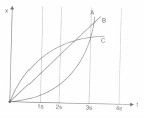
38.
Why do different planets have different escape velocities?
39.
Name four fundamental forces in nature.
40.
A tunning fork of frequency 200 Hz is in resonance with a sonometer wire. How many beats will be heard if tension in the wire is increased by 2%?
41.
Estimate the average thermal energy of a helium atom at (i) room temperature (27 °C), (ii) the temperature on the surface of the Sun (6000 K), (iii) the temperature of 10 million kelvin (the typical core temperature in the case of a star).
42.
In changing the state of a gas adiabatically from an equilibrium state A to another equilibrium state B, an amount of work equal to 22.3 J is done on the system. If the gas is taken from state A to B via a process in which the net heat absorbed by the system is 9.35 cal, how much is the net work done by the system in the latter case ? (Take 1 cal = 4.19 J)
43.
Explain why
(a) The blood pressure in humans is greater at the feet than at the brain
(b) Atmospheric pressure at a height of about 6 km decreases to nearly half of its value at the sea level, though the height of the atmosphere is more than 100 km
(c) Hydrostatic pressure is a scalar quantity even though pressure is force divided by area.
44.
It was summer season and Ishant was sleeping at top of roof when heard some noise at downstairs when he looked down, he saw that two robbers were holding his brother at gun point, suddenly he saw a big drum near to him and he rolled the drum from the stairs which hit one of the robber who was holding gun and robber fell down. In mean time other one run away and the family caught that robber and handed him over to the police.
What kind of motion is described by the drum?
45.
A man of mass 70 kg stands on a weighing scale in a lift which is moving .What would be the reading if the lift mechanism failed and it hurtled down freely under gravity ?
46.
A block of mass 2 kg is placed on the floor. The coefficient of limiting friction is 0.4 . If a force of 3.6 N is applied on the block parallel to the floor. Find the acceleration of the block. What is the force of friction between the block and floor ?
47.
If the resultant of three forces \(\overrightarrow { F } _{ 1 }=p\hat { i } +3\hat { j } -\hat { k } ,\overrightarrow { F } _{ 2 }\)and \(\overrightarrow { F } _{ 3 }=6\hat { i } -\hat { k } \) acting on a particle has a magnitude equal to 5 units, then the value of p is
-6
-4
3
4
48.
Two vessels having equal volume contain molecular hydrogen at one atmosphere and helium at two atmosphere pressure respectively.If both samples are at the same temperature the mean velocity of hydrogen molecule is
equal to that of helium
twice that of helium
half that of helium
\(\sqrt { 2 } \) times that of helium
49.
A cylindrical solid of mass M has raidus R and length L. Its moment of inertia about a generator is:
\(N\left( \frac { L }{ R } +\frac { { R }^{ 2 } }{ 4 } \right) \)
\(\frac { 1 }{ 2 } { MR }^{ 2 }\)
\(\frac { 3 }{ 2 } { MR }^{ 2 }\)
\(M\left( \frac { { L }^{ 2 } }{ 3 } +\frac { { R }^{ 2 } }{ 4 } \right) \)
50.
The displacement of an object at any instant is given by x = 30 + 20 t2, where x is in metres and t in seconds. The acceleration of the object will be
40 ms-2
50 ms-2
30 ms-2
zero
51.
Two bodies of masses m and 4 m are moving with equal linear momentum. The ratio of their kinetic energies is
1 : 4
4 : 1
1 : 1
1 : 2
52.
The length of a simple pendulum is increased by 44%. What is the percentage increase in its time period?
10%
20%
40%
44%
53.
The SI units of the universal gravitational constant G are _____.
kg m2 S-2
kg-l m3 S-2
Nm2 kg-2
N kg2m-2
54.
Which of the following statements is true?
Both light and sound waves can travel in vacuum
Both light and sound waves in air are transverse
The sound waves in air are longitudinal, while the light waves are transverse
Both light and sound waves in air are longitudinal.
55.
The rates of cooling of two different liquids put in exactly similar calorimeters and kept in identical surroundings are the same if
the masses of the liquids are equal
equal masses of the liquids at the same temperature are taken
different volumes of the liquids at the same temperature are taken
equal volumes of the liquids at the same temperature are taken
56.
A wire suspended vertically from one end, is stretched by attaching a weight 200 N to the lower end. The weight stretches the wire by 1 mm. The energy gained by the wire is
0.1 J
0.2 J
0.4 J
4 k
57.
A satellite of mass m revolves around the earth of radius R at a height x from its surface. If g is the acceleration due to gravity on the surface of the earth, the orbital speed of the satellite is
gx
\(\frac{gR}{R-x}\)
\(\frac{gR^2}{R+x}\)
\((\frac{gR^2}{R+x})^{\frac{1}{2}}\)
58.
A cylindrical vessel is filled with water upto height H. A hole is bored in the wall at a depth h from the free surface of water. For maximum range, h is equal to
H/4
H/2
3H/4
H
59.
A rectangular body is held at rest by pressing it against a vertical wall. Which of the following is generally true?
It will be easier to hold the body jf the surfaces in contact are smooth.
Pressing force required is smaller than weight mg of the body.
Pressing force required is greater than weight mg of the body.
The required pressing force is independent of friction between surfaces in contact.
60.
The internal energy of an ideal gas depends on: _______.
Pressure
Volume
Temperature
Sizeof molecules
61.
Who proposed the wave theory?
Maxwell
Huygens
M. Plank
G.P. Thomson
1.
A vector cannot be zero if one of its components is non-zero.
2.
Radius of gyration of a given body depends upon the choice of rotation axis. However, for a given axis of rotation, the radius of gyration of a body has a fixed value.
3.
Since, a =\({F\over m}\) On doubling the force, the acceleration will also be doubled.
4.
The phase difference between two given particles = \(\frac{2\pi}{\lambda} \times \frac{\lambda}{2} = \pi\) radian, i.e., the two particles are in mutually opposite phase conditions.
5.
Percentage increase in speed \(=\frac{v_e-v_0}{v_0}\times100=(\frac{v_e}{v_0}-1)\times100\)
\(=(\sqrt 2-1)\times100=41.4\%\)
6.
C.V. Raman (the great Indian scientist) received Nobel prize for his work on molecular spectra.
7.
We have , 0.25 x 6 x 1023 molecules, each of volume
Molecular volume = 2.5 x 10⁻⁷ m3
Supposing, ideal gas law is valid.
Final volume = \(\frac { { V }_{ in } }{ 100 }\) = \(\frac { { (3) }^{ 3 }\times { 10 }^{ -6 } }{ 100 }\)
\(\approx\) 2.7\(\times\) 10 -7 m3
Which is about the molecular volume. hence, intermolecular forces cannot be neglected. Therefore, the ideal gas situation does not hold.
8.
When a gas in cylinder is compressed by pushing in a piston, the speed of the molecules or their kinetic energy increases. This increases the temperature of the gas.
9.
Bulk modulus of rubber (b) = 9.8 x 10⁸ N/m2
Density of seawater (p) = 103 kg/m3
Percentage decrease in volume
\(\left( \frac { \Delta V }{ V } \times 100 \right) =0.1\ or\ \frac { \Delta V }{ V } =\frac { 0.1 }{ 100 } \)
\(\\ or \frac { \Delta V }{ V } =\frac { 1 }{ 1000 } \)
Let the rubber ball be taken up to depth h.
Change in pressure (p) = hpg
Bulk modulus \((B)=\frac { p }{ (\Delta V/V) } =\frac { hpg }{ (\Delta V/V) } \)
\(or\ h=\frac { B\times (\Delta V/V) }{ pg } =\frac { 9.8\times 10^{ 8 }\times \frac { 1 }{ 1000 } }{ 10^{ 3 }\times 9.8 } =100m\)
10.
We can calculate the spring constant of spring, as it ios extended by 20 cm under 60 N force.
F = kx \(\Rightarrow\)60 = k\(\times\) 20 \(\times\)10-2
k = 300 N/m
At a force of 20 N, the extension in spring is
F = kx \(\Rightarrow\) 20 = 300x
x = \(\frac { 2 }{ 30 } =\frac { 1 }{ 15 } m\)
11.
We can see that the object P covers a distance of 10 m in every 15 min. In other words, it covers equal distance in equal intervals of time. So, the motion of object P is uniform.
On the other hand, the object Q covers 7 m from 9:30 am to 9:45 am, 4 m from 9:45 am to 10:00 am and so on. In other words, it covers unequal distances in equal intervals of time. So, the motion of object Q is non-uniform.
12.
Strain and specific gravity.
13.
Line of sight is defined as an imaginary line joining an object and an observer’s eye. When we observe nearby stationary objects such as trees, houses, etc. while sitting in a moving train, they appear to move rapidly in the opposite direction because the line-of-sight changes very rapidly.
On the other hand, distant objects such as trees, stars, etc. appear stationary because of the large distance. As a result, the line of sight does not change its direction rapidly.
14.
Let the body be projected with velocity u inclined at angle \(\theta\) with the horizontal. The horizontal and vertical components of velocity and acceleration are
ux, ax and uy, ay
where ux = u cos \(\theta\) uy = u sin\(\theta\) ,ax = 0,aY = -g
g is the acceleration due to gravity.
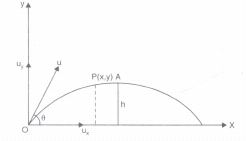
The coordinates of O are (0, 0) considering horizontal motion.
The position of the body after time t has coordinate (x, y);
where x (t)=xo + ux t + \({1\over2}a_x t^2\)
Substituting for various factors
x (t)=xo + U cos \(\theta\) . t + \({1\over2}\) x 0 x t2
or x (t) =u cos \(\theta\) . t
\(t={x(t)\over u \ cos \theta}\) ............(i)
Considering the vertical motion
y (t) Y (0) + uy +\({1\over2}a_y t^2\)
or y (t)=0+ U sin \(\theta\) . t - \({1\over2}\) gt2
or y (t)=U sin \(\theta\) . t - \({1\over2}\) gt2 ............(ii)
Substituting for t from equation (i) in equation (ii), we get
\(y(t)=u \ sin \theta ({x(t)\over u \cos \theta})-{1\over 2}g({x(t)\over u \ cos \theta})^2\)
\(\Rightarrow \ y(t)=x(t)tan \theta -{1\over2}g{x^2(t)\over u^2 \ cos^2 \theta}\) ...............(iii)
This is an equation of parabola. Thus, the path of a projectile is a parabola.
Maximum height attained. At the maximum height, the vertical component of velocity becomes zero. Now using the equation of motion.
\(h={v^2_y-u^2_y\over 2a_y}\)
We have maximum height
\(\therefore h_{max}={0^2-(u \ sin \theta)^2\over 2(-g)}\)
or \(H={u^2sin^2\theta \over 2g}\) .....................(iv)
Time for maximum height. Using equation of motion v = u + at
or vx = ux + ay t
we have 0 =u sin \(\theta\) - gt
or t=\(u \ sin \theta \over \ g\) .....................(v)
Horizontal range. Let the horizontal range be x. Since there is no acceleration in the horizontal direction so
x = x (0) + ux t + \({1\over2}a_x t^2\)
As x (0) = 0, ux = U cos \(\theta\), ax= 0 and it is the total time of the flight which is twice the time for maximum height because body takes same time in rising to and falling from the highest point.
Hence, t = \({2u \ sin \theta \over g}\)
\(\therefore \) x = o + u cos \(\theta\) . t = u cos\(\theta\)\(({2u \ sin \theta \over g})\)
or x \(={u^2\over \ g}(2 \ sin \theta cos \theta)\)
\(\Rightarrow \ x={u^2\over g}sin \ 2 \theta\) ....................(vi)
Maximum horizontal range. From equation (vi) for x to be maximum, the value of sin 2\(\theta\) should be maximum which is 1,
hence \(x_{max}={u^2\over g}\) ....................(vii)
For this xmax' sin 2\(\theta\)= 1\(\Rightarrow\) \(\theta\) = 45°
Therefore, the horizontal range will be maximum if the angle of projection is 45° or \(\pi\over 4\) radians.
Time of flight of the projectiles. The projectile after completing its flight returns back to the same horizontal level from which it was projected. Therefore, the vertical displacement in the whole flight is zero. Considering vertical motion.
y(t) = y(0) +uyt + \({1\over2}a_yt^2\)
Now y(t) = 0,y(o) = 0,uy = u sin \(\theta\) , ay = -g
Then 0 = 0 + u sin \(\theta\) . T-\({1\over2}gT^2\)
\(\Rightarrow T({u \ sin \theta -{1\over2}gT})=0\)
Therefore T = 0
and U sin \(\theta -{1\over 2}gT=0\Rightarrow u\ sin \theta ={1\over2}gT\)
or gT = 2u sin \(\theta\)
\(T={2u \ sin \theta \over g}\) ...........(viii)
Equation (viii) gives the total time of flight. This is twice the time for maximum height.
15.
Let A be the top of the building at a height X above the ground. Be is the window of height 2m. Let t_l be the time taken by the ball to fail from A to B. Then the time taken to fall through a distance
\((x + 2) m is (t_1 + 0.2) s\). Then
x = \(\frac{1}{2}\times 10\times t_1^2 \) ...(i)
and \(x+2=\frac{1}{2}\times 10\times(t_1+0.2)^2 \) ...(ii)
From Eqns. (1) and (2), we have
\(5t_1^2+2=5t_1^2+0.2+2t_1\)
or \(1.8=2t_1\)
∴ t1=0.9s
∴ \( t_1=0.9s\)
∴ x = \(\frac{1}{2}\times 10\times (0.9)^2=4.05m\)
Let V1 be the speed acquired by the ball as it reaches the bottom C of the window.
Then
\( v_1=0+10 x 1.1=11ms^{-1}\)
During the downward journey the ball experiences an acceleration equal to g and strikes the ground with speed V. Since it undergoes a perfectly elastic collision its speed reverses.
The time taken in falling from C to ground to back is 2 s. Therefore, time taken to fall from C to ground must be 1 s. Hence
\( X -(X+2)=11 \times 1 +\frac{1}{2} \times 10(1)^2\)
or \(X -6.05=11+5=16\)
∴ X = 22.05 m
The height of the building is 22.05 m and the bottom of the window is at height of 16 m [= (22.05 - 4.05) m] from the ground.
16.
Equilibrium: A body or a system of particles is said to be in a state of equilibrium if inspite of a number of forces-or torques acting on it, the body or the system of particles remains in its original state of rest or of uniform motion (translational or rotational or both). Thus, equilibrium state means that acceleration (both linear as well as angular) of the body/system must be zero. Hence, equilibrium is of two types:
(i) Equilibrium of rest: If a given system remains in a state of rest and does not change its position inspite of number of forces acting on it, it is said to be in an equilibrium of rest e.g., our house, our school etc.
(ii) Equilibrium of motion: If a given system maintains its state of uniform motion, translational or rotational or combined, under the action of a number of forces then it is said to be in an "equilibrium of motion" e.g., our Earth, the planetary system, electrons revolving around the nucleus of an atom. For a state of equilibrium of motion, the value of linear momentum and/ or angular momentum of the system should have a finite and constant value.
Conditions for complete equilibrium: For complete equilibrium condition for translational equilibrium and condition for rotational equilibrium both must be fulfilled. The conditions are
(a) For translational motion we know that \(\frac { d\vec { p } }{ dt } =\sum { \vec { F_{ ext } } } \)
For equilibrium \(\vec { p } \) = a constant or \(\frac { d\vec { p } }{ dt } \)=0 or \(\sum { \vec { F_{ ext } } } =0\)
Hence for translational equilibrium, the vector sum of all the external forces acting on the system/ body under discussion must be zero
(b) For rotational motion, we that \(\frac { d\vec { L } }{ dt } =\sum { \vec { \tau _{ ext } } } \)
For equilibrium \(\vec { L} \) = a constant or \(\frac { d\vec { L } }{ dt } =0\quad or\quad \sum { \vec { { \tau } } _{ ext } } =0\)
Hence for rotational equilibrium, the vector sum of all the external torques acting on the system/body must be zero
17.
Here,
T1 = 200°C = 473 K and T2 = 100°C = 373 K
∴ Efficiency of engine \(η={W\over Q_1}=\left(T_1-T_2\over T_1\right)={473-373\over 473}=0.21\)
W = 0.21 Q1 = 21% of Q
Thus, engine will convert 21% of heat used for doing work.
18.
(a) Let a drop of a liquid L be poured on a solid surface S placed in air A. If TSL, TLA and TSA be the surface tensions corresponding to solid-liquid layer, liquid-air layer and solid-air layer respectively and \(\theta\) be the angle of contact between the liquid and solid, then
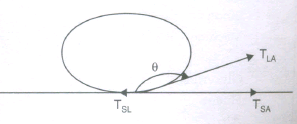
\(T_{LA}\cos\theta+T_{SL}=T_{SA}\)
\(\Rightarrow \cos\theta=\frac{T_{SA}-T_{SL}}{T_{LA}}\)
For the mercury-glass interface, TSA < TSL, Therefore, cos \(\theta\) is negative. Thus \(\theta\) is an obtuse angle. For the water-glass interface, TSA > TSL, Therefore cos \(\theta\) is positive. Thus, \(\theta\) is an acute angle.
(b) Water on a clean glass surface tends to spread out i.e., water wets glass because force of cohesion of water is much less than the force of adhesion due to glass. In case of mercury force of cohesion due to mercury molecules is quite strong as compared to adhesion force due to glass. Consequently, mercury does not wet glass and tends to form drops.
(c) Surface tension of liquid is the force acting per unit length on a line drawn tangentially to the liquid surface at rest. Since t; .is force is independent of the area of liquid surface therefore, surface tension is also independent of the area of the liquid surface.
(d) We know that the clothes have narrow pores or spaces which act as capillaries. Also, we know that the rise of liquid in a capillary tube is directly proportional to cos \(\theta\) (Here \(\theta\) is the angle of contact). As \(\theta\) is small for detergent, therefore cos \(\theta\) will be large. Due to this, the detergent will penetrate more in the narrow pores of the clothes.
(e) We know that any system tends to remain in a state of minimum energy. In the absence of any external force for a given volume of liquid its surface area and consequently. Surface energy is least for a spherical shape. It is due to this reason that a liquid drop, in the absence of an external force is spherical in shape.
19.
If \({ v }_{ 1 },{ v }_{ 1 }{ ,T }_{ 1 }and{ v }_{ 2 },{ v }_{ 2 }{ ,T }_{ 2 }\) are the frequencies, velocity and tension in the first and second strings, respectively, then
\(\frac { { v }_{ 2 } }{ { v }_{ 1 } } =\frac { { v }_{ 2 }/2L }{ { v }_{ 1 }/2L } =\frac { { v }_{ 2 } }{ { v }_{ 1 } } \Rightarrow \quad \frac { { v }_{ 2 } }{ { v }_{ 1 } } =\frac { \sqrt { { T }_{ 2 }/\mu } }{ \sqrt { { T }_{ 1 }/\mu } } \)
Given that the tension in one string is 2.0% larger than the other
\({ T }_{ 2 }={ T }_{ 1 }+\frac { 2 }{ 100 } { T }_{ 1 }=1.02{ T }_{ 1 }\)
The ratio of frequencies
\(\frac { { v }_{ 2 } }{ { v }_{ 1 } } =\sqrt { \frac { 1.02{ T }_{ 1 } }{ { T }_{ 1 } } } =1.01\quad Hz\)
Now, solve for the frequency of the tightened string.
\({ v }_{ 2 }=1.01{ v }_{ 1 }=1.01\times 420=424.2\quad Hz\)
Thus, the beat frequency,
\({ v }_{ beat }={ v }_{ 2 }-{ v }_{ 1 }=424.2-420=4.2\quad Hz\)
20.
\(v_{1}=\frac{v}{4 \times 15}, v_{2}=\frac{v}{2 \times 30.5}=\frac{v}{61} \)
\(m=v_{1}-v_{2}=\frac{v}{60}-\frac{v}{61}=v \times \frac{1}{61 \times 60} \)
\(5=\frac{v}{61 \times 60}\)
or = v = 5 x 16 x 60 cm/s
\(\therefore \quad v_{1} =\frac{v}{60}=\frac{5 \times 61 \times 60}{60}=305 \mathrm{~Hz}\)
\(v_{2} =\frac{v}{61}=\frac{5 \times 60 \times 61}{61}=300 \mathrm{~Hz} \)
21.
(i) \(\sin \omega t+\cos \omega t\) is a periodic function, it can also be written as \(\sqrt{2} \sin (\omega t+\pi / 4)\).
\( \text { Now } \sqrt{2} \sin (\omega t+\pi / 4)=\sqrt{2} \sin (\omega t+\pi / 4+2 \pi) \)
\(= \sqrt{2} \sin [\omega(t+2 \pi / \omega)+\pi / 4]\)
The periodic time of the function is \(2 \pi / \omega\).
(ii) This is an example of a periodic motion. It can be noted that each term represents a periodic function with a different angular frequency. Since period is the least interval of time after which a function repeats its value, sin ωt has a period T0 = 2π/ω ; cos 2 ωt has a period π/ω =T0 /2; and sin 4 ωt has a period 2π/4ω = T0 /4. The period of the first term is a multiple of the periods of the last two terms. Therefore, the smallest interval of time after which the sum of the three terms repeats is T0 , and thus, the sum is a periodic function with a period 2π/ω.
(iii) The function e –ωt is not periodic, it decreases monotonically with increasing time and tends to zero as t → ∞ and thus, never repeats its value.
(iv) The function log(ωt) increases monotonically with time t. It, therefore, never repeats its value and is a nonperiodic function. It may be noted that as t → ∞, log(ωt) diverges to ∞. It, therefore, cannot represent any kind of physical displacement.
22.
\( V=250 \mathrm{cc}=250 \times 10^{-6} \mathrm{~m}^3 \)
\( \mathrm{P}=10^{-3 \mathrm{~mm}}=10^{-3} \times 10^{-3} \mathrm{~m} \)
\( =\left(10^{-6} \times 13600 \times 10\right) \)
\(=136 \times 10^{-3} \text { Pascal } \)
\( \mathrm{T}=27^0 \mathrm{C}=300 \mathrm{k} \)
\( \mathrm{n}=\frac{\mathrm{PV}}{R T} \)
\( =\frac{136 \times 10^{-3} \times 250 \times 10^{-6}}{8.3 \times 300}=1.36 \times 10^{-8}\)
No. of molecules
\(=1.36 \times 10^{-8} \times 6 \times 10^{23} \)
\(=8.17 \times 10^{15}\)
23.
(i) -148o F
(ii) 32oZ
24.
Total cross-sectional area of the femurs is A = 2 × 10 cm2 = 20 × 10–4 m2 . The force acting on them is F = 40 kg wt = 400 N (taking g = 10 m s–2). This force is acting vertically down and hence, normally on the femurs. Thus, the average pressure is
\({ P }_{ av }=\frac { F }{ A } =\frac { 400 }{ 20\times { 10 }^{ -4 } } \)
25.
Given, mass(m) = 14 .5kg
Length of wire (l ) = 1 m
Angular frequency (v) = 2 revls
Angular velocity (\(\omega \)) = 2\(\pi \)v
= 2\(\pi \)\(\times \)2 rad/s = 4\(\pi \) rad/s
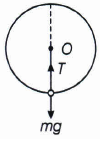
Area of cross-section of wire (A) = 0.065 cm2
= 6.5 \(\times \)10-6 m2
Young's modulus for steel (Y) = 2 \(\times \) 1011 N/m2.
At lowest point of the vertical circle, T - mg = ml\({ \omega }^{ 2 }\)
or T= mg + m\({ \omega }^{ 2 }\)
= (14.5\(\times \)9.8)+14.5\(\times \)1\(\times \)\({ (4\pi ) }^{ 2 }\)
= 14.5(9.8+16\({ \pi }^{ 2 }\))
= 14.5(9.8\(\times \)16\(\times \)9.87) [\(\because \) \({ \pi }^{ 2 }\)=9.87]
= 14.5\(\times \) 167.72N=2431.94 N
Young's modulus (Y) =\(\frac { Stress }{ Strain } =\frac { (T/A) }{ \Delta l/l } =\frac { Tl }{ A.\Delta l } \)
\(\therefore \Delta l=\frac { T.l }{ A.Y } =\frac { 2431.94\times 1 }{ 6.5\times { 10 }^{ -6 }\times 2\times { 10 }^{ 11 } } \)
= 1.87\(\times \)10-3 m =1.87 mm
26.
Young's modulus \((Y)=\frac { Stress }{ Longitudinal\ strain } \)
For same longitudinal strain \(Y\alpha stress\)
\(\frac { { Y }_{ stress } }{ { Y }_{ rubber } } =\frac { { (stress) }_{ steel } }{ { (stress) }_{ rubber } } \)
But \({ Y }_{ steel }>{ Y }_{ rubber }\)
\(\frac { { Y }_{ steel } }{ { Y }_{ rubber } } >1\)
Therefore from Eq(i) we get
\(\frac { { (stress) }_{ steel } }{ { (stress) }_{ rubber } } >1\)
\(or { (stress) }_{ steel }>(stress)_{ rubber }\)
27.
To solve this question, we use the Kepler’s third law. This states that the square of the period of the revolution of all the planets about the sun is directly proportional to the cube of the mean distance between the planets and the sun. This can be mathematically given as
T2 ∝ R3
⇒T2=kR3 where T is the period of the revolution of a planet around the sun, R is the mean radius of the planet to the sun.
Hence, we can write by comparison between two planets, that
\(\frac{T_1^2}{T_2^2}=\frac{R_1^3}{R_2^3}\)
We can use any planet with a known distance and period as the second planet. We choose earth.
\(\frac{T_N^2}{T_E^2}=\frac{R_N^3}{R_E^3}\) where the subscript N and E stands for Neptune and Earth respectively.
For earth, the period is 1 year. Hence, write that
\( \frac{165^2}{1^2}=\frac{R_N^3}{R_E^3} \)
\( \Rightarrow R_N^3=165^2 R_E^3\)
Hence, by finding the cube root of both sides, we have
\(R_N=\sqrt[3]{165^2} R_E\)
⇒RN=30RE
Radius of the earth is about 1.50×10¹¹m
Hence, RN=30(1.50×10¹¹)=4.5×10¹²m
28.
If r is the distance of the given point from the centre of the earth, then gravitational potential at the point.
\(V=-\frac { GM }{ r } =-5.12\times { 10 }^{ 7 }\ J/kg\)
Acceleration due to gravity at this point,
\(g=\frac { GM }{ { r }^{ 2 } } =6.4\ m/{ s }^{ 2 }\)
\(\\ Clearly,\ \frac { \left| V \right| }{ g } =\frac { GM/r }{ GM/{ r }^{ 2 } } =r\)
\(\\ Thus,\ r=\frac { 5.12\times { 10 }^{ 7 }J/kg }{ 6.4m/{ s }^{ 2 } } =8\times { 10 }^{ 6 }m=8000\ km\)
Obviously, height of the point from the earth's surface
= (r-R) = 8000km - 6400km = 1600 km.
29.
The nuclear decay may be represented as follows
Fe57\(\rightarrow\) Fe57 + hv (\(\gamma \)-ray photon)
According to de-Broglie hypothesis, momentum of a photon of energy y E is
\(p=\frac { E }{ c } =\frac { 14.4\times 1.6\times { 10 }^{ -16 }J }{ 3\times { 1 }0^{ 8 }{ ms }^{ -1 } } \)
\(\\ p=\ 7.68\ \times { 10 }^{ -24 }kg { ms }^{ -1 }\)
By conservation of momentum, the momentum of daughter nucleus, p=momentum of \(\gamma \) -ray photon
\(=d\ 7.68 \ \times { 10 }^{ -24 }kg \ { ms }^{ -1 }\)
The recoil energy of the nucleus will be
\(k= \ \frac { { p }^{ 2 } }{ 2m } =\frac { ({ 7.68 \ \times { 10 }^{ -24 }) }^{ 2 } }{ 2\times \ 56.935 \ \times 1.66 \times { 10 }^{ -27 } }\)
\( \\ =0.32\times { 10 }^{ -21 }\)
\(\\ =\frac { 0.312\times { 10 }^{ -21 } }{ 1.6\times { 10 }^{ -16 } } keV\)
\(K=1.95{ \times 10 }^{ -16 }keV\)
30.
Force F = ma, therefore force acting on a particle in unaccelerated (a = 0) motion is zero.
As car is moving with a constant velocity, therefore, its acceleration is zero. i.e., a = 0 therefore, net force acting on the car F = ma = 0.
31.
This is an example of uniform circular motion. Here R = 12 cm. The angular speed ω is given by
The angular speed \(\omega\) is given as
\(\omega ={ 2\pi }/{ T }={ 2\pi \times 7 }/{ 100 }=0.44rad/s\) and linear speed \(\nu \)is\(\nu =\omega R=0.44\times 12=5.3{ cm\ s }^{ -1 }\)
The direction of velocity \(\nu \)is along the tangent to the circle at every point. The acceleration is directed towards the centre of the circle. Since, this direction changes continuously acceleration, here is not a constant vector.
However, the magnitude of acceleration is constant.
a = ω2 R = (0.44 s–1) 2 (12 cm) = 2.3 cm s-2
32.
Let x1,x2 and x3 be distances covered in three parts of the motion
For the first of the motion, we have
u = 0,t = 10s,v = 20m/s
As v = u + at
\(\therefore \ 20=0+a1\times 0\)
Acceleration a=2m/s2
Distance, \({ x }_{ 1 }=ut+\frac { 1 }{ 2 } { at }^{ 2 }\)
\( =0\times 10+\frac { 1 }{ 2 } \times 2\times (10)^{ 2 }=100\quad m\)
For second Part of the motion, we have
\({ x }_{ 1 }=100m,{ x }_{ 3 }=40\quad m\)
AS \({ x }_{ 1 }+{ x }_{ 2 }+{ x }_{ 3 }=640\ \)
\(\therefore \quad 100+{ x }_{ 2 }+40=640\)
\({ x }_{ 2 }=500m\)
The distance is covered with a uniform speed of 20m/s
\(\\ \therefore \) Time taken =\(\frac { 500 }{ 20 } =25s\)
For third part of the motion, we have
u = 20m/s ,v = 0,x = x3= 40m
As \({ v }^{ 2 }-{ u }^{ 2 }=2ax\)
\(\\ { (0) }^{ 2 }-(20)^{ 2 }=2\times a\times 40\)
or \(a=\frac { 400 }{ 80 } =-5m/s^{ 2 }\)
\(\therefore \) Retardation = 5m/s2
Time taken, \(t=\frac { v-a }{ a } =\frac { 0-20 }{ -5 } =4s\)
Total Time taken = 10 + 25 + 4 = 39s
33.
\(Fractional\quad error=\frac { \triangle { D }_{ mean } }{ D } =\pm \frac { 0.004 }{ 1.330 } =\pm 0.003\).
34.
(i) Velocity at any instant t is given by v = Aω cos ωt
Here A = 10cm,ω = \(\frac{2\pi}{T}=\frac{2\pi}{10}\)
When t = 2s, v = 10\(\times\)\(\frac{2\pi}{10}cos(\frac{2\pi}{10}\times2)\)
= 2\(\pi\) cos (0.4 \(\pi\))
= 1.942 cm/s.
(ii) Acceleration at any instant t is given by
a = - Aω2 sin ωt
= -10\((\frac{2 \pi}{10})^2sin(0.4\pi)\)
= - 3.755 cm/ s2
acceleration is numerically equal to 3.754 cm/ s2 and is directed towards the mean position.
35.
Let V be the volume of the load attached to lower end of steel wire of Young's modulus \(\Upsilon \), area of cross-section A and length of wire L. Let \(\rho \) be the relative density of rod.
Then, \(\Upsilon =\frac { FL }{ Ax_{ 1 } } =\frac { V\rho gL }{ Ax_{ 1 } } \) ..........(i)
When load is immersed in liquid, then
\(\Upsilon =\frac { (V\rho g-V\times 1\times g) }{ Ax_{ 2 } } \) .....(ii)
From (i) and (ii),
\(\frac { \rho }{ { x }_{ 1 } } =\frac { \rho -1 }{ { x }_{ 2 } } \) or \(\rho \)x2 = \(\rho \)x1 - x1
or x1 = \(\rho \)(x1-x2) or \(\quad \rho =\frac { { x }_{ 1 } }{ { x }_{ 1 }-{ x }_{ 2 } } \).
36.
For the body,
m1 = 0.2 kg; \(\triangle\)T1 = 1000 - 160 = 840C
S1 = ?
For water,
m2 = 0.5 kg; \(\triangle\)T2 = 160 - 100 =60C;
S2 = 4.2 103J/Kg/0C
From law of conservation of energy;
heat lost by body = heat gained by water
i...e, m1s1 \(\triangle\)T1 = m2S2 \(\triangle\)T2
or S1 = \(\frac { { m }_{ 2 }s_{ 2 }\triangle { T }_{ 2 } }{ { m }_{ 1 }\triangle { T }_{ 1 } } =\frac { 0.5\times \left( 4.2\times { 10 }^{ 3 } \right) \times 6 }{ 0.2\times 84 } \)
= 0.75 x 10³ J/Kg/0C
37.
(a) B
(b) C
(c) Slower
(d) Yes, in the interval 2 to 3 s
38.
Escape velocity, \(v=\sqrt {2gR}=\sqrt {\frac{2GM}{R}}.\)
Thus escape velocity of a planet depends upon (i) its mass (M) and (ii) its size (R). As different planets have different masses and sizes, so they have different escape velocities.
39.
Four fundamental forces present in nature are:
(i) Gravitational force
(ii) Electromagnetic force
(iii) Weak nuclear force
(iv) Strong nuclear force.
40.
2 beats
41.
(i) Given, T = 27 \(^0\)C
= ( 273.15 + 27 )
= 300.15K
Average thermal energy , E = \(\frac{3}{2}\)kBT
( where, kB = Boltzman constant
= 1.38\(\times\)10-23 JK-1 )
E = \(\frac{3}{2}\)\(\times\)1.38\(\times\)10-23\(\times\)300.15
= 6.21 \(\times\)10-21 J
(ii) At the temperatures , T = 107 K
Average thermal energy , E = \( \frac{3}{2}\)kBT
= \( \frac{3}{2}\)\(\times\)1.38\(\times\)10-23\(\times\)6000
= 1.241\(\times\)10-19 J
(iii) At temperature , T = 107K
Average thermal energy,
E = \(\frac{3}{2}\)kBT
= \(\frac{3}{2}\)\(\times\)1.38\(\times\)10-23\(\times\)107
= 2.07\(\times\)10-16 J
42.
Given, work done (W) = - 22.3 J
Work done is taken negative as work is done on the system.
In an adiabatic change, \(\Delta \)Q = 0
Using first law of thermodynamics
\(\Delta \).U = \(\Delta \)Q - W = 0 -(- 22.3) = 22.3J
For another process between states A and B,
Heat absorbed (\(\Delta \)Q) = + 9.35 cal
= + (9.35 x 4.19) J = + 39.18 J
Change in internal energy between two states via different paths are equal.
\(\because \) \(\Delta \)U = 22.3 J
\(\therefore \) From first law of thermodynamics,
\(\Delta \)U = \(\Delta \)Q - W
or W = \(\Delta \)Q -\(\Delta \)U
= 39.18 - 22.3
= 16.88J \(\approx \)16.9J
43.
(a) The pressure of liquid column is given by \(p=h\rho g\), where h is depth, \(\rho \)i s density and g is acceleration due to gravity.
Therefore, pressure of liquid column increases with depth. The height of blood column in human body is more at feet than at the brain. Therefore, the blood pressure in humans is greater at the feet than the brain.
(b) The density of air is maximum near the surface of the earth and decreases rapidly with height. At a height of 6 km, the density of air decreases to nearly half its value at the seal level. Beyond 6km height, the density of air decreases very slowly with height.Hence, the atmospheric pressure at a height of about 6km decreases to nearly half of its value at the sea level.
(c) When force is applied on a liquid, the pressure is transmitted equally in all directions inside the liquid. Therefore, hydrostatic pressure has no fixed direction and hence, it is a scalar quantity.
44.
Rolling motion, i.e. (Rotation + Translation)
45.
When a man is standing on a weighing scale, it will read the normal reaction R as apparent weight.
Given , mass of man (m) = 70 kg
In each case the weighing scale will read the reaction R, i.e. the apparent weight.
(iv) Acceleration of the lift when it is falling freely under gravity
a = g (\(\downarrow\) )
\(\therefore\) Normal reaction, R = m ( g - g ) = 0
\(\therefore\) Reading on weighing scale = 0
46.
zero, 3.6 N
47.
(c)
3
48.
(d)
\(\sqrt { 2 } \) times that of helium
49.
(c)
\(\frac { 3 }{ 2 } { MR }^{ 2 }\)
50.
(c)
30 ms-2
51.
(b)
4 : 1
52.
(b)
20%
53.
(c)
Nm2 kg-2
54.
(d)
Both light and sound waves in air are longitudinal.
55.
(d)
equal volumes of the liquids at the same temperature are taken
56.
(a)
0.1 J
57.
(d)
\((\frac{gR^2}{R+x})^{\frac{1}{2}}\)
58.
(b)
H/2
59.
(c)
Pressing force required is greater than weight mg of the body.
60.
(c)
Temperature
61.
(b)
Huygens

11th Standard CBSE Syllabus & Materials
11th Standard CBSE
CBSE 11th Business Studies Forms of Business Organisation Sample Question Papers Study Material - QB365 Set A
NEW11th Standard CBSE
CBSE 11th Business Studies Business, Trade and Commerce Sample Question Papers Study Material - QB365 Set A
NEW11th Standard CBSE
CBSE 11th Physics Waves Sample Question Papers Study Material - QB365 Set A
NEW11th Standard CBSE
CBSE 11th Physics Kinetic Theory Sample Question Papers Study Material - QB365 Set A



CBSE 11th Standard CBSE Subjects
CBSE Standards









