
 100% FREE ACCESS
11th Standard CBSE Syllabus & Materials
11th Standard CBSE
CBSE 11th Economics PART-A - Presentation of Data - New Sample Question Papers Study Material - QB365 Set A
NEW11th Standard CBSE
CBSE 11th Economics PART-A - Organisation of Data - New Sample Question Papers Study Material - QB365 Set A
NEW11th Standard CBSE
CBSE 11th Economics PART-A - Collection of Data - New Sample Question Papers Study Material - QB365 Set A
NEW11th Standard CBSE
CBSE 11th Economics PART-A - Introduction to Economics and Statistics - New Sample Question Papers Study Material - QB365 Set A
NEW11th Standard CBSE
CBSE 11th Business Studies International Trade Sample Question Papers Study Material - QB365 Set A
NEW11th Standard CBSE
CBSE 11th Business Studies Evolution and Fundamentals of Business Sample Question Papers Study Material - QB365 Set A

Published on: 05/03/2020
11th Standard Physics Board Exam Sample Question 2020
Download CBSE Class 11th Standard CBSE Physics question papers, sample papers, important questions, and previous year solved papers in PDF format. Get free study materials, NCERT solutions, and exam preparation resources for Class 11th Standard CBSE Physics
Questions + Answers key
Take MCQ Physics Test
1.
A ball of mass 100 g is projected vertically upwards from the ground with a velocity of 49 m/ s. At the same time another identical ball is dropped from a height of 98 m fo fall freely along the same path as followed by the first ball. After sometime, the two balls collide and stick together and finally fall together. Find the time of fliglIt of the masses.
2.
What are the three forms of energy possessed by a flowing fluid? Find their expressions.
3.
A Carnot engine whose heat sink is at 27°C has an efficiency of 40%. By how many degrees should the temperature of source be changed to increase the efficiency by 10% of the original efficiency?
4.
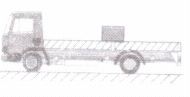
The rear side of a truck is open and a box of 40 kg mass is placed 5 m away from the open end. The coefficient of friction between the box and the surface below it is 0.15. On a straight road, the truck starts from rest and accelerates with 2ms-2. At what distance from the starting point does the box fall off the truck? (Ignore the size of the box).
5.
Which of the following functions of time represent (a) simple harmonic, (b) periodic but not simple harmonic, and (c) non-periodic motion? Give period for each case of periodic motion (ω is any positive constant):
(a) sin ωt – cos ωt
(b) sin3 ωt
(c) 3 cos(\(\frac{\pi}{4}\)-2ωt)
(d) cosωt + cos3ωt + cos5ωt
(e) exp(-ω2t2)
(f) 1 + ωt + ω2t2
6.
Find the components along the x, y, z axes of the angular momentum l of a particle, whose position vector is r with components x, y, z and momentum is p with components Px,Py and Pz. Show that if the particle moves only in the x-y plane the angular momentum has only a z-component.
7.
Explain why (or how) the shape of a pulse gets distorted during propagation in a dispersive medium?
8.
At a depth of 1000 m in an ocean
(a) what is the absolute pressure?
(b) What is the gauge pressure?
(c) Find the force acting on the window of area 20 cm × 20 cm of a submarine at this depth, the interior of which is maintained at sealevel atmospheric pressure. (The density of sea water is 1.03 x 10³ kg m-3 , g = 10 m s–2.)
9.
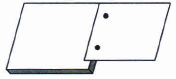
Two long metallic strips are joined together by two rivets each of radius 0.1cm (see Fig.).Each rivet can withstand a maximum shearing stress of 3.0x 10⁸Nm-2.Calculate the maximum tangential force a strip can exert.
10.
Stress in a wire
Calculate the value of stress in a wire of steel heving radius of 2mm of 10 kN of force is applied on it.
11.
Choose the correct alternatives
Acceleration due to gravity is independent of the mass of the earth/mass of the body.
12.
A 400 kg satellite is in a circular orbit of radius 2RE about the earth. How much energy is required to transfer it to a circular orbit of radius 4RE? What are the changes in the kinetic and potential energies? (RE = 6.4 x 10 6 m)
13.
State if each of the following staement is true or false. Give reasons for your answer.
(i) Total energy of a system is always conserved, no matter what internal and external forces on the body are present?
(ii) Work done in the motion of a body over a closed loop is zero for every force in nature.
(iii) In an inelastic collision, the final kinetic energy is always less than the initial kinetic energy of the system.
14.
The nucleus Fe27 emits a \(\gamma \)-ray of energy 14.4 keV. If the mass of the nucleus is 56.935 amu, calculate the recoil energy of the nucleus.
15.
A man of mass 70 kg stands on a weighing scale in a lift which is moving
(a) upwards with a uniform speed of 10 m s-1 ,
(b) downwards with a uniform acceleration of 5 m s-2 ,
(c) upwards with a uniform acceleration of 5 m s-2 . What would be the readings on the scale in each case?
(d) What would be the reading if the lift mechanism failed and it hurtled down freely under gravity ?
16.
A particle is moving Eastwards with a velocity of 5 m/s in 10 second, the velocity changes to 5 m/s Northwards. Find the average accelaration of the particle in this time interval.
17.
If A and B are two vectors such that \(\left| A\times B \right| =\sqrt { 3 } A.B\) Then,
Also, find the value of \(\left| A\times B \right| \)
18.
Science, like any knowledge, can be put to good or bad use, depending on the user. Given below are some of the application of science. Formulate your views on whether the particular application is good, bad or something that cannot be so clearly categorized.
(i) Mass vaccination against small pox to curb and finally eradicate this disease from the population.
(ii) Television for eradication of illiteracy and for mass communication for news and ideas.
(iii) Prenatal sex determination.
(iv) Computers for increase in work efficiency.
(v) Putting artificial satellites around the earth.
(vi) Development of nuclear weapons.
(vii) Development of new and powerful techniques of chemical and biological warfare.
(viii) Purification of water for drinking.
(ix) Plastic surgery.
(x) Cloning.
19.
What is the minimum number of coplanar vectors of different magnitudes, which may give zero resultant?
20.
Why are curved roads generally banked?
21.
No real engine can have an efficiency greater than that of a Carnot engine working between the same two temperatures, why?
22.
What does speedometer record: the average speed or the instantaneous speed?
23.
Obtain the dimensional formula for coefficient of viscosity.
24.
Name that branch of science which deals with the study of Earth.
25.
Give the location of the centre of mass of a (i) sphere, (ii) cylinder, (iii) ring, and (iv) cube, each of uniform mass density. Does the centre of mass of a body necessarily lie inside the body ?
26.
Which of the following relationships between the acceleration a and the displacement x of a particle involve simple harmonic motion?
(i) a = 0.7x
(ii) a = -200x2
(iii) a = -10x
(iv) a = 100x3
27.
Calculate the value of specific heat capacity for one mole water in J/kg
28.
How does tea in a thermo flask remain hot for a long time?
29.
A wire of length L and radius r is clamped rigidly at one end. When the other end of the wire is pulled by a force j, its length increases by l. Another wire of the same material of length 2L and radius 2r, is pulled by a force 2f Find the increase in length of this wire.
30.
Which of the following symptoms is likely to affect an astronaut in space
orientational problem
31.
A particle of mass 1 kg moving with a velocity \({ v }^{ 1 }=(3i-2j)\ m/s\)experience a perfectly inelastic collision with another particle of mass 3 kg having velocity \({ v }_{ 2 }=(4j-6k)\ m/s\). Find the velcocity and speed of the particle formed.
32.
Derive the dimensions formula of physical quantities. Linear mass density
33.
Which of the following length measurement is most accurate and why? 0.004 mm
34.
A block with a mass of 3.0 kg is suspended from an ideal spring having negligible mass and stretches the spring by 0.2 m.
(a) What is the force constant of the spring?
(b) What is the period of oscillation of the block if it is pulled down and released?
35.
The barrel of a gun is 1 m long and it fires a bullet of mass 0.05 kg with a muzzle velocity of 400 ms-1,
Find
(i) the acceleration,
i) the force, and
(iii) the impulse given to the bullet by the gun.
36.
Anurag who is a student of class XI Science could not attend the class on the day when the topic of satellites was taught is the class. Next day Anurag asked about it to his best friend Ram but Ram could not explain very well. Both of them decided to go to their teacher and requested to explain about the natural and artificial satellites. They were happy to know about our natural satellite moon and other artificial satellites.
(i) What values of Anurag are displayed here?
(ii) A body has a sense of weightlessness in a satellite revolving around the earth, why?
37.
Find the velocity of source of sound, when the frequency appears to be (a) double (b) half, the original frequency to a stationary listener.
38.
How should one kg of water at 5OC be so divided that one part of it when converted into ice at DoC, would by this change of state provide a quantity of heat that would be sufficient to vaporise the other part ?
39.
A thermodynamic system is taken from an original state to an intermediate state by the linear process shown in Fig.
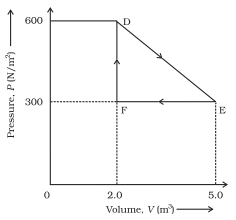
Its volume is then reduced to the original value from E to F by an isobaric process. Calculate the total work done by the gas from D to E to F.
40.
A hoop of radius 2 m weighs 100 kg. It rolls along a horizontal floor so that its centre of mass has a speed of 20 cm/s. How much work has to be done to stop it?
41.
Name the phenomena/fields with which microscopic domain of physics deals. Which theory explains these phenomena?
42.
A car moving along a straight highway with speed of 126 km h–1 is brought to a stop within a distance of 200 m. What is the retardation of the car (assumed uniform), and how long does it take for the car to stop ?
43.
A gas is filled in a cylinder at 300k. Calculate the temperature upto which it should be heated so that its volume becomes \(\frac { 4 }{ 3 } \) of its initial volume.
44.
A steel wire of length 4.7 m and cross-sectional area 3.0 × 10⁻⁵ m2 stretches by the same amount as a copper wire of length 3.5 m and cross-sectional area of 4.0 × 10⁻⁵ m2 under a given load. What is the ratio of the Young’s modulus of steel to that of copper?
45.
A child stands at centre of a turntable with his arms out stretched. The turntable is set rotating with an angular speed of 40 rev/min.
Show that child's new kinetic energy of rotations is more than the initial kinetic energy. How do you account for this increase in kinetic energy?
46.
The blades of windmill sweep out a circle of area A.
(i) If the wind flows at a velocity v perpendicular to the circle, what is the mass of the air passing through it in time t?
(ii) What is the kinetic energy of the air?
(iii) Assume that the windmill converts 25% of the wind's energy v=36km/h and density of the air is 1.2 kg m. What is the el;ectrical power produced?
47.
The range of a rifle bullet is 1000m, when \(\theta \) is the angle of projection. If the bullet is fired with the same angle from a car travelling at 36km/h towards the target, show that the range will be increasing by 142.9\(\sqrt { tan\theta m } \).
When the bullet is fired from the moving car, the horizontal component velocity of the bullet increases with the velocity of car. But the vertical component of the velocity remains uneffected.
48.
If \(\overrightarrow { { a }_{ 1 } } \) and \(\overrightarrow { { a }_{ 2 } } \) are two non collinear unit vectors and if \(\left| \overrightarrow { { a }_{ 1 } } +\overrightarrow { { a }_{ 2 } } \right| \) =\(\sqrt{3}\), then the value of \(\left( \overrightarrow { { a }_{ 1 } } -\overrightarrow { { a }_{ 2 } } \right) .\left( 2\overrightarrow { { a }_{ 1 } } +\overrightarrow { { a }_{ 2 } } \right) \) is
2
\(\frac{3}{2}\)
\(\frac{1}{2}\)
1
49.
A man of mass M is standing at the centre of a rotating turn table rotating with an angular velocity w. The man holds two 'dumb bells' of mass M/4 each in each of his two hands. If he stretches his arms to a horizontal position, the turn table acquires a new angular velocity w' where
\(\omega\)' = 2 \(\omega\)
\(\omega\)' =\(\omega\)/2
\(\omega\)' > \(\omega\)
\(\omega\)' < \(\omega\)
50.
During an adiabatic process, the pressure of a gas is proportional to the cube of its absolute temperature. The value of Cp/ C v for that gas is
3/5
4/3
5/3
3/2
51.
In case of a moving body
displacement > distance
displacement < distance
displacement ≥ distance
displacement ≤ distance
52.
Masses in and 3m are attached to the two ends of a spring of constant k. If the system vibrates freely, the period of oscillation will be
\(\pi\sqrt{m\over k}\)
\(\pi\sqrt{3m\over 2k}\)
\(\pi\sqrt{3m\over k}\)
\(\pi\sqrt{4m\over 3k}\)
53.
The velocity of a body moving in viscous medium is given by v =\(\frac { A }{ B } \left[ 1-{ e }^{ \frac { -t }{ b } } \right] \)where t is time, A and B are constants .Then the dimensions ot A are _____.
M0L0T0
M0L1T0
M0L1T-2
M1L1T-1
54.
Which of the following statements is true?
Both light and sound waves can travel in vacuum
Both light and sound waves in air are transverse
The sound waves in air are longitudinal, while the light waves are transverse
Both light and sound waves in air are longitudinal.
55.
The scale on a steel meter rod is calibrated at 20°C. What will be the error in the reading of 50 ern at 27°C? Take, a = 1.2 x 10.5 °C-1
0.042CM
0.0042
0.021 CM
0.0021 CM
56.
A spring of force constant k is cut into two equal parts. The force constant of each part is
k/2
k
2k
4k
57.
A satellite is orbiting the earth. If its distance from the earth is increased, its
angular velocity would increase
linear velocity would increase
angular velocity would decrease
time period would increase
58.
At which of the following temperature, the value of surface tension of water is minimum?
4°C
25°C
50°C
75°C
59.
A particle of mass 5 kg is pulled along a smooth horizontal surface by a horizontal string. The acceleration of the particle is 10 ms-2. The tension in the string is_______.
2 N
50 N
15 N
10 N
60.
For a gas, r = 1.4 then atomicity, CP, and CV of the gas are _______.
Monoatomic 5/2 R, 3/2R
Monoatomic 7/2 R, 5/2R
Diatomic7/2 R, 5/2R
Triatomic 7/2 R, 5/2R
61.
The range of strong nuclear force is about
10-15 m
10-14 m
10-16 m
10-10 m
62.
A body is initially at rest. It undergoes one-dimensional motion with constant acceleration. The power delivered to it at time t is proportional to
t1/2
t
t3/2
t2
1.
We first find when and where the two balls collide. Let them collide at an instant f seconds after they start their respective motion. Clearly the two balls are at the same height above the ground at this instant.
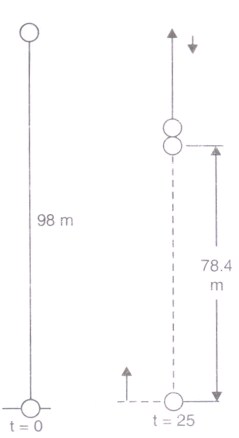
The height of the first ball after t seconds = 49 t - 1/2 x 9.8t2 = 4.9 t (10 - t)
Also the height of the second ball after t seconds = 98 - downward distance moved by it in t seconds.
= \(98-\frac{1}{2}\times 9.8 t^{2}=4.9(20-t^{2})\)
∴ \(4.9 t (100-t)=4.9(20-t^{2}) \)
or \(10t-t^{2}=20-t^{2}\ or \ t=2s\)
The balls thus collide two seconds after the start of their motion. Their velocities at this instant are
First ball: \(v_{1}=(49-9.8 \times 2) m/s\)
= 29.4 m/ s directed upwards
Second ball: v2 = \((0+9.8 \times 2)\) m/s
= 19.6 m/s directed downwards
if v is the velocity of the combined mass of the two balls after they stick together folluwing
their collision, we have, by principle of conservation of momentum.
\(200\times v=100 \times 29.4 -100 \times 19.6\)
∴ v = 4.9 m/s
The 'combined mass' thus moves upward, after collision with a velocity of 4.9 m/s. Its height above the ground at this instant is (considering the position of either of the two balls before collision)
\((98-\frac{1}{2}\times 9.8 \times 2^{2})m= (98-19.6)m = 78.4 m\)
We can now find the time t' taken by the 'combined mass' of the two balls to fall to ground.
We have for this 'combined mass',
u = 4.9 m/s ,s = -78.4 m, a = - g = -9.8 ms-2
ஃ -78.4= 4.9t'+1/2 (-9.8)t'2
or t'2-t'-16=0
ஃ \(t^{'}=\frac{1\pm \sqrt{1+64}}{2} = \frac{1\pm 8.06}{2}\)
= 4.532 s (leaving out the negative solution)
The 'combined mass' thus takes 4.53 s to fall to the ground. Since the balls collided
2 s after they started their motion, their total time of flight is (2 + 4.53) s = 6.53 s.
2.
Three forms of energy possessed by a flowing fluid are as follows:
1. Pressure energy:
Let an ideal fluid of density P be contained in a rectangular vessel, provided with a small side tube at a depth ho below the free surface of fluid in the vessel. At the level of side tube, pressure of fluid along the axis of side tube
p = h0pg
If we want to introduce more fluid into the vessel at this very pressure, we can force it through the side tube by doing work on the piston, If 'A' be the cross-section area of the piston, then force acting on the piston F = PA.
\(\therefore\) Work done in moving the piston through a small distance \(\Delta r\) will be
\(\Delta W=F\Delta x=PA\Delta x=P\Delta V\)
As a result of motion of piston, the mass of the fluid forced in the vessel
\(\Delta m=\rho A\Delta x=\rho\Delta V\)
The work done is stored up in the liquid in the form of its pressure energy.
\(\therefore\) Pressure energy of liquid per unit mass = Work done per unit mass
\(=\frac{\Delta W}{\Delta m}=\frac{P\Delta V}{\rho\Delta V}=\frac{p}{\rho}\)
and pressure energy per unit volume = p.
2. Gravitational potential energy:
Let at any stage of its flow a fluid element of mass "m' be situated at a height 'h' from the reference line (generally taken to be earth's surface), then its gravitational potential energy in that position is mgh.
\(\therefore\) Gravitational potential energy per unit mass = \(\frac{mgh}{m}=gh\)
and gravitational potential energy per unit volume = pgh.
3. Kinetic energy:
Let at any stage of its flow, a fluid element of mass 'm' be moving with a speed 'v', then the kinetic energy of this fluid element is \(\frac{1}{2}v^2\)
\(\therefore\) Kinetic energy per unit mass = \(\frac{\frac{1}{2}mv^2}{m}=\frac{1}{2}v^2\)
and kinetic energy per unit volume = \(\frac{1}{2}\rho v^2\)
These three forms of energy possessed by a flowing fluid are mutually convertible from one form to another.
3.
T2 = 27°C = 27 + 273
= 300K
η = 40%, T22 = ?
From \(η = 1-{T_2\over T_1}\)
\({T_2\over T_1}=1-η=1-{40\over 100}={60\over 100}={3\over 5}\)
\(T_1={5\over 3}T_2={5\over 3}\times300=500K\)
Increase in efficiency 10% of 40 = 4%
∴ New efficiency 'Y]' 40 + 4 = 44%
Let T1 be the new temperature of the source
As \(η'=1-{T_2\over T_1'}\)
\({T_2\over T_1'}=1-η'=1-{44\over 100}={56\over 100}\)
\(T_1'={100\over 56}T_2={100\over 56}\times300=535.7K\)
∴ Increase in temp. of source
= 535.7 - 500 = 35.7 K
4.
Force experienced by box, F = ma = 40 x 2 = 80 N
Frictional force Ff = \(\mu\)mg = 0.15 x 40 x 10 = 60 N .
Net force = F - Ff = 80 - 60 = 20 N.
Backward acceleration produced in the box, n = \({20\over 4}({Net \ force \over m})\)
\(\Rightarrow a=0.5ms^{-2}\)
If t is time taken by the box to travel s = 5 metre and fall off the truck, then from
\(S=ut+{1\over2}at^2\)
\(5=0\times +{1\over2}\times 0.5 t^2\)
\(t=\sqrt{5\times2\over 0.5}=4.47 s.\)
If the truck travels a distance x during this time, then again from
\(S=ut+{1\over2}at^2\)
x = 0 x 4.47 + \(1\over2\) x 2 (4.47)2
= 19.98 m.
5.
(a) (i) Given, function is
\(\sin { \omega t } -\cos { \omega t } \) = \(\sin { \omega t } -\sin { \left( \frac { \pi }{ 2 } -\omega t \right) } \)
\(=2\sin { \left( \frac { \omega t+\frac { \pi }{ 2 } -\omega t }{ 2 } \right) } .\sin { \left( \frac { \omega t-\frac { \pi }{ 2 } +\omega t }{ 2 } \right) } \)
Given function \(=2\sin { \left( \frac { \pi }{ 4 } \right) } .\sin { \left( \omega t-\frac { \pi }{ 4 } \right) } \)
\(=\sqrt { 2 } \sin { \left( \omega t-\frac { \pi }{ 4 } \right) } \)
This function represents a simple harmonic motion having period of \(T=\frac { 2\pi }{ \omega } \) and a phase angle \(\left( -\frac { \pi }{ 4 } \right) \) or \(\left( -\frac { 7\pi }{ 4 } \right) \).
(b) Periodic, but not SHM
The given function is:
sin3ωt = 143sin ωt - sin3 ωt
The terms sin ωt and sin ωt individually represent simple harmonic motion (SHM). However, the superposition of two SHM is periodic and not simple harmonic.(c) 3cos(\(\frac{\pi}{4}\)-2ωt) = 3 cos(2ωt -\(\frac{\pi}{4}\)) [∵ cos (- θ) = cos θ]
Clearly it represents SHM and its time period is 2π/2ω
(d) cos ωt + cos 3 ωt + cos 5 ωt. It represents the periodic but not S.H.M. Its time period is 2π/2ω
(e) \({ e }^{ -{ \omega }^{ 2 }{ t }^{ 2 } }\) It is an exponential function which never repeats itself. Therefore it represents non-periodic motion.
(f) 1 + ωt + ω2t2 also represents non periodic motion.
6.
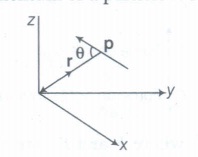
We know that angular momentum \(\vec { l } \) of a particle having position vector \(\vec { r } \) and momentum \(\vec { p } \) is given by
\(\vec { l } \) = \(\vec { r } \)\(\times\)\(\vec { p } \)
But, \(\vec { r } \)= [x\(\vec { i} \)+ y\(\vec { j} \)+ z\(\vec { k} \)] where x,y,z are the components of
\(\vec { r } \)and\(\vec { p } \) = [px\(\vec { i} \)+ py\(\vec { j} \)+ pz\(\vec { k} \)]
∴ \(\vec { l } \) = \(\vec { r } \)\(\times\)\(\vec { p } \) [x\(\vec { i} \)+ y\(\vec { j} \)+ z\(\vec { k} \)]\(\times\)[px\(\vec { i} \)+ py\(\vec { j} \)+ pz\(\vec { k} \)]
or (lx\(\vec { i} \)+ ly\(\vec { j} \)+ lz\(\vec { k} \)) = \(\left| \begin{matrix} \hat { i } & \hat { j } & \hat { k } \\ x & y & z \\ { p }_{ x } & { p }_{ y } & { p }_{ z } \end{matrix} \right| \)
=(ypz - zpy)\(\vec { i} \) +(zpx - xpz)\(\vec { j} \)+(xpy - ypx)\(\vec { k} \)
From this relation, we conclude that
lx= ypz - zpy, ly= zpx - xpz and lz = xpy - ypx
If the given particle moves only in the x - y plane, then z = 0 and pz = 0 and hence,
\(\vec { l } \)=(xpy-ypx)\(\hat { k } \) ,which is only the .z-comonent of \(\vec { l } \)
It means that for a particle moving only in the x - y plane, the angular momentum has only the z-component
7.
As in the dispersive medium wavelengths are different, hence the velocities, therefore, the shape of the pulse gets distorted.
8.
Here h = 1000 m and ρ = 1.03 x 10 3 kg m-3
(a) From Eq. P2 −P1 = ρgh, absolute pressure
P = Pa + ρgh
= 1.01 x 10⁵ Pa
= + 1.03 x 10³ kg m–3 x 10 m s–2 x 1000 m
= 104.01 x 10⁵ Pa
≈ 104 atm
(b) Gauge pressure is P −Pa = ρgh = Pg
P g = 1.03 x 10³ kg m–3 x 10 ms2 x 1000 m
= 103 x 105 Pa
≈ 103 atm
(c) The pressure outside the submarine is P = Pa + ρgh and the pressure inside it is Pa . Hence, the net pressure acting on the window is gauge pressure, P g = ρgh. Since the area of the window is A = 0.04 m2 , the force acting on it is
F = P g A = 103 x 105 Pa x 0.04 m2 = 4.12 x 10⁵ N
9.
Let F be the tensile force applied. Since, each rivet shares the stretching force equally, so the shearing force on each rivet = F/2.
If A is the area of each rivet, then shearing stress on each rivet= \(\frac { F }{ 2A } \).Now, maximum shearing stress on each strip = 3.0\(\times \) 108 Nm-2
i.e. \(\frac { { F }_{ max } }{ 2A } \) = 3.0\(\times \) 108 Nm-2
where, Fmax is maximum tangential force.
or Fmax = 3.0\(\times \) 108\(\times \) 2A = 6.0 \(\times \)108\(\times \) \(\pi { r }^{ 2 }\)
\(\therefore \) r = 0.1 cm
\(\Rightarrow \) 0.1 \(\times \)10-2
r = 1\(\times \)10-3 m
\(\Rightarrow \) Fmax = 6.0\(\times \) 108\(\times \)\(\frac { 22 }{ 7 } \)\(\times \) (1\(\times \)10-3)2
= 1885 N
10.
Force, F = 10 kN = 1 x 10⁴ N
Radius, r = 2 mm = 2 x 10⁻³ m
Area, A = \(\pi \) r2 = \(\pi \) x ( 2 x 10⁻³ )2
= 12.56 x 10⁻⁶ m2
Stress = \(\frac { Force }{ Area } \) = \(\frac { 1\times { 10 }^{ 4 }N }{ 12.56\times { 10 }^{ -6 }{ m }^{ 2 } } \)
= 0.0796 x 1010
= 7.96 x 10⁸ N / m2
11.
Acceleration due to gravity is independent of the mass of the body.
12.
Initially, \({ E }_{t }=\frac { -GMm }{ 4R_E } \)
While finally, \({ E }_{ f }=\frac { -GMm }{ 8R_E } \)
Change in the total energy is given by
\(\triangle E={ E }_{ f }-{ E }_{ i }=\frac { -GM_Em }{ 8R_E } \frac { mR_E }{ 8 } \)
\(∆E =\frac { gmR }{ 8 } =\frac { 9.81\times 400\times 6.37\times { 10 }^{ 6 } }{ 8 } \)
\(\\ \triangle E=3.13\times { 10 }^{ 9 }J\)
The kinetic energy is reduced and it mimics ∆E, namely
\(\therefore \triangle K={ K }_{ f }-{ K }_{ i }=-3.13\times { 10 }^{ 3 }J\)
The change in potential energy is twice the change in the total energy, namely
∆V = Vf – Vi = – 6.25 × 10⁹ J
13.
(i) False, internal as well as external forces can change the kinetic energy.Again forces of conservative may change the potential energy of a system.
(ii) False, for non-conservative force the work done over a closed loop is not zero.
(iii) It is usually true but not always true.As an exmple in the exlposion of a cracker final kinetic energy is greater than the initial kinetic energy. Again final kinetic energy of gun-bullet system after firing is more than initial kinetic energy before collision.
14.
The nuclear decay may be represented as follows
Fe57\(\rightarrow\) Fe57 + hv (\(\gamma \)-ray photon)
According to de-Broglie hypothesis, momentum of a photon of energy y E is
\(p=\frac { E }{ c } =\frac { 14.4\times 1.6\times { 10 }^{ -16 }J }{ 3\times { 1 }0^{ 8 }{ ms }^{ -1 } } \)
\(\\ p=\ 7.68\ \times { 10 }^{ -24 }kg { ms }^{ -1 }\)
By conservation of momentum, the momentum of daughter nucleus, p=momentum of \(\gamma \) -ray photon
\(=d\ 7.68 \ \times { 10 }^{ -24 }kg \ { ms }^{ -1 }\)
The recoil energy of the nucleus will be
\(k= \ \frac { { p }^{ 2 } }{ 2m } =\frac { ({ 7.68 \ \times { 10 }^{ -24 }) }^{ 2 } }{ 2\times \ 56.935 \ \times 1.66 \times { 10 }^{ -27 } }\)
\( \\ =0.32\times { 10 }^{ -21 }\)
\(\\ =\frac { 0.312\times { 10 }^{ -21 } }{ 1.6\times { 10 }^{ -16 } } keV\)
\(K=1.95{ \times 10 }^{ -16 }keV\)
15.
When a man is standing on a weighing scale, it will read the normal reaction R as apparent weight.
Given , mass of man (m) = 70 kg
In each case the weighing scale will read the reaction R, i.e. the apparent weight.
(i) As lift is moving upward with a uniform speed, therefore, its acceleration a = 0
\(\therefore \) Normal reaction w = R = mg = 70 x 10 N = 700 N
w acts vertically downwards and R acts vertically upwards.
\(\therefore \) Reading on weighing scale = \(\frac { 700 }{ 10 } \) = 70 kg
(ii) Acceleration of the lift, a = 5 m/ s2 (\(\downarrow \) )
\(\therefore \) Normal reaction, R = m (g - a) = 70 ( 10 - 5) N
= 70 x 5N = 350 N
\(\therefore \) Reading on weighing scale = \(\frac { 350\quad N }{ 10\quad m/{ s }^{ 2 } } \) = 35 kg
(iii) Acceleration of the lift, a = 5 m/s2 (\(\uparrow \) )
\(\therefore\) Normal reaction R = m ( g + a )
= 70 ( 10 + 5 ) = 1050 N
\(\therefore\) Reading on weighing scale = \(\frac { 1050N }{ 10m/{ s }^{ 2 } } \) = 105 kg
(iv) Acceleration of the lift when it is falling freely under gravity
a = g (\(\downarrow\) )
\(\therefore\) Normal reaction, R = m ( g - g ) = 0
\(\therefore\) Reading on weighing scale = 0
16.
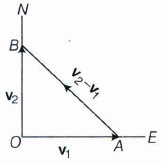
According to triangle law of vector addition, OA + AB = OB
AB = OB -OA = v2-v1 = Change in velocity
|v2-v1| = AB= \(\sqrt { (OA)^{ 2 }+(O{ B) }^{ 2 } } =\sqrt { (5)^{ 2 }+{ (5) }^{ 2 } } =5\sqrt { 2 } \) m/s
Hence, average acceleration = \(\frac { \left| { v }_{ 2 }-{ v }_{ 1 } \right| }{ t } \quad =\frac { 5\sqrt { 2 } }{ 10 } \) = \(\frac { 1 }{ \sqrt { 2 } } \) m/s2
Along North-West direction.
17.
\(\sqrt { { A }^{ 2 }+B^{ 2 }+AB } \)
18.
(i) Mass vaccination is good as, it is used to make the socity free from the diseases like small pox.
(ii) Television for eradication of illiteracy and for mass communication of news and ideas is good as, it is a medium which is easily within the reach of common man and also they are very habitual to it.
(iii) Prenatal sex determination is bad because people are misusing it. Some of the people after determination of sex of child, think to abort. They do it especially with girl child.
(iv) Computer for increase in work efficiency is good as using the computer, a man can do much more work with greater efficiency and accuracy.
(v) Putting artificial satellite into orbits around the Earth is good for development as these satellites serve many purpose like remote sensing, weather foresting.
(vi) Development of nuclear weapons is bad as they can be used in mass destruction.
(vii) Development of new and powerful tool of chemical and biological warfare are bad, as they can also be used for mass destruction.
(viii) Purification of water for drinking purpose is good as we can save ourself from the diseases which we can have due to drinking of the water.
(ix) Plastic surgery is good as with the help of it a man or women can remove the skin defects occurring due to accident or some other reasons. It has some bad effects too but they are not very considerable.
(x) Cloning is good as far as animals are concerned. With the help of it, we can develop some species of animals which can be used to serve some specific purpose. But it is not good for human beings.
19.
Three. Their resultant will be zero provided they can be represented by three sides of a triangle taken in order.
20.
Curved roads are generally banked so as to help in providing centripetal force needed to balance the centrifugal force, arising due to circular motion on the curved road.
21.
A Camot engine is an ideal heat engine from the following points of view:
(i) There is absolutely no friction between the walls of cylinder and the piston.
(ii) The working substance is an ideal gas. In a real engine, these conditions cannot be fulfilled and hence no heat engine working between the same two temperatures can have efficiency greater than that of camot engine
22.
The speedometer measures the instantaneous speed.
23.
According to Stoke's law, viscous force F = 6 \(\pi\eta rv\)
\(\therefore\) Dimensions of \(\eta\) are \(\frac{[F]}{[r][v]}=\frac{MLT^{-2}}{L\times LT^{-1}}[M^1 L^{-1}T^{-1}]\)
24.
Geology.
25.
In all the four cases, as the mass density is uniform, centre of mass is located at their respective geometrical centres.
No, it is not necessary that the centre of mass of a body should lie on the body. For example, in case of a circular ring, centre of mass is at the centre of the ring, where there is no mass.
26.
(i) No negative sign on RHS, hence, not SHM
(ii) Displacement on RHS is squared, hence not SHM
(iii) a = -10x follows the condition of SHM, acceleration α -displacement hence, SHM.
(iv) No negative sign on RHS and displacement appears as cubed, hence, not SHM
27.
75 J / kg , for 1 mole
28.
The air between the two walls of the thermo flask is evacuated. This prevents heat loss due to conduction and convention. The loss of heat due to radiation is minimized by silvering the inside surface of the double wall. As the loss of heat due to the three processes is minimized the tea remains hot for a long time.
29.
The situation is shown in the diagram.
Now, Young's modulus (Y) = \(\frac { f }{ A } \times \frac { L }{ l } \)
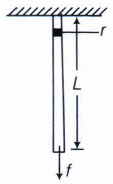
For first wire, Y = \(\frac { f }{ \pi { r }^{ 2 } } \times \frac { L }{ l } \) ....(i)
For second wire, Y = \(\frac { 2f }{ \pi { (2r) }^{ 2 } } \)\(\times \frac { 2L }{ l\prime } =\frac { f }{ \pi { r }^{ 2 } } \times \frac { L }{ l\prime } \) ...(ii)
For Eqs. (i) and (ii), \(\frac { f }{ \pi { r }^{ 2 } } \times \frac { L }{ l } \)= \(\frac { f }{ \pi { r }^{ 2 } } \times \frac { L }{ l\prime } \)
\(\therefore\) l = l' [ \(\because\) both wires are of same material, hence, Young's modulus will be same].
30.
Space also an orientation.We also have the frames of reference in space.Hence, orientational problem will affect the astronaut in space .
31.
Given \({ m }_{ 1 }=1kg ,\ { v }_{ 1 }=(3i-2j)m/s,{ m }_{ 2 }=2 \ kg\ and \ { v }_{ 2 } = (4j-6k)m/s\) When two particles experience a perfectly inelastic collision. They stick together and move with a common velocity v given by
\(v=\frac { { m }_{ 1 }{ v }_{ 1 }+{ m }_{ 2 }{ v }_{ 2 } }{ { m }_{ 1 }+{ m }_{ 2 } } =\frac { 1(3i-2j)+2(4j-6k) }{ 1+2 }\)
\( =(I+2j-4k)m/s\)
Speed of combined particle
\(v=\sqrt { { 1 }^{ 2 }+{ (2) }^{ 2 }+{ (-4 }^{ )2 }=\sqrt { 21 } m/s } \)
32.
\(\text{Linear mass density }=\frac { Mass }{ Length } =\frac { \left[ M \right] }{ \left[ L \right] } =\left[ ML^{ -1 } \right] \)
33.
\(\frac { \triangle x }{ x } =\frac { 0.001 }{ 0.004 } =0.25\)
34.
(a) Force constant \(k=\frac { F }{ l } =\frac { mg }{ l } \)
Here m = 3.0 kg and elongation in length of spring l = 0.2 m
∴ Force constant k = \(\frac{3.0\times 9.8}{0.2}=174Nm^{-1}\)
(b) Period of oscillation \(T=2\pi \sqrt { \frac { m }{ k } } =2\times 3.14\times \sqrt { \frac { 3 }{ 147 } } =0.9s\)
35.
Here mass of bullet, m = 0.05 kg, initial velocity of bullet before firing u = 0, length of barrel of gun, moving through which the bullet is accelerated s = 1m, final muzzle velocity of bullet v = 400ms-1.
(I) Using the relation v2 - u2 = 2as, we have
(400)2 - (0)2 = 2 x a x 1
\(\Rightarrow a={400\times 400\over 2\times 1}=8\times 10^4 ms^{-2}\)
(ii) Force F = ma = 0.05 x 8 x 104 = 4000 N
(iii) Impulse given to the bullet by the gun, J = change in momentum of bullet
= m (v - u) = 0.05 x (400 - 0)
= 20 Ns.
36.
(I) Curiosity, awareness, sharp mind and keen observation.
(ii) The astronauts and the satellite require the centripetal force to revolve around the earth. Their weight is used up in providing the necessary centripetal force. Hence an astronaut feels weightlessness in the space.
37.
(a) v'=2v.
It is possible is source is approaching the stationary listener i.e., vs is +
As \(v^{'}=\frac{v-v_{L}}{v-v_{s}}V\)
∴ 2v = \(\frac{v}{v-v_{s}}V\)
or 2 = \(\frac{v}{v-v_{s}}\)
or 2v - 2vs = v
or 2vs = v
or \(v_{s}=\frac{v}{2}\)
Therefore, source should approach the listener with half the velocity of sound propagation.
(b) \(v^{'}=\frac{v}{2}\)
It is possible if source is receding away from the stationary listener i.e., vs is negative and vL= 0
∴ \(v^{'}=\frac{v}{v+v_{s}}v\)
or \(\frac{v}{2}=\frac{v}{v+v_{s}}v \ or\ \frac{1}{2}=\frac{v}{v+v_{s}}\)
or v + vs = 2v or vs = v
Therefore, source should recede away from the listener with the velocity of sound propagation.
38.
Initially 1000g of water is at 5°C.
Let m gram of it be cooled to ice at O°c.
Heat released due to this = (m x 1 x 5) + (m x 80)
= 5 m + 80 m = 85 meal.
The heat required by (1000 - m) g of water at 5 "C to become steam at lOOoe
[(1000 - m) (100 - 5) + (1000 - m) 540] cal
(1000 - m) (95 + 540) cal
(1000 - 111) (635) cal
Now, 85m (1000 - 111) (635) or 720m = 635 x 1000
m = \(\frac { 635\times 1000 }{ 720 } =881.9g\)
Hence 881.9 g of water by turning into at ooe will supply heat to evaporate 118.1 g of water.
39.
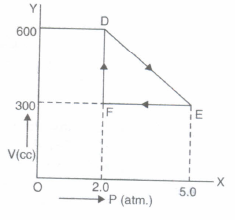
As is clear from Fig.
Change in pressure, Δp = EF = 5.0 - 2.0 = 3.0 atm = 3.0 x 10⁵ Nm-2
Change in volume, ΔV=DF = 600 - 300 = 300 cc = 300 x 10-6 m3
Work done by the gas from 0 to E to F = area of ΔDEF
\(W={1\over 2}\times DF\times EF\)
\(={1\over 2}\times (300 \times 10^{-6})x (3.0 \times 10^5) = 45 J\)
40.
Here, R = 2m M = 100 kg
v = 20 cm/s = 0.2 m/s
Total energy of the hoop = \(\frac { 1 }{ 2 } { Mv }^{ 2 }+\frac { 1 }{ 2 } I{ \omega }^{ 2 }\)
= \(\frac { 1 }{ 2 } {Mv }^{ 2 }+\frac { 1 }{ 2 } (MR^{ 2 }){ \omega }^{ 2 }\)
=\(\frac { 1 }{ 2 } { Mv }^{ 2 }+\frac { 1 }{ 2 } { Mv }^{ 2 }={ Mv }^{ 2 }\)
Work required to stop the hoop = total energy of the hoop
W = Mv2 = 100 (0.2)2 = 4 Joule.
41.
The microscopic domain of physics deals with the constitution and structure of matter at atomic and nuclear scale.
The quantum theory is currently accepted as the proper framework for explaining microscopic phenomena.
42.
Given u = 126 km/h = 126 x \(\frac { 5 }{ 18 } \) rn/s = 35 m/s
S 200 m and v = 0
As v2 - u2 = 2as
∴ 0- (35)2 2a x 200
\(\Rightarrow a=\frac { { -35 }^{ 2 } }{ 400 } =-3.06\quad m/{ s }^{ 2 }\)
Also v = u + at
\(\Rightarrow t=\frac { v-u }{ a } =\frac { 0{ -35 } }{ -3.06 } =11.4 s\)
43.
Given, \({ T }_{ 1 }=300k,{ T }_{ 2 }=?\)
\(\\ { V }_{ 1 }=V,{ V }_{ 2 }=\frac { 4 }{ 3 } V\)
According to Charles law, we get
\(\frac { { V }_{ 2 } }{ { V }_{ 1 } } =\frac { { T }_{ 2 } }{ { T }_{ 1 } } \)
\(\\ \Rightarrow { T }_{ 2 }={ T }_{ 1 }\frac { { V }_{ 2 } }{ { V }_{ 1 } } =300\times \frac { 4 }{ 3 } =400\ k\)
44.
Given for steel wireLength (l1) = 4.7 m
Area of cross-section (A1) = 3.0 x 10⁻⁵m2
For copper wire
Length (l2) =3.5 m
Area of crosssection (A2) = 4.0 x 10⁻⁵m2
Let F be the given load under which steel and copper wires be streched by the same amount \(\Delta l\)
Young's modulus \((Y)=\frac { F/A }{ \Delta l/l } =\frac { F\times l }{ A\times \Delta l } \)
For steel \({ Y }_{ s }=\frac { F\times l_{ 1 } }{ { A }_{ 1 }\times { \Delta l } } \)
For copper \({ Y }_{ c }=\frac { F\times l_{ 2 } }{ { A }_{ 2 }\times { \Delta l } } \)
Dividing Eq (i)by Eq(ii) we get
\(\frac { { Y }_{ s } }{ { Y }_{ c } } =\frac { F\times { l }_{ 1 } }{ { A }_{ 1 }\times \Delta l } \times \frac { { A }_{ 2 }\times \Delta l }{ F\times { l }_{ 2 } }\)
\( \\=\frac { { l }_{ 1 } }{ { l }_{ 2 } } \times \frac { { A }_{ 2 } }{ { A }_{ 1 } } =\frac { 4.7 }{ 3.5 } \times \frac { 4.0\times { 10 }^{ -5 } }{ 3.0\times { 10 }^{ -5 } } \)
\( \frac { { Y }_{ s } }{ { Y }_{ c } } =\frac { 18.8 }{ 10.5 } =1.79=1.8\)
45.
Initial KE = \(\frac { 1 }{ 2 } { I }_{ i }{ \omega }_{ i }^{ 2 }=\frac { 1 }{ 2 } \times{ I }_{ i }\times(40{ ) }^{ 2 }\)
\(=\frac { 1 }{ 2 } \times{ I }_{ i }\times1600=800{ I }_{ i }\)
Final KE = \(\frac { 1 }{ 2 } { I }_{ f }{ \omega }_{ f }^{ 2 }=\frac { 1 }{ 2 } \times\frac { 2 }{ 5 } { I }_{ i }\times(100{ ) }^{ 2 }\)
\(=\frac { 1 }{ 2 } \times\frac { 2 }{ 5 } \times{ I }_{ i }\times100\times100=2000{ I }_{ i }\)
Clearly, final KE > initial KE. This energy is obtained from conversion of muscular work in KE. Muscular work has to be done in folding of arms.
46.
(i) Area swept by blades of windmill = A and wind velocity = v|
\(\therefore \) Volume of air passing per unit time = Av
\(\therefore \) Mass of air passing per unit time = Avp
and mass of air passing in time t, M = Avpt
(ii) KE of said quantity of air , K = \(\frac { 1 }{ 2 } { Mv }^{ 2 }=\frac { 1 }{ 2 } { Aptv }^{ 3 }\)
(iii)
If efficiency of windmill be 25%, then Output electrical power = 25% of input power
\(\frac { 25 }{ 100 } \times \frac { 1 }{ 2 } Ap{ v }^{ 3 }\)
As \(A={ 30m }^{ 2 },\ v=36\ km/h\ =36\times \frac { 5 }{ 18 } m/s\)
\(\\ =10m/s\ and\ p=1.2\ { kgm }^{ -3 }\)
\(\\ \therefore Output\ electrical\ power=\frac { 25 }{ 100 } \times \frac { 1 }{ 2 } \times 30\times 1.2\times ({ 10 })^{ 3 }\)
\(\\ =4500\quad W=4.5\ kW\ 1kW=1000W]\)
47.
Given, R = 1000m
Horizontal range of the bullet fired at an angle \(\theta \) is
\(R=\frac { { u }^{ 2 }sin2\theta }{ g } \Rightarrow 1000=\frac { { u }^{ 2 }sin\theta cos\theta }{ g } ....(i)\)
Bullet is fired from the car moving with 36km/h
i.e.10m/s, then horizontal component of the velocity of = usin\(\theta \) + 10
Vertical component of the velocity of the bullet=usin\(\theta \)
Then, new range of the bullet is
\({ R }_{ 1 }=\frac { 2 }{ g } (usin\theta )(ucos\theta +10)\)
\(\\ =\frac { 2 }{ g } { u }^{ 2 }sin\theta cos\theta +\frac { 20 }{ g } usin\theta \Rightarrow { R }_{ 1 }=R+\frac { 20 }{ g } usin\theta\)
\( \\ \Rightarrow { R }_{ 1 }-R=\frac { 20 }{ g } usin\theta ....(ii)\)
\(\\ From\ Eq.(i),we \ have \ u=\sqrt { \frac { 1000\times g }{ 2sin\theta cos\theta } } .....(iii)|\)
\(\\ Now, \ substituting \ the \ value \ of \ u \ in \ Eq.(ii), \ we \ get\ \)
\(\\ { R }_{ 1 }-R=\frac { 20 }{ g } \sqrt { \frac { 1000\times g }{ 2sin\theta cos\theta } } sin\theta =20\sqrt { \frac { 500\times sin\theta }{ gcos\theta } }\)
\( \\ =20\sqrt { \frac { 500 }{ 9.8 } tan\theta } =142.9\sqrt { tan\theta } \)
48.
(c)
\(\frac{1}{2}\)
49.
(d)
\(\omega\)' < \(\omega\)
50.
(d)
3/2
51.
(d)
displacement ≤ distance
52.
(c)
\(\pi\sqrt{3m\over k}\)
53.
(b)
M0L1T0
54.
(d)
Both light and sound waves in air are longitudinal.
55.
(b)
0.0042
56.
(c)
2k
57.
(a)
angular velocity would increase
58.
(d)
75°C
59.
(b)
50 N
60.
(c)
Diatomic7/2 R, 5/2R
61.
(a)
10-15 m
62.
(b)
t

11th Standard CBSE Syllabus & Materials
11th Standard CBSE
CBSE 11th Business Studies Forms of Business Organisation Sample Question Papers Study Material - QB365 Set A
NEW11th Standard CBSE
CBSE 11th Business Studies Business, Trade and Commerce Sample Question Papers Study Material - QB365 Set A
NEW11th Standard CBSE
CBSE 11th Physics Waves Sample Question Papers Study Material - QB365 Set A
NEW11th Standard CBSE
CBSE 11th Physics Kinetic Theory Sample Question Papers Study Material - QB365 Set A



CBSE 11th Standard CBSE Subjects
CBSE Standards









