
 100% FREE ACCESS
11th Standard Syllabus & Materials
11th Standard
TN 11th Tamil இயற்கை வேளாண்மை,சுற்றுச்சூழல் -செய்யுள் - மனோன்மணீயம் Important Questions And Answers Study Material - QB365 Set A
NEW11th Standard
TN 11th Tamil என்னுயிர் என்பேன் -துணைப்பாடம் - இசைத்தமிழர் இருவர் Important Questions And Answers Study Material - QB365 Set A
NEW11th Standard
TN 11th Tamil மொழி கலை -செய்யுள் - ஒவ்வொரு புல்லையும் Important Questions And Answers Study Material - QB365 Set A
NEW11th Standard
TN 11th Tamil பீடு பெற நில் - இலக்கணம் - பகுபத உறுப்புகள் Important Questions And Answers Study Material - QB365 Set A
NEW11th Standard
TN 11th Tamil பீடு பெற நில் - துணைப்பாடம் - வாடிவாசல் Important Questions And Answers Study Material - QB365 Set A
NEW11th Standard
TN 11th Tamil பீடு பெற நில் - செய்யுள் - குறுந்தொகை Important Questions And Answers Study Material - QB365 Set A

Published on: 01/10/2019
Heat and Thermodynamics
Download Tamil Nadu 11th Standard Physics question papers, model tests, one-mark questions, important questions, and public exam papers in PDF format. Free study materials and answer keys for TN State Board students.
Questions + Answers key
Take MCQ Physics Test1.
2.
State the first law of thermodynamics.
3.
Define one calorie.
4.
What is Wien’s law?
5.
Define one mole.
6.
A refrigerator has COP of 3. How much work must be supplied to the refrigerator in order to remove 200 J of heat from its interion?
7.
A steam engine boiler is maintained at 250°C and water is converted into steam. This steam is used to do work and heat is ejected to the surrounding air at temperature 300K. Calculate the maximum efficiency it can have?
8.
500 g of water is heated from 30°C to 60°C. Ignoring the slight expansion of water, calculate the change in internal energy of the water? (specific heat of water 4184 J/kg.K)
9.
Give an example of a quasi-static process.
10.
A student comes to school by a bicycle whose tire is filled with air at a pressure 240 kPa at 27°C. She travels 8 km to reach the school and the temperature of the bicycle tire increases to 39°C. What is the change in pressure in the tire when the student reaches school?
11.
1 mole of a gas with \(\gamma =\frac { 7 }{ 5 } \) is mixed with 1 mole of gas with \(\gamma =\frac { 5 }{ 3 } \) then value of g of the resulting mixture is ____________.
\(\frac { 7 }{ 5 } \)
\(\frac { 2 }{ 5 } \)
\(\frac { 3 }{ 2 } \)
\(\frac { 12 }{ 7 } \)
12.
An ideal refrigerator has a freezer at temperature −12°C. The coefficient of performance of the engine is 5. The temperature of the air (to which the heat ejected) is
50°C
45.2°C
40.2°C
37.5°C
13.
The efficiency of a heat engine working between the freezing point and boiling point of water is
6.25%
20%
26.8%
12.5%
14.
Identify the state variables given here?
Q, T, W
P, T, U
Q, W
P, T, Q
15.
When you exercise in the morning, by considering your body as thermodynamic system, which of the following is true?
ΔU > 0, W > 0,
ΔU < 0, W > 0,
ΔU < 0, W < 0,
ΔU = 0, W > 0,
16.
In hot summer after a bath, the body’s
internal energy decreases
internal energy increases
heat decreases
no change in internal energy and heat
17.
Consider the following cyclic process consist of isotherm, isochoric and isobar which is given in the figure.
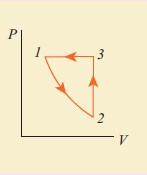
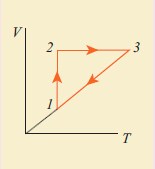
Draw the same cyclic process qualitatively in the V-T diagram where T is taken along x direction and V is taken along y-direction. Analyze the nature of heat exchange in each process.
18.
Define heat engine.
19.
What is a black body?
20.
What is a thermal expansion?
21.
Explain in detail Newton’s law of cooling.
22.
Discuss the ideal gas laws.
1.
2.
First law of thermodynamics states that change in internal energy of the system is equal to heat supplied to the system (Q) minus the work done by the system (W) on the surrounding.
ΔU = Q-W
3.
One calorie is defined as the amount of energy required to raise 1 gram of an object by 1oc.
4.
Wien's law states that, the wavelength of maximum intensity of emission of a black body radiation is inversely proportional to the absolute temperature of the black body.
\({ \lambda }_{ m } \)∝\(\frac { 1 }{ T } \)
\({ \lambda }_{ m }=\frac { b }{ T } \)
5.
One mole of any substance is the amount of that substance which contains Avogadro number (NA) of particles such as atoms or molecules.
6.
COP = \(\beta\) = \(\frac{Q_L}{W}\)
W = \(\frac{QC}{COP}=\frac{200}{3}\) = 66.67J
7.
The steam engine is not a Carnot engine, because all the process involved in the steam engine are not perfectly reversible. But we can calculate the maximum possible efficiency of the steam engine by considering it as a Carnot engine.
\(\eta =1-\frac { { T }_{ L } }{ { T }_{ H } } =1-\frac { 300K }{ 523K } =0.43\)
The steam engine can have maximum possible 43% of efficiency, implying this steam engine can convert 43% of input heat into useful work and remaining 57% is ejected as heat. In practice the efficiency is even less than 43%.
8.
When the water is heated from 30°C to 60°C, there is only a slight change in its volume. So we can treat this process as isochoric. In an isochoric process the work done by the system is zero. The given heat supplied is used to increase only the internal energy.
ΔU = Q = msv ΔT
The mass of water = 500 g = 0.5 kg
The change in temperature = 30K
The heat Q = 0.5\(\times\)4184\(\times\)30 = 62.76 kJ
9.
Consider a container of gas with volume V, pressure P and temperature T. If we add sand particles one by one slowly on the top of the piston, the piston will move inward very slowly. This can be taken as almost a quasi-static process. It is shown in the figure
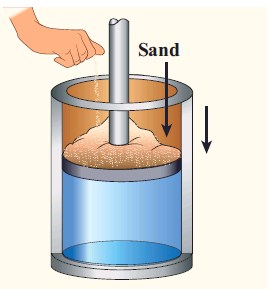
Sand particles added slowly- quasi-static process
10.
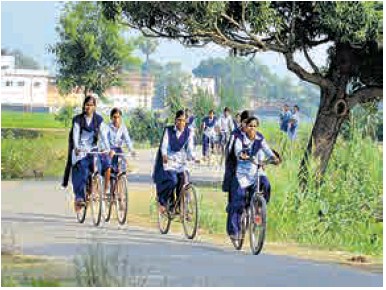
We can take air molecules in the tire as an ideal gas. The number of molecules and the volume of tire remain constant. So the air molecules at 27°C satisfies the ideal gas equation P1V1 = NkT1 and at 39°C it satisfies P2V2 = NkT2
But we know
V1 = V2 = V
\(\frac { { P }_{ 1 }V }{ { P }_{ 2 }V } =\frac { Nk{ T }_{ 1 } }{ Nk{ T }_{ 2 } } \)
\(\frac { { P }_{ 1 } }{ { P }_{ 2 } } =\frac { { T }_{ 1 } }{ { T }_{ 2 } } \)
\( { P }_{ 2 } =\frac { { T }_{ 1 } }{ { T }_{ 2 } } { P }_{ 1 }\)
\({ P }_{ 2 }=\frac { 312K }{ 300K }\times 240\times{ \ 10 }^{ 3 }Pa=249.6Pa\qquad \)
11.
(c)
\(\frac { 3 }{ 2 } \)
12.
\(\mathrm{COP}=\frac{T_{L}}{T_{H}-T_{L}}\)
\(\mathrm{T}_{\mathrm{L}}=-12+273 =261 \mathrm{~K} \)
\(5=\frac{261}{T_{H}-261} \)
\(\therefore 5\left(T_{H}-261\right) =261 \)
\(5 \mathrm{~T}_{\mathrm{H}}-1305 =261 \)
\(5 \mathrm{~T}_{\mathrm{H}} =261+1305 =1566 \)
\(\therefore T_{H} =\frac{1566}{5} \)
\(=313.2 \mathrm{~K} \)
\(\mathrm{~T}_{\mathrm{H}}=313.2-273 =40.2^{\circ} \mathrm{C} \)
13.
\(\mathrm{T}_{2} =0^{\circ} \mathrm{C}+273=273 \mathrm{~K} \)
\(\mathrm{~T}_{1}=100^{\circ} \mathrm{C}=100+273=373 \mathrm{~K} \)
\(\eta =1-\frac{T_{2}}{T_{1}} \)
\(=1-\frac{273}{373} \)
\(=\frac{373-273}{373} \)
\(=\frac{100}{373}=0.26809 \times 100 \)
\(=26.809 \% \)
14.
(b)
P, T, U
15.
\(\Delta Q=\Delta U+\Delta W\)
When, exercise is performed internal energy is utilised (\(\Delta\)U < 0) so it will decrease. But as intemal energy is utilised, exercise ( \(\Delta\)W ) will be more efficient.
\(\therefore \Delta W>0 \ \therefore \Delta U <0 \mathrm{~W}>0\)
16.
(a)
internal energy decreases
17.
Process 1 to 2 = increase in volume. So heat must be added.
Process 2 to 3 = Volume remains constant. Increase in temperature. The given heat is used to increase the internal energy.
Process 3 to 1 = Pressure remains constant. Volume and Temperature are reduced. Heat flows out of the system. It is an isobaric compression where the work is done on the system.
In the process marked as 1-2, the gas undergoes isothermal 'expansion. It receiver certain amount of heat from the outside of spends all this heat in doing work the internal energy of the gas remains unchanged.
In the process marked as 2-3, the gas is heated isochorically (at constant volume). Since its volume does not change, no work is done. The internal energy of the gas is increased only due to the heat transferred to the gas from the outside.
In the process exhibited by 3-1, the gas is compressed isobarically (at constant pressure) of its temperature drops work is done on the gas, but its internal energy is reduced. This means the gas intensively gives up heat to the medium.
18.
Heat engine is a device which takes heat as input and converts this heat in to work by undergoing a cyclic process.
19.
A black body is the one which absorbs completely heat radiations of all wavelengths when heated. A black body neither reflects nor transmits any radiation. Its absorptive power is unity.
20.
Thermal expansion is the tendency of matter to change in shape, area, and volume due to a change in temperature.
21.
Newton's law of cooling states that the rate of loss of heat of a body is directly proportional to the difference in the temperature between that body and its surroundings.
\(\frac{d Q}{d t} \propto-\left(\mathrm{T}-\mathrm{T}_{s}\right)\) ...(1)
The negative sign indicates that the quantity of heat lost by liquid goes on decreasing with time. Where,
T = Temperature of the object
Ts = Temperature of the surrounding
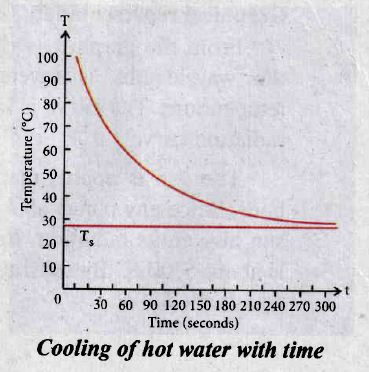
From the graph in figure it is clear that the rate of cooling is high initially and decreases with falling temperature.
Let us consider an object of mass m and specific heat capacity s at temperature T. Let Ts be the temperature of the surroundings. If the temperature falls by a small amount dT in time dt, then the amount of heat lost is,
dQ = msdT ........(2)
(iv) Dividing both sides of equation (2) by dt
\(\frac { dQ }{ dt } =\frac { msdT }{ dt } \)..........(3)
From Newton's law of cooling
\(\frac { dQ }{ dt } \propto -(T-{ T }_{ s })\)
\(\frac { dQ }{ dt } =-\alpha (T-{ T }_{ s })\) ...(4)
Where a is some positive constant.
From equation (2) and (4)
-\(\alpha\) (T - Ts) = \(md\frac { dt }{ dt } \)
\(\frac { dt }{ T-{ T }_{ s } } =\frac { a }{ ms } dt\) ....(5)
Integrating equation (5) on both sides,
\(\int _{ 0 }^{ \infty }{ \frac { dt }{ T-{ T }_{ a } } =-\int _{ 0 }^{ 1 }{ \frac { a }{ ms } dt } } \)
ln (T - Ts) = \(-\frac { a }{ ms } t+{ b }_{ 1 }\)
Where b1 is the constant of integration taking exponential both sides, we get
\(\mathrm{T} =T_{s}+b_{2} e^{-\frac{a}{m s} t} \)
here \(\mathrm{~b}_{2} =e^{b_{1}}=\text { constant }\)
22.
When the gas is kept at constant temperature, the pressure of the gas is inversely proportional to the volume. \(P \propto \frac{1}{V}\). It was discovered by Robert Boyle (1627-1691) and is known as Boyle's law.
When the gas is kept at constant pressure, the volume of the gas is directly proportional to absolute temperature. \(V \propto T\). It was discovered by Jacques Charles (1743-1823) and is known as Charles' law.
By combining these two equations we have
PV = CT. Here C is a positive constant.
We can infer that. C is proportional to the number of particles in the gas container by considering the following argument. If we take two containers of same type of gas with same volume V, same pressure P and same temperature T, then the gas in each container obeys the above equation. PV = CT. If the two containers of gas is considered as a single system, then the pressure and temperature of this combined system will be same but volume will be twice and number of particles will also be double as shown in Figure.
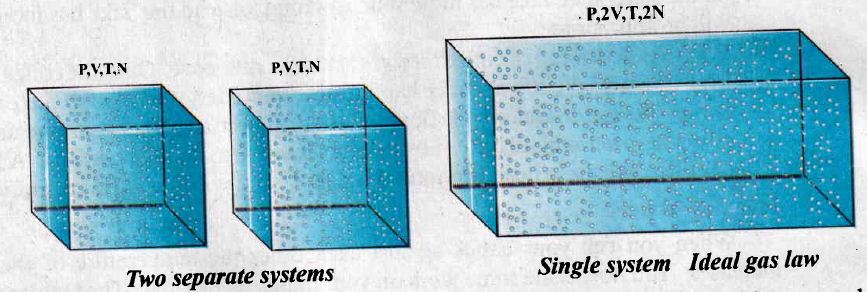
For this combined system, V becomes 2V, so C should also double to match with the ideal gas equation \(\frac { P(2V) }{ T } =2C\). It implies that C must depend on the number of particles in the gas and also should have the dimension of \(\left[ \frac { PV }{ T } \right] ={ JK }^{ -1 }\). So we can write the constant C as k times the number of particles N.
Here k is the Boltzmann constant (1.381\(\times\)10-23 JK-1) and it is found to be a universal constant.
So the ideal gas law can be stated as follows
PV = NkT ....(1)
The equation (1 )can also be expressed in terms of mole.
Suppose if a gas contains \(\mu\) mole of particles then the total number of particles can be written as
\(\mathrm{N}=\mu \mathrm{N}_{\mathrm{A}}\) .....(2)
where NA is Avogádro number \(\left(6.023 \times 10^{23} \mathrm{~mol}^{-1}\right)\)
Substituting for N from equation (2), the equation (1) becomes
\(\mathrm{PV}=\mu N_{A} k T\)
Here \(\mathrm{N}_{\mathrm{A}} \mathrm{k}=\mathrm{R}\) called universal gas constant and its value is \(8.314 \mathrm{~J} / \mathrm{mol}. \mathrm{K}\).
So the ideal gas law can be written for $\mu$ mole of gas as
\(\mathrm{PV}=\mu R T\)
This is called the equation of state for an ideal gas. It relates the pressure, volume and temperature of thermodynamic system at equilibrium.

11th Standard Syllabus & Materials
11th Standard
TN 11th Tamil பீடு பெற நில் - செய்யுள் - காவடிச்சிந்து Important Questions And Answers Study Material - QB365 Set A
NEW11th Standard
TN 11th Tamil பீடு பெற நில் - உரைநடை - மலை இடப்பெயர்கள் : ஓர் ஆய்வு Important Questions And Answers Study Material - QB365 Set A
NEW11th Standard
TN 11th Tamil மாமழை போற்றுதும் - துணைப்பாடம் - யானை டாக்டர் Important Questions And Answers Study Material - QB365 Set A
NEW11th Standard
TN 11th Tamil மாமழை போற்றுதும் - செய்யுள் - ஐங்குறுநூறு Important Questions And Answers Study Material - QB365 Set A



Tamilnadu Stateboard 11th Standard Subjects

Maths

Commerce

Economics

Biology

Business Maths and Statistics

Accountancy

Computer Science
Physics

Chemistry
Maths
Biology
Economics
Physics
Chemistry

History
Business Maths and Statistics

Computer Science
Accountancy

Computer Applications
History
Computer Technology
Commerce
Computer Applications
Computer Technology

Tamil

English

French
Tamilnadu Stateboard Standards

