
 100% FREE ACCESS
11th Standard Syllabus & Materials
11th Standard
TN 11th Tamil இயற்கை வேளாண்மை,சுற்றுச்சூழல் -செய்யுள் - மனோன்மணீயம் Important Questions And Answers Study Material - QB365 Set A
NEW11th Standard
TN 11th Tamil என்னுயிர் என்பேன் -துணைப்பாடம் - இசைத்தமிழர் இருவர் Important Questions And Answers Study Material - QB365 Set A
NEW11th Standard
TN 11th Tamil மொழி கலை -செய்யுள் - ஒவ்வொரு புல்லையும் Important Questions And Answers Study Material - QB365 Set A
NEW11th Standard
TN 11th Tamil பீடு பெற நில் - இலக்கணம் - பகுபத உறுப்புகள் Important Questions And Answers Study Material - QB365 Set A
NEW11th Standard
TN 11th Tamil பீடு பெற நில் - துணைப்பாடம் - வாடிவாசல் Important Questions And Answers Study Material - QB365 Set A
NEW11th Standard
TN 11th Tamil பீடு பெற நில் - செய்யுள் - குறுந்தொகை Important Questions And Answers Study Material - QB365 Set A

Published on: 18/02/2019
+1 Second Revision Test Question Answer
Download Tamil Nadu 11th Standard Physics question papers, model tests, one-mark questions, important questions, and public exam papers in PDF format. Free study materials and answer keys for TN State Board students.
Questions + Answers key
Take MCQ Physics Test1.
Two simple pendulums of time periods 2.0 s & 2.1 s are made to vibrate simultaneously. They are in phase initially, after how may vibrations are there in the same phase?
21
25
30
35
2.
If there were no gravity, which of the following will not be there for a fluid?
viscosity
surface tension
pressure
archimedes upward thrust
3.
A transverse wave moves from a medium A to a medium B. In medium A, the velocity of the transverse wave is 500 ms-1 and the wavelength is 5 m. The frequency and the wavelength of the wave in medium B when its velocity is 600 ms-1, respectively are
120 Hz and 5 m
100 Hz and 5 m
120 Hz and 6 m
100 Hz and 6 m
4.
The damping force on an oscillator is directly proportional to the velocity. The units of the constant of proportionality are
kgms−1
kgms−2
kgs−1
kgs
5.
The ratio \(\gamma =\frac { { C }_{ p } }{ { C }_{ V } } \) for a gas mixture consisting of 8 g of helium and 16 g of oxygen is
23/15
15/23
27/11
17/27
6.
When a uniform rod is heated, which of the following quantity of the rod will increase
mass
weight
center of mass
moment of inertia
7.
8.
The work done by the Sun’s gravitational force on the Earth is
always zero
always positive
can be positive or negative
always negative
9.
A circular disc is rolling down in an inclined plane without slipping. The percentage of rotational energy in its total energy is ______________.
66.61%
33.33%
22.22%
50%
10.
If \(|\vec P\times \vec Q|=|\vec P.\vec Q|\), then angle between \(\vec P\) and \(\vec Q\) will be ______________
0o
45o
90o
180o
11.
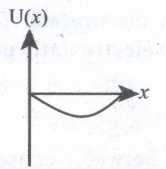
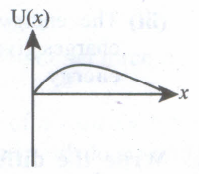
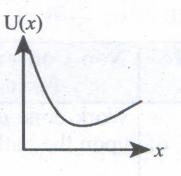
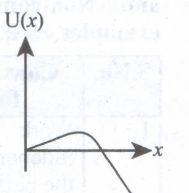
A particle which is constrained to move along x-axis, is subjected to a force in the same direction which varies with the distance x of the particle from the origin as F(x) = kx + ax3. Here, k and a are positive constants. For x ≥ 0, the functional form of the potential, energy U(x) of the particles
12.
A particle is moving with a constant velocity along a line parallel to positive X-axis. The magnitude of its angular momentum with respect to the origin is
zero
increasing with x
decreasing with x
remaining constant
13.
A book is at rest on the table which exerts a normal force on the book. If this force is considered as reaction force, what is the action force according to Newton's third law?
Gravitational force exerted by Earth on the book
Gravitational force exerted by the book on Earth
Normal force exerted by the book on the table
None of the above
14.
If a particle executes uniform circular motion, choose the correct statement
The velocity and speed are constant
The acceleration and speed are constant.
The velocity and acceleration are constant.
The speed and magnitude of acceleration are constant.
15.
A length-scale (I) depends on the permittivity (e) of a dielectric material, Boltzmann constant (kB), the absolute temperature (T), the number per unit volume (n) of certain charged particles, and the charge (q) carried by each of the particles. Which of the following expression for I is dimensionally correct?
\(l=\sqrt{{{nq^2}\over{\epsilon {k}_{B}T}}}\)
\(l=\sqrt{{{\epsilon {k}_{B}T}\over{nq^2}}}\)
\(l=\sqrt{{{q^2}\over{e{n}^{{{2}\over{3}}}{k}_{B}}T}}\)
\(l=\sqrt{{{q^2}\over{\epsilon n{k}_{B}T}}}\)
16.
What is Reverberation?
17.
Calculate the speed of sound in a steel rod whose Young’s modulus Y = 2\(\times\)1011 N m-2 and \(\rho\) = 7800 kg m-3.
18.
State the second law of thermodynamics in terms of entropy.
19.
Estimate the mass of air in your class room at NTP. Here NTP implies normal temperature (room temperature) and 1 atmospheric pressure.
20.
Define stress and strain.
21.
An object is thrown vertically downward. What is the acceleration experienced by the object?
22.
Deduce dimensional formulae of Boltzmann's constant
23.
Define the different types of potential energy?
24.
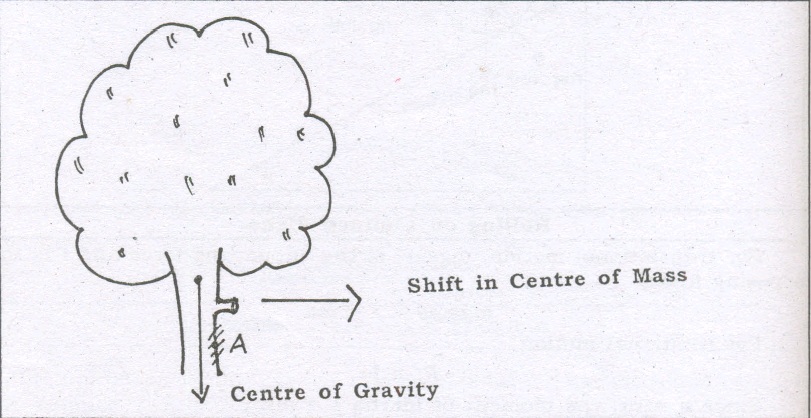
When a tree is cut, the cut is made on the side facing the direction in which the tree is required to fall. Why?
25.
Can a single isolated force exist in nature? Explain your answer
26.
Define one newton.
27.
State Newton's law of cooling verify with an experiment.
28.
State and prove Bernoulli’s theorem for a flow of incompressible, non-viscous, and streamlined flow of fluid.
29.
30.
Identify the free body diagram that represents the particle accelerating in positive x direction in the following.
31.
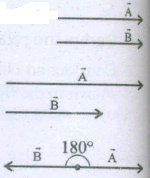
Define and illustrate the following terms.
(i) Equal vectors
(il) Parallel vectors
(iii) Anti-parallel vectors
(iv) Unit vector.
32.
Find the work done in pulling and pushing another through 200 m horizontally when a force of 1000N is acting along a chain making an angle of 60° with ground. Assume the floor to be smooth frictionless surface.
33.
Derive an expression for the Center of Mass of Two Point Masses.
34.
A particle is projected upward from the surface of the earth (radius) with a K.E equal to half the minimum value needed for it to escape. To which height, does it rise above the surface of earth?
35.
Write the main features of the prevost theory.
36.
State and explain Boyle's law.
37.
Write down the equation of time period for linear harmonic oscillator.
38.
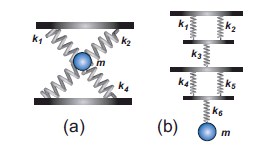
Calculate the equivalent spring constant for the following systems and also compute if all the spring constants are equal:
39.
The following graphs represent position-time graphs. Arrange the graphs in ascending order of increasing speed.
.png)
40.
A metre stick is balanced on a knife edge at its centre. When two coins, each of mass 5g are put one on top of the other at the 12.0 cm mark, the stick is found to be balanced at 45.0 cm, what is the mass of the meter stick?
41.
Obtain an expression for the time period T of a simple pendulum. The time period T depend upon
(i) mass 'm' of the bob
(ii) length 'l' of the pendulum and
(iii) acceleration due to gravity g at the place where the pendulum is suspended. (Constant k = 2π) i.e
42.
What is the stopping distance for a vehicle, of mass m moving with speed v along a level road, if the co-efficient of friction between the tyres and the road is \(\mu\)?
43.
In a physical units, how many units are there in 1 metre?
1 micron (\(\mu\)) = 10-6 m
Given data:
1 AU = 1.496\(\times\)1011m
1 ly = 9.467\(\times\)1015m
1 mm = 10-6m
1 parsec = 3.08\(\times\)1016m
1.
(a)
21
2.
(d)
archimedes upward thrust
3.
\(v_{\mathrm{A}}=500 \mathrm{~ms}^{-1} \quad \lambda_{A}=5 \mathrm{~m}\)
Frequency in medium B
\(\mathrm{f}_{\mathrm{B}}=\frac{v_{A}}{\lambda_{A}}=\frac{500}{5}=100 \mathrm{~Hz}\)
Wavelength in medium B
\(\lambda_{B}=\frac{v_{s}}{f_{s}}=\frac{600}{100}=6 \mathrm{~Hz}\)
4.
\(\mathrm{F}_{\mathrm{d}} \propto \mathrm{v} \)
\(\mathrm{F}_{\mathrm{d}}=-\mathrm{bv} ; \quad \mathrm{F}_{\mathrm{d}}=\mathrm{kv} \)
\(\therefore \mathrm{k}=\frac{F_{d}}{v} \)
\(\text { Units of } k=\frac{k g m s^{-2}}{m s^{-1}}\)
\(\mathrm{k}=\mathrm{kg} \mathrm{s}^{-1}\)
5.
\(\gamma=\frac{27}{17}\)
Number of moles of helium
\(\mathrm{n}=\frac{8}{4}=2\)
Number of moles of oxygen
\(n^{\prime}=\frac{16}{32}=\frac{1}{2}\)
For mono atomic Helium gas
\(\mathrm{f} =3 \)
\(\mathrm{C}_{\mathrm{V}} =\frac{f}{2} R \)
\(=\frac{3}{2} R \)
For diatomic oxygen gas
f = 5
\(\mathrm{C}_{\mathrm{V}} =\frac{f}{2} R \)
\(=\frac{5}{2} R \)
\(\mathrm{C}_{\mathrm{V}} \text { mixture } =\frac{n c_{v}+n^{\prime} C_{v}^{\prime}}{n+n^{\prime}} \)
\(=\frac{2 \times \frac{3}{2} R+\frac{1}{2} \times \frac{5}{2} R}{2+\frac{1}{2}} \)
\(C_{V} =\frac{3 R+\frac{5}{4} R}{\frac{5}{2}} \)
\(=\frac{17 R}{10} \)
\(\gamma =\frac{C_{p}}{C_{v}} \)
\(=1+\frac{R}{C_{V}} \)
\(=1+\frac{R}{\frac{17 R} {10}}\)
\(=1+\frac{10}{17} \)
\(=\frac{27}{17} \)
6.
Moment of Inertia = MK2
K-Radius of gyration
During heating K would be increased.
Hence moment of inertia will increase
7.
(b)
8.
(c)
can be positive or negative
9.
(b)
33.33%
10.
(c)
90o
11.
\(F=-\frac{d u}{d x} \quad F(x) =k x+a x^{3} \)
\(d u =-F d x \)
\(u(x) =-\int_{0}^{x}\left(-k x+a x^{3}\right) d x \)
\(=\int_{0}^{x} k x d x-a \int_{0}^{x} x^{3} d x \)
\(=\frac{k x^{2}}{2}-\frac{a x^{4}}{2} \)
\(U(x) =\frac{x^{2}}{2}\left(k-\frac{a x^{2}}{2}\right) \)
\(u(x)=0 \text { at } x=0 \text { and }\)
\(U(x) =0 ; k-\frac{a x^{2}}{2}=0 \)
\(=\frac{a}{2} x^{2}=-k \)
\(x^{2} =\frac{2 k}{a} \)
\(\therefore x =\sqrt{\frac{2 k}{a}} \)
\(\text { Clearly } u(x)=0 \text { at } x=0 \text { and }\)
\(x=\sqrt{\frac{2 k}{a}}\)
\(\text { For } x>\sqrt{\frac{2 k}{a}} U(x) \text { will be negative. } \)
\(\text { At } x=0 ; F=\frac{-d u}{d x}=0\)
(i.e.,) Slope of V - x graph is zero at x = 0
Hence the most appropriate answer is d.
12.
(d)
remaining constant
13.
(c)
Normal force exerted by the book on the table
14.
It is a uniform circular motion. So the direction of velocity changes but not the magnitude. Therefore speed in considered constant. Again magnitude of acceleration does not change.
15.
\(\text {Dimension of permittivity } \varepsilon=A^{2} C^{2} N^{-1} m^{-2}\)
\(\text {Dimension of Boltzmann constant } k_{B}=\left[\mathrm{ML}^{2} \mathrm{~T}^{-2} \mathrm{~K}^{-1}\right]\)
\(\text {Dimension of Absolute Temperature }=T\)
No. of charged particles per unit
Volume = No. of dimensions = a
Dimension of charge = AT
Dimension of length = L
\(\text { Dimension of }=\frac{\sqrt{\varepsilon k_{B} T}}{n q^{2}}\)
\(=\frac{\sqrt{\left[\mathrm{A}^{2} \mathrm{C}^{2} \mathrm{~N}^{-1} \mathrm{~m}^{-2}\right]}\left[\mathrm{ML}^{2} \mathrm{~T}^{-2} \mathrm{~K}^{-1}\right][\mathrm{T}]}{[\mathrm{AT}]^{2}}\)
\(=\sqrt{L^{2}}=L\)
\(\therefore \text { Dimension of length }=\mathrm{L}\)
16.
In a closed room the sound is repeatedly reflected from the walls and it is even heard long after the sound source ceases to function. The residual sound remaining in an enclosure and the phenomenon of multiple reflections of sound is called reverberation.
17.
\(v=\sqrt { \frac { y }{ \rho } } =\sqrt { \frac { 2\times { 10 }^{ 11 } }{ 7800 } } =\sqrt { 0.2564\times { 10 }^{ 8 } } \)
= 0.506\(\times\)104ms-1= 5\(\times\)103ms-1
Therefore, longitudinal waves travel faster in a solid than in a liquid or a gas. Now you may understand why a shepherd checks before crossing railway track by keeping his ears on the rails to safeguard his cattle.
18.
For all the processes that occur in nature (irreversible process), the entropy always increases. For reversible process entropy will not change.
19.
The average size of a class is 6m length, 5 m breadth and 4 m height. The volume of the room V = 6\(\times\)5 \(\times\)4 = 120m3. We can determine the number of mole. At room temperature 300K, the volume of a gas occupied by any gas is equal to 24.6L.
The number of mole \(\mu =\frac { 120{ m }^{ 2 } }{ 24.6\times { 10 }^{ -3 }{ m }^{ 3 } } \approx 4878mol\)
Air is the mixture of about 20% oxygen, 79% nitrogen and remaining one percent are argon, hydrogen, helium, and xenon. The molar mass of air is 29 g mol-1.
So the total mass of air in the room m = 4878\(\times\)29 = 141.4kg
20.
Stress: Stress is defined as the restoring force per unit area.
Stress, \(\sigma=\frac{Force}{Area}\)
Strain: Strain is defined as the rates of change in size to the original size if an object.
Strain, ε \(=\frac{\Delta l}{l}\)
21.
.png)
We know that when the object falls towards the Earth, it experiences acceleration due to gravity g = 9.8 m s-2 downward. We can choose the coordinate system as shown in the figure. The acceleration is along the negative y direction.
\(\vec { a } =g(-\hat { j } )-g\hat { j } \)
22.
k=\(\frac { Heat }{ Temperature } =[k]=\frac { [{ ML }^{ 2 }{ T }^{ 2 }] }{ [K] } \)= [M1L2T-2K-1]
23.
(i) The energy possessed by the body due to gravitational force gives rise to gravitational potential energy.
(ii) The energy due to spring force and other similar forces give rise to elastic potential energy.
(iii) The energy due to electrostatic force on charges gives rise to electrostatic potential energy.
24.
The weight of tree exerts a torque about the point where the cut is made. This causes rotation of the tree about the cut has to be made at say point A to weaken the tree trunk and to shift the centre of mass to the right and eventually move towards the ground on the right.
25.
No, a single isolated force cannot exist in nature because it violates the Newton's third law.
26.
One Newton is that force which produces an acceleration of 1 m/s-2 in a body of mass 1 kilogram.
∴ 1 Newton = 1 kg m/s2
27.
(i). It states that the rate of cooling of a body is directly proportional to the temperature differ between the body and the surroundings.
(ii) Consider a spherical calorimeter of mass m whose outer surface is blackened. It is filled with hot water of mass m, the calorimeter with thermometer is suspended from a stand.
(iii) The calorimeter & the hot water radiate heat energy to the surrounding. Using a stop clock, the temperature is noted for every 30 sec. interval of time tree the temperature falls by about 20°C. The readings are tabulated.
(iv) If the temperature falls from T1 to T2 in I see, the quantity of heat energy lost by radiation Q = (ms + m1s1)(T1 - T2), where 's' is the specific heat capacity of the material of the calorimeter & S1 - specific heat capacity of water.
Rate of cooling =\(\frac{Heat energy lost}{timet_n}\)
\(\therefore \frac { Q }{ E } =\frac { \left( ms+{ m }_{ 1 }{ m }_{ 1 } \right) \left( { T }_{ 1 }+{ T }_{ 2 } \right) }{ t } \)
Room temperature - To
(v) Average excess temperature of the colorimeter over that of the surroundings
\(-\frac { { T }_{ 1 }-{ T }_{ 2 } }{ 2 } ={ T }_{ 0 }\)
(vi) Acceleration to Newton's law of cooling
\(\frac { Q }{ T } =\left( \frac { { T }_{ 1 }+{ T }_{ 2 } }{ 2 } -{ T }_{ 0 } \right) \)
(vii) Assume the pressure of the gas remains constant during an infinitesimally small outward displacement dy then work done dW - F. dx = P.A. dx
dW = pdv
Total work done by the gas from volume
V1 to v2 is \(W=\int _{ { v }_{ 1 } }^{ { v }_{ 2 } }{ pdv } \)
(ix) But pv\(\gamma\) = constant (k)
\(W=\int _{ { v }_{ 1 } }^{ { v }_{ 2 } }{ k{ v }^{ \gamma } } dv=k{ \left[ \frac { { v }^{ \gamma -1 } }{ 1-\gamma } \right] }_{ { v }_{ 1 } }^{ { v }_{ 2 } }\quad \left[ \because p=\frac { k }{ { v }^{ \gamma } } \right] \)
\(\therefore W=\frac { k }{ 1-\gamma } \left[ { v }_{ 2 }^{ 1-\gamma }{ -v }_{ 1 }^{ 1-\gamma } \right] \)
\(W=\frac { 1 }{ 1-\gamma } \left[ { kv }_{ 2 }^{ 1-\gamma }{ -kv }_{ 1 }^{ 1-\gamma } \right] \)
\({ p }_{ 2 }{ v }_{ 2 }^{ \gamma }={ p }_{ 1 }{ v }_{ 2 }^{ \gamma }\)
(x) Subtract the value of k
\(\therefore W=\frac { 1 }{ 1-\gamma } \left[ { p }_{ 2 }{ v }_{ 2 }^{ \gamma },{ v }_{ 2 }^{ 1-\gamma }-{ p }_{ 1 }{ v }_{ 1 }^{ \gamma }{ v }_{ 1 }^{ 1-\gamma } \right] \)
\(W=\frac { 1 }{ 1-\gamma } \left[ { { p }_{ 2 }v }_{ 2 }^{ }{ -{ p }_{ 1 }v }_{ 1 }^{ } \right] \)
It T~ is the final temperature of the gas in adorable expansion, then
p1v1 = RT1P2v2 = RT2
\(\therefore W=\frac { 1 }{ 1-\gamma } \left[ { R }_{ 2 }^{ }{ -R }_{ 1 }^{ } \right] \)
This is the equation for the work done during adiabatic process.
28.
According to Bernoulli's theorem, the sum of pressure energy, kinetic energy, and potentialenergy per unit mass of an incompressible, nonviscous fluid in a streamlined flow remains a constant. Mathematically,
\(\frac{P}{\rho}+\frac{1}{2}v^{2}+gh\) = constant
This is known as Bernoulli's equation.
Proof:
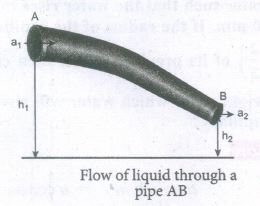
Let us consider a flow of liquid through a pipe AB as shown in Figure. Let V be the volume of the liquid when it enters A in a time t which is equal to the volume of the liquid leaving B in the same time. Let aA, vA and PA be the area of cross section of the tube, velocity of the liquid and pressure exerted by the liquid at A respectively.
Let the force exerted by the liquid at A is
FA= PAaA
Distance travelled by the liquid in time t is
d = vAt
Therefore, the work done is
W = FAd = PAaAvA t
But aAvAt = aAd = V, volume of the liquid entering at A.
Thus, the work done is the pressure energy (at A), W = FAd = PAV
Pressure energy per unit volume at
A = \(\frac{Pressure \ energy}{volume}=\frac{P_{A} V}{V}=P_{A}\)
Pressure energy per unit mass at
A = \(\frac{Pressure \ energy}{volume}=\frac{P_{A} V}{m}=\frac{P_{A}}{\frac{m}{V}}=\frac{P_{A}}{\rho}\)
Since m is the mass of the liquid entering at A in a given time, therefore, pressure energy of the liquid at A is
\(E_{PA}=P_{A}V=P_{A}V\times (\frac{m}{m})=m \frac{P_{A}}{\rho}\)
Potential energy of the liquid at A, PEA = mg hA,
Due to the flow of liquid, the kinetic energy of the liquid at A,
\(KE_{A}=\frac{1}{2}m V_{A}^{2}\)
Therefore, the total energy due to the flow of liquid at A, EA= EPA+ KEA + PEA
\(E_{A}=m \frac{P_{A}}{\rho}+\frac{1}{2}m V^{2}_{A}+mg \ h_{A}\)
Similarly, let aB, vB, and PB be the area of cross section of the tube, velocity of the liquid, and pressure exerted by the liquid at B. Calculating the total energy at EB, we get
\(EB=m \frac{P_{B}}{\rho}+\frac{1}{2}mv^{2}_{B}+mg h_{B}\)
From the law of conservation of energy,
EA = EB
\(m \frac{P_{A}}{\rho}+\frac{1}{2} mv^{2}_{A}+mgh_{A}=m\frac{P_{B}}{\rho}+\frac{1}{2}mv^{2}_{B}+mgh_{B}\)
\(\frac{P_{A}}{\rho}+\frac{1}{2}V^{2}_{A}+gh_{A}=\frac{P_{B}}{\rho}+\frac{1}{2}V^{2}_{B}+gh_{B}\) = constant
Thus, the above equation can be written as
\(\frac{P}{\rho g}+\frac{1}{2}\frac{v^{2}}{g}+h\) = constant
The above equation is the consequence of the conservation of energy which is true until there is no loss of energy due to friction. But in practice, some energy is lost due to friction. This arises due to the fact that in a fluid flow, the layers flowing with different velocities exert frictional forces on each other. This loss of energy is generally converted into heat energy. Therefore, Bernoulli's relation is strictly valid for fluids with zero viscosity or non-viscous liquids. Notice that when the liquid flows through a horizontal pipe, then \(\mathrm{h}=0 \Rightarrow \frac{P}{\rho g}+\frac{1}{2} \frac{v^{2}}{g}=\) constant.
29.
30.
The relative magnitude of forces should be indicated when the free body diagram for mass m is drawn.
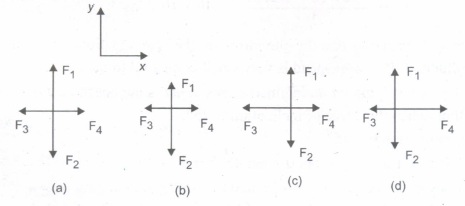
Case (a): The forces F1 and F2 have equal length but opposite direction. So net force along y-direction is zero. Since the force is zero, acceleration is also zero along Y-direction (Newton's second law). Similarly in the x direction, F3 and F4 have equal length and opposite in direction. So 'net force is zero in the x direction. So there is no acceleration in x direction.
Case (b): The forces F1 and F2 are not equal in length and act opposite to each other. The figure (b) shows that there are unbalanced forces along the y-direction. So the particle has acceleration in the y-direction. The forces F3 and F4 are having equal length and act in opposite directions. So there is no net force along the x direction. So the particle has no acceleration in the x direction.
Case (c): The forces F1 and F2 are equal in magnitude and act opposite to each other. The net force is zero in y direction. F3 So in y-direction there is no acceleration. F4 The forces and F3 are not equal in F4 magnitude and is greater than. So there is a net acceleration in negative x direction.
Case (d): The forces F1 and F2 are equal in magnitude and act opposite to each other. The net force is zero in y direction. So there is no acceleration in y-direction. The forces F3 and F4 are not equal in magnitude. The force F4 is greater than the force F3. So there is a net acceleration in the positive x direction.
31.
(i) Two vectors\(\vec A\) and \(\vec B\) are said to be equal when they have equal magnitude and same direction.
(ii) If two vectors \(\vec A\) and \(\vec B\) act in the same direction along the same line or on parallel lines, such that the angle between them is 0°.
(iii) Two vectors are said to be anti-parallel when they are in opposite directions.
(iv) A vector divided by its magnitude is a unit vector. It has a magnitude equal to unit or one. \(\hat A=\frac{\vec A}{A}\).
32.
Force, F = 1000 N
Displacement, s = 200 m
Angle e = 60°
Workdone =?
Workdone W = Fs cos ,
= 1000\(\times\)200\(\times\)cos 60°
= 1000\(\times\)200\(\times\)\(\frac{1}{2}\)
=1\(\times\)105 J = 1\(\times\)102 kJ
33.
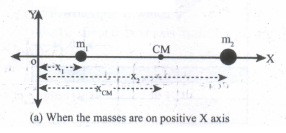
Let the center of mass of two point masses m1 and m2, which are at positions x1 and x2 respectively on the X-axis. For this case, we can express the position of center of mass in the following three ways based on the choice of the coordinate system.
(i) When the masses are on positive X-axis: The origin is taken arbitrarily so that the masses m1 and m2 are at positions x1 and x2 on the positive X-axis as shown in Figure. The center of mass will also be on the positive X-axis at xCM as given by the expression,
\({ x }_{ CM }=\frac { { m }_{ 1 }x_{ 1 }+{ m }_{ 2 }x_{ 2 } }{ { m }_{ 1 }+{ m }_{ 2 } } \)
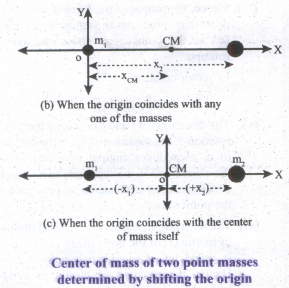
(ii) When the origin coincides with any one of the masses: The calculation could be minimised if the origin of the coordinate system is made to. coincide with any one of the masses as shown in Figure. When the origin coincides with the point mass m1 its position x1 is zero, (i.e. x1 = 0). Then,
\({ x }_{ CM }=\frac { { m }_{ 1 }\left( 0 \right) +{ m }_{ 2 }x_{ 2 } }{ { m }_{ 1 }+{ m }_{ 2 } } \)
The equation further simplifies as,
\({ x }_{ CM }=\frac { { m }_{ 2 }x_{ 2 } }{ { m }_{ 1 }+{ m }_{ 2 } } \)
(iii) When the origin coincides with the center of mass itself:
If the origin of the coordinate system is made to coincide with the center of mass, then, xCM =0 and the mass m1 is found to be on the negative X-axis as shown in Figure. Hence, its position x1 is negative, (i.e. -x1).
\(0=\frac { { m }_{ 1 }\left( -{ x }_{ 1 } \right) +{ m }_{ 2 }{ x }_{ 2 } }{ { m }_{ 1 }+{ m }_{ 2 } } \)
0 = m1(-x1) + m2x2
m1x1 = m2x2
The expression given above is known as principle of moments.
34.
For the particle to escape, K.E = P.E
\(\frac { 1 }{ 2 } { mV }_{ e }^{ 2 }=\frac { GMm }{ R+h } \)
But supphed K.E =\(=\frac { 1 }{ 2 } \times \frac { 1 }{ 2 } { mV }_{ e }^{ 2 }=\frac { GMm }{ 2R } \)
Suppose the particle rises to a height h, then
\(=\frac { 1 }{ 2 } \times \frac { 1 }{ 2 } { mV }_{ e }^{ 2 }=\frac { GMm }{ R+h } \)
\(\frac { GMm }{ R+h } =\frac { GMm }{ R+h } \)
h=R
35.
(i) Every object emits heat radiations at all finite temperatures (except 0 K) as well as it absorbs radiations from the surroundings. For example, if you touch someone, they might feel your skin as either hot or cold.
(ii) A body at high temperature radiates more heat to the surroundings than it receives from it. Similarly, a body at a lower temperature receives more heat from the surroundings than it loses to it.
(iii) Prevost applied the idea of 'thermal equilibrium' to radiation. He suggested that all bodies radiate energy but hot bodies radiate more heat than the cooler bodies. At one point of time the rate of exchange of heat from both the bodies will become the same. Now the bodies are said to be in 'thermal equilibrium'.
(iv) Only at absolute zero temperature, a body will stop emitting.
36.
It states that the volume of a gn mass of a gas is inversely proportional to it pressure provided the temperature remains constant.
\(v\times \frac { 1 }{ P } (or)v=\frac { k }{ p } \) (or) pv = constant
Its value depends on
(i) mass of the gas
(ii) its temperature and
(iii) the units in which P and v are measured.
P1 & V1 - initial values of pressure and volume
P2 & v2 - Final values of pressure and volume
then accumulate the Boyle's law P1 V1 = P2 v2
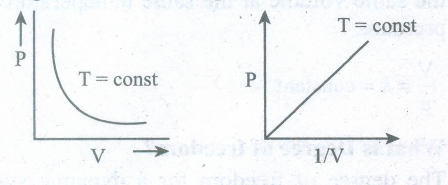
Graph between P vs. V and P vs.\(\frac{1}{v}\) for a gn mass a gas a constant temperature T are shown below.
37.
Time period of a simple harmonic oscillator
\(T=2\pi \sqrt { \frac { m }{ k } } \)
m - mass k - force constant
38.
a. Since k1 and k2 are parallel, ku = k1 + k2 Similarly, k3 and k4 are parallel, therefore, kd = k3 + k4 But ku and kd are in series,
therefore, \({ k }_{ eq }=\frac { { k }_{ u }{ k }_{ d } }{ { k }_{ u }+{ k }_{ d } } \)
If all the spring constants are equal then, k1 = k2 = k3 = k4 = k
Which means, ku = 2k and kd = 2k
Hence, \({ k }_{ eq }=\frac { { 4k }^{ 2 } }{ 4k } =k\)
b. Since k1 and k2 are parallel, kA = k1 + k2 Similarly, k4 and k5 are parallel,
therefore, kB = k4 + k5
But kA, k3, kB, and k6 are in series,
therefore, \(\frac { 1 }{ { k }_{ eq } } =\frac { 1 }{ { K }_{ A } } +\frac { 1 }{ { K }_{ 3 } } +\frac { 1 }{ { K }_{ B } } +\frac { 1 }{ { K }_{ 6 } } \)
If all the spring constants are equal
then, k1 = k2 = k3 = k4 = k5 = k6 = k
which means, kA = 2k and kB = 2k
\(\frac { 1 }{ { k }_{ eq } } =\frac { 1 }{ { 2K } } +\frac { 1 }{ { K } } +\frac { 1 }{ { 2K } } +\frac { 1 }{ { K } } =\frac { 3 }{ { K } } \)
\({ k }_{ eq }=\frac { k }{ 3 } \)
39.
The slope in the position-time graph will give the speed of the particle.
In the graph (a) slope is zero. Graph (c) has higher slope than graphs (b) and (d). So we can arrange the speeds in ascending order as
va<vb<vd<vc
40.
m = 66.0 gm.
41.
T ∝ ma lb gc;
T = k.ma lb gc
Here k is the dimensionless constant. Rewriting the above equation with dimensions
[T1] = [Ma] [Lb] [LT-2]c
[M0L0T1] = [MaLb+cT-2c]
Comparing the powers of M, L and T on both sides, a = 0, b + c = 0, -2c = 1
Solving for a, b and c a = 0, b = 1/2, and c = -1/2
From the above equation T = k.m0 l1/2 g-1/2
T= k\(\left( \frac { 1 }{ g } \right) ^{ 1/2 }=k\sqrt { \frac { l }{ g } } \)
Experimentally k = 2π hence
T = \(2\pi \sqrt { l/g } \)
42.
When the vehicle of mass m is moving with velocity v, the kinetic energy of the vehicle \(k=\left( {1\over 2} \right){mv}^{2}\) and if s is the stopping distance, then work done by friction.
W = \(fs\ \cos\theta=\mu mg\ s\ \cos 180°\)
So by work - Energy theorem, \(W=\triangle k = k_f-k_i\)
i.e, \(-\mu mgs=0-{1\over 2}{mv}^{2}\) or \(s={v^2\over 2\mu g}\)
43.
10-6m equivalent of 1 \(\mu\) m
1 metre is equivalent to \({{1}\over{{10}^{-6}}}={10}^{6}\mu\) m
In one metre 106 microns are present

11th Standard Syllabus & Materials
11th Standard
TN 11th Tamil பீடு பெற நில் - செய்யுள் - காவடிச்சிந்து Important Questions And Answers Study Material - QB365 Set A
NEW11th Standard
TN 11th Tamil பீடு பெற நில் - உரைநடை - மலை இடப்பெயர்கள் : ஓர் ஆய்வு Important Questions And Answers Study Material - QB365 Set A
NEW11th Standard
TN 11th Tamil மாமழை போற்றுதும் - துணைப்பாடம் - யானை டாக்டர் Important Questions And Answers Study Material - QB365 Set A
NEW11th Standard
TN 11th Tamil மாமழை போற்றுதும் - செய்யுள் - ஐங்குறுநூறு Important Questions And Answers Study Material - QB365 Set A



Tamilnadu Stateboard 11th Standard Subjects

Maths

Commerce

Economics

Biology

Business Maths and Statistics

Accountancy

Computer Science
Physics

Chemistry
Maths
Biology
Economics
Physics
Chemistry

History
Business Maths and Statistics

Computer Science
Accountancy

Computer Applications
History
Computer Technology
Commerce
Computer Applications
Computer Technology

Tamil

English

French
Tamilnadu Stateboard Standards

