
 100% FREE ACCESS
11th Standard Syllabus & Materials
11th Standard
TN 11th Tamil இயற்கை வேளாண்மை,சுற்றுச்சூழல் -செய்யுள் - மனோன்மணீயம் Important Questions And Answers Study Material - QB365 Set A
NEW11th Standard
TN 11th Tamil என்னுயிர் என்பேன் -துணைப்பாடம் - இசைத்தமிழர் இருவர் Important Questions And Answers Study Material - QB365 Set A
NEW11th Standard
TN 11th Tamil மொழி கலை -செய்யுள் - ஒவ்வொரு புல்லையும் Important Questions And Answers Study Material - QB365 Set A
NEW11th Standard
TN 11th Tamil பீடு பெற நில் - இலக்கணம் - பகுபத உறுப்புகள் Important Questions And Answers Study Material - QB365 Set A
NEW11th Standard
TN 11th Tamil பீடு பெற நில் - துணைப்பாடம் - வாடிவாசல் Important Questions And Answers Study Material - QB365 Set A
NEW11th Standard
TN 11th Tamil பீடு பெற நில் - செய்யுள் - குறுந்தொகை Important Questions And Answers Study Material - QB365 Set A

Published on: 12/11/2019
Download Tamil Nadu 11th Standard Maths question papers, model tests, one-mark questions, important questions, and public exam papers in PDF format. Free study materials and answer keys for TN State Board students.
Questions + Answers key
Take MCQ Maths Test1.
Let \(\overrightarrow { a } ,\overrightarrow { b } \) and \(\overrightarrow { c } \) be non-coplanar vectors. Let A, B and C be the points whose position vectors with respect to the origin O are \(\overrightarrow { a } +2\overrightarrow { b } +3\overrightarrow { c } ,-2\overrightarrow { a } +3\overrightarrow { b } +5\overrightarrow { c } \) and \(7\overrightarrow { a } -\overrightarrow { c } \) respectively. Then prove that A, B and C are collinear.
2.
Examine the continuity of \(f\left( x \right) =\begin{cases} \frac { \sin { 2x } }{ \sin { 3x } } \quad if\quad x\neq 0 \\ 2\quad \quad \quad if\quad x=0 \end{cases}at\quad x=0\)
3.
If xy = 4, Prove that \(x\left( \frac { dy }{ dx } +{ y }^{ 2 } \right) =3y.\)
4.
Prove that \(\left| \begin{matrix} -2a & a+b & a+c \\ b+a & -2b & b+c \\ c+a & c+b & -2c \end{matrix} \right| \) = 4(a + b)(b + c)(c + a). Using factor theorem.
5.
Find the derivatives of the following functions with respect to corresponding independent variables : y = x sin x cos x
6.
If \(\begin{bmatrix} 0 & p& 3 \\ 2 & q^2 & -1 \\ r & 1 & 0 \end{bmatrix}\) is skew-symmetric, find the values of p, q, and r.
7.
Compare and contrast the graph y = x2 - 1, y = 4(x2 - 1) and y = (4x)2 = 1.
8.
Find the zeros of the polynomial function f(x) = 9x2- 36
9.
Find the equation of the line passing through the point (5, 2) and perpendicular to the line joining the points (2, 3) and (3, -1).
10.
Show that the statement, "if f and g o f are one-to-one, then g is one-to-one" is not true.
11.
If p(h) is the statement "n2 + n is even" and if p(r) is true, then p(r + 1) is true.
12.
Find the equation of the straight lines passing through (8, 3) and having intercepts whose sum is 1.
13.
Write the first 6 terms of the exponential series \({ e }^{ \frac { 1 }{ 2 } x }\)
14.
Let A={1,2,3,4} and B = {a,b,c,d}. Give a function from A\(\rightarrow\)B for each of the following:
neither one-to-one and nor onto.
15.
For each given Angle, find a coterminal angle with a measure of \(\theta\) such that \(0^o\le \theta \le 360°\)
3950
16.
Assertion (A) : \(\overset { \rightarrow }{ a } ,\overset { \rightarrow }{ b } ,\overset { \rightarrow }{ c } \) are the position vector three collinear points then 2 \(\overset { \rightarrow }{ a }=\overset { \rightarrow }{ b } +\overset { \rightarrow }{ c } \)
Reason (R): Collinear points, have same direction
Both A and R are true and R is the correct explanation of A
Both A and R are true and R is not a correct explantion of A
A is true but R is false
A is false but R is true
17.
If \(\begin{bmatrix} 4 & 3 \\ -2 & x \end{bmatrix}\) is singular then the value of x is _____________
\(\frac{3}{2}\)
-\(\frac{3}{2}\)
3
-2
18.
If \(|\overrightarrow { a } |=|\overrightarrow { b } |\) then
\(\overrightarrow { a } =\overrightarrow { b } \)
\(\overrightarrow { a } =\overrightarrow { -b } \)
\(\overrightarrow { a } =\pm \overrightarrow { b } \)
both are null vectors
19.
The rate of change of area A of a circle of radius r is
\(2\pi r\)
\(2\pi r\frac { dr }{ dt } \)
\(\pi { r }^{ 2 }\frac { dr }{ dt } \)
\(\pi \frac { dr }{ dt } \)
20.
Choose the correct or the most suitable answer from the given four alternatives.
If \(y=\sin ^{ -1 }{ x } +\cos ^{ -1 }{ x } \) then \(\frac { dy }{ dx } \) is _____
1
\(\pi \)
\(\frac { \pi }{ 2 } \)
0
21.
If  \(f(x)=\left\{\begin{array}{l} x+1, \quad \text { when } x<2 \\ 2 x-1 \text { when } x \geq 2 \end{array}\right.\), then f'(2) is
0
1
2
does not exist
22.
\(lim_{\theta\rightarrow0}{Sin\sqrt{\theta}\over \sqrt{sin \theta}} \)
1
-1
0
2
23.
The value of x, for which the matrix A = \(\begin{bmatrix} e^{x-2}& e^{7+x} \\ e^{2+x} & e^{2x+3} \end{bmatrix}\) is singular
9
8
7
6
24.
What must be the matrix X, if 2x +\(\begin{bmatrix} 1& 2 \\ 3 & 4 \end{bmatrix}=\begin{bmatrix} 3 & 8 \\ 7 & 2 \end{bmatrix}?\)
\(\begin{bmatrix} 1& 3 \\ 2 &-1 \end{bmatrix}\)
\(\begin{bmatrix} 1& -3 \\ 2 &-1 \end{bmatrix}\)
\(\begin{bmatrix} 2& 6 \\ 4 &-2 \end{bmatrix}\)
\(\begin{bmatrix} 2& -6 \\ 4 &-2 \end{bmatrix}\)
25.
If A, B, C are in A.P and B = \(\frac{\pi}{4}\) then tan A tan B tan C = _______________
1
-1
0
None
26.
The image of the point (1, 2) with respect to the line y = x is ______________
(-1, -2)
(2, 1)
(2, -1)
(2, 1)
27.
\(\frac{1}{1!}+\frac{1}{3!}+\frac{1}{5!}+...\) is ______________
\(\frac{e^{-1}}{2}\)
\(\frac{e+e^{-1}}{2}\)
\(\frac{e-e^{-1}}{2}\)
none of these
28.
 is _________
\(\lfloor{n}(n+2)\)


none of these
29.
\(\sqrt [ 4 ]{ { \left( -2 \right) }^{ 4 } } \times { \left( -1000 \right) }^{ \frac { 1 }{ 3 } }\) is ___________
20
-20
2-10
100
30.
Domain of the function \(y={x-1\over x+1}\) is __________
1R
Q
R-(-1)
R-1
31.
The locus of a point which moves such that it maintains equal distance from the fixed point is a ______________
straight line
line bisector
circle
angle bisector
32.
If 10 lines are drawn in a plane such that no two of them are parallel and no three are concurrent, then the total number of points of intersection are
45
40
10!
210
33.
If \({ log }_{ \sqrt { x } }\) 0.25 = 4, then the value of x is
0.5
2.5
1.5
1.25
34.
Which of the following is not true?
sin ፀ = \(-\frac { 3 }{ 4 } \)
cosፀ = -1
tan ፀ = 25
sec ፀ = \(\frac { 1 }{ 4 } \)
35.
The relation R defined on a set A= {0,-1, 1, 2} by xRy if |x2+y2| ≤ 2, then which one of the following is true?
R = {(0,0), (0,-1), (0, 1), (-1, 0), (-1, 1), (1, 2), (1, 0)}
R-1 = {(0,0), (0,-1), (0, 1), (-1, 0), (1, 0)}
Domain of R is {0,-1, 1, 2}
Range of R is {0,-1, 1}
36.
Determine k, so that \(f\left( x \right) =\begin{cases} k{ x }^{ 2 },\quad x\le 2 \\ 3,\quad x>2 \end{cases}\) is continuous.
37.
Differentiate \({ tan }^{ -1 }(secx+tanx),\) \(-\frac{\pi}{ 2 }\)
38.
The position vectors of the points P, Q, R, S are \(\hat{i}\) + \(\hat{j}\) + \(\hat{k}\), 2 \(\hat{i}\) + 5\(\hat{j}\), 3\(\hat{i}\) + 2\(\hat{j}\) - 3\(\hat{k}\), and \(\hat{i}\) - 6\(\hat{j}\) - \(\hat{k}\), respectively. Prove that the line PQ and RS are parallel.
39.
For any natural number n, 7n - 2n is divisible by 5.
40.
Resolve into partial fractions \(\frac { 9 }{ (x-1)(x+2)^{ 2 } } \)
41.
If 22pr+1: 20pr+2 = 11 : 52, find r.
42.
Suppose two radar stations located 100 km apart, each detect a fighter aircraft between them. The angle of elevation measured by the first station is 30°, whereas the angle of elevation measured by the second station is 45°. Find the altitude of the aircraft at that instant.
43.
Prove that \(\sqrt [ 3 ]{ { x }^{ 3 }+6 } -\sqrt [ 3 ]{ { x }^{ 3 }+3 } \) is approximately equal to \(\frac { 1 }{ { x }^{ 2 } } \) when x is sufficiently large.
44.
Using the mathematical induction, show that for any natural number n > 2
\({1\over 1+2}+{1\over 1+2+3}+{1\over 1+2+3+4}+...+{1\over 1+2+3..+n}={n-1\over n+1}\)
45.
If a, b, c are respectively the pth qth and rth terms of a GP. show that (q - r) log a + (r - p) log b + (p - q) log c = 0.
46.
Resolve the following rational expressions into partial fractions.
\({{1}\over{x^4-1}}\)
47.
In \(\triangle\)ABC, Prove the following
\(\frac { a+b }{ a-b } =tan\left( \frac { A+B }{ 2 } \right) cot\left( \frac { A-B }{ 2 } \right) \)
48.
Evaluate: \(\underset { x\rightarrow 0 }{ lim } \frac { { e }^{ 5x }-1 }{ x } \)
49.
Differentiate \(\sin { (\sqrt { 3 } \sin { x } +\cos { x } ) } \) with respect to x.
50.
Find the value of x such that [1 \(\times\) 1]\(\left[ \begin{matrix} 1 & 3 & 2 \\ 2 & 5 & 1 \\ 15 & 3 & 2 \end{matrix} \right] \left[ \begin{matrix} 1 \\ 2 \\ x \end{matrix} \right] =0\)
51.
Find |A| if A = \(\begin{bmatrix} 0& sin \alpha &cos \alpha \\ sin \alpha & 0 & sin \beta \\ cos \alpha & -sin\beta & 0 \end{bmatrix}\).
52.
Find the 5th term in the sequence whose first three terms are 3, 3, 6 and each term after the second is the sum of the two terms preceding it.
53.
In how many ways can the letters of the word PENCIL be arranged so that N is always next to E.
54.
Given log216 = 4. Find log162
1.
Given \(\overrightarrow { OA } =\overrightarrow { a } +2\overrightarrow { b } +3\overrightarrow { c } \)
\(\overrightarrow { OB } =-2\overrightarrow { a } +3\overrightarrow { b } +5\overrightarrow { c } \) and \(\overrightarrow { OC } =7\overrightarrow { a } -\overrightarrow { c } \)
Then \(\overrightarrow { AB } =\overrightarrow { OB } -\overrightarrow { OA } =(-2\overrightarrow { a } +3\overrightarrow { b } +5\overrightarrow { c } )-(\overrightarrow { a } +2\overrightarrow { b } +3\overrightarrow { c } )=-3\overrightarrow { a } +\overrightarrow { b } +2\overrightarrow { c } \)
\(\overrightarrow { AC } =\overrightarrow { OC } -\overrightarrow { OA } =(7\overrightarrow { a } -\overrightarrow { c } )-(\overrightarrow { a } +2\overrightarrow { b } +3\overrightarrow { c } )=6\overrightarrow { a } -2\overrightarrow { b } -4\overrightarrow { c } \)
\(=-2(-3\overrightarrow { a } +\overrightarrow { b } +2\overrightarrow { c } )=-2\overrightarrow { AB } \)
\(\therefore \overrightarrow { AC } ||\overrightarrow { AB } \) and A is a common points. Hence, the points A, B and C are collinear.
2.
Given f(0)=2
\(\lim _{ x\rightarrow 0 }{ f\left( x \right) } =\lim _{ x\rightarrow 0 }{ \frac { \sin { 2x } }{ \sin { 3x } } } =\lim _{ x\rightarrow 0 }{ \left( \frac { \sin { 2x } }{ 2x } \right) } \left( \frac { 3x }{ \sin { 3x } } \right) \left( \frac { 2 }{ 3 } \right) \)
\(=\left( \lim _{ 2x\rightarrow 0 }{ \frac { \sin { 2x } }{ 2x } } \right) \left( \lim _{ 3x\rightarrow 0 }{ \frac { 1 }{ \frac { \sin { 3x } }{ 3x } } } \right) \times \frac { 2 }{ 3 } =1\times 1\times \frac { 2 }{ 3 } =\frac { 2 }{ 3 } \)
\(\therefore \lim _{ x\rightarrow 0 }{ f\left( x \right) } \neq f\left( 0 \right) \)
3.
Given xy = 4
Differentiating both sides with respect to 'x' we get,
\(x.\frac { dy }{ dx } =y(1)=0\quad \Rightarrow x\frac { dy }{ dx } =-y ...(1)\)
\(LHS= x\left( \frac { dy }{ dx } +{ y }^{ 2 } \right) =x\frac { dy }{ dx } +x{ y }^{ 2 }= -y+(xy)y=-y+4y\quad \left[ \because \quad xy=4 \right] \)
\(=3y=RHS\)
Hence proved
4.
Let \(\triangle\) = \(\left| \begin{matrix} -2a & a+b & a+c \\ b+a & -2b & b+c \\ c+a & c+b & -2c \end{matrix} \right| \)
Putting a = -b in (1) we get,
\(\triangle =\left| \begin{matrix} 2b & 0 & -b+c \\ 0 & -2b & b+c \\ c-b & c+b & -2c \end{matrix} \right| \)
Expanding along R1 we get,
\(\triangle\) = 2b (4bc - (b + cp (- b + c) (2b(c - b))
= 2b (4bc - b2 - c2 - 2bc) + (c - b) (2bc - 2b2)
= 2b (2bc - b2 - c2) + (c - b) (2bc - 2b2)
=
\(\therefore\) (a + b) is a factor of A.
Similarly (b + c) and (c + a) are factors of \(\triangle\).
Since the leading diagonal is of degree 3, their will be a constant k and 3 factors.
\(\therefore\) \(\triangle\) = k (a + b)(b + c)(c + a)
\(\triangle =\left| \begin{matrix} -2a & a+b & a+c \\ b+a & -2b & b+c \\ c+ & c+b & -2c \end{matrix} \right| \)=k (a + b)(b + c)(c + a)
Put a = 0, b = 1 and c = 2 we get,
\(\left| \begin{matrix} 0 & 1 & 2 \\ 1 & -2 & 3 \\ 2 & 3 & -4 \end{matrix} \right| \)=k(1)(3)(2)
\(\Rightarrow\) - 1(-4 - 6) +2(3 + 4) = 6 k [Expanded along R1]
\(\Rightarrow\) -1(-10) + 14 = 6k
\(\Rightarrow\) 24 = 6k
\(\Rightarrow\) k = 4
\(\therefore \left| \begin{matrix} -2a & a+b & a+c \\ b+a & -2b & b+c \\ c+a & c+b & -2c \end{matrix} \right| \) = 4(a + b)(b + c)(c + a)
5.
y = x sin x cos x
\(\frac{d y}{d x}=\frac{d}{d x}(x) \sin x \cos x+x \frac{a}{d x}(\sin x) \cos x +x \sin x \frac{d}{d x}(\cos x)\) \([\because d(u v w)=u v(d w)+u(d v) w+(d u) v w]\)
\(=(1) \sin x \cos x+x \cos x \cos x+x \sin x(-\sin x)\)
\(=\sin x \cos x+x \cos ^2 x-x \sin ^2 x\)
\(=\sin x \cos x+x\left(\cos ^2 x-\sin ^2 x\right)\)
\(=\sin x \cos x+x \cos 2 x \ \left[\because \cos ^2 A-\sin ^2 A=\cos 2 A\right] \)
6.
Let B = \(\left[ \begin{matrix} 0 & p & 3 \\ 2 & q^{ 2 } & -1 \\ r & 1 & 0 \end{matrix} \right] \)
\(\Rightarrow { B }^{ T }=\left[ \begin{matrix} 0 & 2 & r \\ p & { q }^{ 2 } & 1 \\ 3 & -1 & 0 \end{matrix} \right] \)
Since B is a skew-symmetric matrix,
BT = -B
\(\left[ \begin{matrix} 0 & 2 & r \\ p & { q }^{ 2 } & 1 \\ 3 & -1 & 0 \end{matrix} \right] =-\left[ \begin{matrix} 0 & p & 2 \\ 2 & { q }^{ 2 } & -1 \\ r & 1 & 0 \end{matrix} \right] \)
\(\Rightarrow \left[ \begin{matrix} 0 & 2 & r \\ p & { q }^{ 2 } & 1 \\ 3 & -1 & 0 \end{matrix} \right] =-\left[ \begin{matrix} 0 & -p & -3 \\ -2 & -{ q }^{ 2 } & -1 \\ -r & -1 & 0 \end{matrix} \right] \)
Equating the corresponding entries on both sides, we get
-p = 2
p = -2
r = -3
q2 = -q2
q2 + q2 = 0
2q2 = 0
q2 = 0
q = 0
\(\therefore\) p = -2
r = -3
q = 0
7.
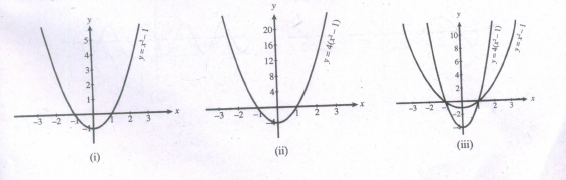
The graphs figures (i) and (ii) look identical until we compare the scales on the y-axis. The scale in figure(ii) is four times as large, reflecting the multiplication of the original function by 4 (i).
The effect looks different when the functions are plotted on the same scale as in figure(iii).
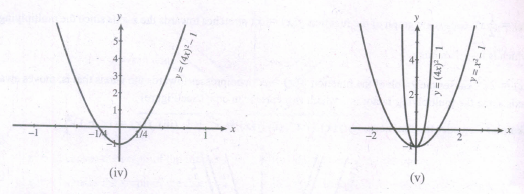
The graph of y = (4x)2 - 1 is shown in figure (iv). Can you spot the difference between figure (i) and figure (iv)? In this case, x-scale has now changed, by the same factor of 4 as in the function (figure (iv)).
To see this, note that substituting \(x={1\over 4}\) into (4x)2 - 1 produces 12 - 1, 1, exactly the same as substituting x = 1 into the original function (figure (i)), When plotted on the same set of axes (as in figure (v» the parabola y = (4x)2 - 1 looks thinner.
Here, the x-intercepts are different, but y-intercepts are the same.
8.
9x2- 36 = (3x)2- 6x2
= (3x + 6)(3x - 6)
So 3x + 6 = 0
⇒ 3x = -6
⇒ x = -2
∴ x = -2, 2
3x - 6 = 0
⇒ 3x - 6 = 0
⇒ 3x = 6
⇒ x = \(\frac { 6 }{ 3 } \)= 2
9.
Slope of the line joining the points (2, 3) and (3, -1) is
\(\frac { -1-3 }{ 3-2 } \)=-4
Slope of the required line which is perpendicular to it
=\(\frac { -1 }{ -4 } =\frac { 1 }{ 4 } \) [∵ m1m2=-1]
Equation of the line passing through the point (5, 2) is
y-2 =\(\frac { 1 }{ 4 } \)(x-5) [y-y1=m(x-x1)]
⇒ 4y-8=x-5
⇒ x-4y+3=0
10.
To claim a statement is not true we have to prove by giving an example. Such examples are called counter examples. Consider the diagram given below.
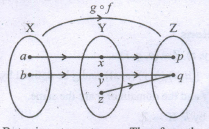
Clearly, f and g o f are one-to-one. But g is not one to one. Thus from the above diagram, it shows that the statement is not true.
11.
p(n): "n2 + n is even"
Given p(r) is true
\(\Rightarrow\) r2+ r is even
\(\Rightarrow\) r2+ r = 2k where k is a constant
To prove that p(r+1) is true
To prove that (r+1)2 + (r+1) is even
Consider (r+1)2+r+1
=r2+2r+1+r+1
= (r2+ r) + 2r + 2
= 2k + 2r + 2
= 2(k+r+1) which is even always
\(\therefore\) p(r+1) is true.
12.
Equation of the straight line in intercept form is \(\frac { x }{ a } +\frac { y }{ b } =1\)
Given a + b = 1 \(\Rightarrow\) b = 1 - a
\(\Rightarrow \quad \frac { x }{ a } +\frac { y }{ 1-a } =1\)
Since (8, 3) lies on this line, we get,
\(\Rightarrow \frac { 8 }{ a } +\frac { 3 }{ 1-a } =1 \)
\(\Rightarrow \frac { 8-8a+3a }{ a(1-a) } =1\)
\(\Rightarrow \frac { 8-5a }{ a-{ a }^{ 2 } } =1\)
\(\Rightarrow \quad 8-5a=a-{ a }^{ 2 }\)
\(\Rightarrow\) 8 - 5a - a + a2 = 0 \(\Rightarrow\) a2- 6a + 8 = 0
\(\Rightarrow\) (a-4)(a-2) = 0 \(\Rightarrow\) a = 4 or 2
If a = 4, b = 1-4 = -3
if a = 2, b = 1-2 = -1
When a = 4, b = -3, equation of straight line is \(\frac { x }{ 4 } +\frac { y }{ -3 } =1\)
\(\Rightarrow\) -3x + 4y = -12 [Form (1)]
\(\Rightarrow\) 3x - 4y = 12
If a = 2 and b = -1, equation of the other straight line is \(\frac { x }{ 2 } +\frac { y }{ -1 } =1\) [From (1)]
\(\Rightarrow\) -x + 2y = -2 \(\Rightarrow\) x - 2y = 2
13.
we have \({ e }^{ x }=1+\frac { x }{ 1! } +\frac { { x }^{ 2 } }{ 2! } +\frac { { x }^{ 3 } }{ 3! } +\frac { { x }^{ 4 } }{ 4! } +..\)
\({ e }^{ \frac { 1 }{ 2 } x }=1+\frac { \left( \frac { 1 }{ 2 } x \right) }{ 1! } +\frac { { \left( \frac { 1 }{ 2 } x \right) }^{ 2 } }{ 2! } +\frac { { \left( \frac { 1 }{ 2 } x \right) }^{ 3 } }{ 3! } +\frac { { \left( \frac { 1 }{ 2 } x \right) }^{ 4 } }{ 4! } +...\)
\(=1+\frac { x }{ 2 } +\frac { { x }^{ 2 } }{ 8 } +\frac { { x }^{ 3 } }{ 48 } +\frac { { x }^{ 4 } }{ 388 } +\frac { { x }^{ 5 } }{ 32\times 5 } +...\)
\({ e }^{ \frac { 1 }{ 2 } x }=1+\frac { x }{ 2 } +\frac { { x }^{ 2 } }{ 8 } +\frac { { x }^{ 3 } }{ 48 } +\frac { { x }^{ 4 } }{ 388 } +\frac { { x }^{ 5 } }{ 3840 } +...\)
14.
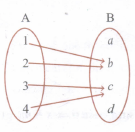
Let f = {(1, b) (2, b) (3, c) (4, e)}
Different elements in A does not have different images in B
∴ f is not one- one
Now, Co-domain = {a, b, e, d}, Range = {b, e}
Co-domain ≠ range
∴ f is not onto. Hence f is neither one - one and nor onto.
15.
3950
3950 = 3600 + 350
\(\Rightarrow \) 395 - 350 = 3600
∴ Coterminal angle For 3950 is 350
16.
(a)
Both A and R are true and R is the correct explanation of A
17.
(b)
-\(\frac{3}{2}\)
18.
(c)
\(\overrightarrow { a } =\pm \overrightarrow { b } \)
19.
(b)
\(2\pi r\frac { dr }{ dt } \)
20.
(d)
0
21.
\(f^{\prime}\left(2^{-}\right)=\lim _{x \rightarrow 2^{-}} \frac{f(x)-f(2)}{x-2}=\lim _{x \rightarrow 2^{-}} \frac{x+1-(2+1)}{x-2}\)
\(=\lim _{x \rightarrow 2^{-}} \frac{x+1-3}{x-2}=\lim _{x \rightarrow 2^{-}} \frac{x-2}{x-2}=1\)
\(f^{\prime}\left(2^{+}\right)=\lim _{x \rightarrow 2^{+}} \frac{f(x)-f(2)}{x-2}=\lim _{x \rightarrow 2^{+}} \frac{(2 x-1)-(4-1)}{x-2}\)
\(=\lim _{x \rightarrow 2^{+}} \frac{2 x-1-3}{x-2}=\lim _{x \rightarrow 2^{+}} \frac{2 x-4}{x-2}\)
\(=\lim _{x \rightarrow 2^{+}} \frac{2(x-2)}{(x-2)}=2\)
\(f^{\prime}\left(2^{-}\right) \neq f^{\prime}\left(2^{+}\right)\)
\(\therefore f^{\prime}(2) \text { does not exist. }\)
22.
\(\lim _{\theta \rightarrow 0} \frac{\sin \sqrt{\theta}}{\sqrt{\sin \theta}} =\lim _{\theta \rightarrow 0}\left(\frac{\sin \sqrt{\theta}}{\sqrt{\theta}} \cdot \frac{\sqrt{\theta}}{\sqrt{\sin \theta}}\right) \)
\(=\lim _{\theta \rightarrow 0} \frac{\sin \sqrt{\theta}}{\sqrt{\theta}} \cdot\left(\lim _{\theta \rightarrow 0} \frac{\sin \sqrt{\theta}}{\theta}\right)^{\frac{1}{2}}=1.1=1
\)
23.
\(|A|=0 \quad \text { [since } A \text { is singular] }\)
\(\left|\begin{array}{ll} e^{x-2} & e^{7+x} \\ e^{2+x} & e^{2 x+3} \end{array}\right| =0 \)
\(e^{x-2+2 x+3}-e^{2+x+7+x} =0 \)
\(e^{3 x+1} =e^{9+2 x} \)
\(3 x+1 =9+2 x \)
\(x =8 \)
24.
\(2 X=\left[\begin{array}{ll} 3 & 8 \\ 7 & 2 \end{array}\right]-\left[\begin{array}{ll} 1 & 2 \\ 3 & 4 \end{array}\right]=\left[\begin{array}{cc} 2 & 6 \\ 4 & -2 \end{array}\right]\)
\(X=\left[\begin{array}{cc} 1 & 3 \\ 2 & -1 \end{array}\right]\)
25.
(a)
1
26.
(d)
(2, 1)
27.
(c)
\(\frac{e-e^{-1}}{2}\)
28.
(a)
\(\lfloor{n}(n+2)\)
29.
(b)
-20
30.
(c)
R-(-1)
31.
(c)
circle
32.
\(\text { Number of points of intersection }={ }^{10} \mathrm{C}_{2}\)
\(=\frac{10 \times 9}{1 \times 2}=45\)
33.
\(\log _{\sqrt{x}} 0.25 =4 \)
\((\sqrt{x})^{4} =0.25 \)
\((\sqrt{x})^{4} =\frac{1}{4} \)
\(x^{2} =\frac{1}{4} \)
\(\Rightarrow x=\frac{1}{2}=0.5\)
34.
\(\text { Since }|\cos x|<1\)
\(\text { From option (4), }\)
\(\sec \theta=\frac{1}{4}\)
\(\Rightarrow \cos \theta=4 \text { is not possible. }\)
35.
\(\text { Since }\left|x^{2}+y^{2}\right|<2, x, y \text { must be } 0,1,-1 \text {. }\)
36.
Since polynomial function and a constant function are continuous, the given function is continuous for all x < 2 and for all x>2.
At x=2,
\(\lim _{ x\rightarrow { 2 }^{ - } }{ f\left( x \right) } =\lim _{ x\rightarrow { 2 }^{ - } }{ k{ x }^{ 2 } } =k{ (2) }^{ 2 }=4k\)
\(\lim _{ x\rightarrow { 2 }^{ + } }{ f\left( x \right) } =\lim _{ x\rightarrow { 2 }^{ + } }{ 3 } =3\)
\(Also,\quad f(2)=k{ (2) }^{ 2 }=4k\)
\(Since\quad f\left( x \right) is\quad continuous\quad at\quad x=2,\)
\(\lim _{ x\rightarrow { 2 }^{ - } }{ f\left( x \right) } =\lim _{ x\rightarrow { 2 }^{ + } }{ f\left( x \right) } =f(2)\)
\(\Rightarrow 4k=3\)
\(k=\frac { 3 }{ 4 } \)
37.
Let \(y=\tan ^{ -1 }{ (\sec { x } +\tan { x } ) }\)
\(\Rightarrow y=\tan ^{ -1 }{ \left( \frac { 1 }{ \cos { x } } +\frac { \sin { x } }{ \cos { x } } \right) }\)
\(\Rightarrow y=\tan ^{ -1 }{ \frac { 1+\sin { x } }{ \cos { x } } }\)
\(\Rightarrow y=\tan ^{ -1 }{ \left( \frac { 1-\cos { \left( \frac { \pi }{ 2 } +x \right) } }{ \sin { \left( \frac { \pi }{ 2 } +x \right) } } \right) }\)
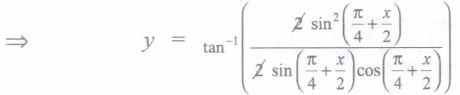
\(\Rightarrow y=\tan ^{ -1 }{ \left( \tan { \left( \frac { \pi }{ 4 } +\frac { x }{ 2 } \right) } \right) } \Rightarrow y=\frac { \pi }{ 4 } +\frac { x }{ 2 } \)
Differentiating both sides, with respect to 'x' we get
\(\Rightarrow \frac { dy }{ dx } =\frac { 1 }{ 2 } \)
38.
Given \(\overrightarrow { OP } =\hat { i } +\hat { j } +\hat { k } \)
\(\overrightarrow { OQ } =2\hat { i } +5\hat { j } \)
\(\overrightarrow { OR } =3\hat { i } +2\hat { j } -3\hat { k }\)
and \(\overrightarrow { OS } =\hat { i } -6\hat { j } -\hat { k } \)
\(\overrightarrow { PQ } =\overrightarrow { OQ } -\overrightarrow { OP } =(2\hat { i } +5\hat { j } )-(\hat { i } +\hat { j } +\hat { k } )=\hat { i } +4\hat { j } -\hat { k } \)
\(\overrightarrow { RS } =\overrightarrow { OS } -\overrightarrow { OR } =(\hat { i } -6\hat { j } -\hat { k } )-(3\hat { i } +2\hat { j } -3\hat { k } )\)
\(=-2\hat { i } -8\hat { j } +2\hat { k } =-2(\hat { i } +4-\hat { k } )=-2\overrightarrow { PQ } \)
\(\therefore \overrightarrow { RQ } =\lambda \overrightarrow { PQ } \) where \(\lambda =-2\)
\(\therefore \overrightarrow { RQ } ||\overrightarrow { PQ } \)
39.
Let P(n) : 7n - 2n
Step 1 : P(1) : 71 - 21 = 5 which is divisible by 5. So it is true for P(1).
Step 2: P(k): 7k - 2k = 5\(\lambda\). Let it be true for P(k)
Step 3 : P(k + 1) = 7k + 1- 2k + 1
= 7k + 1 + 7k. 2 - 7k. 2 -2k + 1
= (7k + 1 -7k .2) + (7k. 2 -2k + 1)
= 7k (7 - 2) + 2.(7k- 2K)
= 5.7k + 2.5 \(\lambda\)
= 5(7k + 2\(\lambda\))which is divisible by 5. (from Step 2)
So, it is true for P(k + 1).
Hence, P(k + 1) is true whenever P(k) is true.
40.
\(\frac { 9 }{ (x-1)(x+2)^{ 2 } } =\frac { A }{ x-1 } +\frac { B }{ x+2 } +\frac { C }{ (\quad ) } \)
= \(\frac { A(x+2)^{ 2 }+B(x-1)(x+2)+C(x-1) }{ (x-1)(x+2)(x+2)^{ 2 } } \)
Equating numerator on b/s
9=A(x+2)2+B(x-1)(x+2)+C(x-1)
put x =-2
9 = A(0)+B(0)+C(-3)
-3C = 9 ⇒ C=-3
put x =1
9 - A(1+2)2 +B(0)+C(0)
9A =9
A =1
put x =0
9 =4A-2B-C
9=4(1)-2B+3
9-7 =-2B
2 = -2B
B =-1
∴ \(\frac { 9 }{ (x-1)(x+2)^{ 2 } } =\frac { 1 }{ x-1 } \frac { 1 }{ x+2 } \frac { -3 }{ (x+2)^{ 2 } } \)
41.
Here 22pr+1 : 20pr+2 = 11 : 52
\(\Rightarrow {22!\over(21-r)!}\times{(18-r)!\over20!}={11\over52}\)
\(\Rightarrow {22\times21\times20!\over(21-r)(20-r)(19-r)(18-r)!}\times{(18-r)!\over20!}={11\over52}\)
\(\Rightarrow {22\times21\over(21-r)(20-r)(19-r)}={11\over52}\)
\(\Rightarrow \) (21 - r) (20 - r) (19 - r) = 2 \(\times\) 21 \(\times\) 52
\(\Rightarrow \) (21 - r)(20 - r)(19 - r) = 14 \(\times\) 13 \(\times\) 12
\(\Rightarrow \) (21 - r)(20 - r) (19 - r) = (21 -7)(20 -7)(19 -7)
\(\Rightarrow \) r = 7
42.
Let R1 and R2 be two radar stations and A be the position of fighter aircraft at the time of detection.
Let x be the required altitude of the aircraft.
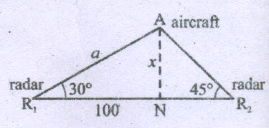
Draw \(\bot AN\) from A to R1R2 meeting at N.
\(\angle A=180^0-(30^0+45^0)=105^0\)
Thus, \(\frac{a}{sin\ 45^0}=\frac{100}{sin\ 105^0}\) \(\Rightarrow a=\frac{100}{\frac{\sqrt 3+1}{2\sqrt 2}}\times\frac{1}{\sqrt 2}=\frac{200(\sqrt 3-1)}{2}\)\(=100\times(\sqrt 3-1)km\)
Now, \(sin\ 30^0=\frac{x}{a}\Rightarrow x=50\times(\sqrt 3-1)km\)
43.
LHS = \({ \left( { x }^{ 3 }+6 \right) }^{ \frac { 1 }{ 3 } }-{ \left( { x }^{ 3 }+3 \right) }^{ \frac { 1 }{ 3 } }\)
\(={ x }^{ 3\times \frac { 1 }{ 3 } }{ \left( 1+\frac { 6 }{ { x }^{ 3 } } \right) }^{ \frac { 1 }{ 3 } }-{ x }^{ 3\times \frac { 1 }{ 3 } }{ \left( 1+\frac { 3 }{ { x }^{ 3 } } \right) }^{ \frac { 1 }{ 3 } }\)
\(=x\left[ 1+\frac { 1 }{ 3 } \left( \frac { 6 }{ { x }^{ 3 } } \right) \right] -x\left[ 1+\frac { 1 }{ 3 } \left( \frac { 3 }{ { x }^{ 3 } } \right) \right] \)
\(=x+\frac { 2 }{ { x }^{ 2 } } -x-\frac { 1 }{ { x }^{ 2 } } \)
\(=\frac { 2 }{ { x }^{ 2 } } -\frac { 1 }{ { x }^{ 2 } } =\frac { 1 }{ { x }^{ 2 } } =RHS\)
Hence proved.
44.
Adding 1 both sides to the given statement
p(n): \(1+{1\over 1+2}+{1\over 1+2+3}+..+{1\over 1+2+3+.+n}=1+{n-1\over n+1}={n+1+n-1\over n+1}={2n\over n+1}\)
Step 1:
Putting n = 2
\(1+{1\over 1+2}={2(2)\over 2+1}⇒1+{1\over 3}={4\over 3}⇒{4\over3}={4\over 3}\)
∵ p(1) is true
Step 2:
Let us assume that p(K) is true
\(∵\ 1+{1\over 1+2}+...+{1\over 1+2+3+...+K}={2K\over K+1}\)
Step 3:
To prove that p(K+1) is true
ie \(1+{1\over 2}+...+{1\over 1+2+3+K}+{1\over 1+2+...+K+1}={2(K+1)\over K+2}\)
LHS = \(1+{1\over 1+2}+...+{1\over 1+2+3+...+K}+{1\over 1+2+...+(K+1)}\)
\(={2K\over K+1}+{1\over 1+2+3+..+(K+1)}\) [using (1)]
\(={2K\over K+1}+{1\over {(K+1)(K+2)\over2}}\) \(\left[ ∵\ \sum n={n(n+1)\over2} \right]\)
\(={2K\over K+1}+{2\over (K+1)(K+2)}={2\over K+1}\left[ K+{1\over K+2}\right]={2\over K+1}\left(K^2+2K+1\over K+2\right)\)
\(={2(K+1)^2\over (K+1)(K+2)}={2(K+1)\over K+2}=RHS\)
∵ p(K+1) is true
Hence, by mathematical induction, p(n) is true for all values of n
45.
Let A be the first term and R be the common ratio of the given G.P.
Then a = pth term ⇒ a = ARPp-1
⇒ log a log A+(p-1 )logR...(1)
b = qth term b = ARq-1
⇒ log b = logA +(q-1) log R...(2)
c = rth term ⇒ c = ARr-1
⇒ log c = log A + (r-1) log R
Now, LHS = (q - r) log a + (r - p) log b + (p - q) log c
= (q - r) [log A + (p - 1) log R] + (r - p) [log A + (q - 1) log R] + (p - q)[log A + (r-1) log R]
= log A [q - r + r - p + P - q] + log R [(p - 1) (q - r) + (q - 1) (r - p) + (r - 1) (p - q)]
= log A (0) + log R [pq - pr - q + r + qr - pq - r + p + rp - rq - p + q]
= log R [0] = 0
∴ (q - r) log a + (r- p) log b + (p - q) log c = 0.
46.
\({1\over x^4-1}={1\over (x^2+1)(x^2-1)}={1\over (x^2+1)(x+1)(x-1)}\)
\({1\over x^4-1}={Ax+B\over x^2+1}+{C\over x+1}+{D\over x-1}\)
\(⇒ {1\over x^2-1}={(Ax+B)(x+1)(x-1)+C(x^2+1)(x-1)+D(x^2+1)(x+1)\over (x^2+1)(x^2+1)}\)
⇒ 1= (Ax + B)(x + 1)(x - 1) + C(x2 + 1) (x - 1) + D(x2 + 1) (x + 1)
Putting x=1 in (1) we get
1 = D (2) (2) ⇒ \(D={1\over 4}\)
Putting x = -1 in we get
1 = C(2)(-2) ⇒ \(C=-{1\over 4}\)
Equating the coefficient of x3 we get
0 = A + C + D ⇒ A = - C - D
⇒ \(A={1\over 4}-{1\over 4}=0\)
⇒ A = 0
Putting x = 0 in (1) we get
1 = -B - C +D
⇒\(1=-B+{1\over 4}+{1\over 4}\)
⇒ \(B=-1+{1\over 2}⇒B=-{1\over 2}\)
\(∴\ \ {1\over x^4-1}={0x-{1\over2}\over x^2+1}+{-{1\over 4}\over x+1}+{{1\over 4}\over x-1}\)
\(\Rightarrow\) \({{1}\over{x^4-1}}={{-{{1}\over{2}}}\over{x^2+1}}-{{{{1}\over{4}}}\over{x+1}}+{{{{1}\over{4}}}\over{x-1}}=-{{1}\over{2(x^2+1)}}-{{1}\over{}4(x+1)}+{{1}\over{4(x-1)}}\)
47.
\(\frac { a }{ sin\quad A } =\frac { b }{ sinB } =\frac { c }{ sinC } =k\)
a = k sin A, b = k sin B and c = k sin C
LHS = \(\frac { a+b }{ a-b } =\frac { 2ksinA+2sksinB }{ 2ksinA-ksinB } =\frac { sinA+sinB }{ sinA-sinB } \)
= \(\frac { 2sin\left( \frac { A+B }{ 2 } \right) cos\left( \frac { A-B }{ 2 } \right) }{ 2sin\left( \frac { A+B }{ 2 } \right) sin\left( \frac { A-B }{ 2 } \right) } =tan\left( \frac { A+B }{ 2 } \right) cot\left( \frac { A-B }{ 2 } \right) =Rhs\)
48.
\(\underset { 5x\rightarrow 0 }{ lim } \frac { { e }^{ 5x }-1 }{ x } \times5=5(1)\)
49.
Let y = \(\sin { (\sqrt { 3 } \sin { x } +\cos { x } ) } \)
\(\frac { dy }{ dx } =\cos { (\sqrt { 3 } \sin { x } +\cos { x } ) } \frac { d }{ dx } (\sqrt { 3 } \sin { x } +\cos { x } )=\cos { (\sqrt { 3 } \sin { x } +\cos { x } )\left[ \sqrt { 3 } \cos { x } -\sin { x } \right] } \)
50.
Consider [1 \(\times\) 1]\(\left[ \begin{matrix} 1 & 3 & 2 \\ 2 & 5 & 1 \\ 15 & 3 & 2 \end{matrix} \right] \left[ \begin{matrix} 1 \\ 2 \\ x \end{matrix} \right] =0\)
\(\Rightarrow \left[ 1\quad x\quad 1 \right] \left[ \begin{matrix} 7+ & 2x \\ 12 & +x \\ 21 & +2x \end{matrix} \right] =0\)
[7 + 2x + 12x + x2 + 21 + 2x] = 0
\(\Rightarrow \) x2 + 16 x +28 = 0
\(\Rightarrow \) (x + 14)(x + 2) = 0
\(\Rightarrow \) x = -2 or x = -14
51.
\(\begin{bmatrix} 0& sin \alpha &cos \alpha \\ sin \alpha & 0 & sin \beta \\ cos \alpha & -sin\beta & 0 \end{bmatrix}\)= 0M11 - sin\(\alpha\) M12 + cos\(\alpha\) M13
= 0 − sin\(\alpha\) (0 − cos\(\alpha\) sin\(\beta\) ) + cos\(\alpha\) (−sin\(\alpha\) sin\(\beta\) − 0) = 0.
52.
Let Tn be the nth term of the sequence
Then, given T1 = 3, T2 = 3, T3 = 6 and
Tn = Tn-1 + Tn-2, n > 2.
T3 = T2 + T1 = 3 + 3 = 6
T4 = T3 + T2 = 6 + 3 = 9
T5 = T4 + T3 = 9 + 6 = 15.
53.
Let us keep EN together and consider it as one letter.
Now, we have 5 letters which can be arranged in a row in 5P5 = 5! = 120 ways.
Hence, the total number of ways in which N is always next to E is 120.
54.
Given log216 = 4
Using \({ log }_{ b }^{ m }=\frac { { log }_{ a }^{ m } }{ { log }_{ b }^{ m } } \) we have
\({ log }_{ 16 }^{ 2 }=\frac { { log }_{ 2 }^{ 2 } }{ { log }_{ 2 }^{ 16 } } =\frac { 1 }{ { log }_{ 2 }^{ { 2 }^{ 4 } } } \) \([{ log }_{ a }^{ a }=1]\)
= \(\frac { 1 }{ 4{ log }_{ 2 }^{ 2 } } =\frac { 1 }{ 4 } \) [using power rule]
∴ \({ log }_{ 16 }^{ 2 }=\frac { 1 }{ 4 } \)

11th Standard Syllabus & Materials
11th Standard
TN 11th Tamil பீடு பெற நில் - செய்யுள் - காவடிச்சிந்து Important Questions And Answers Study Material - QB365 Set A
NEW11th Standard
TN 11th Tamil பீடு பெற நில் - உரைநடை - மலை இடப்பெயர்கள் : ஓர் ஆய்வு Important Questions And Answers Study Material - QB365 Set A
NEW11th Standard
TN 11th Tamil மாமழை போற்றுதும் - துணைப்பாடம் - யானை டாக்டர் Important Questions And Answers Study Material - QB365 Set A
NEW11th Standard
TN 11th Tamil மாமழை போற்றுதும் - செய்யுள் - ஐங்குறுநூறு Important Questions And Answers Study Material - QB365 Set A



Tamilnadu Stateboard 11th Standard Subjects
Maths

Commerce

Economics

Biology

Business Maths and Statistics

Accountancy

Computer Science

Physics

Chemistry
Maths
Biology
Economics
Physics
Chemistry

History
Business Maths and Statistics

Computer Science
Accountancy

Computer Applications
History
Computer Technology
Commerce
Computer Applications
Computer Technology

Tamil

English

French
Tamilnadu Stateboard Standards

