
 100% FREE ACCESS
11th Standard Syllabus & Materials
11th Standard
TN 11th Tamil இயற்கை வேளாண்மை,சுற்றுச்சூழல் -செய்யுள் - மனோன்மணீயம் Important Questions And Answers Study Material - QB365 Set A
NEW11th Standard
TN 11th Tamil என்னுயிர் என்பேன் -துணைப்பாடம் - இசைத்தமிழர் இருவர் Important Questions And Answers Study Material - QB365 Set A
NEW11th Standard
TN 11th Tamil மொழி கலை -செய்யுள் - ஒவ்வொரு புல்லையும் Important Questions And Answers Study Material - QB365 Set A
NEW11th Standard
TN 11th Tamil பீடு பெற நில் - இலக்கணம் - பகுபத உறுப்புகள் Important Questions And Answers Study Material - QB365 Set A
NEW11th Standard
TN 11th Tamil பீடு பெற நில் - துணைப்பாடம் - வாடிவாசல் Important Questions And Answers Study Material - QB365 Set A
NEW11th Standard
TN 11th Tamil பீடு பெற நில் - செய்யுள் - குறுந்தொகை Important Questions And Answers Study Material - QB365 Set A

Published on: 17/01/2020
Download Tamil Nadu 11th Standard Maths question papers, model tests, one-mark questions, important questions, and public exam papers in PDF format. Free study materials and answer keys for TN State Board students.
Questions + Answers key
Take MCQ Maths Test1.
In a box containing 10 bulbs, 2 ae defective. What is the probability that among 5 bulbs chosen at random, none is defective?
2.
Suppose \(f(x)=\{ \begin{matrix} a+bx, & x<1 \\ 4, & x=1 \\ b-ax & x>1 \end{matrix}\) and,if \(\underset { x\rightarrow 1 }{ lim } f(x)=f(1)\) .What are possible values of a and b?
3.
Evaluate \(\int { \frac { { e }^{ -x } }{ 16+9{ e }^{ -2x } } } \)dx
4.
Find the second order derivative if x and y are given by
x = a cos t
y = a sin t.
5.
Consider the functions:(i) y = ex; (ii) y = logeX.
6.
Expand \({\left( 2x-{1\over 2x} \right)}^{4}.\)
7.
Simplify \(\sqrt{x^2-10x+25}\)
8.
Prove that ap + q = 0 if f(x) = x3 - 3px + 2q is divisible by g(x) = x2 + 2ax + a2.
9.
A question paper has two parts A and B, each containing 10 questions. If a student has to choose 8 from part A, 5 from Part B, in how many ways can he choose the questions?
10.
Find the value of log2 \(\left({{\sqrt [ 3 ]{4 } }\over{4^2\sqrt{8}}} \right).\)
11.
Prove that \(1+cos2x+cos4x+cos6x=4cosx\ cos2x\ cos3x\)
12.
If \(A=\left[ \begin{matrix} 1 & -1 \\ 2 & -1 \end{matrix} \right] \) and \(B=\left[ \begin{matrix} x & 1 \\ y & -1 \end{matrix} \right] \) and (A + B)2 = A2 + B2, find X and.
13.
If x = 1 is one root of the equation x3 - 6x2 + 11x - 6 = 0, find the other roots.
14.
An insurance company insured 2000 scooter drivers, 4000 car drivers and 6000 truck drivers. The probability of an accident are 0.01, 0.03 and 0.15 respectively. One of the insured person meets with an accident. What is the probability that he is a scooter driver?
15.
Evaluate \(\lim _{ x\rightarrow \frac { \pi }{ 2 } }{ \left( \frac { \pi }{ 2 } -x \right) \tan { x } } \)
16.
Evaluate the following integrals : \(\int {5x-7\over \sqrt{3x-x^2-2}}dx\)
17.
18.
Show that the following vectors are coplanar 5\(\hat{i}\) +6\(\hat{j}\) +7\(\hat{k}\) ,7 \(\hat{i}\) -8\(\hat{j}\) +9 \(\hat{k}\),3\(\hat{i}\)+20\(\hat{j}\) +5\(\hat{k}\) .
19.
Find the number of positive integers greater than 6000 and less than 7000 which are divisible by 5, provided that no digit is to be repeated.
20.
Using the mathematical induction, show that for any natural number n,\(\frac { 1 }{ 1.2 } +\frac { 1 }{ 2.3 } +\frac { 1 }{ 3.4 } +...+\frac { 1 }{ n(n+1) } =\frac { n }{ n+1 } \).
21.
Find p and q, if the following equation represents a pair of perpendicular lines 6x2 + 5xy - py2 + 7x + qy - 5 = 0.
22.
If n is a positive integer, show that 9n+1 - 8n - 9 is always divisible by 64
23.
From the curve y = sin x, graph the functions.
(i) y = sin(-x)
(ii) y = -sin(-x)
(iii) \(y=sin\left( {\pi\over 2}+x\right)\) which is cos x
(iv) \(y=sin\left({\pi\over 2}-x \right)\) which is also cos x (refer trigonometry)
24.
Assertion (A) : In rolling die, getting number
Reason (R) : In a die contains only numbers 1,2,3,4,5,6
Both (A) and (R) are true and (R) is the correct rexplanation of (A)
Both (A) and (R) are true but (R) is not the correct explantion of (A)
(A) is true (R) is false
(A) is false (R) is true
25.
Find the odd one out of the following
|x|
sin x
cos x
\(\frac{1}{x}\)
26.
If m \(\left( \overset { \rightarrow }{ 2 } +\overset { \rightarrow }{ j } +\overset { \rightarrow }{ k } \right) \) is a unit vector then the value of m is ___________ .
\(\pm \frac { 1 }{ \sqrt { 3 } } \)
\(\pm \frac { 1 }{ \sqrt { 5 } } \)
\(\pm \frac { 1 }{ \sqrt { 6 } } \)
\(\pm \frac { 1 }{ {2 } } \)
27.
\(\int { { 3 }^{ x+2 } } \) dx = __________+c.
\(\frac { { 3 }^{ x } }{ log3 } \)
\(9\left( \frac { { 3 }^{ x } }{ log3 } \right) \)
\(\frac { { 3 }^{ x } }{ 9log3 } \)
3x.9
28.
Choose the correct or the most suitable answer from the given four alternatives.
If \(y=\log \left(\frac{1-x^2}{1+x^2}\right)\) then \(\frac{dy}{dx}\) is ______
\(\frac { 4{ x }^{ 3 } }{ 1-{ x }^{ 4 } } \)
\(-\frac { 4x }{ 1-{ x }^{ 4 } } \)
\(\frac { 1 }{ 4-{ x }^{ 4 } } \)
\(\frac { -4{ x }^{ 3 } }{ 1-{ x }^{ 4 } } \)
29.
If A=\(\begin{bmatrix} 0 & 1 \\ 1 & 0 \end{bmatrix}\) then A2 is equal to __________ .
\(\begin{pmatrix} 0 & 1 \\ 1 & 0 \end{pmatrix}\)
\(\begin{pmatrix} 1 & 0 \\ 1 & 0 \end{pmatrix}\)
\(\begin{pmatrix} 0 & 1 \\ 0 & 1 \end{pmatrix}\)
\(\begin{pmatrix} 1 & 0 \\ 0 & 1 \end{pmatrix}\)
30.
An urn contains 5 red and 5 black balls. A ball is drawn at random, its colour is noted and is returned to the urn. Moreover, 2 additional balls of the colour drawn are put in the urn and then a ball is drawn at random. The probability that the second ball drawn is red will be
\(5\over 12\)
\(1\over 2\)
\(7\over 12\)
\(1\over 4\)
31.
The gradient (slope) of a curve at any point (x, y) is\({x^2-4\over x^2}\). If the curve passes through the point (2, 7), then the equation of the curve is
\(y=x+{4\over x}+3\)
\(y=x+{4\over x}+4\)
y = x2 + 3x + 4
y = x2 - 3x + 6
32.
If y = cos (sin x2), then \({dy\over dx}\) at x = \(\sqrt{\pi\over 2}\) is
-2
2
\(-2\sqrt{\pi\over 2}\)
0
33.
\(lim_{x \rightarrow 0}{e^{sin \ x}-1\over x}=\)
1
e
\({1\over e}\)
0
34.
If (1, 2, 4) and (2, -3\(\lambda\), -3) are the initial and terminal points of the vector \(\hat{i}+5\hat{j}-7\hat{k}\) , then the value of \(\lambda\) is equal to
\(7\over 3\)
-\(7\over 3\)
-\(5\over 3\)
\(5\over 3\)
35.
If aij = \({1\over2}(3i-2j)\) and A = [aij]2x2 is
\(\begin{bmatrix} {1\over 2}& 2 \\ -{1\over2} & 1 \end{bmatrix}\)
\(\begin{bmatrix} {1\over 2}& -{1\over2} \\ 2& 1 \end{bmatrix}\)
\(\begin{bmatrix} 2& 2\\ {1\over 2}& -{1\over2} \end{bmatrix}\)
\(\begin{bmatrix} -{1\over 2}& {1\over2} \\ 1& 2 \end{bmatrix}\)
36.
The co-ordinates of a point on x + y + 3 = 0 whose distance from x + 2y + 2 = 0 is \(\sqrt 5\), is ______________
(9, 6)
(-9, 6)
(6, -9)
(-9, -6)
37.
For any four sets A, B, C and D, which of the following is not true?
A x C ⊂ B x D
(A x B) ∩ (C x D) = (A ∩ C) x (B ∩ D)
A x (B U,C) = (A x B) U (A x C)
A x (B ∩ C) = (A x B) ∩ (A x C)
38.
\(\left(1+\frac{1}{\lfloor2}+\frac{1}{\lfloor4}+\frac{1}{\lfloor6}+...\right)^2-\left(1+\frac{1}{\lfloor3}+\frac{1}{\lfloor5}+\frac{1}{\lfloor7}+...\right)^2=\)______________
1
2
e
2e
39.
AB = 12 cm. AB slides with A on x-axis, B on y-axis respectively. Then the radius of the circle which is the locus of ΔAOB, where O is origin is ______________
36
4
16
9
40.
The coefficient of x5 in the series e-2x is
\(\frac { 2 }{ 3 } \)
\(\frac { 2 }{ 3 } \)
\(\frac { -4 }{ 15 } \)
\(\frac { 4 }{ 15 } \)
41.
In an examination there are three multiple choice questions and each question has 5 choices. Number of ways in which a student can fail to get all answer correct is
125
124
64
63
42.
If tan x = \(\frac { -1 }{ \sqrt { 5 } } \) and x lies in the IV quadrant, then the value of cos x is ___________
\(\sqrt { \frac { 5 }{ 6 } } \)
\(\frac { 2 }{ \sqrt { 6 } } \)
\(\frac { 1 }{ 2 } \)
\(\frac { 1 }{ \sqrt { 6 } } \)
43.
The number of roots of (x + 3)4+ (x + 5)4 = 16 is
4
2
3
0
44.
Events A and B are such that P(A) = \(\frac { 1 }{ 2 } \) , P(B) = \(\frac { 7 }{ 12 } \) and P(not A or not B) = \(\frac { 1 }{ 4 } \). State whether A and B are independent?
45.
Evaluate \(\lim _{ x\rightarrow a }{ \frac { \sqrt { x } +\sqrt { a } }{ x+a } } \)
46.
Differentiate \(\sin { (\sqrt { 3 } \sin { x } +\cos { x } ) } \) with respect to x.
47.
Using properties of determinant, show that \(\triangle =\left| \begin{matrix} { cosec }^{ 2 }\theta & -{ cot }^{ 2 }\theta & 1 \\ { cot }^{ 2 }\theta & -cose{ c }^{ 2 }\theta & -1 \\ 42 & 40 & 2 \end{matrix} \right| =0\)
48.
Integrate the following with respect to x : x11
49.
Evaluate: 8P4.
50.
If 9x2 + 12xy + 4y2 + 6x + 4y - 3 = 0 represents two parallel lines, find the distance between them.
51.
Find a negative value of m if the Co-efficient of x2 in the expansion of (1+x)m, |x|<1 is 6
52.
Find n if (n+1)! = 12\(\times\)(n-1)!
1.
Total number of bulbs = 10
Number of defective bulbs = 2 .
ஃ Number of good bulbs = 10 - 2 = 8
Now selecting 5 from the 10 bulbs can be done in 10C5 ways.
(i.e.,) \(n(S)=^{ 10 }{ C }_{ 5 }=\cfrac { 10\times 9\times 8\times 7\times 6 }{ 5\times 4\times 3\times 2\times 1 } =252\)
Let A be the event of selecting 5 good bulbs (from 8 good bulbs)
\(\therefore n(A)={ 8C }_{ 5 }=8{ C }_{ 3 }=\cfrac { 8\times 7\times 6 }{ 3\times 2\times 1 } =56\)
\(\therefore P(A)=\cfrac { n(A) }{ n(S) } =\cfrac { 56 }{ 252 } =\cfrac { 2 }{ 9 } \)
2.
We have,\(\underset { x\rightarrow 1 }{ lim } f(x)=f(1)\)
\(\Leftrightarrow \underset { x\rightarrow { 1 }^{ - } }{ lim } f(x)=\underset { x\rightarrow ^{ + } }{ lim } f(x)=f(1)\)
\(\Leftrightarrow \underset { x\rightarrow { 1 }^{ - } }{ lim } f(x)=f(1)and,\underset { x\rightarrow ^{ + } }{ lim } f(x)=f(1)\)
\(\Leftrightarrow \underset { x\rightarrow { 1 }^{ - } }{ lim } f(x)=4and,\underset { x\rightarrow 0 }{ lim } f(1+h)=4\)
\(\Leftrightarrow \underset { x\rightarrow 0 }{ lim } \left\{ a+b(1-h) \right\} =4and,\underset { x\rightarrow 0 }{ lim } \left\{ b-a\left( 1+h \right) \right\} =4\)
\(\Leftrightarrow a+b=4and,b-a=4\)
\(\Leftrightarrow a=0,b=4\)
3.
Let I = \(\int { \frac { { e }^{ -x } }{ 16+9{ e }^{ -2x } } } \) = \(\int { \frac { { e }^{ -x }dx }{ { 4 }^{ 2 }+(3e^{ -x })^{ 2 } } } \)
Let 3e-x = t \(\Rightarrow\) -3ex dx = dt \(\Rightarrow\) e-x dx = -\(\frac { dt }{ 3 } \)
\(\therefore\) I = \(\int { \frac { \frac { -dt }{ 3 } }{ { 4 }^{ 2 }+{ t }^{ 2 } } } =-\frac { 1 }{ 3 } \int { \frac { dt }{ { 4 }^{ 2 }+{ t }^{ 2 } } =-\frac { 1 }{ 3 } \times \frac { 1 }{ 4 } { tan }^{ -1 }\left( \frac { t }{ 4 } \right) } +c\)
= \(\frac { -1 }{ 12 } { tan }^{ -1 }\left( \frac { 3e^{ -x } }{ 4 } \right) +c\)
4.
Differentiating the function implicitly with respect to x, we get
\({dy\over dx}={{dy\over dt}\over {dx\over dt}}={a \ cos \ t\over -a \ sin \ t}=-{cos \ t\over sin \ t}\)
\({d^2y\over dx^2}={d\over dx}({dy\over dx})\)
\(={d\over dx}({-cos \ t \over sin \ t})\)
\(=\frac{d}{d t}\left(\frac{-\cos t}{\sin t}\right) \frac{d t}{d x}=-\left[-\operatorname{cosec}^2 t\right] \times \frac{1}{x^{\prime}(t)}\)
\(=cosec^2t\times {1\over -a \ sin \ t}\)
\(=-\frac{\operatorname{cosec} e^3 t}{a}\)
5.
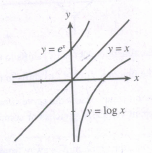
We know that, y = ex is the inverse function of y = logex and hence y = ex is the reflection of y -= logex about y = x.
6.
We have \({\left( 2x-{1\over 2x} \right)}^{4}\) = 4C0(2x)4 \({\left(-{1\over 2x} \right)}^{0}\) +4C1(2x)3\({\left(-{1\over 2x} \right)}^{1}\) + 4C2(2x)2\({\left(-{1\over 2x} \right)}^{2}\)+4C3(2x)1\({\left(-{2\over x} \right)}^{3}\) + 4C4(2x)0\({\left(-{1\over 2x} \right)}^{4}\)
= (2x)4 - 4(2x)3\({\left({1\over 2x} \right)}\) + 6(2x)2\({\left({1\over 2x} \right)}^{2}\)- 6(2x)\({\left({1\over 2x} \right)}^{2}+{\left({1\over 2x} \right)}^{4}\)
\(=16x^4-16x^2+6-{3\over2x^2}+{1\over16x^4}\)
7.
Observe that \(\sqrt{x^2-10x+25}=\sqrt{(x-5)^2}=|x-5|\)
8.
Note that the degree of f(x) is 3 and the leading coefficient is 1. Since g(x) divides f(x), we have f(x) = (x + b) g(x), for some b ∈ R. Thus, x3 - 3px + 2q = (x + b) (x2 + 2ax + a2 ).
Equating like coefficients on both sides, we have 2a + b = 0, a2 + 2ab = -3p and 2q = ba2, Thus b = -2a, p = a2 and q = -a3
Now, q = -a3 = -a(a2) = -ap, which gives ap + q = 0.
9.
There are 10 questions in Part-A, out of which 8 questions can be chosen in 10C8 ways.
Similarly from Part-B, contains using 10 questions, 5 questions can be chosen in 10C5 ways.
Hence, the total number of ways of selecting 8 questions from Part-A and 5 from Part-B.
= 10C8 \(\times\)10C5 = \(\frac { 10! }{ 8!2! } \times \frac { 10! }{ 5!\times 5! } \)

= 11340.
10.
Given \(log_2\left({{\sqrt [ 3 ]{4 } }\over{4^2\sqrt{8}}} \right)\)
= \({log}_{2}\sqrt [ 3 ]{4 }-{log}_{2}4^2(\sqrt{8})\)
= \(log_24^{1/3}-[log_24^2+log_2\sqrt{8}]\)
= log2(22)1/3- log2(22)2- log2(23)1/2
= log221/3- log224- log223/2
\(={{2}\over{3}}(1)-4(1)-{{3}\over{2}}(1)\) \([\because {log}^{2}_{2}=1]\)
\(={{4-24-9}\over{6}}={{-29}\over{6}}\)
11.
\(LHS=1+cos2x+cos4x+cos6x\quad \left[ \because 1+cos2x=2{ cos }^{ 2 }x \right] \)
\(=2{ cos }^{ 2 }x+cos4x+cos6x\)
\(=2{ cos }^{ 2 }x+2cos\left( \frac { 4x+6x }{ 2 } \right) .cos\left( \frac { 4x-6x }{ 2 } \right) \quad \left[ \because cosA+cosB=2cos\left( \frac { A+B }{ 2 } \right) .cos\left( \frac { A-B }{ 2 } \right) \right] \)
= 2cos2x + 2cos 5x.cos(-x)
= 2cos2x + 2cos 5x cos x
\(=2cosx\left( 2cos\frac { x+5x }{ 2 } .cos\left( \frac { x-5x }{ 2 } \right) \right) \)
= 2cos x.2cos 3x.cos(-2x)
= 4cos x cos 3x.cos 2x
= RHS \(\quad \left[ \because cos(-\theta =cos\theta \right] \)
12.
\(A=\left[ \begin{matrix} 1 & -1 \\ 2 & -1 \end{matrix} \right] ;B=\left[ \begin{matrix} x & 1 \\ y & -1 \end{matrix} \right] \)
\(A+B=\left[ \begin{matrix} 1 & -1 \\ 2 & -1 \end{matrix} \right] +\left[ \begin{matrix} x & 1 \\ y & -1 \end{matrix} \right] =\left[ \begin{matrix} 1+x & 0 \\ 2+y & -2 \end{matrix} \right] \)
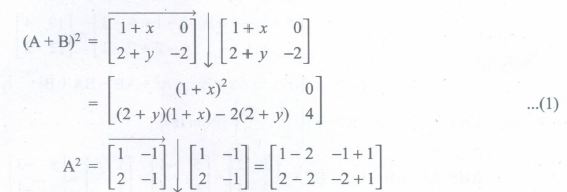
= \(\left[ \begin{matrix} -1 & 0 \\ 0 & -1 \end{matrix} \right] \)
\({ B }^{ 2 }=\left[ \begin{matrix} x & 1 \\ y & -1 \end{matrix} \right] \left[ \begin{matrix} { x }^{ 2 } & 1 \\ y & -1 \end{matrix} \right] =\left[ \begin{matrix} { x }^{ 2 }+y-1 & y-1 \\ xy-y & y+1 \end{matrix} \right] \)
So, \({ A }^{ 2 }+{ B }^{ 2 }=\left[ \begin{matrix} -1 & 0 \\ 0 & 1 \end{matrix} \right] +\left[ \begin{matrix} { x }^{ 20 }+y & x-1 \\ xy-y & y+1 \end{matrix} \right] \)
= \(\left[ \begin{matrix} { x }^{ 2 }+y-1 & x-1 \\ xy-y & y+1-1 \end{matrix} \right] =\left[ \begin{matrix} { x }^{ 2 }+y-1 & x-1 \\ xy-y & y \end{matrix} \right] \) ..(2)
Given \((1)=(2)\Rightarrow \left[ \begin{matrix} (1+x)^{ 2 } & 0 \\ (2x+y)(1+x)-2(2+y) & 4 \end{matrix} \right] =\left[ \begin{matrix} { x }^{ 2 }+y-1 & x-1 \\ xy-y & y \end{matrix} \right] \)
(i,e) x - 1 = 0 ⇒ x = 1
y = 4 So, x = 1, y = 4
13.
Given, one of the root is x = 1
Using synthetic division we get,
(x -1)(x - 2)(x - 3) = 0
Other roots 2, 3
\(\therefore\) x = 1,2,3
14.
Consider the following events
E1: Company insured scooter driver
E2: Company insured a car driver
E3: Company insured a truck driver
\(\therefore P({ E }_{ 1 })=\frac { 2000 }{ 2000+4000+6000 } =\frac { 2000 }{ 12000 } =\frac { 1 }{ 6 } \)
\(P({ E }_{ 2 })=\frac { 4000 }{ 12000 } =\frac { 1 }{ 3 } ,\)
\(P({ E }_{ 3 })=\frac { 6000 }{ 12000 } =\frac { 1 }{ 2 } \)
It is given that
P(A/E1) = 0.01, P(A/E1) = 0.03 and P(A/E3) = 0.15
By Bayes' theorem,
\(P({ E }_{ 1 }/A)=\frac { P({ E }_{ 1 })P(A/{ E }_{ 1 }) }{ P({ E }_{ 1 }).P(A/{ E }_{ 1 })+P({ E }_{ 2 }).P(A/{ E }_{ 3 }).P(A/{ E }_{ 3 }) } \)
\(=\frac { \frac { 1 }{ 6 } \times \frac { 1 }{ 100 } }{ \frac { 1 }{ 6 } \times \frac { 1 }{ 100 } +\frac { 1 }{ 3 } \times \frac { 3 }{ 100 } +\frac { 1 }{ 2 } \times \frac { 15 }{ 100 } } =\frac { \frac { 1 }{ 600 } }{ \frac { 1 }{ 600 } +\frac { 1 }{ 100 } +\frac { 15 }{ 200 } } =\frac { \frac { 1 }{ 600 } }{ \frac { 52 }{ 600 } } \)
\(=\frac { 1 }{ 600 } \times \frac { 600 }{ 52 } =\frac { 1 }{ 52 } \)
15.
\(\lim _{ x\rightarrow \frac { \pi }{ 2 } }{ \left( \frac { \pi }{ 2 } -x \right) \tan { x } } \)
\(Put\quad \frac { \pi }{ 2 } -x=\theta ;\quad \Rightarrow x=\frac { \pi }{ 2 } -\theta \\ Also,\quad \theta =\quad \frac { \pi }{ 2 } -x\quad \rightarrow 0\quad as\quad x\rightarrow \frac { \pi }{ 2 } \)
\(\therefore \lim _{ x\rightarrow \frac { \pi }{ 2 } }{ \left( \frac { \pi }{ 2 } -x \right) \tan { x } } =\lim _{ \theta \rightarrow 0 }{ \theta .\tan { \left( \frac { \pi }{ 2 } -\theta \right) = } } \lim _{ \theta \rightarrow 0 }{ \theta } \cot { \theta } =\lim _{ \theta \rightarrow 0 }{ \frac { \theta }{ \tan { \theta } } } =\frac { 1 }{ \lim _{ \theta \rightarrow 0 }{ \theta } \left( \frac { \tan { \theta } }{ \theta } \right) } =\frac { 1 }{ 1 } =1\)
16.
5x - 7 = A\({d\over dx}(3x-x^2-2)+B\)
5x - 7 = \(A(3-2x)+B\)
Comparing the coefficients of like terms, we get
\(-2A=5 \Rightarrow A=-{5\over2};3A+B=-7 \Rightarrow B={1\over2}\)
\(I=\int {{-5\over 2}(3-2x)+{1\over2}\over \sqrt{3x-x^2+2}}dx\)
\(I=-{5\over2}\int {3-2x\over \sqrt{3x-x^2+2}}+{1\over2}\int {1\over( \sqrt{17\over 2})^2-(x-{3\over2})^2}dx\)
\(=-5\sqrt{3x-x^2+2}+{1\over 2}sin^{-1}({x-{3\over2}\over{\sqrt{17}\over 2}})+c\)
Thus, I = \(-5\sqrt{3x-x^2+2}+{1\over2}sin^{-1}({2x-3\over \sqrt{17}})+c\)
17.
18.
Let \(\overrightarrow{a}=5\hat{i}+6\hat{j}+7\hat{k}\)
\(\overrightarrow{b}=\)7 \(\hat{i}\) -8\(\hat{j}\) +9 \(\hat{k}\)
\(\overrightarrow{c}=\)3\(\hat{i}\)+20\(\hat{j}\) +5\(\hat{k}\)
Let \(\overrightarrow{a}=s\overrightarrow{b}+t \overrightarrow{c}\)
\(\Rightarrow 5\hat { i } +6\hat { j } +7\hat { k } =s(7\hat { i } -8\hat { j } +9\hat { k } )+t(3\hat { i } +20\hat { j } +5\hat { k } )\)
\(\Rightarrow 5\hat { i } +6\hat { j } +7\hat { k } =(7s+3t)\hat { i } +(-8s+20t)\hat { j } +(9s+5t)\hat { k } \)
Equating the like components, both sides we get.
5 = 7s + 3t .....(1)
-8s + 20t = 6 ....(2)
9s + 5t = 7 ......(3)
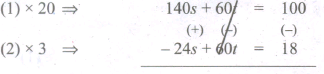
164s = 82 \(\Rightarrow \quad s=\frac { 82 }{ 164 } =\frac { 1 }{ 2 } \)
Substituting \(\\ s=\frac { 1 }{ 2 } \) in (1) we get,
\(7\left( \frac { 1 }{ 2 } \right) +3t=5\quad \Rightarrow 3t=5-\frac { 7 }{ 2 } =\frac { 10-7 }{ 2 } =\frac { 3 }{ 2 } \)
\(\Rightarrow t=\frac { 3 }{ 2\times 3 } =\frac { 1 }{ 2 } \)
Substituting \(s=\frac { 1 }{ 2 } ,t=\frac { 1 }{ 2 } \) in (3) we get,
\(9\left( \frac { 1 }{ 2 } \right) +5\left( \frac { 1 }{ 2 } \right) =7\)
\(\Rightarrow \frac { 9 }{ 2 } +\frac { 5 }{ 2 } =7\)
\(\Rightarrow \frac { 14 }{ 2 } =7\)
\(\Rightarrow\) 7 = 7 which satisfies the (3) equation.
Thus, one vector is a linear combination of other two vectors.
Hence, the given vectors are co-planar.
19.
Any number divisible by 5, its unit place must have 0 or 5. We have to find 4-digit number greater than 6000 and less than 7000.
So, the unit place can be filled with 2 ways (0 or 5) since, repetition is not allowed.
\(\therefore\) Tens place can be filled with 7 ways and hundreds place can be filled with 8 ways.
But the required number is greater than 6000 and less than 7000. So, thousand place can be filled with I digits (i.e) 6.
| Th | H | T | O |
| 1 | 8 | 7 | 2 |
So, the total number of integers = 1 \(\times\) 8 \(\times\) 7 \(\times\) 2 = 112
Hence, the required number of integers = 112
20.
Let P(n) = \(\frac { 1 }{ 1.2 } +\frac { 1 }{ 2.3 } +\frac { 1 }{ 3.4 } +...+\frac { 1 }{ n(n+1) } =\frac { n }{ n+1 } \)
Substituting the value of n = 1, in the statement we get
P(1) = \(\frac { 1 }{ 1.2 } =\frac{1}{2}\)
Hence, P(1) is true. Let us assume that the statement is true for n = k. Then
P(k) = \(\frac { 1 }{ 1.2 } +\frac { 1 }{ 2.3 } +\frac { 1 }{ 3.4 } +...+\frac { 1 }{ k(k+1) } =\frac { k }{ k+1 } \)
We need to show that P(k + 1) is true. Consider,
\(P(k+1) =\underbrace{\frac { 1 }{ 1.2 } +\frac { 1 }{ 2.3 } +\frac { 1 }{ 3.4 } ...+\frac { 1 }{ k(k+1) }} +\frac { 1 }{ (k+1)(k+2) } \)
= \(P(k)+\frac{1}{(k+1)(k+2)}\)
= \(\frac{ k} {(k + 1)} + \frac{1}{ (k + 1)(k + 2)}\)
= \(\frac{1} {k + 1} (\frac{ k}{ 1} + \frac{1} {k + 2})\)
= \(\frac{1} {k + 1} (\frac{ k ^2 + 2k + 1}{ k + 2 })\)
= \(\frac{1}{(k+1) }\frac{(k+1)^2}{k+2}=\frac{k+1}{k+2}\)
This implies, P(k + 1) is true
The validity of P(k + 1) follows from that of P(k)
Therefore by the principle of mathematical induction, for any natural number n,
\(\frac { 1 }{ 1.2 } +\frac { 1 }{ 2.3 } +\frac { 1 }{ 3.4 } +...+\frac { 1 }{ n(n+1) } =\frac { n }{ n+1 } \).
21.
Given equation of pair of lines is 6x2 + 5xy - py2 + 7x + qy - 5 = 0.
6x2+ 5xy - py2+ 7x + qy - 5 = 0
Here a = 6, b = -p, 2h = 5, 2g = 7, 2f = q
h = \(\frac { 5 }{ 2 } \) g = \(\frac { 7 }{ 2 } \) f = \(\frac { q }{ 2 } ,\) c = -5
The condition to represent perpendicular lines is a + b = 0 \(\Rightarrow\) 6 - p = 0 \(\Rightarrow\) p = 6
The condition to represent pair of lines is abc + 2fgh - af2- bg2- ch2 = 0
\(\Rightarrow \ 6-(-6)(-5)+\left( \frac { 7 }{ 2 } \right) \left( \frac { 5 }{ 2 } \right) -6\left( \frac { { q }^{ 2 } }{ 4 } \right) +6\left( \frac { 4q }{ 4 } \right) +5\left( \frac { 25 }{ 4 } \right) =0\)
Multiplying by 4 throughout we get,
720 + 35q - 6q2+294 + 125 = 0
\(\Rightarrow \quad 35q-6q^{ 2 }+1139=0\)
\(\Rightarrow \quad q=\frac { 35\pm \sqrt { { (-35) }^{ 2 }-4(6)(1139) } }{ 2\times 6 } \)
\(\Rightarrow \quad q=\frac { 35\pm \sqrt { 1225+27336 } }{ 12 } \)
\(\Rightarrow \quad q=\frac { 35\pm \sqrt { 28561 } }{ 12 } =\frac { 35\pm 169 }{ 12 } \)
\(\Rightarrow \quad q=\frac { 204 }{ 12 } or-\frac { 134 }{ 12 } \)
\(\Rightarrow \quad q=17\quad or\quad -\frac { 67 }{ 6 } \)
Hence p = 6, q = 17 or \(-\frac{67}{6}\)
22.
We know (1 +x)n = nC0 +nC1 x +nC2 x2 +...+nCn-1 xn-1 +nCnXn
Putting x = 8
(1 +8)n = nC0 + nC1 (8) + nC2 (64) +..+ nCn-1 8n-1 + nCn . 8N
9n = 1 + 8n + nC2 (64) + nC3 + ..+ nCn 8n-2
9n - 8n -1 is divisible by 64 for all positive integer n
putting N = n +1 we get
9n+1 -8(n+1) -1 is divisible by 64 for all positive integer n
(9n-1 -8n -8 -1 ) is divisible by 64
9n-1 - 8n -9 is always divisible by 4
23.
(i) y = sin (-x)
.png)
Let y = sin x.
Then sin(-x) is the reflection of the graph of sin x, about y-axis.
(ii) y = -sin(-x)
.png)
-sin(-x) is the reflection of the graph of sin(-x) about the x-axis.
(iii) \(y=sin\left( {\pi\over 2}+x\right)\)
.png) Let y = sinx.
Let y = sinx.
Then \(sin\left( {\pi\over 2}+n\right)\)causes the shift to the left for \(\pi\over 2\) unit to the sin x curve.
(iv) \(y=sin\left({\pi\over 2}-x \right)\)
.png)
Let y = sin x. Then \(sin\left( {\pi\over 2}-n\right)\) causes the shift to the left for \(\pi\over 2\) unit to the sin (-x) curve.
24.
(d)
(A) is false (R) is true
25.
(d)
\(\frac{1}{x}\)
26.
(c)
\(\pm \frac { 1 }{ \sqrt { 6 } } \)
27.
(c)
\(\frac { { 3 }^{ x } }{ 9log3 } \)
28.
(b)
\(-\frac { 4x }{ 1-{ x }^{ 4 } } \)
29.
(d)
\(\begin{pmatrix} 1 & 0 \\ 0 & 1 \end{pmatrix}\)
30.
\(5 R, 5 B \text { one ball is drawn }\)
\(\mathrm{P}(\text { getting red ball })=\frac{5}{10}=\frac{1}{2}\)
\(\text { Now } 2 \text { red balls are added }=7 \mathrm{R}, 5 \mathrm{~B}\)
\(P(\text {getting red ball })=\frac{7}{12}\)
\(\text {Supdose one black ball is obtained in first draw }\)
\(\mathrm{P}(\text {Black ball })=\frac{5}{10}=\frac{1}{2}\)
\(\text {Now } 2 \text { black balls are added }=5 R, 7 B\)
\(P(\text {getting red ball })=\frac{5}{12}\)
\(\text {Required Probality }=\frac{1}{2} \times \frac{7}{12}+\frac{1}{2} \times \frac{5}{12}\)
\(=\frac{7}{24}+\frac{5}{24}=\frac{12}{24}=\frac{1}{2}\)
31.
Given \(\frac{d y}{d x} =\frac{x^{2}-4}{x^{2}} \)
\(=1-\frac{4}{x^{2}} \)
\(d y =\left(1-\frac{4}{x^{2}}\right) d x \)
\(\int d y =\int\left(1-\frac{4}{x^{2}}\right) d x \)
\(y =x-4\left(\frac{-1}{x}\right)+c \)
\(y =x+\frac{4}{x}+c \)
\(y=7 \text { when } x=2\)
\(7=2+\frac{4}{2}+c \)
\(7=4+c \Rightarrow c=3 \)
\(\therefore \text { The equation of the required curve }\)
\(y=x+\frac{4}{x}+3\)
32.
\(y =\cos \left(\sin x^{2}\right) \)
\(\frac{d y}{d x} =-\sin \left(\sin x^{2}\right) \cos \left(x^{2}\right)(2 x) \)
\(\text { At } x =\sqrt{\pi / 2}, \frac{d y}{d x}=-\sin \sin \left(\frac{\pi}{z}\right) \cos (\pi / 2) 2(\sqrt{\pi / 2}) \)
\(=(\sin 1)(0) 2\left(\frac{\sqrt{\pi}}{2}\right)=0 \quad[\because \cos \pi / 2=0] \)
33.
\(\lim _{x \rightarrow 0} \frac{e^{\sin x}-1}{x}=\lim _{x \rightarrow 0} \frac{e^{x}-1}{x} \quad(\text { replacing } \sin x \text { by } x)\)
= 1
34.
\(\text {Given} \ \overrightarrow{O A}=\hat{i}+2 \hat{j}+4 \hat{k}, \overrightarrow{O B}=2 \hat{i}-3 \lambda \hat{j}-3 \hat{k} \)
\(\overrightarrow{A B}=\overrightarrow{O B}-\overrightarrow{O A}=2 \hat{i}-3 \lambda \hat{j}-3 \hat{k}-\hat{i}-2 \hat{j}-4 \hat{k}\)
\(\hat{i}+5 \hat{j}-7 \hat{k}=\hat{i}+(-3 \lambda-2) \hat{j}-7 \hat{k}\)
\(-3 \lambda-2=+5\) \((\because \text { compare coefft of } \hat{j}\text { on both sides) }\)
\(-3 \lambda=7 \)
\(\lambda=-\frac{7}{3} \)
35.
\(A=\left[\begin{array}{ll} a_{11} & a_{12} \\ a_{21} & a_{22} \end{array}\right] \)
\(a_{11}=\frac{1}{2}(3-2)=\frac{1}{2} ; a_{12}=\frac{1}{2}(3-4)=\frac{-1}{2} \)
\(a_{21}=\frac{1}{2}(3(2)-2)=\frac{4}{2}=2 ; a_{22}=\frac{1}{2}(6-4)=\frac{2}{2}=1 \)
\(\therefore A=\left[\begin{array}{ll} \frac{1}{2} & -\frac{1}{2} \\ 2 & 1 \end{array}\right] \)
36.
(b)
(-9, 6)
37.
(a)
A x C ⊂ B x D
38.
(a)
1
39.
(a)
36
40.
\(\mathrm{e}^{-2 x}=1-\frac{2 x}{1 !}+\frac{(2 x)^{2}}{2 !}-\frac{(2 x)^{3}}{3 !}+\frac{(2 x)^{4}}{4 !}-\frac{(2 x)^{5}}{5 !}+\ldots\)
\(\text { Coefficient of } x^{5} \text { is } \frac{-2^{5}}{5 !}=\frac{-32}{120}=\frac{-4}{15}\)
41.
No. of ways of answering = 53 = 125
Correct answer - 1
.'. Number of incorrect answer = 125 - 1 = 124
42.
(a)
\(\sqrt { \frac { 5 }{ 6 } } \)
43.
(a)
4
44.
Given P(A) = \(\frac { 1 }{ 2 } \), P(B) = \(\frac { 7 }{ 12 } \) and P(\(\bar { A } \cup \bar { B } \)) = \(\frac { 1 }{ 4 } \).
Now, \(P(\bar { A } \cup \bar { B } )=P(\overline { A\cap B } )=1-P(A\cap B)\)
\(\Rightarrow \frac { 1 }{ 4 } =1-P(A\cap B)\quad \Rightarrow P(A\cap B)=1-\frac { 1 }{ 4 } =\frac { 3 }{ 4 } \)
Now P(A) \(\times\) P(B) = \(\frac { 1 }{ 2 } \times \frac { 7 }{ 12 } =\frac { 7 }{ 24 } \)
\(\therefore P(A\cap B)\neq P(A)\times P(B)\)
Thus, A and B are not independent.
45.
\(\lim _{ x\rightarrow a }{ \frac { \sqrt { x } +\sqrt { a } }{ x+a } } =\frac { \sqrt { a } +\sqrt { a } }{ a+a } =\frac { 2\sqrt { a } }{ 2a } =\frac { 1 }{ \sqrt { a } } \)
46.
Let y = \(\sin { (\sqrt { 3 } \sin { x } +\cos { x } ) } \)
\(\frac { dy }{ dx } =\cos { (\sqrt { 3 } \sin { x } +\cos { x } ) } \frac { d }{ dx } (\sqrt { 3 } \sin { x } +\cos { x } )=\cos { (\sqrt { 3 } \sin { x } +\cos { x } )\left[ \sqrt { 3 } \cos { x } -\sin { x } \right] } \)
47.
Applying C1 ⟶ C1 - C2 we get
\(\triangle =\left| \begin{matrix} { cosec }^{ 2 }\theta & -{ cot }^{ 2 }\theta & 1 \\ { cot }^{ 2 }\theta & -cose{ c }^{ 2 }\theta & -1 \\ 42 & 40 & 2 \end{matrix} \right| =\left| \begin{matrix} 1 & { cot }^{ 2 }\theta & 1 \\ -1 & cose{ c }^{ 2 }\theta & -1 \\ 2 & 40 & 2 \end{matrix} \right| \)
= 0 \([\therefore { C }_{ 1 }\equiv { C }_{ 2 }]\)
48.
\(\int x^{11} d x=\frac{x^{11+1}}{11+1}+c=\frac{x^{12}}{12}+c\)
49.
8P4 = 8 \(\times\)7 \(\times\) 6 \(\times\) 5 = 1680
50.
Given equation is 9x2 + 12xy + 4y2 + 6x + 4y - 3 = 0
\(\Rightarrow (3x+2y)^2+2(3x+2y)-3=0\)
\(\Rightarrow\) y2+ 2y - 3 = 0 where y = 3x + 2y
\(\Rightarrow\) (y+3) (y-1) = 0
\(\Rightarrow\) (3x + 2y + 3) (3x + 2y - 1) = 0[y = 3x + 2y]
Hence the separate equation are 3x + 2y + 3 = 0 and 3x + 2y - 1 = 0
\(\Rightarrow\) a = 3, b = 2, c1 = 3 and c2 = -1
Now, Distance between parallel lines \(=\left|\frac{c_1-c_2}{\sqrt{a^2+b^2}}\right|\)
\(=\left|\frac{3-(-1)}{\sqrt{3^2+2^2}}\right|=\left|\frac{4}{\sqrt{9+4}}\right|=\left|\frac{4}{\sqrt{13}}\right|\)
\(=\frac{4}{\sqrt{13}}\)
51.
\((1+x)^{ m }=1+mx+\frac { m(m-1) }{ 2! } { x }^{ 2 }+..\) [Binomial theorem for rational index]
∴ Co-efficient of x2 = \(\frac { m(m-1) }{ 2 } \)
Given \(\frac { m(m-1) }{ 2 } \) = 6 ⇒ m2- m = 12
⇒ m2-m -12 = 0 ⇒ (m - 4) (m + 3) = 0
⇒ m = 4 or -3
∴ Negative value of m is -3
52.
Given (n+1)! = 12\(\times\)(n-1)!
\(\Rightarrow\) (n+1)(n)(n-1)! = 12(n-1)!
\(\Rightarrow\) (n+1)n = 12
\(\Rightarrow\) n2+n-12 = 0
\(\Rightarrow\) (n+4)(n-3) = 0
\(\Rightarrow\) n = -4 or 3
\(\Rightarrow\) n = 3

11th Standard Syllabus & Materials
11th Standard
TN 11th Tamil பீடு பெற நில் - செய்யுள் - காவடிச்சிந்து Important Questions And Answers Study Material - QB365 Set A
NEW11th Standard
TN 11th Tamil பீடு பெற நில் - உரைநடை - மலை இடப்பெயர்கள் : ஓர் ஆய்வு Important Questions And Answers Study Material - QB365 Set A
NEW11th Standard
TN 11th Tamil மாமழை போற்றுதும் - துணைப்பாடம் - யானை டாக்டர் Important Questions And Answers Study Material - QB365 Set A
NEW11th Standard
TN 11th Tamil மாமழை போற்றுதும் - செய்யுள் - ஐங்குறுநூறு Important Questions And Answers Study Material - QB365 Set A



Tamilnadu Stateboard 11th Standard Subjects
Maths

Commerce

Economics

Biology

Business Maths and Statistics

Accountancy

Computer Science

Physics

Chemistry
Maths
Biology
Economics
Physics
Chemistry

History
Business Maths and Statistics

Computer Science
Accountancy

Computer Applications
History
Computer Technology
Commerce
Computer Applications
Computer Technology

Tamil

English

French
Tamilnadu Stateboard Standards

