
 100% FREE ACCESS
11th Standard Syllabus & Materials
11th Standard
TN 11th Tamil இயற்கை வேளாண்மை,சுற்றுச்சூழல் -செய்யுள் - மனோன்மணீயம் Important Questions And Answers Study Material - QB365 Set A
NEW11th Standard
TN 11th Tamil என்னுயிர் என்பேன் -துணைப்பாடம் - இசைத்தமிழர் இருவர் Important Questions And Answers Study Material - QB365 Set A
NEW11th Standard
TN 11th Tamil மொழி கலை -செய்யுள் - ஒவ்வொரு புல்லையும் Important Questions And Answers Study Material - QB365 Set A
NEW11th Standard
TN 11th Tamil பீடு பெற நில் - இலக்கணம் - பகுபத உறுப்புகள் Important Questions And Answers Study Material - QB365 Set A
NEW11th Standard
TN 11th Tamil பீடு பெற நில் - துணைப்பாடம் - வாடிவாசல் Important Questions And Answers Study Material - QB365 Set A
NEW11th Standard
TN 11th Tamil பீடு பெற நில் - செய்யுள் - குறுந்தொகை Important Questions And Answers Study Material - QB365 Set A

Published on: 26/02/2019
11th 3rd Revision Exam 2019
Download Tamil Nadu 11th Standard Economics question papers, model tests, one-mark questions, important questions, and public exam papers in PDF format. Free study materials and answer keys for TN State Board students.
Questions + Answers key
Take MCQ Economics Test
1.
Vishesh Krishi Upaj Yojana has been started for____________.
Agricultural export
Export of services
Export of handlooms and handicrafts
Export of gems and jewellery
2.
The investment in equipment of Micro service Enterprises does not exceed__________.
20 Lakhs
10 Lakhs
5 Lakhs
25 Lakhs
3.
Indifference curves never intersect each other due to_______________.
different levels of satisfaction
same levels of satisfaction
convex to the origin
concave to the origin
4.
The GSDP of Tamil Nadu on nominal term is equal to the GDP of___________________.
Bangladesh
Burma
Kuwait
Canada
5.
"Perfect competition prevails when the demand for the output of each producer is perfectly elastic" says__________________.
Joan Robinson
Edward Chamberlin
John Maynard Keynes
Prof. Clark
6.
Higher the risks, the greater are the ________.
Loss
Subsidy
profit
None of these
7.
Who 'defined "Economics as the science' of wealth"
J.M. Keynes
Adamsmith
Marshall
Malthus
8.
Economies are broadly divided into ___________types.
One
Two
Three
Four
9.
Given potential price is Rs. 250 and the actual price is Rs. 200. Find the consumer surplus.
375
175
200
50
10.
Annual plans formed in the year _________ .
1989 - 1991
1990 - 1992
2000 - 2001
1981 - 1983
11.
Identify the year of launch of MUDRA Bank?
1995
2000
2010
2015
12.
13.
The new economic policy is concerned with the following
Foreign investment
Foreign technology
Foreign trade
All the above
14.
Product obtained from additional factors of production is termed as
Marginal product
Total product
Average product
Annual product
15.
Profit of a firm is obtained when __________.
TR < TC
TR - MC
TR > TC
TR = TC
16.
Marginal revenue is the addition made to the
total sales
total revenue
total production
total cost
17.
Utility means
Equilibrium point at which demand and supply are equal
Want-satisfying capacity of goods and services
Total value of commodity
Desire for goods and services
18.
A statement of equality between two quantities is called
Inequality
Equality
Equations
Functions
19.
Residual Claimant Theory is propounded by
Keynes
Walker
Hawley
Knight
20.
Amartya Kumar Sen received the Nobel Prize in Economics in the year
1998
2000
2008
2010
21.
Definition of law of supply.
22.
What is Life Expectancy?
23.
What are the different types of Natural resources?
24.
What is "EXIM POLICY (2015 - 2020)"?
25.
What is Oligopoly?
26.
The demand function is given by x = 20 - 2p - p2 where p and x are the price and the quantity respectively. Find the elasticity of demand for p = 2.5.
27.
What are the objectives of Tenth five year plan?
28.
What do you mean by Micro Finance?
29.
30.
Define cost function.
31.
Find the equilibrium price and quantity by using the following demand and supply functions Qd = 200 - 10P and Qs= 10P respectively.
32.
Discuss the impact of LPG OIL Agricultural Sector reforms.
33.
Distinguish between Price-Marker and Price-Taker?
34.
Write the classification of wants.
35.
Explain about J.C. Kumarappa.
36.
Explain the Period of Merchant Capital.
37.
State and explain the elasticity of supply.
38.
Distinguish between rent and quasi-rent.
39.
Explain different types of economic activities.
40.
Distinguish between explicit cost and implicit cost.
41.
What are the impact of LPG on agricultural sector reforms?
42.
Relationship between TR, AR, MR and Elasticity of demand.
43.
Describe the law of supply in details.
44.
Total cost of the goods produced by a firm is TC(Q) = 192 + 48Q + 4Q2. Find the (i) Marginal cost, (ii) Average cost, (iii) Fixed cost, (iv) Average variable cost and (v) Average fixed cost.
45.
Trace the development of Industry in Tamil Nadu.
46.
Explain the standard of Living Theory of Wages.
47.
Distinguish between Inductive and deductive method?
48.
49.
Calculate the elasticity of demand for the demand schedule by using differential calculus method P = 60 - 0.2Q where price is (i) zero, (ii) Rs. 20, (iii) Rs. 40
50.
Explain various sources of energy.
51.
52.
Analyse the causes for Rural Indebtedness.
53.
Compare and contrast various definitions of Economics.
54.
How price and output are determined under the perfect competition?
1.
(a)
Agricultural export
2.
(b)
10 Lakhs
3.
(a)
different levels of satisfaction
4.
(c)
Kuwait
5.
(a)
Joan Robinson
6.
(c)
profit
7.
(b)
Adamsmith
8.
(b)
Two
9.
(d)
50
10.
(b)
1990 - 1992
11.
(d)
2015
12.
(b)
13.
(d)
All the above
14.
(a)
Marginal product
15.
(c)
TR > TC
16.
(b)
total revenue
17.
(b)
Want-satisfying capacity of goods and services
18.
(c)
Equations
19.
(b)
Walker
20.
(a)
1998
21.
"Other things remaining the same, if the price of a commodity increases its quantity supplied increases and if the price of a commodity decreases, quantity supplied also decreases" .
22.
The average period that a person may expect to live is called life expectancy.
Life Expectancy in T.N - Total - 70.6
Male -68.6
Female -72.7
23.
Natural Resources
Any stock (or) reserve that can be drawn from nature is a Natural resource.
Types of Natural Resources
i) Renewable Resources than can regenerated in a given span of time forest, biomass, hydro-energies, etc.
ii) Non-renewable Resources: Resources that cannot be regenerated. Eg., fossil fuels - coal, petroleum, minerals, etc.
24.
The new EXIM Policy has been formulated focusing on increasing in Export scenario boosting production and supporting the concepts like Make in India and Digital India.
25.
(i) Oligopoly is a market situation in which there are few firms selling homogeneous or differentiated products.
(ii) Competition among only a few firms in the market.
26.
x = 20 - 2p - p2 p = 2.5
\(e_{p} =\frac{d x}{d p}, \frac{p}{x} \)
\(\frac{d x}{d p} =0-2-2 p
\)
\(e_{p} =(-2-2 p) \cdot \frac{2.5}{\left(20-2 p-p^{2}\right)}
\)
\(=-2-2(2.5) \times \frac{2.5}{20-2(2.5)-(2.5)^{2}}\)
\(=(-2-5) \times \frac{2.5}{20-5-6.25}=\frac{-7 \times 2.5}{8.75}=\frac{-17.5}{8.75}=-2=|2|\)
Elastic demand.
27.
(i) The plan aimed to double the per capita income of India in the next 10 years.
(ii) It aimed to reduce the poverty ratio to 15 % by 2012.
(iii) Its growth target was 8.0 % but it
achieved only 7.2%.
28.
Micro Finance is also called micro credit, it is a financial service that offers loans, savings and insurance to entrepreneurs and small business owners who do not have access to banks or investors.
29.
30.
C = F(Q) the functional relationship between cost and output is cost function. When output increases, Cost increases.
31.
Equilibrium is attained when,
Qd = Qs
\(\therefore\)200 - 10P = 10P
200 = 10P + 10P = 20 P
\(p=\frac { 200 }{ 20 } =10\)
When P = 10
In supply function
Qs = 10 P = 10 x 10 = 100 s
In demand function,
Hence at
Qd = 200 - 10 P
= 200 - 10 x 10 = 200 - 100 = 100
| P = 10, Qd 7 100, Qs = 100 |
32.
Impact of LPG on Agricultural Sector Reforms:
(i) Since the inception of economic reforms, Indian economy has achieved a remarkable rate of growth in industry and service sector.
(ii) However, this growth process bypassed the agricultural sector, which showed sharp deceleration in the growth rate (3.62 percent during 1984/85 - 1995/96 to 1.97 percent in 1995/96 - 2004/05).
(iii) The sector has recorded wide variations in yield and productivity and there was a shift towards cash crop cultivation.
(iv) Moreover, agricultural indebtedness pushed several farming households into poverty and some of them resorted to extreme measures like suicides.
33.
Price-Marker : The power in the firm to get the price for good in the market
Price-Taker : The feature of a firm to accept the price fixed in the industry.
34.
(i) Goods which are indispensable for the human being to exist in the world are called "necessaries" (for example food).
(ii) Goods which are not indispensable for life but to make our life easy, convenient and comfortable are called "comforts". (for example: TV)
(iii) Goods which are not very essential but are very costly are known as "Luxuries". (for example- Jewellery, Diamonds).
35.
(i) Kumarappa was a pioneer of rural economic development theories.
(ii) Kumarappa is created for developing economic theories based on Gandhism.
(iii) A school of economic thought he coined "Gandhian Economics".
(iv) Kumarappa worked as a professor of economics at the Gujarat, Vidyapith and Ahmedabad.
(v) He was serving as the editor of Young India during the salt Satyagraha.
(vi) He founded the All India Village Industries Association in 1935 and he was imprisoned for more than a year during the Quit India Movement.
(vii) He wrote during his imprisonment, Economy of Permanence and Economy and Way of Life (1945).
36.
(i) The period of merchant capital was from 1757 to 1813.
(ii) The only aim of the East India Company was to earn profit by establishing monopoly trade in goods with India and East Indies.
(iii) When Bengal and South India came under the political shake of the East India Company in 1750s and 1760s, the objective of monopoly trade was fulfilled.
(iv) The company generated huge surpluses which were sent to England.
(v) The officers of the company were unscrupulous and corrupt.
37.
(i) Elasticity of supply is the degree of responsiveness of change in supply to change in price on the part of sellers.
(ii) There are 5 types of elasticity of supply:
1. Relatively elastic supply
2. Relatively inelastic supply
3. Unitary elastic supply
4. Perfectly elastic supply
5. Perfectly inelastic supply
(iii) The factors governing elasticity of supply are the nature of the commodity, cost of production, technical condition & time factor.
38.
| SI.No | Rent | Quasi Rent |
|---|---|---|
| 1 | Rent accrues to land | Quasi - Rent accrues to man made appliances |
| 2 | The supply of land is fixed forever. | The supply of man made appliances is fixed for a short period only. |
| 3 | It enters into price. | It does not enter into price. |
| 4 | It is temporary. |
39.
Consumption: Human wants come under consumption.
Production: It deals with the transformation of inputs into output.
Exchange: It deals with trade and commerce.
Distribution: It deals with the reward to the factors of production.
40.
| S.No | Explicit cost | Implicit cost |
| 1 | Payment made to others for buying factors of production. | Payment made for the use of firm's own resource. |
| 2 | Actual expenditure of the firm in buying or hiring the inputs. | Cost of firm's self owned, self employed resources. |
| 3 | (eg) wages, rent, advertisement, depreciation. | Costs are not recorded as no cash payment takes place. |
| 4 | Also called accounting cost, out of pocket cost money cost. | Value of the own services are imputed and considered for preparing profit loss accounts. Also called imputed cost. |
41.
(i) Crop Insurance: Agriculture in India is highly prone to risks like droughts and floods. It is necessary to protect the farmers from natural calamities and ensure their credit eligibility for the next season. For this purpose, the Government of India introduced many agricultural schemes throughout the country. The Pradhan Mantri Fasal Bima Yojana (Prime Minister's Crop Insurance Scheme) was launched on 18 February 2016. It envisages a uniform premium of only 2 percent to be paid by farmers for Kharif cmps and 1.5 percent for Rabi crops. The premium for (annual) commercial and horticultural crops will be 5 percent.
(ii) Cold Storage: India is the largest producer of fruits and second largest producer of vegetables in the world. In spite of that per capita availability of fruits and vegetables is quite low because of post harvest losses which account for about 25% to 30% of production. Besides, quality of a sizable quantity of produce also deteriorates by the time it reaches the consumer. Most of the problems relating to the marketing of fruits and vegetables can be traced to their perishability. Perishability is responsible for high marketing costs, market gluts, price fluctuations and other similar problems. In order to overcome this constraint, the Government of India and the Ministry of Agriculture promulgated an order known as, i Cold Storage Order, 1964" under Section 3 of the Essential Commodities Act, 1955. However, the cold storage facility is still very poor and highly inadequate. Post Harvest measures: The annual value of harvest and post-harvest losses of major agricultural produce at national level was of the order of Rs.92,651 crores, calculated using production data of 2012-13 at 2014 and wholesale prices, estimated by the Indian Council of Agricultural Research (ICAR).
42.
The relationship among AR, MR and elasticity of demand (e) is stated as follows. MR = AR.( e-1/e)
The relationship between the AR curve and MR curve depends upon the elasticity of AR curve (AR = DD = Price).
(i) When price elasticity of demand is greater than one, MR is positive and TR is increasing.
(ii) When price elasticity of demand is less than one, MR is negative and TR is decreasing.
(iii) When price elasticity of demand is equal to one, MR is equal to zero and TR is maximum and constant.
It is to be noted that, the output range of 1 to 5 units, the price elasticity of demand is greater than one according to total outlay method. Hence, TR is increasing and MR is positive.
At the output range of 5 to 6 units, the price elasticity of demand is equal to one. Hence, TR is maximum and MR equals to zero.
At the output range of 6 units to 10 units, the price elasticity of demand is less than unity. Hence, TR is decreasing and MR is negative.
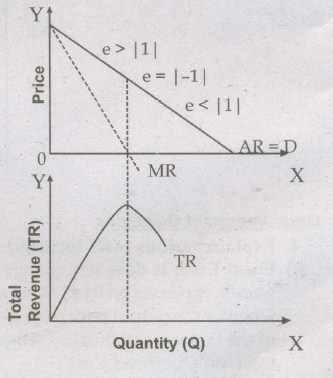
| Quantity (Q) | Price (P) | TR | AR | MR | Elasticity |
| 0 | 11 | 0 | 11 | - | e > 1 |
| 1 | 10 | 10 | 10 | 10 | e > 1 |
| 2 | 9 | 18 | 9 | 8 | e > 1 |
| 3 | 8 | 24 | 8 | 6 | e > 1 |
| 4 | 7 | 28 | 7 | 4 | e > 1 |
| 5 | 6 | 30 | 6 | 2 | e > 1 |
| 6 | 5 | 30 | 5 | 0 | e = 1 |
| 7 | 4 | 28 | 4 | -2 | e < 1 |
| 8 | 3 | 24 | 3 | -4 | e < 1 |
| 9 | 2 | 18 | 2 | -6 | e < 1 |
| 10 | 1 | 10 | 1 | -8 | e < 1 |
| 11 | 0 | 0 | 0 | -10 | e < 1 |
43.
Meaning: It is associated with production analysis. It explains the positive relationship between the price of a commodity and the supply of that commodity. For example, if the price of cloth increases, the supply of cloth will also increase.
Definition: "Other things remaining the same, if the price of a commodity increases its quantity supplied increases and if the price of a commodity decreases, quantity supplied also decreases".
Supply Function: The supply of a commodity depends on the factors such as price of commodity, price of labour, price of capital, the state of technology, number of firms, prices of related goods, and future price expectations and so on. Mathematically the supply function is
Qs = f (Px, Pr, Pf, T, O, E )
Where Qs = Quantity supplied of x commodity
Px = Price of x Commodity
Pr = Price of related goods
Pf = Price of factors of production
T = Technology
O = Objective of the producer
E = Expected Price of the commodity.
Assumptions:
(i) There is no change in the prices of factors of production.
(ii) There is no change in price of capital goods.
(iii) Natural resources and their availability remain the same.
(iv) Prices of substitutes are constant.
(v) There is no change in technology.
(vi) Climate remains unchanged.
(vii) Political situations remains unchanged.
(viii) There is no change in tax policy.
Explanation: Supply function is Qs = f (P) or Q = 20P.
P is an independent variable. When its value changes, new values of Qs can be calculated.
Supply Schedule: It shows the different quantities of supply at different prices. This information is given in the supply schedule given below.
| Price (P) | Supply(Qs) |
| 1 | 20 |
| 2 | 40 |
| 3 | 60 |
| 4 | 80 |
| 5 | 100 |
Qs = 20 P
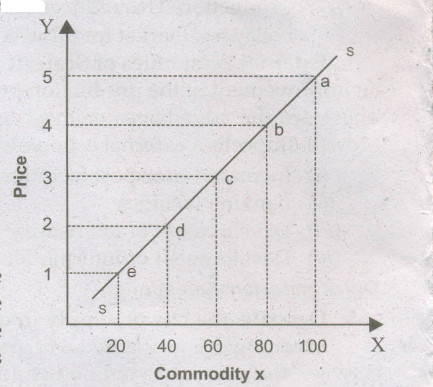
Supply Curve: A supply curve represents the data given in the supply schedule. As the price of the commodity increases, the quantum supplied of the commodity also increases. Thus-the supply curve has a positive slope from left to right.
The quantum supplied of commodity x is represented on X axis. And the price of the commodity is represented on the Y axis. The points such as e, d, c, b and a on the supply' curve 55', represent various quantities at different prices.
Factors determining supply:
(a) Price of the commodity
(b) Price of other commodities
(c) Price of factors
(d) Price expectations
(e) Technology
(f) Natural factors
(g) Discovery of new raw-materials
(h) Taxes and subsidies
(i) Objective of the firm
44.
Given that TC(Q) = 192 + 48Q + 4Q2
(i) MC (Q) = \(\frac { d(TC(Q)) }{ dQ } \) = 0 + 48 + 8Q
MC = 48 + 8Q
(ii) Average Cost =\(\frac { TC(Q) }{ dQ } =\frac { 192+48Q+4Q^{ 2 } }{ Q } \)
Average Cost = \(\frac { 192 }{ Q } \) + 48 + 4Q
(iii) Fixed Cost = Value of the constant = 192
(iv) Average Fixed Cost = \(\frac { 192 }{ Q } \)
(v) Average Variable Cost =\(\frac { TVCQ }{ Q } \)
TVC(Q) = TCQ - Constant
= 48Q + 4Q2
∴ AVC =\(\frac { 48Q+4Q^{ 2 } }{ Q } \)= 48 + 4Q
45.
Industry - in Tamil Nadu:
(a) Chennai is sometimes referred to as the Health Capital of India or the Banking Capital of India, having attracted investments from International Finance Corporations and the World Bank. It is also called as Detroit of Asia.
(b) Tamil Nadu has a network of about 110 industrial parks/estates that offer developed' plots with supporting infrastructure. Also, the Government is promoting other industrial parks like Rubber Park, Apparel Park, Floriculture Park, TICEL Park for Biotechnology, Siruseri IT Park and Agro Export Zones.
(c) The heavy engineering manufacturing companies are centred around the suburbs of Chennai. Chennai boasts of global car manufacturing giants as well as homegrown companies.
46.
Standard of Living Theory of Wages:
(i) The Standard of Living Theory of Wages developed by Torrance is an improved and refined version of the Subsistence Theory of Wage.
(ii) According to this theory, wage is equal to the standard of living of the workers.
(iii) If standard of living is high, wages will be high and vice versa.
(iv) Standard of living wage means the amount necessary to maintain the labourer in the standard of life to which he is accustomed.
Criticism:
According to this theory, the standard of living determines wages. But in actual practice, wages determine the standard of living.
47.
Introduction - Economics has its laws or generalization. The logical process of arriving at a low or generalization in a science is called its method. Economics uses two methods. (Deductive and Inductive).
| S.No | Deductive Method | Inductive Method |
| 1. | It is also named as analytical or Abstract Method. | It is also called Empirical Method |
| 2. | It is adopted by the classical and neoclassical school of economists | It is adopted by the Historical School of Economists |
| 3. | It consists in deriving conclusions from general truths to the specific application. | It involves the process of Reasoning from Particular facts to general principles |
Conclusions :
Alfred Marshall has rightly remarked "Inductive and deductive methods are both needed for scientific thought as the right and left foot are both needed for walking.
48.
.JPG)
.JPG)
49.
i) zero
\(\mathrm{P} =60-0.2 \mathrm{Q}
\)
\(0 =60-0.2 \mathrm{Q}
\)
\(0.2 \mathrm{Q} =60
\)
\(\mathrm{Q} =\frac{60}{0.2}=\frac{600}{2}=300\)
ii) Rs. 20
\(\mathrm{P} =60-0.2 \mathrm{Q}
\)
\(20 =60-0.2 \mathrm{Q}
\)
\(0.2 \mathrm{Q} =60-20=40 ; \quad \mathrm{Q}=\frac{40}{0.2}=\frac{400}{2}=200\)
iii) Rs. 40
\(\mathrm{P} =60-0.2 \mathrm{Q}
\)
\(40 =60-0.2 \mathrm{Q}
\)
\(0.2 \mathrm{Q} =60-40
\)
\(\mathrm{Q} =\frac{20}{0.2}=\frac{200}{2}=100\)
50.
(i) Electrical energy is one of the necessary components of our life.
(ii) Now-a-days, without electricity, we cannot survive in this world of technology.
Classifications of energy:
The energy sources are classified under two heads. They are,
(a) Non-renewable energy sources
(b) Renewable energy sources
(a) Non-renewable energy Sources:
(i) The sources of energy which cannot be renewed (or) re-used are called non-renewable energy sources.
(ii) This energy sources which will get exhausted over a period of time.
(iii) For example: coal, oil, gas etc.
(b) Renewable energy Sources:
(i) The sources energy which can be renewed or re-used again and again are called renewable energy sources.
(ii) These kinds of materials do not exhaust (or) these are available in abundant (or) infinite quantity.
(iii) For example: Solar energy, Wind energy, Tidal energy, Geothermal energy and Biomass energy.
(iv) Sometimes renewable sources are also called non-conventional sources of energy.
51.
52.
Introduction:
Rural indebtedness refers to the situation where the rural people are unable to repay the loan accumulated over a period.
Causes:
Poverty of farmers:
The vicious circle of poverty forces the farmers to borrow for consumption, cultivation and celebrations. Poverty, debt and high rates of interest hold the farmer in the grip of money lenders.
Failure of monsoon:
So it is difficult to identify good years to repay their debts.
Litigation:
(i) Due to land disputes, litigation in the court compels them to borrow heavily
(ii) Being uneducated and ignorant they are caught in the litigation process and lose their savings.
Money lenders-high interest rate:
The rate of interest charged by the local money lenders is very high and the compounding of interest leads to indebtedness of the farmer.
53.
| Wealth | Welfare | Scarcity | Growth |
| Adam Smith classical era. |
Alfred Marshall- neo classical era. |
Lionel Robbins new age. |
Paul Samuelson modern age. |
| An Inquiry into nature and causes of Wealth of Nations (1776). |
Principles of |
An Essay on the nature and Significance of Economic Science (1932). |
Economics studies how men and society choose with or without the use of money, to employ scarce productive resources which could have alternative uses, to produce various commodities over time and distribute them for consumption now and in the future among various people and groups of society. |
| Economics is the science of wealth. | Economics is a study of mankind in the ordinary business of life, it examines that part of individual and social action which is most closely connected with the attainment and with the use of material requisites of well being. It studies wealth and man. |
Economics is a science which studies human behaviour as a relationship between ends and scarce means which have alternative uses. |
Economics deals with how the society uses the limited resources for alternative uses. |
| Deals with only the goods which are scarce and have money value |
wealth and welfare of man is important. | Human behaviour regarding choice is important. |
It covers production, distribution and consumption. |
| Deals with consumption, production, exchange, distribution of wealth. |
Only material welfare is considered, differentiates between material and immaterial things. |
Economic problem arises because of scarcity of resources. |
Economics is a social science. |
| By introducing welfare, economics becomes inexact. |
Ethical aspects are not considered so Economics is exact |
||
| Welfare definition makes Economics classificatory. | Economics is a positive science. |
||
| Economics is a science of individual behaviour. |
|||
| Both material and immaterial activities are considered. |
54.
Short run equilibrium:
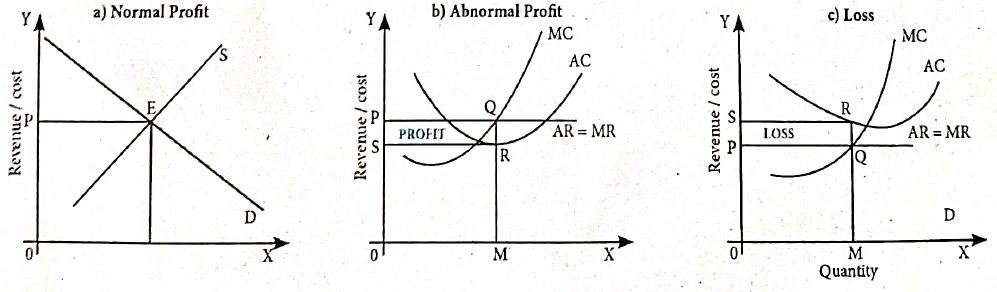
In diagram (a) the demand and supply of all firms interact and price OP is fixed.
(i) In diagram (b) the AC is less than the price.
(ii) At equilibrium MC = MR, AR = QM, AC = RM. Profit per unit is RQ
(iii) Total profit is PQRS.
(iv) In diagram (c) AC is greater than AR.
(v) At equilibrium AR = QM, AC = RM, loss per unit is RQ.
(vi) Total loss is PQRS.
(vii) When there is abnormal profit, new firms will enter the industry
(viii) Supply increases, price falls, profits become normal.
Long run equilibrium:
.JPG)
(i) All factors are variable. Firms earn normal profit.
(ii) There is no tendency for new firms to enter or leave the industry.
(iii) Equilibrium is at minimum point of LAC.
(iv) At point E, LMC = MR = AR = LAC.
(v) AC = QM, AR = QM.
(vi) Profit is normal.
(vii) Long run equilibrium price is lower than short run equilibrium price.
(viii) Long run equilibrium quantity is larger than short run equilibrium quantity.

11th Standard Syllabus & Materials
11th Standard
TN 11th Tamil பீடு பெற நில் - செய்யுள் - காவடிச்சிந்து Important Questions And Answers Study Material - QB365 Set A
NEW11th Standard
TN 11th Tamil பீடு பெற நில் - உரைநடை - மலை இடப்பெயர்கள் : ஓர் ஆய்வு Important Questions And Answers Study Material - QB365 Set A
NEW11th Standard
TN 11th Tamil மாமழை போற்றுதும் - துணைப்பாடம் - யானை டாக்டர் Important Questions And Answers Study Material - QB365 Set A
NEW11th Standard
TN 11th Tamil மாமழை போற்றுதும் - செய்யுள் - ஐங்குறுநூறு Important Questions And Answers Study Material - QB365 Set A



Tamilnadu Stateboard 11th Standard Subjects

Maths

Commerce
Economics

Biology

Business Maths and Statistics

Accountancy

Computer Science

Physics

Chemistry
Maths
Biology
Economics
Physics
Chemistry

History
Business Maths and Statistics

Computer Science
Accountancy

Computer Applications
History
Computer Technology
Commerce
Computer Applications
Computer Technology

Tamil

English

French
Tamilnadu Stateboard Standards
