
 100% FREE ACCESS
7th Standard CBSE Syllabus & Materials
7th Standard CBSE
CBSE 7th Social Science Theme E - Understanding Market - New Sample Question Papers Study Material - QB365 Set A
NEW7th Standard CBSE
CBSE 7th Social Science Theme E - From Barter to Money - New Sample Question Papers Study Material - QB365 Set A
NEW7th Standard CBSE
CBSE 7th Social Science Theme D - The Constitution of India- An Introduction - New Sample Question Papers Study Material - QB365 Set A
NEW7th Standard CBSE
CBSE 7th Social Science Theme D - From the Rulers to the Ruled : Types of Governments - New Sample Question Papers Study Material - QB365 Set A
NEW7th Standard CBSE
CBSE 7th Social Science Theme B - The Age of Reorganisation - New Sample Question Papers Study Material - QB365 Set A
NEW7th Standard CBSE
CBSE 7th Social Science Theme B - The Rise of Empires - New Sample Question Papers Study Material - QB365 Set A

Published on: 17/10/2019
Exponents and Powers
Download CBSE Class 7th Standard CBSE Mathematics question papers, sample papers, important questions, and previous year solved papers in PDF format. Get free study materials, NCERT solutions, and exam preparation resources for Class 7th Standard CBSE Mathematics
Questions + Answers key
Take MCQ Mathematics Test
1.
Express the following in exponential form:
[(23)2 x 36]. X 56
2.
A googol is the number 1 followed by 100 zeroes.
(a) How is a googol written as a power?
(b) How is a googol times a googol written as a pawer?
3.
Express the following numbers in standard form.
(i) 31865000000
(ii) 3908.78
4.
Simplify:
(i) \({ \left[ { \left\{ { \left( -\frac { 1 }{ 4 } \right) }^{ 2 } \right\} }^{ -2 } \right] }^{ -1 }\)
(ii) \({ \left( -\frac { 3 }{ 2 } \right) }^{ 3 }\div { \left( -\frac { 3 }{ 2 } \right) }^{ 6 }\)
5.
If the distance between Earth and Moon is 384000000 m and the distance between the Sun and the Earth is 146900000000 m. Then, which have more distance moon or Sun from Earth. Explain it with the help of standard form of the number.
6.
Using laws of exponents simplify the following.
\(\frac { \left( -\frac { 3 }{ 4 } \right) ^{ 4 }\times \left( \frac { 125 }{ 27 } \right) }{ \left( \frac { 5 }{ 3 } \right) ^{ 2 }\times \left( \frac { 9 }{ 16 } \right) } \).
7.
Find the value of x, such that \({ \left( \frac { 1 }{ 5 } \right) }^{ 5 }\times { \left( \frac { 1 }{ 5 } \right) }^{ 19 }={ \left( \frac { 1 }{ 5 } \right) }^{ 8x }\) .
8.
Simplify \(\frac { { 5 }^{ -2 }\times { 3 }^{ -3 }\times (125)^{ 2/3 } }{ (27)^{ -2/3 }\times (32)^{ -1/5 } } \).
9.
Express the following in usual form.
1.75 x 10⁻³
10.
Find five examples, where a number is expressed in exponential form. Also, identify the base and the exponent in each case.
1.
306
2.
(a) 1x10100
(b) 10200
3.
(i) 3.1865 x 10¹⁰
(ii) 3.90 x 10³
4.
(i) \(\frac { 1 }{ 256 } \)
(ii) \(-\frac { 8 }{ 27 } \)
5.
Distance between Earth and Moon = 384000000 m
=384 x 106
=3.84 x10⁸m ........(i)
and Distance between Sun and Earth = 146900000000
= 1469x108 .......(ii)
Comparing Eqs. (i) and (ii), we see that
3.84 x10⁸ < 1469 x108 [\(\because\) 3.84 < 1469]
So, distance between Sun and Earth is more than distance between Earth and Moon.
6.
Given, \(\frac { \left( -\frac { 3 }{ 4 } \right) ^{ 4 }\times \left( \frac { 125 }{ 27 } \right) }{ \left( \frac { 5 }{ 3 } \right) ^{ 2 }\times \left( \frac { 9 }{ 16 } \right) } \)
∵ \(\frac { 125 }{ 27 } =\frac { 5\times 5\times 5 }{ 3\times 3\times 3 } =\frac { 5^{ 3 } }{ 3^{ 3 } } \)
and \(\frac { 9 }{ 16 } =\frac { (-3)\times (-3) }{ 4\times 4 } =\frac { (-3)^{ 2 } }{ { 4 }^{ 2 } } \)
So, \(\frac { \left( -\frac { 3 }{ 4 } \right) ^{ 4 }\times \frac { { 5 }^{ 3 } }{ { 3 }^{ 3 } } }{ \left( \frac { 5 }{ 3 } \right) ^{ 2 }\times \frac { (-3)^{ 2 } }{ { 4 }^{ 2 } } } =\frac { \left( -\frac { 3 }{ 4 } \right) ^{ 4 }\times \left( \frac { 5 }{ 3 } \right) ^{ 3 } }{ \left( \frac { 5 }{ 3 } \right) ^{ 2 }\times \left( -\frac { 3 }{ 4 } \right) ^{ 2 } } \) \(\left[ \because \frac { { a }^{ n } }{ b^{ n } } =\left( \frac { a }{ b } \right) ^{ n } \right] \)
= \(\left( \frac { -3 }{ 4 } \right) ^{ 4-2 }\times \left( \frac { 5 }{ 3 } \right) ^{ 3-2 }\) [∵ am ÷ an = am-n]
=\(\left( \frac { -3 }{ 4 } \right) ^{ 2 }\times \left( \frac { 5 }{ 3 } \right) ^{ 1 }\)
= \(\frac { (-3)\times (-3) }{ 4\times 4 } \times \frac { 5 }{ 3 } =\frac { 9 }{ 16 } \times \frac { 5 }{ 3 } =\frac { 3\times 5 }{ 16 } =\frac { 15 }{ 16 } \).
7.
Given, \({ \left( \frac { 1 }{ 5 } \right) }^{ 5 }\times { \left( \frac { 1 }{ 5 } \right) }^{ 19 }={ \left( \frac { 1 }{ 5 } \right) }^{ 8x }\)
\(\Rightarrow { \left( \frac { 1 }{ 5 } \right) }^{ 5+19 }={ \left( \frac { 1 }{ 5 } \right) }^{ 8x }\) [\(\because\)am x an = am+n]
\(\Rightarrow { \left( \frac { 1 }{ 5 } \right) }^{ 24 }={ \left( \frac { 1 }{ 5 } \right) }^{ 8x }\)
Since, bases are equal, by equating their exponents, we get
8x = 24
\(\therefore\) x = 24/8 = 3
8.
\(\frac { { 5 }^{ -2 }\times { 3 }^{ -3 }\times (125)^{ 2/3 } }{ (27)^{ -2/3 }\times (32)^{ -1/5 } } \)
∵ 125 = (5)3 = 5 x 5 x 5
So, (125)2/3 =(5)3 x 2/3 =52 and 27=(3)3
∴ (27)-2/3 = {(3)3}-2/3 =\({ (3 })^{ 3\times \frac { -2 }{ 3 } }\) =(3)2
32 = 2 x 2 x 2 x 2 x 2 = (2)5
So, (32)-1/5 = {(2)5}-1/5 = \({ (2) }^{ 5\times \frac { (-1) }{ 5 } }\)=(2)-1
Now \(\frac { { 5 }^{ -2 }\times { 3 }^{ -3 }\times { 5 }^{ 2 } }{ (3)^{ -2 }\times (2)^{ -1 } } \) \(\left[ \because a^{ -m }=\frac { 1 }{ { a }^{ m } } \right] \)
= 5-2 x 3-3 x 32 x 21 x 52
=5-2+2 x 3-3+2 x 21
am x an =am+n
=50 x 3-1 x 21 = 1 x \(\frac { 1 }{ 3 } \times 2=\frac { 2 }{ 3 } \).
9.
Given, 1.75 x1 0-3
1.75 = 175 x 10-2
So, 1.75 x 10-3 =175 x 10-3 x 10-2
=175 x 10-5 \(\left[ \because \frac { 1 }{ { 10 }^{ 5 } } ={ 10 }^{ -5 } \right] \)
= 0.00175
10.
Five such examples are given below:
(i) We have, 4096
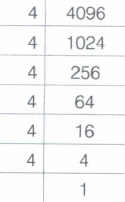
= 4x4x4x4x4x4 = 46
Thus, the exponential form of 4096 is 46.
Here, base = 4 and exponent = 6
(ii) We have, 216
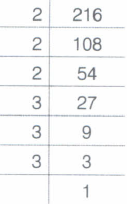
=2x2x2x3x3x3
= 23 x 33 = (2 x 3)3 = 63
Thus, exponential form of 216 is 63
Here, base = 6 and exponent = 3
(iii) We have, 15625
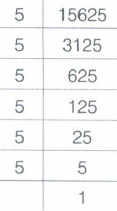
= 5 x 5 x 5 x 5 x 5 x 5 = 56
Thus, exponential form of 15625 is 56.
Here, base = 5 and exponent = 6
(iv) We have, 1331
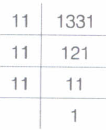
= 11 x 11 x 11 = 113
Thus, exponential form of 1331 is 113
Here, base = 11 and exponent = 3
(v) We have, 196
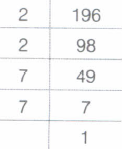
= 2 x 2 x 7 x 7 = 22 X 72 = (2 x 7)2 = 142
Thus, exponential form of 196 is 142.
Hence, base = 14 and exponent = 2

7th Standard CBSE Syllabus & Materials
7th Standard CBSE
CBSE 7th Social Science Theme B - New Beginnings : Cities and States - New Sample Question Papers Study Material - QB365 Set A
NEW7th Standard CBSE
CBSE 7th Social Science Theme A - Climates of India - New Sample Question Papers Study Material - QB365 Set A
NEW7th Standard CBSE
CBSE 7th Social Science Theme A - Geographical Diversity of India - New Sample Question Papers Study Material - QB365 Set A
NEW7th Standard CBSE
CBSE 7th Science Earth, Moon and the Sun - New Sample Question Papers Study Material - QB365 Set A



CBSE 7th Standard CBSE Subjects
CBSE Standards




