
 100% FREE ACCESS
7th Standard CBSE Syllabus & Materials
7th Standard CBSE
CBSE 7th Social Science Theme E - Understanding Market - New Sample Question Papers Study Material - QB365 Set A
NEW7th Standard CBSE
CBSE 7th Social Science Theme E - From Barter to Money - New Sample Question Papers Study Material - QB365 Set A
NEW7th Standard CBSE
CBSE 7th Social Science Theme D - The Constitution of India- An Introduction - New Sample Question Papers Study Material - QB365 Set A
NEW7th Standard CBSE
CBSE 7th Social Science Theme D - From the Rulers to the Ruled : Types of Governments - New Sample Question Papers Study Material - QB365 Set A
NEW7th Standard CBSE
CBSE 7th Social Science Theme B - The Age of Reorganisation - New Sample Question Papers Study Material - QB365 Set A
NEW7th Standard CBSE
CBSE 7th Social Science Theme B - The Rise of Empires - New Sample Question Papers Study Material - QB365 Set A

Published on: 31/12/2018
7th Slip Test
Download CBSE Class 7th Standard CBSE Mathematics question papers, sample papers, important questions, and previous year solved papers in PDF format. Get free study materials, NCERT solutions, and exam preparation resources for Class 7th Standard CBSE Mathematics
Questions + Answers key
Take MCQ Mathematics Test
1.
Let us find 1.2 x 2.5.
2.
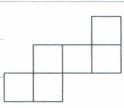
The following diagrams show the nets of various solids. Name the solids.
3.
A man earns Rs 1500 in 15 days. How much will he earn in 20 days?
4.
Add the following rational numbers.
\(\frac { 2 }{ 4 } +\frac { 2 }{ 20 } \)
5.
The runs scored in a cricket match by 11 players are as follows:
6,15,120,50,100,80,10,15,8,10,15 Find the mean, mode and median of this data. Are the three same?
6.
\(\frac { { 3 }^{ 8 } }{ { 3 }^{ 5 }\times { 3 }^{ 3 } } \)=
1
3
5
8
7.
Which of the following pairs of terms is a pair of like terms?
7p, 8q
10pq, -7qp
12q2p2, -5p2
2405 p, 78 qp
8.
On a number line, when we add a positive integer, we
move to the right
move to the left
do not move at all
none of these
9.
A water bottle contains 2litres of water Meenu drank \(\frac{1}{8}\) of water. How much water did Meenu drink?
\(\frac{1}{2}litre\)
\(\frac{1}{8}\ litre\)
\(\frac{1}{4}\ litre\)
None of these
10.
Number of edges in a square pyramid is:
6
8
10
12
11.
In a linear pair of angles. one angle is \(\frac { 2 }{ 3 } \) of the other. The measure of the smaller angle is:
108°
72°
36°
54°
12.
If 7x + 4 = 25, then x is equal to
\(\frac { 29 }{ 7 } \)
\(\frac { 100 }{ 7 } \)
2
3
13.
20% of 700 m is :
560 m
70 m
210 m
140 m
14.
The exterior angle of a triangle is 120° and one of its interior opposite angle is 70°. Find the measure of its other interior opposite angle?
90°
50°
60°
100°
15.
To reduce a rational number to its standard form, we divide its numerator and denominator by their
LCM
HCF
product
Multiple
16.
Express in exponential notation.
81
17.
Find \(\\ \frac { -3 }{ 4 } \times \frac { 1 }{ 7 } \)
18.
Find 43.07 x 100
19.
Describe how the following expressions are obtained? 4x2 - 5x
20.
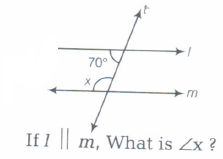
21.
Solve the equation \(\frac{1}{2}\)(x - 1) + 2 = 5.
22.
xm x xn = xm + n, where x is a non-zero rational number and m, n are positive integers.
23.
Product of a negative integer and a positive integer is a positive integer.
24.
A triangular prism has 5 faces, 9 edges and 6 vertices.
25.
If ΔABC is an isosceles triangle, where AB = AC and D is mid-point of BC, then ΔABD ≌ ΔACD.
26.
if \(\frac { -6 }{ 7 } =\frac { x }{ 28 } ,\) then the value of x is \(\frac { -3 }{ 2 } \)
27.
By what number should (- 4)5 be divided so that the quotient may be equal to (-4)3?
28.
Michelle drives 10 km South-East, then 8 km West. How far is he from his initial position?
29.
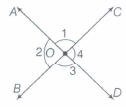
Two lines AB and CD intersect at 0 [figure]. Write all the pairs of adjacent angles by taking angles 1,2,3 and 4 only.
30.
Find the sum of \(\frac { 4 }{ 7 } +\frac { -8 }{ 9 } +\frac { -5 }{ 21 } +\frac { 1 }{ 3 } \).
31.
Sugar is sold at Rs 17\(\frac{3}{5}\) per kg. Find the cost of 16 kg of sugar.
32.
A parallelogram has ___________ lines of symmetry
33.
If \(\frac{4x}{5}-\frac{1}{4}=\frac{3x}{5}\),then x =_______________.\(\left[ 20/\frac { 5 }{ 4 } \right] \quad \quad \)
34.
Product of a proper and improper fraction is_______the improper fraction.
35.
If 20 lemons are bought for Rs.10 and sold at 5 for three rupees, then_____________ in the transaction is _________%.
36.
When -16 is divided by ______ the quotient is 4.
37.
Identify the numerical coefficient of terms (other than constants) in the following expressions:
-xy - x2y 2
38.
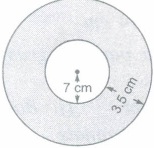
What is the area of the shaded region?
39.
How many lines of symmetry are there in a rhombus?
40.
An item is sold for Rs.754 with a profit of 4%. What is cost price?
41.
Write the following rational numbers in ascending order: \(\frac{3}{4}\), \(\frac{-1}{2}\), \(\frac{-4}{5}\), \(\frac{-1}{-4}\)
42.
Find the complement of each of the following angles:31°
43.
Find:\(\frac{4}{5}\div\frac{4}{9}\)
44.
If (-10) is divided by (-2), then what is the quotient?
45.
What is the mode of 3, 1, 2, 3, 4, 3, 5, 3, 1?
46.
Find the angles of a triangle which are in the ratio 2: 3: 5.
47.
Simplify the following:
(a) (6-1 - 8-1)-1 + (2-1 - 3-1)-1
(b) \({ \left\{ { 6 }^{ -1 }+{ \left( \frac { 3 }{ 2 } \right) }^{ -1 } \right\} }^{ -1 }\)
48.
Solve for x: \(\frac { 3 }{ 4 } (7x-1)-\left[ 2x-\frac { 1-x }{ 2 } \right] =x+\frac { 3 }{ 2 } \)
1.
Multiply 12 and 25.
We get 300. Both, in 1.2 and 2.5, there is 1 digit to the right of the decimal point.
So, count 1 + 1 = 2 digits from the right most digit (i.e., 0) in 300 and move towards left.
We get 3.00 or 3.
2.
Cube
3.
A man earns in 15 days = Rs1500
In 1 day, he earns =Rs \({1500\over 15}\)
\(\therefore\)20 days = \({1500\over 15}\) x 20 = 100 x 20 = Rs 2000
4.
We have,\(\frac { 2 }{ 4 } +\frac { 2 }{ 10 } \)
LCM of 4 and 10 is 20
\(\\ \frac { 2\times 5 }{ 4\times 5 } =\frac { 10 }{ 20 } ,\frac { 2\times 2 }{ 10\times 2 } =\frac { 4 }{ 20 } \)
So, \(\\ \frac { 10 }{ 20 } +\frac { 4 }{ 20 } =\frac { 10+4 }{ 20 } =\frac { 14 }{ 20 } =\frac { 7 }{ 10 } \)
5.
(i) We have, 6,15,120,50,100,80,10,15,8,10,15
On arranging the data in ascending order, we get 6,8,10,10,15,15,15,50,80,100,120 Now, sum of the runs
= 6 + 8 + 10 + 10 + 15 + 15 + 15 + 50 + 80 + 100 + 120
= 429
Number of players = 11
\(\therefore\) \(Mean=\frac { sum\quad of\quad the\quad runs }{ NUmber\quad of\quad players } =\frac { 429 }{ 11 } =39\)
(ii) From part (i), ascending order of runs is as follows:
6,8,10,10,15, 15, 15,50,80,100,120
Here, 15 occurs more frequently i.e. 3 times.
\(\therefore\) Mode =15
(iii) The value of the middle observation is 15.
\(\therefore\) Median =15
No, mean, mode and median are not same.
6.
\(\frac { { 3 }^{ 8 } }{ { 3 }^{ 5 }\times { 3 }^{ 3 } } \)=\(\frac { { 3 }^{ 8 } }{ { 3 }^{ 5+3 } } \)=\(\frac { { 3 }^{ 8 } }{ { 3 }^{ 8 } } \)=1
7.
(b)
10pq, -7qp
8.
(a)
move to the right
9.
Meenu drank water\(=\frac{1}{8}\ of 2=\frac{1}{8}\times2=\frac{1\times2}{8}=\frac{2}{8}=\frac{1}{4}\ litre\)
10.
(b)
8
11.
(b)
72°
12.
(d)
3
13.
(d)
140 m
14.
(b)
50°
15.
(b)
HCF
16.
We have, 81

= 3 x 3 x 3 x 3 =81 = 34
17.
\(\\ \frac { -3 }{ 4 } \times \frac { 1 }{ 7 } \)\(=\frac { (-3)\times 1 }{ 4\times 7 } =\frac { -3 }{ 28 } \)
18.
We have, 43.07 X 100 = 4307
19.
In 4x2 - 5x, first obtain x2 by multiplying the variable x by itself and then multiply x2 by 4 to get 4x2. From 4x2, subtract the product of 5 and x, to get the expression 4x2 - 5x.
20.
Given, l || m and t is a transversal.
We know that, the sum of pairs of interior angles on the same side of the transversal is supplementary.
\(\therefore\) \(\angle \) x + 70° =180° \(\Rightarrow\) \(\angle \)x=180°-70° = 110°
21.
x = 7.
22.
(a)
23.
(b)
24.
(a)
25.
(a)
26.
(b)
27.
(-4)2 or 16
28.
6 km
29.
In this figure, they have common vertex O, common arm OA and non-common arms OB and OC lying on the either side of OA.
\(\therefore\) \(\angle \)AOB (i.e. \(\angle \)2) and \(\angle \)AOC (i.e. \(\angle \)1) are adjacent angles and they have common vertex O, common arm OD and non-common arms DC and OB.
So, \(\angle \)COD (i.e. \(\angle \)4) and \(\angle \)DOB (i.e. \(\angle \)3) are adjacent angles.
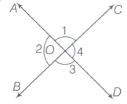
Similarly \(\angle \)3, \(\angle \)2 and \(\angle \)4, \(\angle \)1 are adjacent angles.
30.
Given,\(\frac { 4 }{ 7 } +\frac { -8 }{ 9 } +\frac { -5 }{ 21 } +\frac { 1 }{ 3 } \)
For same denominator
LCM of 7,9,21 and 3 is 63,\(\)
\(\frac { 4\times 9 }{ 7\times 9 } =\frac { 36 }{ 63 } \),\(\frac { -8\times 7 }{ 9\times 7 } =\frac { -56 }{ 63 } \)
\(\frac { -5\times 3 }{ 21\times 3 } =\frac { -15 }{ 63 } \) , \(\frac { 1\times 21 }{ 3\times 21 } =\frac { 21 }{ 63 } \)
\(\therefore \)\(\frac { 4 }{ 7 } +\frac { -8 }{ 9 } +\frac { -5 }{ 21 } +\frac { 1 }{ 3 } =\frac { 36 }{ 63 } +\frac { -56 }{ 63 } +\frac { -15 }{ 63 } +\frac { 21 }{ 63 } \)
So,\(\frac { 36+(-56)+(-15)+(21) }{ 63 } \)
\(=\frac { 36+21+(-56)+(-15) }{ 63 } =\frac { 57+(-71) }{ 63 } \)
\(=-\frac { 14 }{ 63 } =\frac { -2 }{ 9 } \)
31.
We have
Cost of 1 kg of sugar = Rs.17\(\frac { 3 }{ 4 } \)=Rs\(\frac { 71 }{ 4 } \)k
∴ Cost of 8 kg of sugar = Rs \(\left( \frac { 71 }{ 4 } \times 8\frac { 1 }{ 2 } \right) \)
=Rs \(\left( \frac { 71 }{ 4 } \times \frac { 17 }{ 2 } \right) =Rs.\left( \frac { 71\times 17 }{ 4\times 2 } \right) \)
=Rs\(\left( \frac { 1207 }{ 8 } \right) \) =Rs.150\(\frac { 7 }{ 8 } \)
Hence, the cost of 8\(\frac { 1 }{ 2 } \) kg of sugar is Rs.150\(\frac { 7 }{ 8 } \)
32.
()
Zreo
33.
()
\(\frac{5}{4}\)
34.
()
less than
35.
()
profit, 20%
36.
()
-4
37.
()
-1,-1
38.
()
192.5 cm2
39.
()
2
40.
()
Rs.725
41.
()
\(\frac{-4}{5}<\frac{-1}{2}<\frac{-1}{-4}<\frac{3}{4}\)
42.
()
59o
43.
()
1\(\frac{4}{5}\)
44.
()
5
45.
()
3
46.
()
Let the angles be 2x, 3x and 5x
\(\therefore\)2x + 3x + 5x = 180°
\(\Rightarrow\) 10x = 180°
\(\Rightarrow\) x = 18°
Angles are 36, 54, 90.
47.
(a) (6-1 - 8-1)-1 + (2-1 - 3-1)-1
\(=(\frac{1}{6}-\frac{1}{8})^{-1}+(\frac{1}{2}-\frac{1}{3})^{-1}\)
\(=(\frac{4-3}{24})^{-1}+(\frac{3-2}{6})^{-1}\)
\((\frac{1}{24})^{-1}+(\frac{1}{6})^{-1}\)
= 24 + 6 = 30
(b) \({ \left\{ { 6 }^{ -1 }+{ \left( \frac { 3 }{ 2 } \right) }^{ -1 } \right\} }^{ -1 }\)
\(=(\frac{1}{6}+\frac{2}{3})^{-1}\)
\(=(\frac{1+4}{6})^{-1}=(\frac{5}{6})^{-1}\)
\(=\frac{6}{5}\)
48.
\(\frac { 21x }{ 4 } -\frac { 3 }{ 4 } -2x+\frac { 1-x }{ 2 } =x+\frac { 3 }{ 2 } \)
\(\Rightarrow \quad \frac { 21x }{ 4 } -2x+\frac { 1 }{ 2 } -\frac { x }{ 2 } =x+\frac { 3 }{ 2 } +\frac { 3 }{ 4 } \)
\(\Rightarrow \quad \frac { 21x }{ 4 } -2x-\frac { x }{ 2 } -x=\frac { 3 }{ 2 } +\frac { 3 }{ 4 } -\frac { 1 }{ 2 } \)
\(\Rightarrow \quad \frac { 21 }{ 4 } x-3x-\frac { x }{ 2 } =\frac { 3 }{ 2 } +\frac { 3 }{ 4 } -\frac { 1 }{ 2 } \)
\(\Rightarrow \quad \frac { 21x-4\times 3x-2\times x }{ 4 } =\frac { 3x+3-1\times 2 }{ 4 } \)
\(\Rightarrow \quad \frac { 7x }{ 4 } =\frac { 7 }{ 4 } \)
\(\Rightarrow\) 7x = 7
\(\Rightarrow\) x = 1

7th Standard CBSE Syllabus & Materials
7th Standard CBSE
CBSE 7th Social Science Theme B - New Beginnings : Cities and States - New Sample Question Papers Study Material - QB365 Set A
NEW7th Standard CBSE
CBSE 7th Social Science Theme A - Climates of India - New Sample Question Papers Study Material - QB365 Set A
NEW7th Standard CBSE
CBSE 7th Social Science Theme A - Geographical Diversity of India - New Sample Question Papers Study Material - QB365 Set A
NEW7th Standard CBSE
CBSE 7th Science Earth, Moon and the Sun - New Sample Question Papers Study Material - QB365 Set A



CBSE 7th Standard CBSE Subjects
CBSE Standards




