
 100% FREE ACCESS
7th Standard CBSE Syllabus & Materials
7th Standard CBSE
CBSE 7th Social Science Theme E - Understanding Market - New Sample Question Papers Study Material - QB365 Set A
NEW7th Standard CBSE
CBSE 7th Social Science Theme E - From Barter to Money - New Sample Question Papers Study Material - QB365 Set A
NEW7th Standard CBSE
CBSE 7th Social Science Theme D - The Constitution of India- An Introduction - New Sample Question Papers Study Material - QB365 Set A
NEW7th Standard CBSE
CBSE 7th Social Science Theme D - From the Rulers to the Ruled : Types of Governments - New Sample Question Papers Study Material - QB365 Set A
NEW7th Standard CBSE
CBSE 7th Social Science Theme B - The Age of Reorganisation - New Sample Question Papers Study Material - QB365 Set A
NEW7th Standard CBSE
CBSE 7th Social Science Theme B - The Rise of Empires - New Sample Question Papers Study Material - QB365 Set A

Published on: 24/09/2019
Heat
Download CBSE Class 7th Standard CBSE Science question papers, sample papers, important questions, and previous year solved papers in PDF format. Get free study materials, NCERT solutions, and exam preparation resources for Class 7th Standard CBSE Science
Questions + Answers key
Take MCQ Science Test
1.
Why is the handle of a metallic kettle covered with strips of cane?
2.
Explain the reason for wrapping of ice in gunny bags.
3.
Briefly explain the maximum and minimum thermometers.
4.
State the limitation of clinical thermometer.
5.
What are conductors of heat and insulators? Discuss their practical applications.
6.
Explain the sea breeze and land breeze.
7.
Describe in detail about the occurrence of oceanic currents.
8.
Last Sunday, Pooja on her week off entered in her kitchen to cook rice for her family in lunch time. The moment she put fry pan on the gas stove and lighted it through the matchstick, all of sudden her 5 years small daughter entered into the kitchen and tends to touch the hot fry pan. At the same time, Pooja saw her and pushed her away from the hot fry pan. In this way, she saved her child.
(a) Explain why do the fry pan are provided with the plastic handles?
(b) Mention the values represented by Pooja here towards her 5 years small daughter.
9.
Prove with the help of an experiment that heat radiation can travel through vacuum.
10.
Explain the differences between heat and temperature.
1.
Handle of a metallic kettle is covered with strips of cane because when kettle is heated, the heat does not pass through strips of cane. The strips of cane are bad conductor of heat and we may hold the handle with our bare hands.
2.
Since, we know that gunny bags consist of number of fine pores which are filled with air. As air is a bad conductor of heat, so due to this reason, it does not allow the external heat to move inside and melts the ice.
3.
Maximum and minimum thermometers are the special thermometers which automatically record the maximum and minimum temperature of the day. The maximum and minimum temperature of the last day reported in weather reports in TV and newspapers are measured by the maximum and minimum thermometers.
4.
The clinical thermometer cannot be used for measuring the temperature of any object more than 42°C (i.e. more than the body temperature). If it kept in the sun or near a flame, then this clinical thermometer can be break.
5.
Substances that allow heat energy to flow through them are called good conductors of heat. e.g., metals. Substances that do not allow heat energy to flow through them are insulators. e.g., wood, plastic, glass, etc.
(a) Practical applications of good conductors of heat:
(i) Cooking utensils are made of metals so that heat can easily get transferred to food.
(ii) Coils of refrigerators and air conditioners are made of copper to conduct away heat.
(iii) Mercury is used as a thermometric liquid in thermometers.
(b) Practical applications of insulators:
(i) Handle of cooking utensils are made of insulators like bakelite, wood, etc.
(ii) Woollen clothes are insulators and keep us warm in winter.
(iii) Hair and fur in animals are insulators. So they keep them warm during winter.
6.
At sea-shore during the day cold air from the sea moves towards the beach because the land gets more heated than the sea water. Hot air above the land rises up, and cold air from the sea moves towards the land beach. This is called sea breeze as shown in fig. (a).
During the night, cold air from the land moves towards the sea because the land cools more quickly than the sea water. So hot air above the sea rises up and cold air from the land moves towards the sea. This is called land breeze as shown in fig.(b).
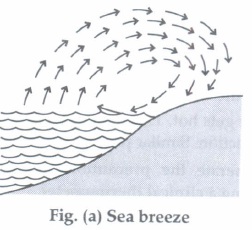
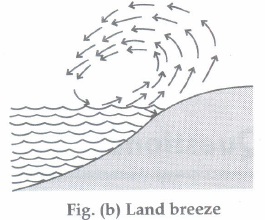
7.
Since, it is a fact that the water present in the ocean (near the equator) is heated by the sun to a very higher temperature than the water near the poles of the earth. It is due to the falling of the sun rays perpendicularly in the equatorial region. So, in the equatorial region, the ocean water expands and becomes lighter.
While on the other side, the water in the polar region remains cold and heavy. It leads to the flow of convection currents of heat of warm water from the equator towards the poles.
Heat of the cold water flow from the poles towards the equator just below the surface of ocean. So, these types of currents are known as oceanic currents.
8.
(a) As we know that plastic is a bad conductor of heat which does not allow the heat to pass through itself. So, heat from the fry pan does not flow to the handle due to which we can hold it easily. So that's why, the fry pans are provided with the plastic handles.
(b) The value showed by Pooja here is a great concern and careness towards her five years old small daughter.
9.
First of all, take a flat bottom flask and fix a rubber stopper having two holes in the mouth of the flask. Shift a thermometer through one hole and a glass tube with stopper through the other hole. Now, with the help of a vacuum pump, remove the air from the flask and try to record the temperature from the thermometer. Put a flask in the bright sunlight and we will observe that the thermometer records a rise in temperature. So, on this basis, we can say that this experiment proves that the heat radiation can travel through vacuum.
10.
The differences between heat and temperature are given as below
| Heat | Temperature |
|---|---|
| It is a form of energy which flows from one body to another when there is a difference in temperature between the objects. | It is the thermal condition of a body that indicates whether or not and in which direction, heat will flow from one body to the other. |
| It is equal to the sum of internal energies of the molecules of a body. | It is proportional to average kinetic energy of the molecules of the body. |
| As a heat between two bodies, total amount of heat of two bodies remains unchanged. | As a conclusion of exchange of heat between two bodies sum of their temperatures before and after exchange is not same. |
| SI unit of heat is joule (J). | SI unit of temperature is kelvin (K). |

7th Standard CBSE Syllabus & Materials
7th Standard CBSE
CBSE 7th Social Science Theme B - New Beginnings : Cities and States - New Sample Question Papers Study Material - QB365 Set A
NEW7th Standard CBSE
CBSE 7th Social Science Theme A - Climates of India - New Sample Question Papers Study Material - QB365 Set A
NEW7th Standard CBSE
CBSE 7th Social Science Theme A - Geographical Diversity of India - New Sample Question Papers Study Material - QB365 Set A
NEW7th Standard CBSE
CBSE 7th Science Earth, Moon and the Sun - New Sample Question Papers Study Material - QB365 Set A



CBSE 7th Standard CBSE Subjects
CBSE Standards




