
 100% FREE ACCESS
7th Standard CBSE Syllabus & Materials
7th Standard CBSE
CBSE 7th Social Science Theme E - Understanding Market - New Sample Question Papers Study Material - QB365 Set A
NEW7th Standard CBSE
CBSE 7th Social Science Theme E - From Barter to Money - New Sample Question Papers Study Material - QB365 Set A
NEW7th Standard CBSE
CBSE 7th Social Science Theme D - The Constitution of India- An Introduction - New Sample Question Papers Study Material - QB365 Set A
NEW7th Standard CBSE
CBSE 7th Social Science Theme D - From the Rulers to the Ruled : Types of Governments - New Sample Question Papers Study Material - QB365 Set A
NEW7th Standard CBSE
CBSE 7th Social Science Theme B - The Age of Reorganisation - New Sample Question Papers Study Material - QB365 Set A
NEW7th Standard CBSE
CBSE 7th Social Science Theme B - The Rise of Empires - New Sample Question Papers Study Material - QB365 Set A

Published on: 06/12/2018
From this post important questions with solutions for CBSE Class 7 Science Chapter 15 - Light prepared by expert Science teachers from the latest edition of CBSE(NCERT) books.
Questions from very important topics are covered by Class 7. You also get idea about the type of questions and method to answer in your Class 7th examination.
Here you can get Class 7 Important Questions Science based on NCERT syllabus. Science Class 7 Important Questions are very helpful to score high marks in board exams. Here we have covered Important Questions on Light for Class 7 Science subject.
In this question paper, questions are covered from the chapter Light and questions are prepared as per NCERT guidelines. Questions are covered from NCERT solutions and NCERT Exemplar.
The latest sample papers have been designed as per the latest blueprints, syllabus and examination trends. Sample papers should be practiced in examination condition at home or school and also show it to your teachers for checking or compare with the answers provided.
Download CBSE Class 7th Standard CBSE Science question papers, sample papers, important questions, and previous year solved papers in PDF format. Get free study materials, NCERT solutions, and exam preparation resources for Class 7th Standard CBSE Science
Questions + Answers key
Take MCQ Science Test
1.
Spherical mirrors obey law of __________.
2.
Light is a form of _______.
3.
The inner surface of the reflector of a torch acts as a ............. mirror
4.
_________________lens is also known as a magnifying glass.
5.
An image that cannot be obtained on a screen is called ____________________
6.
The mirror which can form a magnified image of an object is both convex and concave mirrors.
7.
A concave mirror always forms an erect and diminished image of the object.
8.
An object can be seen only if it emits light
9.
The sides of an object and its image formed by a concave mirror are always interchanged.
10.
We can obtain an enlarged and erect image by a convex mirror.
11.
Rajiv neighbour got heart attack. He immediately extended help and called for an ambulance. Due to the rush of vehicles on road and the fact that people were not giving way to ambulance, the patient could not reach hospital in time and died. Rajiv felt bad and started spreading awareness among people to be sensitive regarding this issue.
(a) Which value is being promoted by Rajiv?
(b) Why is word "Ambulance" written in its mirror image form?
(c) Write any four characteristics of image formed by plane mirror.
12.
Given below is a ray diagram of an experiment done with a mirror.
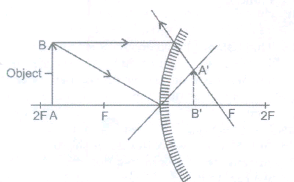
Answer the following questions:
(i) Name the mirror used.
(ii) What are the characteristics of the image formed?
(iii) How will the position of image change if the position of object is changed?
13.
Briefly explain why in ambulance words are written laterally inverted.
14.
Explain the term lateral inversion.
15.
A shopkeeper wanted to fix a mirror which will give a maximum view of his shop. What type of mirror should he use? Give reason.
16.
Give two uses each of a concave and a convex mirror
17.
Give one use each of a concave mirror and convex mirror in automobiles.
18.
When the ray of light is reflected along the same line, what would be angle of incidence and angle of reflection? Explain.
19.
What is regular reflection?
20.
An erect and enlarged image of an object is formed on a screen. Explain how this could be possible.
21.
Briefly tell that how many reflected rays can be obtained from a single incident ray in respect of a plane mirror
22.
A jug placed facing a plane mirror. Draw the position or image of jug.
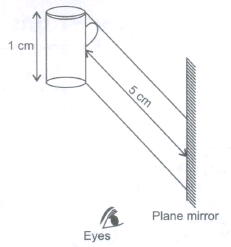
Answer the following questions:
(i) What is the size of the image of the jug?
(ii) What is the distance between image of jug and mirror?
23.
One day, Ramesh's friend was performing their respective experiments given by their teacher. While sitting in the practical lab instead of performing experiment, Ramesh was playing with his meter scale. All the sudden, he held the scale in his hand and started moving in front of tubelight, then he observed the seven colours of white light. After sometimes, he got scolded by his lab teacher for not performing the experiment.
(a) Give the name of phenomenon that leads to the formation of band of seven colours.
(b) Name the constituent colours of white light.
(c) Mention the values shown by Ramesh here.
24.
When the object is placed very dose to the lens, the image formed is virtual, erect and magnified, the lens is:
Convex lens
Concave mirror
Biconcave lens
All of these
25.
The ratio of size of image to the size of object is called:
Power of glass
Magnification
Transformation ratio
Deviation
26.
The rear view mirror of a car is a plane mirror. A driver is reversing his car at a speed of 2 m/s. The driver sees in his rearview mirror, the image of a truck parked behind his car. The speed at which the image of the truck appears to approach the driver will be
1 m/s
2 m/s
4 m/s
8 m/s
27.
The colour of light which is deviated the least by prism in the spectrum of white light is
violet
green
yellow
red
28.
Which of the following always diverge light rays?
Convex mirror and plane mirror
Concave lens and convex mirror
Concave mirror and convex lens
Concave lens and convex mirror
29.
When does rainbow usually appear?
30.
What kind of image is formed by a convex mirror?
31.
What happens when light falls on a mirror or what is reflection?
1.
()
Reflection
2.
()
Energy
3.
()
concave
4.
()
Convex
5.
()
virtual image
6.
(b)
7.
(b)
8.
(b)
9.
(a)
10.
(b)
11.
(a) Humanitarian value of giving way to AMBULANCE so that any patient can immediately reach to the hospital.
(b) Because any person driving the vehicle which is ahead of the Ambulance van, can see the laterally inverted alphabets correctly from his rear view mirror & make way for it to pass through.
(c) Characteristics of Image formed by Plane Mirror:
(1) Virtual & Erect.
(2) It is of the same shape & size.
(3) It is at the same distance behind the mirror as the object is in front of it.
(4)It is formed behind the mirror.
12.
(i) Convex mirror.
(ii) The image formed is virtual, erect and smaller than the size of the object.
(iii) The size of the image will increase as the object is moved closer to the convex mirror but is never larger than the size of the object.
13.
In case of mirror, the image formed by it is laterally inverted, i.e. left seems to be right and right seems to be left. So, in ambulance there is emergency for patients to reach hospital and by viewing in rear mirror, it can be easily identified of a vehicle and everyone give him a way.
14.
When an image is formed by the mirror in such a way that the left side of image is object's right side and right side of image is object's left side. So, this process of change in the sides of the object as well as of image is known as lateral inversion.
15.
If a Shopkeeper wanted to fix a mirror which will give him maximum view of his shop, he should use convex mirror.
In case of convex mirror, it will give a wider field of view, i.e. it can collect light from a large area spread over them.
16.
Uses of convex mirror
(i) It is used in side mirrors of vehicles.
(ii) It is used in reflector of torch.
Uses of concave mirror
(i) It is used by doctors to examine eyes, ears, etc.
(ii) It is also used by dentists to see an enlarged image of the teeth
17.
In automobiles, concave mirror is used as a reflector in headlights of cars or scooters.
In automobiles, convex mirror is used as side mirror to get the rear view to see the traffic corning from behind.
18.
When the incident ray is striking at 90°, the angle of reflection will also be 90° as per laws of reflection. This also means that ray of light is reflected back along the same line.
19.
When a ray of light falls on a smooth and shiny surface, the whole of light is sent back. Silvered glass or mirrors do not allow even a small amount of light to pass through them. Mirrors thus show regular or complete reflection.
20.
An erect and enlarged image of an object is formed only by the concave mirror or convex lens when object is inverted and placed between F and 2F
21.
For a single incident ray, there will be only one reflected ray that can be obtained in respect of a plane mirror
22.
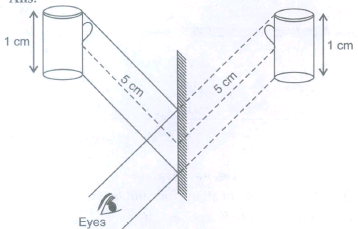
(i) Size of image of jug is 1cm.
(ii) Distance between image of jug and mirror is 5 cm.
23.
(a) Dispersion of white light is the name of phenomenon which leads to the formation of band of seven colours.
(b) There are seven constituent colours of white light, they are Violet, Indigo, Blue, Green, Yellow, Orange, Red (i.e. VIBGYOR).
(c) Ramesh seems to be quite innovative with respect to the scientific methods and also very eager to learn science regarding phenomena.
24.
(a)
Convex lens
25.
(b)
Magnification
26.
The speed at which the image of the truck appears to approach the driver will be same as that the reverse speed of the car, i.e. 2 m/s.
27.
(a)
violet
28.
(b)
Concave lens and convex mirror
29.
()
Rainbow usually appears in rainy season when the sun is low in the sky.
30.
()
The image formed by convex mirror is always virtual, erect and diminished in size.
31.
()
When a ray of light falls on the surface of any mirror it bounces back in the same medium. This is called reflection of light.

7th Standard CBSE Syllabus & Materials
7th Standard CBSE
CBSE 7th Social Science Theme B - New Beginnings : Cities and States - New Sample Question Papers Study Material - QB365 Set A
NEW7th Standard CBSE
CBSE 7th Social Science Theme A - Climates of India - New Sample Question Papers Study Material - QB365 Set A
NEW7th Standard CBSE
CBSE 7th Social Science Theme A - Geographical Diversity of India - New Sample Question Papers Study Material - QB365 Set A
NEW7th Standard CBSE
CBSE 7th Science Earth, Moon and the Sun - New Sample Question Papers Study Material - QB365 Set A



CBSE 7th Standard CBSE Subjects
CBSE Standards




