
 100% FREE ACCESS
7th Standard CBSE Syllabus & Materials
7th Standard CBSE
CBSE 7th Social Science Theme E - Understanding Market - New Sample Question Papers Study Material - QB365 Set A
NEW7th Standard CBSE
CBSE 7th Social Science Theme E - From Barter to Money - New Sample Question Papers Study Material - QB365 Set A
NEW7th Standard CBSE
CBSE 7th Social Science Theme D - The Constitution of India- An Introduction - New Sample Question Papers Study Material - QB365 Set A
NEW7th Standard CBSE
CBSE 7th Social Science Theme D - From the Rulers to the Ruled : Types of Governments - New Sample Question Papers Study Material - QB365 Set A
NEW7th Standard CBSE
CBSE 7th Social Science Theme B - The Age of Reorganisation - New Sample Question Papers Study Material - QB365 Set A
NEW7th Standard CBSE
CBSE 7th Social Science Theme B - The Rise of Empires - New Sample Question Papers Study Material - QB365 Set A

Published on: 13/12/2018
Now-a-days learning with effective preparation is a must. Our study materials for CBSE Class 7 follow the latest CBSE syllabus and are prepared by subject experts who have much experience in the academic industry. Students who have referred to our solutions have seen a significant increase in overall marks and ease in understanding the subjects. Our study materials are not only used by students but also by educational institutes in India.
Creative questions were added in this question paper in order to enhance the student's knowledge and get the idea that how to answer strategic questions asked in the board exams. This question paper is designed based on the academic syllabus. Sample papers should be practiced in examination condition at home or school and also show it to your teachers for checking or compare with the answers provided.
From the post, the questions are covered from the chapter Motion and Time and questions are prepared from creative like NCERT and HOTs as well as previous year questions.
The latest sample papers have been designed as per the latest blueprints, syllabus and examination trends. Sample papers should be practiced in examination condition at home or school and also show it to your teachers for checking or compare with the answers provided.
Download CBSE Class 7th Standard CBSE Science question papers, sample papers, important questions, and previous year solved papers in PDF format. Get free study materials, NCERT solutions, and exam preparation resources for Class 7th Standard CBSE Science
Questions + Answers key
Take MCQ Science Test
1.
Describe various methods used to measure time in earlier days.
2.
The distance between two stations is 240 km. A train takes 4 h to cover this distance. Calculate the speed of the train.
3.
Which of the following are not correct?
(a) The basic unit of time is second.
(b) Every object moves with a constant speed.
(c) Distances between two cities are measured in kilometres.
(d) The time period of a given pendulum is not constant.
(e) The speed of a train is expressed in m/h.
4.
Classify the following as motion along a straight line, circular or oscillatory motion.
(a) Motion of your hands while running.
(b) Motion of a horse pulling a cart on a straight road.
(c) Motion of a child in a merry-go-round.
(d) Motion of a child on a see-saw.
(e) Motion of the hammer of an electric bell.
(f) Motion of a train on a straight bridge.
5.
A solar day is
24 h
1440 min
86400 sec
All of these
6.
One millionth second is
Microsecond
Nanosecond
Picosecond
None of these
7.
Boojho walks to his school which is at a distance of 3 km from his home in 30 min. On reaching, he finds that the school is closed and comes back by a bicycle with his friend and reaches home in 20 min. His average speed in km/h is
8.3
7.2
5
3.6
8.
If we denote speed by S, distance by D and time by T, the relationship between these quantities is
S =D \(\times\) T
\(T=\frac{S}{D}\)
\(S=\frac{1}{T}\times D\)
\(S=\frac{T}{D}\)
9.
How will you convert the speed given in km/h to m/s?
By multiplying with 5/16
By multiplying with 6/5
By multiplying with 18/5
By multiplying with 5/18
10.
What is the relation between distance and speed?
Distance = Speed \(\times\) Time
Distance = Speed/Time
Distance = Time/Speed
None of the above
11.
The basic unit of speed is
km/min
m/min
km/h
m/s
12.
What is a sundial?
13.
State the way through which we can prepare a pendulum by our own.
14.
State the condition under which the distance-time graph of an object is a horizontal line parallel to the axis of time.
15.
If you did not have a clock, how would you decide what time of the day is?
16.
Mention which is the most common thing in almost all the clocks.
17.
Distance between Bholu's and Golu's house is 9 km. Bholu has to attend Golu's birthday party at 7 0' clock. He started his journey from his home at 6 0' clock on his bicycle and covered a distance of 6 km in 40 min. At that point, he met Chintu and he spoke to him for 5 min and reached Golu's birthday party at 7 0' clock. With what speed, did he cover the second part of the journey? Calculate his average speed for the entire journey.
18.
Explain by giving example that how can we choose a suitable scale.
19.
The unit of speed is ..................
20.
Motion and__________are relative terms
21.
Shadow of an object is__________at noon
22.
Motion of objects can be represented in the pictorial form by their__________graph.
23.
A________________is one billionth of a second.
24.
The symbols of all units are written in_____________
25.
Time period of a pendulum depends on its_____________.
26.
Time between one sunrise and the next sunrise was called a_______________
27.
A simple pendulum takes 45 see to complete 30 oscillations. What is the time period of the pendulum ?
28.
On what factors the time period of pendulum depends?
29.
What devices are fitted in vehicles to record speed or distance?
30.
What is a stop watch?
31.
When does a motion become uniform or nonuniform?
1.
There were no electronic watches in earlier days. Sunset time was a little bit difficult proportion. The earliest method of measuring time was based on the position of the Sun. The Sundials were used for this purpose. Time was measured by the shadow cast by the changing position of the sun from day to night. Chinese made a water clock 6000 years ago. Sand clock was also used to measure time. Sand clock was used by Romans. The time taken by sand to fall into the lower chamber from the upper chamber was considered to be the unit of measuring time. The discovery of pendulum helped in determining the exact time before the elecronic watches were invented.
2.
As, we know that the speed of a body is given by \(Speed=\frac{Distance\ travelled}{time\ taken}=\frac{240}{4}=60km/h\)
3.
(b), (d) and (e) are not correct.
4.
(a) Oscillatory
(b) Straight line
(c) Circular
(d) Oscillatory
(e) Oscillatory
(f) Straight line
5.
(d)
All of these
6.
(a)
Microsecond
7.
(b)
7.2
8.
(c)
\(S=\frac{1}{T}\times D\)
9.
(d)
By multiplying with 5/18
10.
(a)
Distance = Speed \(\times\) Time
11.
(d)
m/s
12.
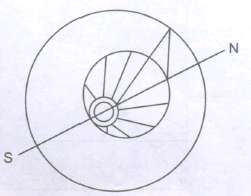
A sundial consists of triangular metallic plate called gnomon fixed vertically at the centre of a circular plate. The device is placed in the open in such a way that gnomon points in the north-south direction. It works on the principle that as position of sun in the sky changes, the position and length of shadow also changes. These are calibrated with time
13.
By suspending a metal ball with the help of a cotton thread and the other end of the thread can be tied to some different supports, so in this way, we can prepare a pendulum by our own.
14.
When the object is at rest, then the distance-time graph of an object is a horizontal line parallel to the axis of time.
15.
We can decide time of the day without clock by seeing shadow formed by the sun, e.g. at noon, shadow formed by the sun is shorter than at evening.
16.
The most common thing in almost all the clocks is that all of them shows periodic motion.
17.
From the question, Bholu covers 3 km distance in 15 min
speed of Bholu \(=\frac{3}{15}\times60=12\ km/h\) \((1\ min=\frac{1}{60}h)\)
Now, average speed is given by
\(=\frac{Total\ distance\ travelled}{Total\ time\ taken}=\frac{9}{1}=9\ km/h\)
18.
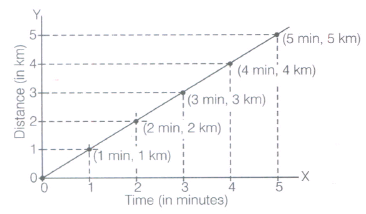
While choosing the most suitable scale for drawing a graph, we should keep the following points in mind
(i) The difference between the highest and lowest values of each quantity.
(ii) The intermediate values of each quantity so that with the scale chosen, it is easy to mark the values on the graph.
(iii) To utilise the maximum part of the paper on which the graph is to be drawn, assume that we have a graph paper of size 25 cm \(\times\) 25 cm and we have to accommodate following data:
| Tim (AM) | Odometer reading | Distance from the starting point |
| 8:00 AM | 36540 km | 0 km |
| 8:30 AM | 36560 km | 20 km |
| 9:00 AM | 36580 km | 40 km |
| 9:30 AM | 36600 km | 60 km |
| 10:00 AM | 36620 km | 80 km |
Since, one of the scales will be
Distance 5 km = 1 cm and Time 6 min = 1 cm
19.
()
m/s
20.
()
Rest
21.
()
Shortest
22.
()
distance-time
23.
()
nanosecond
24.
()
singular
25.
()
length
26.
()
day
27.
()
Time taken to complete 30 oscillations = 45 sec
Time taken to complete 1 oscillation 45/30 = 1.5 sec
One oscillation = Time period = 1.5 sec.
28.
()
Periods of a pendulum depends upon-(i) length of the pendulum and (ii)Acceleration due to gravity.
29.
()
Odometer is fitted to record the distance covered and speedometer is fitted to record the speed of the vehicle at any moment.
30.
()
Stop watch can measure time up to fraction of second and can be stopped or started at any moment.
31.
()
When a body covers equal distance in equal interval of time, the motion is uniform, but if it covers unequal distance in a given time, it is non-uniform motion.

7th Standard CBSE Syllabus & Materials
7th Standard CBSE
CBSE 7th Social Science Theme B - New Beginnings : Cities and States - New Sample Question Papers Study Material - QB365 Set A
NEW7th Standard CBSE
CBSE 7th Social Science Theme A - Climates of India - New Sample Question Papers Study Material - QB365 Set A
NEW7th Standard CBSE
CBSE 7th Social Science Theme A - Geographical Diversity of India - New Sample Question Papers Study Material - QB365 Set A
NEW7th Standard CBSE
CBSE 7th Science Earth, Moon and the Sun - New Sample Question Papers Study Material - QB365 Set A



CBSE 7th Standard CBSE Subjects
CBSE Standards




